Akrasia (ἀκρασία): Meaning, Definition & Modern Application
ah-KRAH-see-ah
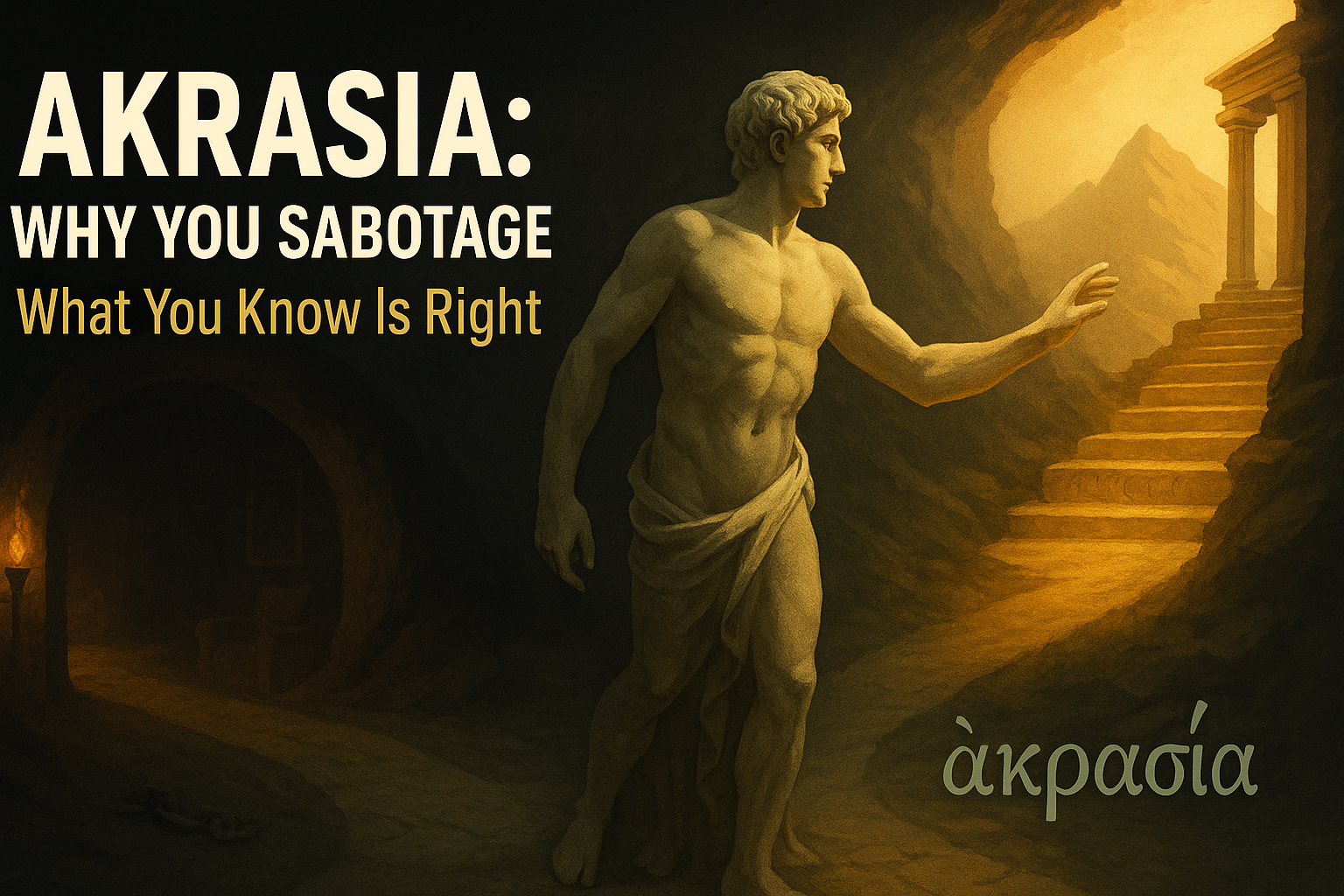
Weakness of will—acting against your own better judgment. For Aristotle, akrasia occurs when you know what is good but fail to do it, overcome by passion, appetite, or momentary impulse.
Etymology
From a- (without) and kratos (power, strength, control), literally “without power” or “lacking command.” Socrates famously denied that akrasia was possible, arguing that no one does wrong knowingly. Aristotle disagreed, devoting a significant portion of the Nicomachean Ethics to explaining how a person can know what is right yet fail to act on it. The concept remains one of philosophy’s most enduring puzzles: how can knowledge be present yet impotent?
Deep Analysis
Akrasia is one of the oldest unsolved problems in moral philosophy. Socrates denied it was possible. In the Protagoras, he argued that no one does wrong willingly. If you truly know the good, you will do the good. What looks like weakness of will is actually ignorance: the person who eats the cake while dieting does not truly know that the diet serves their interest. They have an opinion about it, but the opinion lacks the force of genuine knowledge.
Aristotle disagreed, and his disagreement in Nicomachean Ethics Book VII remains one of the most psychologically sophisticated arguments in ancient philosophy. Aristotle observed that people routinely act against their own acknowledged best judgment. The alcoholic who reaches for the bottle knows it will harm them. The procrastinator who opens social media instead of working on the deadline knows which action serves their interest. Knowledge is present. It is simply impotent in the face of appetite or passion.
Aristotle’s explanation involves a distinction between two types of knowledge. You can possess knowledge in a general sense (“excessive drinking destroys health”) while failing to activate that knowledge in the particular moment (“this drink, right now, will harm me”). The person in the grip of akrasia has the general knowledge but cannot bring it to bear on the specific situation. Passion creates a kind of temporary blindness where the universal principle is known but the particular application is blocked. Aristotle compared this to a person who is asleep or drunk: the knowledge is technically present but functionally absent.
The relationship between akrasia and enkrateia illuminates the moral spectrum. Aristotle positioned four states on a continuum. At the bottom is akolasia, vice, where the person pursues pleasure without conflict because their desires have been trained toward the wrong objects. Above that sits akrasia, where the person knows the right action but fails to perform it because passion overpowers knowledge. Above akrasia is enkrateia, where the person feels the pull of temptation but successfully overrides it through willpower. At the top is sophrosyne, where the person’s desires have been trained to align with reason so thoroughly that no internal conflict remains. The progression from akrasia through enkrateia to sophrosyne maps the path of character development.
What makes akrasia philosophically interesting is that it challenges the intuitive equation between knowledge and action. Modern behavioral science has confirmed Aristotle’s observation from multiple angles. Cognitive load research shows that depleted executive function reduces your capacity to act on your intentions. Dual-process theory distinguishes between fast, automatic responses (System 1) and slow, deliberate reasoning (System 2), demonstrating that knowledge residing in System 2 can be overridden by impulses generated in System 1.
The practical implications are significant. If akrasia is a knowledge problem, as Socrates argued, the solution is education: teach people more effectively and they will act better. If akrasia is a willpower problem, as Aristotle argued, the solution is hexis, the formation of stable dispositions through repeated practice. You overcome akrasia not by knowing more but by training your responses until right action becomes habitual rather than heroic. This is why Aristotle placed such emphasis on habituation in his ethical theory. Character is built through repetition, not revelation.
The modern environment has made akrasia epidemic. Digital technology has created an ecosystem optimized for exploiting the gap between intention and action. Every notification, every algorithmic recommendation, every infinite scroll is designed to trigger the appetitive response that overrides your deliberate intentions. The person who intends to work for two hours but instead spends ninety minutes on social media is experiencing the same phenomenon Aristotle described twenty-four hundred years ago. The difference is that Aristotle’s contemporaries had to seek out their temptations. Yours are engineered to seek you out.
Phronesis, practical wisdom, plays a crucial role in addressing akrasia. The practically wise person does not merely know what is right in the abstract. They know how to arrange their circumstances, anticipate their weaknesses, and structure their environment so that right action becomes more likely. This is why Aristotle’s solution to akrasia is not more knowledge but better practice. The person who recognizes their patterns of weakness and designs countermeasures is exercising phronesis in the service of overcoming akrasia. Pre-commitment strategies, environmental design, and accountability structures are all expressions of practical wisdom applied to the problem of weakness of will.
Modern Application
You've felt akrasia every time you chose the urgent over the important, knowing better even as you did it. Recognize that leadership failure rarely comes from ignorance—it comes from this gap between knowing and doing. Bridge that gap through deliberate practice until right action becomes habitual, not heroic.
Historical Examples
Aristotle’s analysis of akrasia in Nicomachean Ethics Book VII drew on the Socratic tradition while deliberately overturning its central claim. Socrates, as presented in Plato’s Protagoras, had argued that weakness of will is impossible because no one willingly chooses what they know to be harmful. Aristotle’s response was empirical rather than theoretical. He looked at how people actually behave and concluded that Socrates was wrong. People do act against their better judgment, and the philosophical task is to explain how, not to deny that it happens.
Saint Augustine’s Confessions provides one of history’s most vivid accounts of akrasia. In Book VIII, Augustine describes his inability to commit to the Christian faith despite his intellectual conviction that it was true. He famously prayed, “Give me chastity and continence, but not yet.” The prayer captures the structure of akrasia perfectly: the person knows what they should do, wants to want to do it, and still cannot bring themselves to act. Augustine’s eventual conversion, prompted by hearing a child’s voice saying “take up and read,” illustrates that the resolution of akrasia sometimes requires an external catalyst that breaks the paralysis of conflicting desires.
Samuel Johnson, the eighteenth-century English writer, was a self-documented akratic. His diaries are filled with resolutions to wake earlier, work more diligently, drink less, and pray more regularly. The same resolutions appear year after year, alongside honest admissions of failure. Johnson wrote in Rasselas that “the mind is seldom quickened to very vigorous operations but by pain, or the dread of pain,” acknowledging that knowledge of the good often lacks the motivational force to produce action. His lifelong battle with procrastination, depression, and self-described indolence, despite his extraordinary intellectual achievements, makes him one of history’s most articulate witnesses to the reality of akrasia.
How to Practice Akrasia
Identify your three most common akrasia patterns: the specific situations where you consistently act against your own better judgment. Write each one down with complete honesty. For each pattern, design an environmental change that makes the right action easier and the wrong action harder. Remove temptations rather than relying on willpower. Create accountability structures: tell someone what you intend to do and ask them to follow up. When you notice the gap between knowing and doing, shrink the action to its smallest possible form, something so small that resistance dissolves. Build the habit through micro-actions before scaling up. Socrates famously denied that akrasia was possible, arguing that no one does wrong knowingly. Aristotle disagreed, recognizing that passion can temporarily override knowledge. His insight is practically useful: if you understand that strong emotion can temporarily disable your better judgment, you can design systems that protect you during those moments. Create pre-commitment strategies that bind your future self to right action before the tempting moment arrives. Schedule your most important work for times when your willpower is strongest, and remove all temptation from your environment during those windows.
Application Examples
A CEO recognizes that the company needs to invest in long-term infrastructure rather than continuing to chase short-term revenue wins. She presents the case to her leadership team, gets agreement, and then watches as every quarterly pressure leads the same team, including herself, to redirect resources back to quick-hit revenue projects. The knowledge of what the company needs is unanimous. The action contradicts it every quarter.
Organizational akrasia mirrors individual akrasia. Groups can collectively know the right strategic direction while systematically failing to act on it. The solution is not more strategy sessions. It is structural pre-commitment: allocate the infrastructure budget before the quarter begins, making it harder to redirect when short-term pressure arrives.
A father knows that his relationship with his teenage son requires dedicated, device-free time together. He has read the research, believes the principle, and schedules weekly one-on-one time. But each week, something comes up: a work emergency, fatigue, or the teenager’s own resistance. After three months, only four of the twelve scheduled sessions have actually happened.
Akrasia in relationships follows the same pattern as akrasia anywhere else. The knowledge is present but impotent against the friction of daily life. The solution is the same: reduce friction through environmental design. Schedule the time as immovable. Leave the phone in another room. Make the default action the right action rather than requiring heroic effort each week.
A physician who specializes in cardiovascular health continues to skip her own exercise routine, eat poorly during hospital shifts, and sleep fewer than six hours a night. She knows the clinical consequences of her behavior better than almost anyone alive. Her knowledge is not general or abstract. It is specific, evidence-based, and urgent. She acts against it daily.
Akrasia is most visible when the knowledge is indisputable and the person possessing it is an expert. The physician’s behavior demonstrates Aristotle’s point: knowledge alone does not produce action. The gap closes through environmental design, habit formation, and accountability, not through acquiring more information.
A team lead knows that micromanaging his direct reports undermines their development and his own capacity to focus on strategic work. He has received this feedback from his manager, his peers, and an executive coach. After each conversation, he resolves to delegate more. Within days, he is back in the weeds, reviewing every deliverable and rewriting others’ work.
Behavioral patterns reinforced over years become automatic responses that knowledge alone cannot override. The team lead does not need more feedback about micromanagement. He needs to practice delegation in small, structured increments until the new behavior becomes a stable disposition, what Aristotle called hexis.
Common Misconceptions
The most common error is treating akrasia as a knowledge problem, as though people act against their interests because they do not know better. When someone fails to exercise despite knowing its benefits, observers often conclude that the person does not truly understand the consequences. Aristotle’s point was that the understanding can be genuine and complete while still lacking the power to produce action. A different error is treating akrasia as a fixed character flaw rather than a condition that can be addressed through environmental design and habit formation. The akratic person is not permanently weak-willed. They are a person whose behavioral systems have not been structured to support their intentions. Finally, some people assume akrasia is always dramatic, involving major moral failures. In practice, it operates most powerfully in the small daily choices: the skipped workout, the avoided conversation, the deferred important task. These micro-failures of will accumulate into patterns that shape the trajectory of a life.
The gap between knowing and doing has been the defining struggle of my professional life. Not because I lacked knowledge. I have always been good at acquiring frameworks, reading research, and articulating what ought to happen. My problem was that I could give a compelling presentation on the importance of focus while simultaneously checking my phone during someone else’s presentation. I could coach a team on the discipline of saying no while saying yes to every incoming request on my own calendar.
The turning point was not an insight. It was a system. A colleague challenged me to track, for one week, every instance where I acted against my own stated principles. The list was devastating. I ate lunch at my desk after recommending that my team take real breaks. I answered emails during family dinner after telling my partner I would be present. I postponed deep work in favor of shallow tasks after writing a blog post about the importance of prioritizing what matters.
What struck me was not that I failed. Failure is normal. What struck me was the precision of the gap. I was not ignorant about any of these domains. My knowledge was specific and current. I simply could not get the knowledge to fire at the moment of decision. Aristotle’s description of the akratic person resonated: the knowledge was present but functionally asleep.
The systems I built in response were deliberate and environmental. I removed social media from my phone. I blocked my calendar for deep work before anyone could fill it. I created a pre-commitment with my partner: phone in a drawer during dinner, no exceptions. Each system reduced the gap between intention and action by making the right choice the default. I still experience akrasia. The difference is that I have learned to design around it instead of pretending willpower will solve it.
Frequently Asked Questions
What is akrasia in Greek philosophy?
Akrasia is Aristotle's concept of weakness of will, acting against your own better judgment. It describes the puzzling human capacity to know what is good and right yet fail to do it, overcome by passion, appetite, or momentary impulse. Aristotle devoted a significant portion of the Nicomachean Ethics to explaining how knowledge can be present yet impotent, making akrasia one of philosophy's most enduring puzzles.
What does akrasia mean?
Akrasia literally means "without power" or "lacking command," from a- (without) and kratos (power, control). It describes the state of knowing the right action but lacking the strength of will to perform it. The word is the direct opposite of enkrateia (self-mastery), and the tension between these two states defines much of the moral struggle in daily life.
How do you overcome akrasia?
You overcome akrasia by designing environments that make right action easier and wrong action harder. Remove temptations, create accountability structures, and build habits through small, manageable actions. Bridge the knowing-doing gap through practice until right action becomes automatic rather than heroic. When willpower alone is insufficient, pre-commit to the right course of action before the tempting moment arrives, binding your future self to choices your present self knows are correct.
What is the difference between akrasia and enkrateia?
Akrasia is weakness of will, failing to act on your knowledge of what is right. Enkrateia is self-mastery, successfully overriding impulse through conscious effort. They are direct opposites: the akratic person knows the right action but cannot perform it; the enkratic person feels the pull of temptation but overcomes it. Both states involve the same inner tension; the difference lies in which side wins the contest between knowledge and desire.