Episteme (ἐπιστήμη): Meaning, Definition & Modern Application
eh-pis-TAY-may
Scientific or systematic knowledge—understanding that grasps not merely that something is true, but why it must be so. For Aristotle, episteme represents demonstrable knowledge of causes and principles, distinguished from mere opinion (doxa) or practical skill (techne).
Etymology
From epistasthai, meaning “to know how to” or “to understand,” derived from epi (upon) and histanai (to stand). Literally “standing upon” something, suggesting the firmness of knowledge that has a solid foundation. Aristotle defined episteme as knowledge through demonstration, grasping not merely that something is true but why it must be so. The word gives us “epistemology,” the study of knowledge itself. Plato’s dialogues repeatedly contrast episteme with doxa (mere opinion).
Deep Analysis
Plato’s distinction between episteme and doxa (opinion) established the foundational question of Western epistemology: what separates genuine knowledge from mere belief? In the Theaetetus, Plato explored and rejected several definitions of knowledge, including the famous formulation “justified true belief” that would dominate epistemology for two millennia. His conclusion was that knowledge requires something beyond true belief and justification. It requires a grasp of the rational account, the logos, that explains why the thing is true and cannot be otherwise.
Aristotle systematized the concept by identifying five intellectual virtues in Nicomachean Ethics Book VI: episteme (scientific knowledge), techne (craft knowledge), phronesis (practical wisdom), sophia (theoretical wisdom), and nous (intuitive understanding). Each represents a different mode of knowing. Episteme specifically is knowledge through demonstration, the capacity to derive conclusions from first principles through valid reasoning. When you possess episteme of something, you can explain why it must be the way it is, not merely that it is. This capacity for demonstration distinguishes episteme from experience (empeiria), which knows what works without understanding why.
The Foucauldian reading of episteme, developed in The Order of Things (1966), adds a dimension the Greeks did not anticipate. Foucault used episteme to describe the underlying framework of assumptions, categories, and rules that determines what counts as knowledge in a given historical era. The medieval episteme, with its emphasis on divine order and analogy, produced one kind of knowledge. The modern episteme, with its emphasis on classification and mathematical representation, produces another. Foucault’s insight was that what a culture recognizes as knowledge is not determined solely by evidence but by the epistemic framework through which evidence is interpreted. This does not make knowledge arbitrary. It makes it historically situated, which means that understanding the episteme of your era is a prerequisite for understanding what your era can and cannot see.
The relationship between episteme and doxa in professional life is more practically important than most people recognize. When you make a decision based on “industry best practices” without understanding why those practices work, you are operating from doxa. When you adopt a strategy because a successful competitor used it, you are working from doxa. When you implement a management framework because a business book recommended it, you are applying someone else’s conclusions without possessing the underlying understanding. None of these approaches is necessarily wrong. But each leaves you unable to adapt when conditions change because you do not understand the causal mechanisms that make the approach effective or ineffective.
Techne (craft knowledge) and episteme are related but distinct in a way that matters for professional development. Techne knows how to produce something well. Episteme knows why the production process works. The skilled surgeon possesses techne. The medical researcher who understands the biological mechanisms underlying the surgical technique possesses episteme. The person who possesses both can adapt their technique to novel situations because they understand the principles, not merely the procedures. The tension between these two modes of knowledge plays out in every professional domain where practitioners who know how are supervised by theorists who know why, or where practitioners who know how resist the theories of people who have never practiced.
Phronesis (practical wisdom) complements episteme by providing the judgment to apply general knowledge to specific situations. Episteme tells you that a specific medication lowers blood pressure through a specific biochemical mechanism. Phronesis tells you whether this particular patient should receive this medication given their specific history, other medications, and life circumstances. Episteme without phronesis produces technically correct but contextually inappropriate decisions. Phronesis without episteme produces experienced judgment that cannot explain itself and therefore cannot be transmitted, questioned, or refined.
The modern knowledge economy has created a paradox: information has never been more abundant, and genuine episteme has never been harder to distinguish from its imitations. The person who reads a summary of a research study has acquired information. The person who reads the study itself, evaluates the methodology, examines the data, and considers alternative explanations has moved closer to episteme. The person who can derive the expected result from first principles and then compare it to the empirical finding possesses episteme. Each level requires more effort and produces more reliable knowledge. The incentive structure of modern information consumption pushes toward the first level while the demands of sound decision-making require the third.
Modern Application
You lead most effectively when you understand the underlying principles, not just the surface tactics. Invest time in grasping the 'why' behind what works—this foundational knowledge becomes your anchor when circumstances shift and popular strategies fail. Build your leadership on bedrock, not sand.
Historical Examples
Aristotle’s Posterior Analytics provides the most rigorous ancient account of episteme as demonstrative knowledge. Aristotle argued that you possess scientific knowledge of something when you can demonstrate it through a syllogism that proceeds from true, primary, and better-known premises to a necessary conclusion. The demand for demonstration from first principles established a standard for knowledge that shaped Western science for two millennia. His biological works, particularly History of Animals and Parts of Animals, demonstrate episteme in practice: Aristotle did not merely catalogue organisms but sought to explain their features in terms of function, adaptation, and final cause.
The founding of the Royal Society in 1660 marked an institutional commitment to replacing doxa with episteme through systematic experimentation. The Society’s motto, “Nullius in verba” (take nobody’s word for it), explicitly rejected the authority-based knowledge that had dominated European intellectual life and replaced it with the principle that claims must be demonstrated through repeatable observation and experiment. Robert Boyle, Robert Hooke, and Isaac Newton, among others, established the experimental method as the standard pathway from belief to knowledge, institutionalizing the transition from doxa to episteme that Plato had described philosophically two thousand years earlier.
Ignaz Semmelweis’ discovery that handwashing dramatically reduced maternal mortality in Vienna’s maternity wards in 1847 illustrates both the power and the social difficulty of episteme that contradicts established doxa. Semmelweis demonstrated, through meticulous data collection, that doctors who washed their hands before delivering babies reduced mortality from around 10% to under 2%. The medical establishment rejected his findings because they contradicted the prevailing theory that disease arose from imbalanced humors. Semmelweis had episteme, knowledge grounded in demonstrable causal mechanisms, but the medical community’s epistemic framework could not accommodate it. He died in an asylum in 1865, and his findings were not widely accepted until Louis Pasteur’s germ theory provided a theoretical framework that made the causal mechanism visible.
How to Practice Episteme
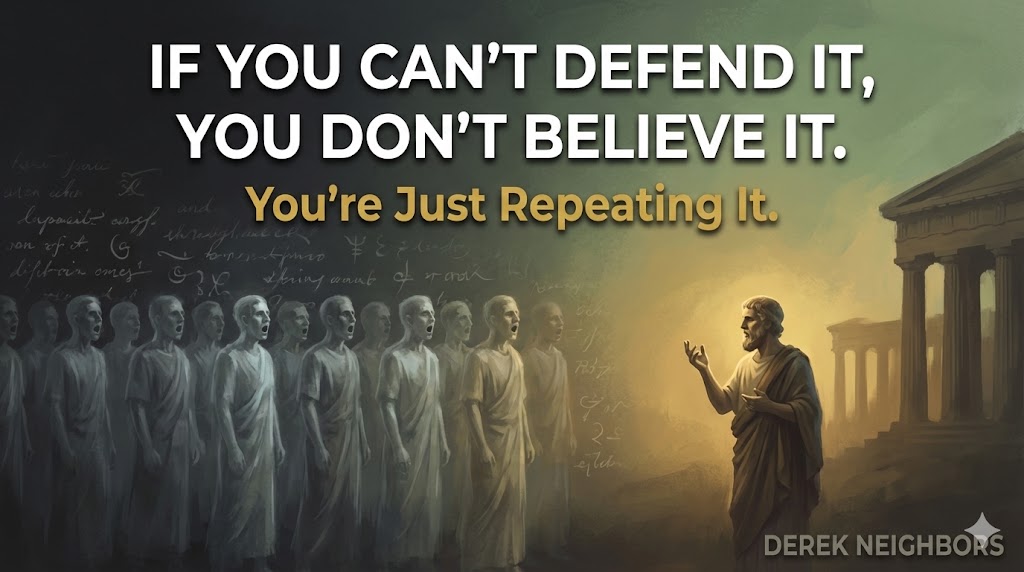
Choose one area where you operate on habit or intuition and investigate its underlying principles. Ask “why does this work?” and keep asking until you reach a foundational explanation. Read the primary research or foundational texts in that area, not summaries or popular interpretations. Test your understanding by predicting outcomes before they happen; accurate prediction reveals genuine comprehension. When a strategy fails, use the failure as an opportunity to examine whether your understanding of the underlying principles was accurate or superficial. Build a reading practice that prioritizes primary sources over secondary commentary. Aristotle defined episteme as knowledge through demonstration, meaning you truly know something when you can show why it must be the way it is. Apply this standard to your professional knowledge: for each claim you make, ask whether you can demonstrate why it is true or whether you are repeating something you heard without understanding its foundation. Keep a list of things you believe but cannot explain, and systematically investigate one per month until your knowledge has genuine depth.
Application Examples
A data science team builds a machine learning model that predicts customer churn with 94% accuracy. The team can describe what the model does and how well it performs. They cannot explain why the model’s features predict churn, what causal mechanisms connect the input variables to the output, or under what conditions the model would fail. They possess techne of model building without episteme of the phenomenon they are modeling.
Technical capability without understanding of underlying causes is sophisticated doxa. The model works until conditions change in ways the team cannot anticipate because they do not understand the causal structure their model is exploiting. Episteme would require understanding why the predictive features matter, which would also reveal when and how the model will break.
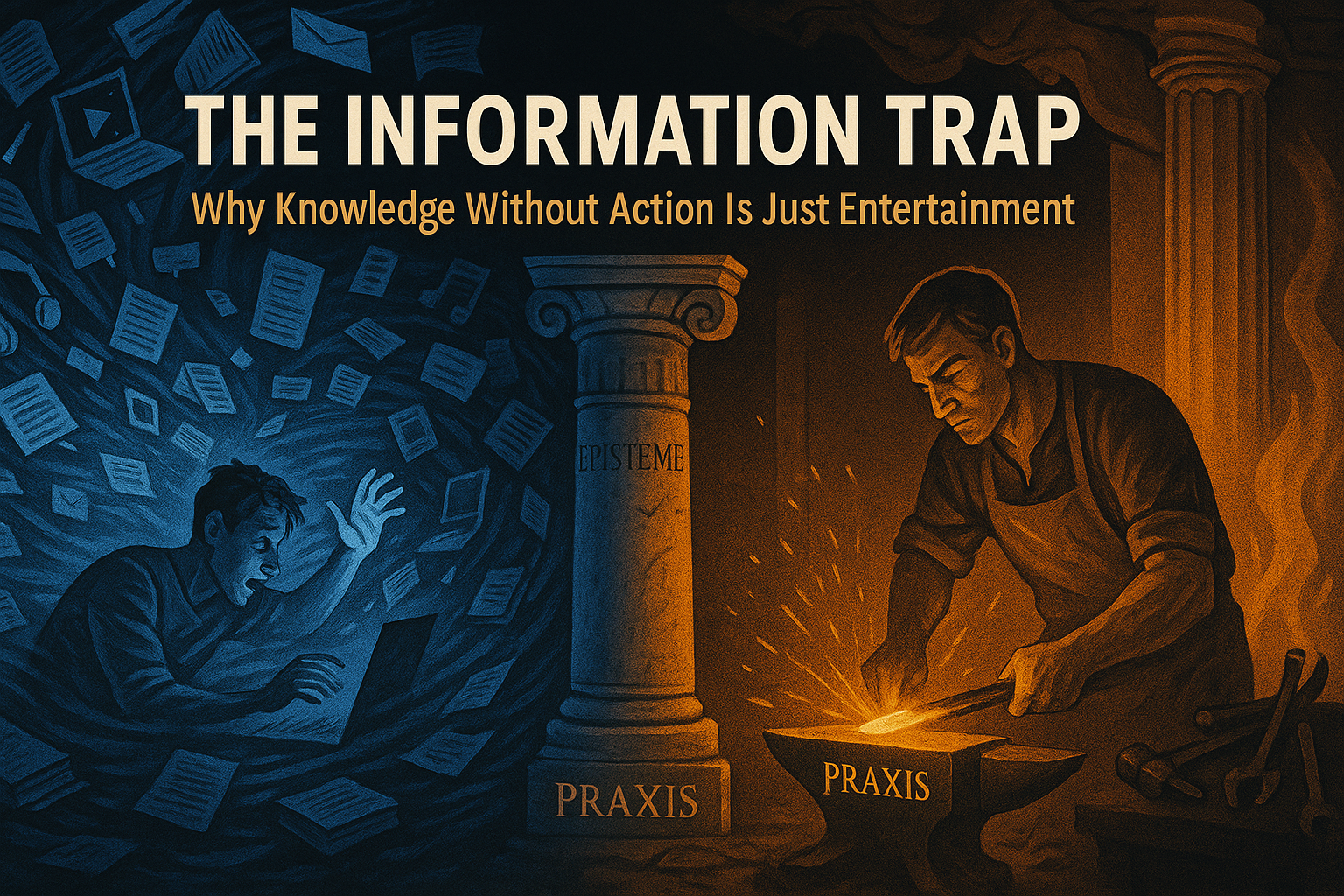
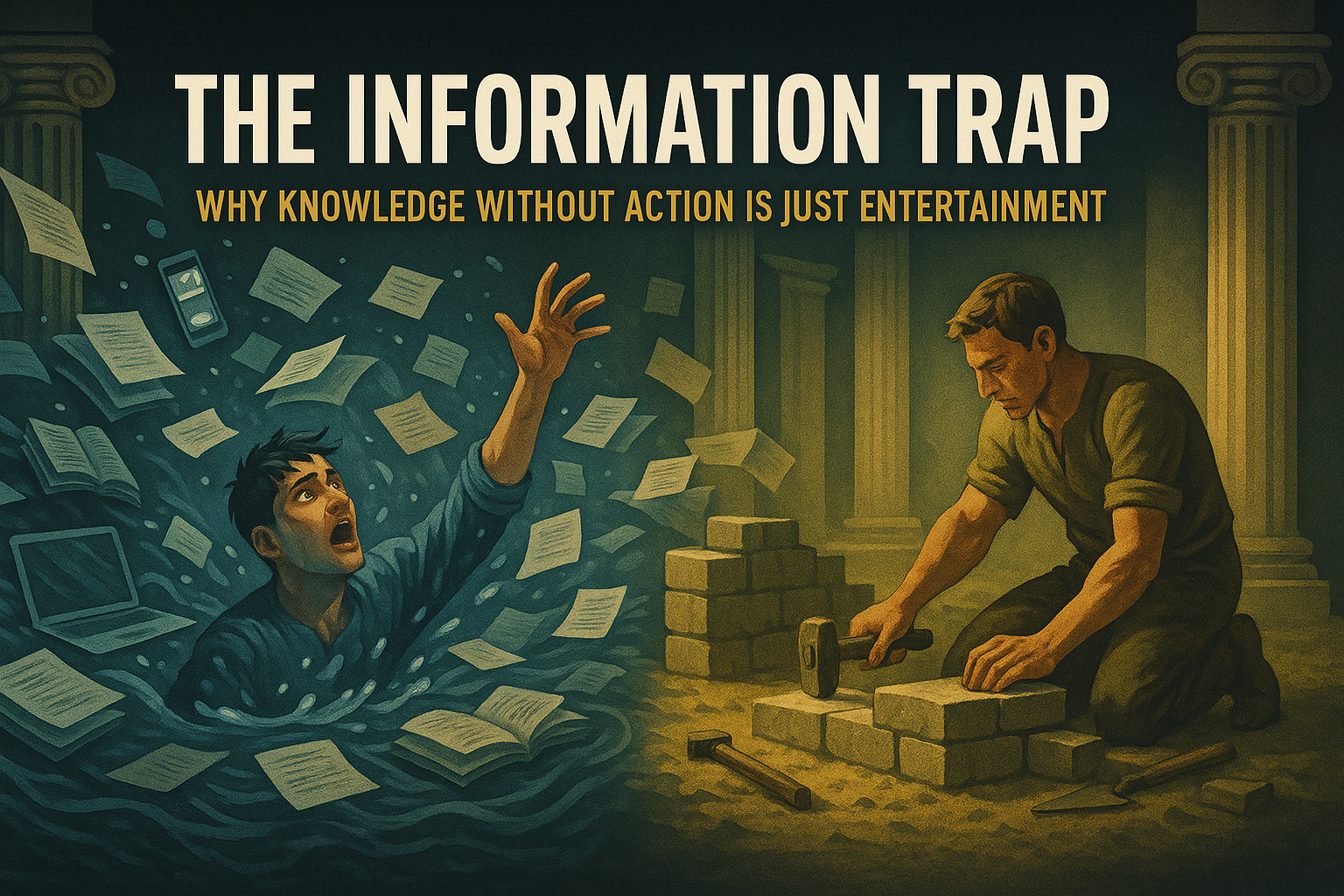
A man has read over two hundred books on philosophy, psychology, and self-development. He can cite research, reference frameworks, and articulate principles with impressive fluency. His actual behavior has not changed meaningfully in five years. He has accumulated an enormous body of information without converting any of it into the kind of understanding that produces different action.
Reading about a subject is not the same as understanding it. The conversion of information into episteme requires active engagement: questioning, testing, applying, and revising. The person who reads widely but never tests their understanding against practice has built an impressive library of doxa.
A CEO implements OKRs (Objectives and Key Results) because Google and Intel use them successfully. She does not investigate the organizational conditions that make OKRs effective, the failure modes they create, or the cultural prerequisites for their adoption. The implementation fails, and she blames the framework rather than her understanding of it.
Adopting practices from successful organizations without understanding the principles that make them work is epistemic tourism: visiting the surface of someone else’s knowledge without building your own. Episteme of a management framework means understanding the conditions under which it works, the reasons it works under those conditions, and the ways it fails when those conditions are absent.
Two medical students learn the same pharmacological content. One memorizes drug interactions and dosing protocols. The other learns the biochemical mechanisms that produce the interactions and determine the dosing. When confronted with an unfamiliar drug combination that was not covered in the curriculum, the first student cannot assess the risk. The second can reason from mechanism to predict the likely interaction.
The practical value of episteme over memorized information reveals itself in novel situations. The person who understands mechanisms can reason about situations they have never encountered. The person who has memorized facts can only recognize situations they have already studied. Professional expertise at the highest level requires episteme, not merely accumulated doxa.
Common Misconceptions
Episteme is commonly equated with having a lot of information. The person who has read extensively about a topic may possess enormous amounts of doxa while lacking genuine episteme of any of it. The test is not volume but depth: can you explain why, not merely describe what? A related error is treating credentials as evidence of episteme. A degree certifies that you completed a program of study. It does not certify that you possess deep understanding of the principles underlying your field. Credentialed professionals who cannot explain the causal mechanisms behind their practices possess certified doxa, which is socially powerful but epistemically empty. A third misconception is that episteme is only relevant to academic or scientific pursuits. Every professional domain has principles that can be understood at the level of episteme. The carpenter who understands wood grain, structural forces, and joinery mechanics at the level of causes possesses episteme of woodworking as genuinely as the physicist possesses episteme of mechanics.
I became aware of the doxa-episteme distinction in my own thinking when a mentee asked me to explain why agile software development works. I had been coaching agile practices for years. I could describe the ceremonies, explain the roles, and facilitate the process with skill. But when pressed on why iterative development produces better outcomes than waterfall planning, I discovered I was repeating explanations I had absorbed from books and conferences rather than articulating my own understanding of the underlying principles.
That gap between what I could describe and what I genuinely understood motivated a change in my learning practice. I stopped reading about agile and started investigating the principles beneath it: why does frequent feedback improve outcomes? What are the cognitive limitations that make long-range planning unreliable? How does team size affect communication overhead, and why does that matter for project management? Each question led me deeper into the causal structure that makes iterative development effective.
The result was not a different set of practices but a fundamentally different relationship with my practices. I could now adapt my approach to novel situations because I understood why specific methods worked rather than merely knowing that they did. When a team’s context made standard agile practices inappropriate, I could design modifications that preserved the underlying principles while adjusting the surface implementation. This capacity for principled adaptation is the practical signature of episteme.
The practice I recommend to anyone in a knowledge-intensive role is what I call “principle drilling.” Take any practice you rely on professionally and ask “why does this work?” Keep asking until you reach a principle you can state clearly and defend. If you reach a point where your answer is “because experts say so” or “because it has always been done this way,” you have found the boundary between your episteme and your doxa. That boundary is where your development work should focus.
Frequently Asked Questions
What is episteme in Greek philosophy?
Episteme is Aristotle's concept of systematic, demonstrable knowledge that grasps not merely what is true but why it must be so. It represents understanding grounded in causes and principles, distinguished from opinion (doxa) and practical skill (techne). Plato's dialogues repeatedly contrast episteme with doxa, establishing the fundamental philosophical distinction between genuine knowledge and mere belief.
What does episteme mean?
Episteme means scientific knowledge or systematic understanding. It derives from epistasthai (to understand), from epi (upon) and histanai (to stand), literally "standing upon" a firm foundation. The word is the root of epistemology, the study of knowledge itself. The metaphor of standing firmly on something captures the Greek conviction that genuine knowledge provides a solid foundation from which to reason and act.
How do you practice episteme?
You develop episteme by investigating the principles beneath your practices. Ask why things work, read primary sources, test your understanding through prediction, and use failures as opportunities to examine whether your foundational knowledge is genuine or superficial. For each claim you make in your professional life, ask whether you can demonstrate why it must be true, not merely assert that it is.
What is the difference between episteme and doxa?
Episteme is knowledge grounded in demonstrable causes and principles, understanding why something must be true. Doxa is opinion or belief that may be correct but lacks grounding in understood causes. The difference is between knowing and merely thinking you know. Plato argued that the transition from doxa to episteme requires philosophical inquiry, the systematic examination of assumptions that most people accept without question.