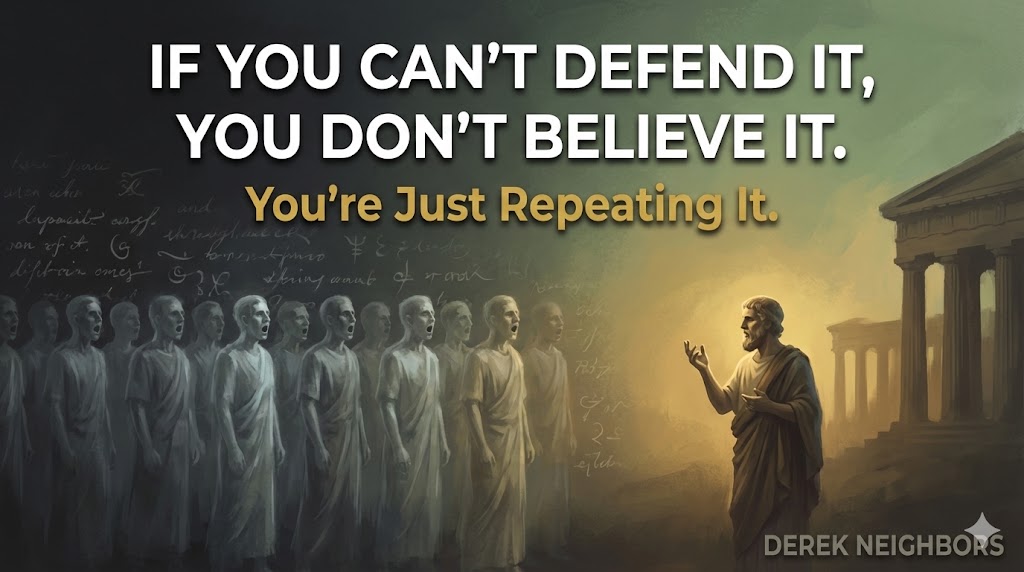
If You Can't Defend It, You Don't Believe It. You're Just Repeating It.
By Derek Neighbors on November 30, 2025
I watched a CEO unravel in a leadership meeting.
He was defending the company’s hiring philosophy. “We only hire people who are already excellent. We don’t have time to develop talent.”
Someone new to the team asked a simple question: “Why?”
He started explaining. But he was just restating the position with different words. She pressed: “But why do you believe that’s true?”
His face flushed. His voice got tight. He started talking faster, louder, more emphatic. All the signs of someone defending territory, not explaining reasoning.
The room went quiet. Everyone could see it. He had no idea why he believed this. He’d inherited it from a mentor he respected decades ago. He’d repeated it so many times it felt like conviction. But when pressed for actual reasoning, he had nothing but borrowed words.
He wasn’t defending a belief. He was defending an echo.
I’ve seen this pattern hundreds of times since. In boardrooms, in strategy sessions, in one-on-ones. The moment someone asks “Why do you believe that?” and the answer is emotion instead of explanation.
The Myth of Strong Convictions
We tell ourselves we’re people of principle. We “know what we believe.” We “stand for something.”
But here’s what standing for something actually looks like for most people: repeating positions we absorbed before we could think critically, defending them with emotional intensity instead of reasoned explanation, and mistaking the duration of a belief for the depth of our understanding.
This seems logical. The beliefs feel like ours. We’ve held them for years, sometimes decades. We get passionate when they’re challenged. That passion must mean something, right?
Wrong. Passion protects identity. Understanding produces explanation. The brutal honesty test reveals which one you’re actually operating from.
When you actually understand why you believe something, challenges feel like conversations. When you’re protecting inherited programming, challenges feel like attacks.
What Happens Under Pressure
Socrates spent his life wandering Athens asking people to explain their beliefs. He questioned politicians about justice. They couldn’t define it. He questioned poets about wisdom. They couldn’t explain their own work. He questioned craftsmen about knowledge. They knew their trade but couldn’t articulate why their expertise applied beyond it.
The pattern was universal: confidence without comprehension. Certainty without examination.
Watch what happens when someone presses you on a deeply held belief:
“That’s just how it is.” Translation: I’ve never thought about it.
“Smart people agree with me.” Translation: I’m borrowing authority I don’t possess.
“You wouldn’t understand.” Translation: I can’t explain it.
“Why are you attacking me?” Translation: I’ve confused my beliefs with my identity.
The emotional reaction is the tell. When you actually understand something, questions feel like opportunities to clarify. When you’re repeating programming, questions feel like threats.
Most of what people call “beliefs” are hand-me-downs. Political positions inherited from parents. Business practices absorbed from mentors. Relationship expectations copied from culture. Career assumptions adopted to fit in.
None of this was chosen. It was installed.
The Real Cost of Unexamined Beliefs
This matters more than intellectual honesty. Beliefs drive behavior. Every decision you make flows from assumptions you hold about how the world works, what matters, and what’s possible.
If those assumptions were never examined, you’re not making your own decisions. You’re executing someone else’s program. This is akrasia at the belief level, acting against your own capacity for reason.
Socrates put it bluntly: “The unexamined life is not worth living.”
Not because unexamined living is immoral. Because it’s not actually yours. To be rational is to examine. Choosing not to is forfeiting your defining capacity.
Here’s what unexamined beliefs cost you:
You’re living inside invisible constraints. Beliefs you won’t question become the walls of your world. They determine what you’ll attempt, what you think is possible, who you think you can become. The prison has no bars because you can’t see it. You just keep bumping into the same limits without understanding why.
You’re defending someone else’s territory. The beliefs running your life might have served their original owners. They might have made sense in their context, for their generation, given their circumstances. That doesn’t mean they serve you. Cultural programming optimizes for conformity. Family beliefs solved problems you might not have. When you defend positions you never chose, you’re a soldier in someone else’s war.
You can’t have genuine conviction. The Greeks distinguished between doxa (opinion) and episteme (knowledge). doxa is what you hold. episteme is what you understand. Most people have opinions they mistake for knowledge. They repeat positions without comprehension and call it conviction.
Real conviction requires understanding. Without examination, you don’t believe anything. You’re just loud about your programming.
What Actually Works
Socrates didn’t tell people what to believe. He asked questions until their beliefs collapsed under their own contradictions.
This wasn’t hostile. It was clarifying.
The Socratic method, what he called elenchus (cross-examination), wasn’t designed to destroy faith. It was designed to test whether faith was warranted. You either emerge with stronger conviction because you’ve tested it, or you discover you were carrying someone else’s baggage.
The difference between held beliefs and earned beliefs:
Held beliefs: Inherited, assumed, defended emotionally. You have them because someone gave them to you.
Earned beliefs: Examined, tested, defended rationally. You have them because you did the work to understand them.
You earn a belief the way you earn a skill. You don’t earn a skill by being told you have it. You earn it by using it, testing it, failing, and improving. Beliefs work the same way. You earn them by defending them against the strongest objections, discovering their limits, and refining your understanding until you can explain why you hold them.
Some knowledge resists articulation. A master craftsman knows things they can’t fully explain. This doesn’t exempt that knowledge from examination. Intuition can be tested even when it can’t be perfectly stated. The goal isn’t eloquence. It’s understanding.
This takes courage. Examining beliefs means risking being wrong. It means discovering that positions you’ve defended for decades might have been hollow the whole time. It means admitting you’ve been a parrot when you thought you were a philosopher.
That’s why most people don’t do it. The ego would rather be confidently wrong than humbly uncertain. Every time you avoid examination, you break the integrity loop between what you claim and what you actually know.
How to Earn Your Beliefs
Pick one belief you feel strongly about. Political, professional, personal. Something you’d defend passionately at a dinner party.
Now put it through the examination:
Why do I believe this? Not “who told me this” or “when did I start believing this.” Why. What’s the actual reasoning? If you can’t articulate the logic, you don’t understand the position. You’re just holding it.
Where did this belief come from? Trace it back. Did you reason your way here, or did you absorb it from parents, culture, mentors, peers? There’s no shame in inherited beliefs. There’s just honesty about what they are.
Can I steelman the opposition? Can you articulate the strongest version of the opposing view? Not a strawman you can easily knock down. The actual best argument against your position. If you can’t, you don’t understand the territory well enough to have chosen your ground.
What would change my mind? If nothing could change your mind, it’s not a belief. It’s an identity. And identities don’t update with evidence. They just defend themselves.
If you can answer these clearly, you’ve earned the belief. You understand it. You chose it. It’s yours.
If you can’t, you’ve found something to work on. But examination has an endpoint. The goal is conviction, not perpetual uncertainty. If you’re still “questioning” after honest examination, that’s not philosophy. That’s hiding.
This requires no education, no status, no resources. Epictetus was a slave. He practiced this with nothing but his own mind. The only requirement is the willingness to question yourself honestly. That’s available to everyone.
The Discomfort Is the Point
This will feel uncomfortable. Your ego will resist. Beliefs that have been with you for decades feel like identity. Questioning them feels like questioning yourself.
That’s exactly why it matters.
Confusion feels like failure when you’re used to certainty. But confusion is progress. It means you’ve discovered the edges of your actual understanding instead of the edges of your borrowed words.
Changing positions based on examination feels like weakness. It’s actually strength. The ability to update beliefs based on better understanding is the definition of intellectual honesty.
The people who never change their minds aren’t principled. They’re fossilized. They stopped thinking decades ago and have been repeating themselves ever since.
The Challenge
This week, take one belief you’ve never questioned and put it through the examination. To discover whether it’s yours.
This isn’t a suggestion. This is the minimum standard for calling yourself a thinking person.
Start with something that matters. Something you’d argue about. Something that feels like part of who you are.
Then ask: Can I explain this without getting defensive? Can I articulate why without citing authority? Can I steelman the opposition without dismissing it? Do I know what would change my mind?
If the belief survives, you’ll hold it more firmly than before. Not because you inherited it, but because you earned it.
If it doesn’t survive, you’ll have room for something true. Something that’s actually yours. Sometimes hitting bottom on a cherished belief is exactly what creates space for genuine conviction.
Final Thoughts
Socrates wasn’t executed for having wrong beliefs. He was executed for asking questions. Athens could tolerate almost anything except someone who made people examine what they claimed to know.
The discomfort of examination is preferable to the unconsciousness of repetition. A single earned belief is worth more than a library of inherited opinions.
The question isn’t whether you have beliefs. It’s whether they’re yours.
Stop defending echoes. Start earning convictions.
If you’re ready to stop repeating and start examining, MasteryLab is the community for people willing to do the uncomfortable work of earning their convictions. Because the world doesn’t need more people with strong opinions. It needs more people with examined ones.