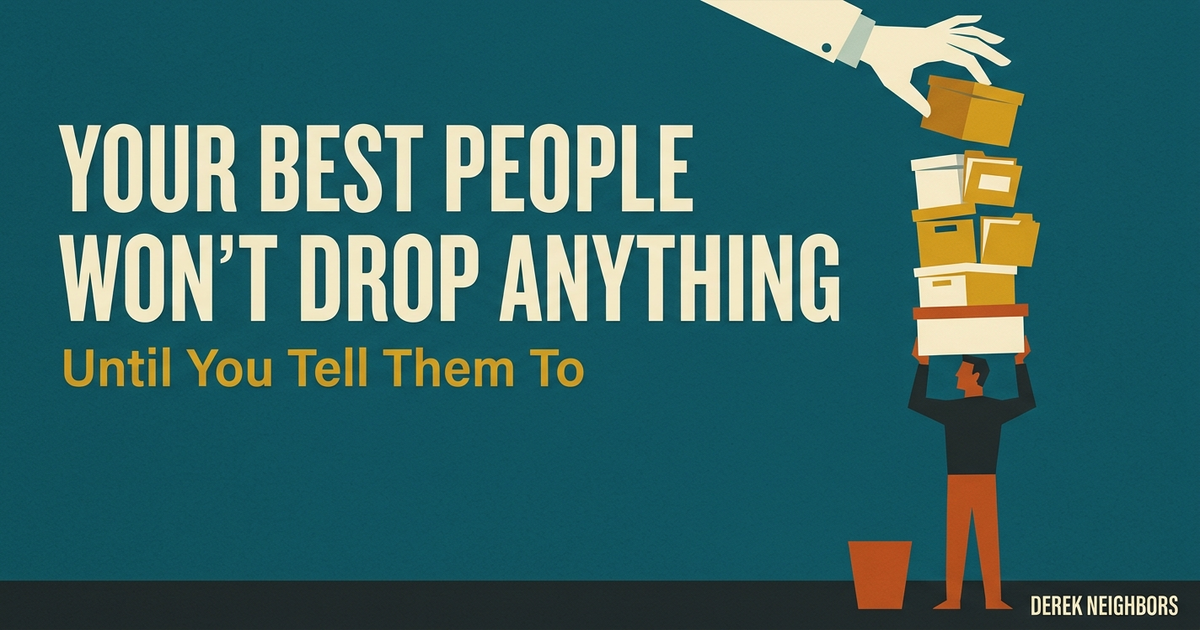
Your Best People Won't Drop Anything Until You Tell Them To
By Derek Neighbors on November 5, 2026
The slide goes up at the all-hands. There is a new priority, and the leader is excited about it, and the room claps. Nobody asks what comes off the list, because nothing does.
Ninety days later the new thing is half-built, and the team has too many priorities, because every old thing is still running. The weekly report from last year’s big push still goes out every Friday. The migration nobody talks about anymore is still eating two engineers. And the most reliable person on the team is working Sundays to keep all of it alive.
I have watched this happen at company after company. The leader usually calls it a bandwidth problem and asks for more people. What I see is a team that has never been told to stop anything, and the leader is the only one who can tell them.
The Surface Problem: Too Many Priorities
From the outside it looks like overload. Dates slip and quality gets uneven. People who used to be sharp start sending replies at 11 p.m. that are a little off. Someone good quits and says in the exit interview that they were tired.
The usual fixes are reasonable on paper: a prioritization workshop, a stack-ranked list, two more hires, time management training, a new tool to track it all.
Every one of these fails the same way, because sorting a list does not make it shorter. A ranked list of fourteen priorities still has fourteen priorities on it, and somebody is still doing number fourteen, because nobody told them to stop. New hires get loaded with the same pile within a quarter. The workshop produces a beautiful matrix, and on Monday everyone goes back to doing all of it.
To see what is going on, look at what happens to old work.
The System
Three parts make overload, and they feed each other.
The leader adds. Announcing a new priority is cheap and it feels like leading. You get the slide and the applause. Ending something is expensive. It means telling a customer, a peer, or your own boss that a thing they care about is going away. So leaders add in public and almost never end anything out loud. They stop mentioning the old thing and assume the team will figure it out.
Conscientious people keep. Your best people do not figure it out, because to them, a commitment is a promise. They said they would send that report. They said they would keep the old integration running. You never told them to stop, so in their minds the promise still holds. Dropping it on their own would feel like breaking their word. This is the trait you hired them for, and it is the trait the system uses against them. A promise is made to someone, though. Once the person it was made to has stopped caring, keeping it helps no one, and since the promise was made to the leader, releasing it is the leader’s job.
Nobody owns stopping. Every old project has someone who will complain if it ends. New projects have the boss behind them. There is a meeting for starting things, with a deck and a kickoff and a budget. I have rarely seen a company with a meeting where things die.
Put the three together and you get a loop. The leader adds. The reliable people absorb it on top of everything else. Quality slips a little across all of it, because there are only so many hours. The leader notices the slippage and launches an initiative to fix quality, which is one more thing on the pile.
Meanwhile, the less conscientious people on the team have let half their old commitments rot without telling anyone, and they look fine. They are rested and they hit the new priority. The system punishes reliability and rewards whoever is willing to let things slide without asking. Run that long enough and you lose the people you most wanted to keep. The people who drop work silently are guessing, too. Sometimes they drop something that mattered, and nobody finds out until it breaks. Copying them is the wrong lesson. Stopping should be decided out loud and done in the open.
In Plato’s Gorgias, Callicles defends pleonexia, the Greek word for wanting more than your share, as the right of the strong. Socrates answers with an image. A soul run by that appetite, he says, is like a jar full of holes. You can pour water into it all day and it never fills.
A leader’s appetite for priorities works the same way. Each new one feels like the piece that will finally make the plan complete, and there is always another one after it. Every one of them takes hours the team does not have, and those hours are the share the leader is taking.
The Leverage Points
Three points in the system carry most of the weight.
The moment of addition. The cheapest time to end something is the moment you start something else. Everyone is paying attention, and nobody has built habits around the new work yet. Wait three months and the same trade becomes a fight.
The word “stop” belongs to authority. A conscientious person cannot give themselves permission to drop a commitment you gave them. They need a sentence from you that names the thing and says it is done.
The hard decision is what not to do. Peter Drucker spent a chapter of The Effective Executive on this. He called the things you decide not to do posteriorities, and he said picking them is harder than picking priorities, because every one of them is somebody’s favorite. He also said the choice takes courage more than analysis. Most leaders I talk to already know what should stop. They do not want the conversation that stopping it takes.
The Intervention
Trade at the door. Make it a rule that nothing new goes on the list unless something comes off in the same meeting. Say both halves in the same breath: “We are starting the onboarding rebuild, and we are ending the Friday metrics report.” Write both down. If you cannot name what stops, you are not ready to start.
Run the restart question on everything already running. Drucker’s question is simple: “If we did not already do this, would we go into it now?” Walk the whole list with your team and ask it about every item. When the answer is no, the item gets an end date, a person who tells the stakeholders, and a line in the notes. Unless the answer is a clear yes, Drucker said, drop it or cut it back sharply. Some people will be disappointed when their item ends. Tell them yourself, before the date, instead of letting the thing fade.
Give permission out loud, to the person. Go to the engineer who has been keeping the old integration alive and tell them directly: “You can stop doing this. If anyone complains, send them to me.” That last sentence matters most. Your people will not stop as long as they think they will take the blame for it. Tell them you will take it.
Keep a stopped list. Put it next to the priorities list, in the same doc, where everyone can see it. When the team reviews progress, review what you ended, too. A team that can see things ending starts to believe the new priority is real.
Start with your own pet project. The hardest thing to stop is the thing you launched. You have stories about why it still matters, and some of them are true. Kill one of yours first. Everyone is watching to see whether the rule applies to the boss, and if your projects are exempt, the rule does nothing.
Read calendars, not status reports. Status reports tell you the new priority is on track. Your best people’s calendars tell you what they are carrying. If you see a recurring block for something you forgot existed, that is a promise they are still keeping for you.
If you are the one carrying the pile, ask. You may not be the leader, and you do not need to wait for one to read this. Bring your list to your boss the next time something new lands, and ask by name which item stops to make room. Most leaders will answer when the question is that specific.
Marcus Aurelius ran an empire and still wrote a note to himself that fits on an index card: “Ask yourself at every moment, ‘Is this necessary?’” He was writing about his own day. It works for a roadmap, too.
The Results
When you fix the trade, the first thing that changes is that work finishes. A team carrying five things finishes things, while a team carrying fifteen moves all of them forward a little and finishes none.
Trust changes next. When you say “this matters,” people believe you, because they watched something else end to make room for it. A leader who calls everything urgent gets the opposite result, and the team stops listening.
The change you will feel most is that your reliable people stop burning out. The person working Sundays goes back to working weeks. You stop losing the people who keep their word, and the people who were letting things slide lose their quiet advantage, because now stopping happens in the open.
I wrote recently that ten priorities means you have not picked one. That piece was about choosing at the top. This one is about the old work underneath the choice, which keeps running until someone with authority ends it.
The Test
Answer these about your own team this week.
What did you add in the last ninety days? For each one, can you name what you ended to make room?
Who on your team is still running something you stopped caring about a year ago? Have you told them, by name, that they can stop?
When did your team last have a meeting where the main job was ending things?
Which of your own projects would you defend first if someone suggested killing it? What would the restart question say about it?
If you cannot answer the first question, your best people are paying for that gap every week.
FAQ
What do you do when your team has too many priorities?
Stop adding without trading. Every time a new priority goes on the list, name in the same meeting what comes off, and say it out loud to the people doing the work. Then go through what is already running and ask Peter Drucker’s question: if we were not already doing this, would we start it now? Anything that gets a no gets an end date.
Why do high performers burn out first?
Conscientious people treat each commitment as a promise, so they will not drop old work on their own, even when the leader has clearly moved on to something new. Less conscientious people let things slide quietly and look fine. The most reliable people end up carrying the most work, and they keep carrying it until someone with authority tells them to stop.
What is Drucker’s restart question?
In The Effective Executive, Peter Drucker tells leaders to ask of every activity: if we did not already do this, would we go into it now? Unless the answer is a clear yes, he says the activity should be dropped or cut back sharply. It puts the burden of proof on old work instead of on new work.
What is pleonexia?
Pleonexia is the Greek word for wanting more than your share, a grasping that has no natural stopping point. In Plato’s Gorgias, Callicles defends it as the right of the strong, and Socrates compares that kind of appetite to a jar full of holes that never fills up.
Final Thoughts
Leaders add in public and stop in silence, and conscientious people keep every promise until someone with authority releases them. That is how your most reliable people end up carrying the most dead weight. Make every addition a trade. Ask Drucker’s question about everything already running. Then say “stop” out loud, to a person, and take the heat for it yourself. Your team will start finishing things once something has come off their list.
Learning to lead by what you end as much as by what you start is part of the work of excellence. That is what MasteryLab is for.