Write With AI Every Day and Own Every Word That Ships
By Derek Neighbors on November 3, 2026
Most mornings a thought comes back with me from a long run in the desert. There is no signal out there, so I get two hours alone with whatever I have been chewing on. When I get home I dump it into the repo as a ramble: half-sentences, a story, the thing that annoyed me, the claim I think is true.
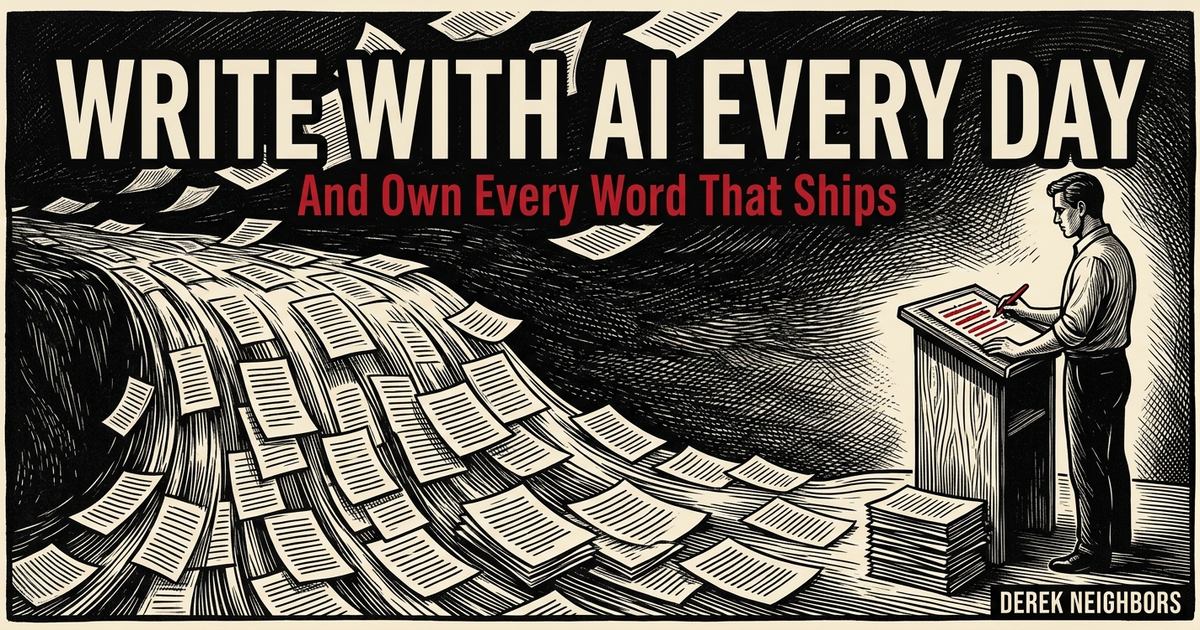
This is how I write with AI every day. A workflow checks whether I have already written this, pulls search data, builds an outline, and writes a draft. A voice pass checks the draft against a long list of things I never want to see in my writing. A review skill has five ancient philosophers take shots at the argument, and the social posts get drafted from there.
Then I read it, and my first job is to find the sentence I do not believe.
That is how most of the articles on this site get made. I publish here most days. Some people hear that and decide I stopped writing a long time ago and started publishing what a machine made. They have the wrong picture of what writing ever was.
The Myth: The Model Wrote It, So You Didn’t
There are two versions of this belief, and they look like opposites.
The purist version says real writers type every word. If a model drafts the piece, you cheated, and the daily writing habit is fake. You are a manager of a word factory, and your skill will rot.
The lazy version says the problem is solved. The model writes, you hit publish, and anyone can put out a post a day. Writing as a craft is over.
Both versions assume writing means producing words. The purist treats the words as sacred because you made them, and the lazy one treats them as free, so nothing is left to do. If writing meant producing words, both would be right. That assumption is where both versions break.
Why It Feels True
The myth has real support.
Start with the pain. Anyone who has written for years knows the blank page. You sit there, nothing comes, and you push through anyway. That struggle felt like the proof that you were a writer. When the model writes a first draft in forty seconds, it feels like the proof went away.
The old advice was about output, too. Anthony Trollope wrote with his watch on the desk and held himself to 250 words every quarter hour, for three hours each morning before he went to his job at the post office. He finished dozens of novels that way. For a long time the best daily writing advice was some version of his: a word count, a page count, a number of hours in the chair. If the model can hit any word count you like, the old measure of the habit is gone.
And a lot of AI writing is bad, and you can tell. It runs long, hedges every claim, leans on the same six phrases, and tells stories that never happened to anyone. People read a lot of that and decide the model is the problem.
All three points are real, and none of them shows that a person who uses a model stopped writing.
The Pen Was Never the Point
Writers have been getting help with the words for as long as there have been writers.
John Milton was blind when he wrote Paradise Lost. He composed lines in his head, often at night, and dictated them to whoever was there to write them down. Henry James started dictating to a typist in the late 1890s and wrote his last great novels out loud, pacing the room while someone else typed. Nobody says Milton or James did not write their books. Their helpers took down words the author had already composed, and a model composes its own sentences, which is a real difference. It puts more of the weight on what happens after the draft, and that is where the best example lives.
Maxwell Perkins, the editor at Scribner, took the enormous manuscript of Thomas Wolfe’s first novel and helped cut tens of thousands of words before it became Look Homeward, Angel. Perkins shaped the structure. He told Wolfe what to drop. The book is still Wolfe’s, because Wolfe decided what the book was about, and Wolfe said yes to what shipped. Authorship lives in what the piece claims and in what the author lets stay in.
That also explains the bad AI writing. Somebody hit publish on a draft they never argued with and skipped the job that was always theirs. People did the same thing with ghostwriters, interns, and templates for decades.
The Two Jobs You Keep
When you write with a model, you hand off the typing, a lot of the research, and the first try at a structure. You keep two jobs, and they are the whole craft.
The claim. What do you believe that your reader does not believe yet? The model can’t answer that for you. It can give you the average of what everyone has said, which is the opposite of what you need. Every piece that is worth reading starts with a person who thinks something specific and is willing to be wrong about it in public. That is why my process starts with a ramble from a run. Start from a topic like “an article about writing” instead of a thought, and the draft comes out smooth and empty.
The cut. Once the draft exists, you read it like an opponent. Which sentence would you not say out loud to a friend? Which claim can’t you defend if someone pushes back? Which example did not happen? Which line sounds smart and means nothing? Cut it or fix it. The cut covers the order too. If the outline the model proposed buries your claim in paragraph six, move it to the top. The model will produce weak lines all day, and it will produce them in your voice if you trained it on your voice. Finding them is your job.
Both jobs get bigger with a model. I see more drafts in a week now than I used to write in a month. Every one of them needs a claim I believe and a cut I am willing to sign. The hour I used to spend typing goes into editing.
This is the same idea I wrote about with agents in general: the work does not stop being yours because something else did the first pass. What you do with the first pass is the practice.
How to Write With AI Without Losing Your Voice
Here is the practice, close to how it works for me. You can start a version of it this week with whatever model you already use.
Start from your thought, never a blank prompt. Write down the claim in your own words before the model touches anything. Talk it into your phone on a walk if that is easier. Messy is fine. The ramble is where your voice and your angle come from, and the model can work with mess. It can’t invent a point of view you never gave it.
Let the model do the heavy lifting, all of it. Research, outline, first draft, headline options, the social posts, checking whether you already wrote this, pulling your search data. Do not hold back out of guilt. The point of going fast with the model is that you get to spend your time on the two jobs that matter. Treat the model as the default and keep only what you cannot afford to get wrong for yourself.
Write your standards down once, where every draft reads them. This is the move most people skip. My repo has a file of rules every draft has to pass. It bans the phrases I never want to see: no em dashes, no “X is just Y,” no “Everyone X. No one Y.” setups. It tells the model to write so a sharp twelfth grader gets every sentence on the first read, and it keeps the reading list at the bottom to books only. Every time I catch the model doing something I hate, I add a line to that file, and the next draft starts closer. If you have no repo, a plain text file you paste at the top of every session does the same job. That file is my taste, written down. It is the best thing I have built for my writing in years.
Run a review with a different lens. After the draft, I have the work reviewed by a skill that plays five old philosophers, each looking for a different weakness: where I am blaming things outside someone’s control, where I am contradicting myself, where a claim has no support. Any second pass works if it looks for something besides “does this sound good.” Ask the model to argue against your piece. Ask it which claim is weakest. Then decide.
Read it out loud and cut. This is still the best editing tool there is. Your ear catches what your eye skims past. If you stumble, the reader will. If a line makes you wince, it goes.
Put your name only on what you would defend. If someone emailed you a hard question about any sentence in the piece, could you answer it? If a story is in there, did it happen? If the answer is no, it does not ship, no matter how good it sounds. That is the one rule I do not let the model help with.
The Habit Got Harder
The purists miss what happens to the habit itself. Writing with a model every day takes away the easiest excuse for skipping a day. “I did not have two hours to type” stops working when a draft can exist in minutes. What is left is the part that was always hard: sitting down and deciding what I actually think, then reading a smooth draft and admitting which parts of it are not true. Steven Pressfield calls the thing that keeps you from your work Resistance. The model got rid of a lot of the busywork. Resistance is still there, and it is waiting for you at the claim and the cut.
The lazy version misses the market. A post a day is easy now, and a post a day you would defend line by line is as rare as it ever was. Cheap words make a clear, specific point of view worth more, because the feed is full of smooth posts with nothing in them.
The Test
Open the last thing you published, whether you wrote it with a model or not.
Can you say the main claim in one sentence, in your own words, without looking?
Is there one sentence in it you would not say out loud to a smart friend? Why is it still there?
Did every story in it happen, to you or to someone you can name?
Do you have your standards written down anywhere a model could read them, or do you fix the same problems by hand every time?
When did you last cut something good because it was not true?
Final Thoughts
The people who call AI writing cheating and the people who let AI publish for them share one belief: that writing means producing words. Milton and James had help with the words, and Wolfe had an editor who cut his book apart. Authorship was always the claim and the cut.
So go all in. Let the model type, research, outline, and draft. Write your taste into a file it reads every time, and add to that file every time it misses. Start from your own thought. Read every draft like an opponent, out loud, and cut what is not true. Then put your name on it, because you decided what it says. That is still writing, and you can do it every day.
Building a daily practice where the tools go fast and the standards stay yours is part of the craft. That is what MasteryLab is for.