Prokopton (προκόπτων): Meaning, Definition & Modern Application
pro-KOP-ton
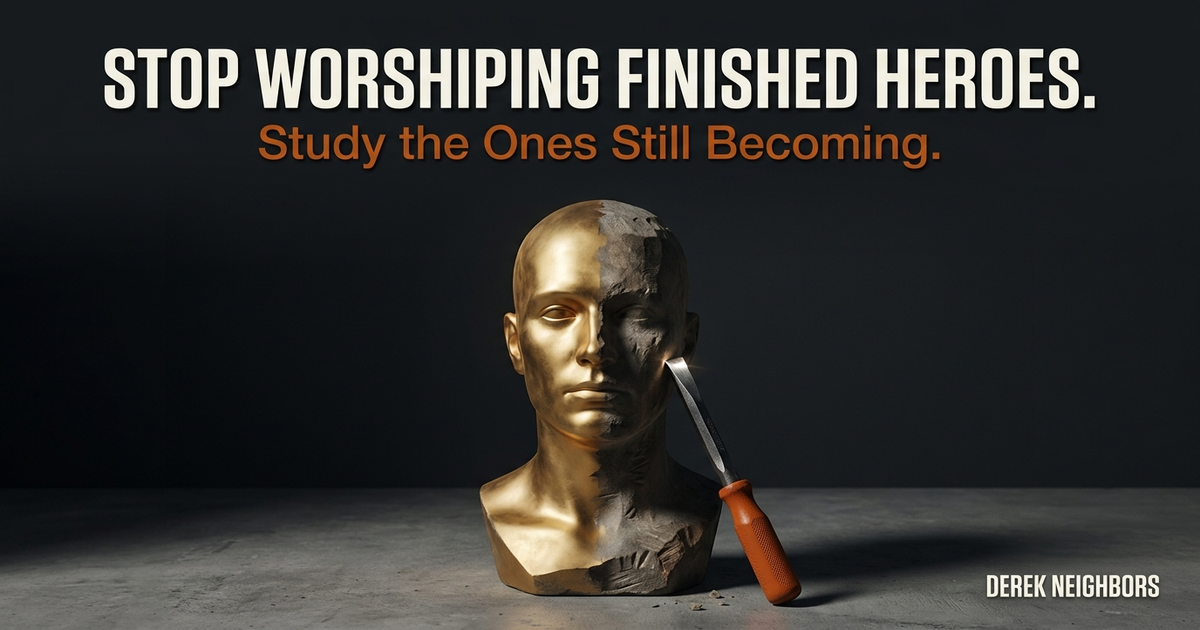
One who is making progress, the practitioner advancing toward wisdom and virtue. In Stoic philosophy, the prokopton occupies the space between ignorance and sage-hood, committed to moral improvement while acknowledging imperfection.
Etymology
Derived from prokoptō (προκόπτω), meaning ‘to cut forward’ or ‘to advance,’ combining pro (forward) and koptō (to strike or cut). The term evolved from its literal sense of cutting a path through obstacles to its philosophical meaning of one who makes moral and intellectual progress. The Stoics adopted it to describe the practitioner who, while not yet a sage, actively works toward that ideal.
Deep Analysis
The concept of prokopton addresses one of philosophy’s most vexing practical problems: how do imperfect beings pursue perfection without either despairing at the gap or deceiving themselves about having closed it? The Stoics developed this concept with remarkable psychological sophistication, creating a framework that honors both aspiration and honest self-assessment.
Epictetus, in his Discourses, devoted significant attention to what distinguishes genuine progress from mere pretense. He identified three stages of the prokopton’s development. In the first stage, one works to align desires and aversions with nature, wanting only what is within one’s control. The second stage involves proper motivation in relationships and duties. The third stage concerns the refinement of judgment and the elimination of hasty assent to impressions. Most practitioners, Epictetus acknowledged, remain in the first stage throughout their lives. This admission itself demonstrates the concept’s power: it allows for meaningful progress without guaranteeing completion.
The prokopton concept resolves a tension inherent in virtue ethics. If virtue is the only good and we lack complete virtue, are we therefore completely lacking goodness? The Stoics answered no. Progress itself has value, and the commitment to progress reflects a correct orientation of the will (prohairesis) even when the execution remains imperfect. This philosophical move has profound implications. It means the prokopton who fails while trying differs categorically from one who succeeds while not caring about virtue.
Seneca’s Letters to Lucilius can be read as an extended meditation on being a prokopton. Seneca repeatedly acknowledges his own struggles, his failures to live up to his principles, his ongoing battles with anger and luxury. Yet he does not present these confessions as disqualifications from philosophical teaching. Rather, they establish his credibility as a fellow traveler. When Seneca writes, ‘I am not wise, nor will I ever be,’ he is not expressing false modesty but articulating the prokopton’s honest position.
This honesty creates a fascinating paradox. The prokopton must believe progress is possible while acknowledging that the destination may be unreachable. Marcus Aurelius captures this in his Meditations, writing his private exhortations to virtue while clearly struggling with the same impulses he critiques. The Meditations reveal a prokopton in real-time: returning again and again to the same principles because they have not yet become second nature.
The relationship between prokopton and askesis (disciplined practice) deserves attention. Progress requires method, not mere intention. The Stoics developed specific exercises: evening review of the day’s actions, morning preparation for challenges, attention to impressions (prosoche), and the discipline of assent. These practices do not guarantee progress but create the conditions for it. The prokopton without method becomes merely aspirational, not actually advancing.
Critically, the Stoics distinguished between philosophical knowledge and genuine progress. One might memorize all of Chrysippus and remain a beginner if that knowledge has not transformed behavior. Epictetus mocked students who could recite arguments but lost their temper at a slave. The prokopton is measured by reduced passion, improved judgment, and alignment of action with principle, not by theoretical sophistication.
The concept also addresses comparison with others. The prokopton measures themselves against their own past, not against other practitioners or theoretical sages. This prevents both the despair of comparing oneself to perfection and the complacency of comparing oneself to those less committed. Your only relevant competition is who you were yesterday.
Perhaps most importantly, the prokopton framework makes visible what perfectionism hides: the dignity of struggle itself. The prokopton who fights and falls and rises demonstrates something the untested cannot demonstrate and the complacent will not. They show that virtue matters enough to pursue even when pursuit is difficult and completion uncertain. This is why the tradition honors practitioners like Marcus Aurelius, clearly imperfect yet clearly striving, rather than claiming any historical figure achieved sage-hood.
Modern Application
You are a prokopton the moment you commit to growth while accepting you will never fully arrive. This concept frees you from the paralysis of perfectionism. Instead of waiting until you have mastered leadership to lead, you lead while learning, making your development visible and your progress the point. Your value lies not in achieved perfection but in demonstrated commitment to the path.
Historical Examples
Epictetus himself exemplifies the prokopton path through his biography. Born a slave, crippled by his master according to some accounts, he was later freed and began studying Stoic philosophy under Musonius Rufus. He did not claim sage-hood despite becoming one of the most influential Stoic teachers. In his Discourses, preserved by his student Arrian, Epictetus repeatedly places himself among those still making progress rather than those who have arrived. When challenged to demonstrate the sage’s freedom from disturbance, he admitted he could not, saying he was still ‘in training.’ This honest self-assessment from a master teacher demonstrates that the prokopton identity is not a beginner’s stage to be transcended but a permanent posture of philosophical humility.
Marcus Aurelius provides perhaps the most documented example of a prokopton in action. His Meditations were private writings, never intended for publication, in which the most powerful man in the world repeatedly exhorts himself to patience, kindness, and acceptance of mortality. He returns to the same themes obsessively because he has not mastered them. In Book 5, he writes about the importance of rising early and doing his work, a passage that only makes sense if he frequently failed to do so. The Meditations reveal that twenty years of philosophical practice had not made Marcus immune to anger, frustration, or the desire for praise. Yet he kept practicing. This persistence despite imperfection is the prokopton’s essential quality.
Seneca’s relationship with Nero reveals the prokopton’s dilemma in political life. As tutor and later advisor to the young emperor, Seneca attempted to guide Nero toward clemency and justice while navigating an increasingly dangerous court. He clearly failed in many respects, remaining in power while Nero’s behavior grew more tyrannical. Seneca himself acknowledged this tension in his letters, wrestling with questions about complicity and compromise. When forced to commit suicide by Nero’s order, Seneca is reported by Tacitus to have met death with Stoic composure, but his final years represented not philosophical triumph but the prokopton’s struggle to apply principles in impossible circumstances. His imperfect navigation does not disqualify him from the philosophical tradition; it makes his writings more credible precisely because he wrote from within the struggle rather than above it.
How to Practice Prokopton
Start each morning by acknowledging one specific area where you remain a learner, not an expert. Write it down. This practice grounds you in the prokopton mindset before the day’s challenges tempt you toward pretense.
Track your progress using a weekly review. Every Sunday, document three moments where you fell short of your ideals and three where you improved upon previous attempts. The prokopton measures themselves against their past self, not against perfection.
Seek feedback actively. Ask one colleague each week: ‘Where have you seen me improve? Where am I still struggling?’ Record their responses without defending yourself. The prokopton treats criticism as navigation data.
Review your reactions throughout the day. When you notice irritation, anxiety, or judgment arising, pause and ask: ‘What does this reveal about the work still ahead?’ Use a simple tally system to track how often you catch yourself versus how often emotions carry you away.
Practice ‘progressive disclosure’ by sharing your learning journey with those you lead. Once a month, tell your team about something you are actively working to improve. This normalizes growth and demonstrates that advancement, not arrival, defines excellence.
Application Examples
A CEO implements a new strategy that fails significantly in its first quarter. Rather than hiding the results or blaming market conditions, she presents a detailed post-mortem to the board, identifying her own decision-making errors and the specific adjustments she is making. She asks to be evaluated on whether she repeats these errors, not on whether she made them.
The prokopton transforms accountability from a threat into a tool. Public commitment to learning from failure creates more credibility than concealed imperfection ever could.
A father notices he loses patience with his children most evenings when tired from work. Instead of simply feeling guilty, he begins logging these incidents, identifying triggers, and experimenting with interventions: arriving home later after decompressing, establishing quiet transition time, or frontloading difficult conversations to morning hours. Progress is slow but measurable over months.
The prokopton approach replaces shame with data. Tracking failure systematically reveals patterns that guilt alone obscures.
A manager realizes she has been avoiding difficult conversations with an underperforming team member. She commits to having one direct conversation per week, enlisting a peer to hold her accountable. After each conversation, she debriefs what she avoided saying and why, gradually building her capacity for directness.
Prokopton leadership means identifying specific developmental edges and creating structures that make avoidance difficult. Growth requires engineered exposure to what you currently evade.
A writer who has published three novels still struggles with the opening chapters of new projects, often abandoning them. Rather than treating this as a character flaw, she studies her past patterns, identifies that she needs a complete draft before evaluating quality, and commits to finishing rough drafts regardless of how poor the openings seem.
The prokopton understands that recurring struggles are not signs of failure but invitations to develop new disciplines. The pattern is diagnostic, not damning.
Common Misconceptions
Many people assume the prokopton is merely a beginner, someone in early stages who will eventually graduate to full wisdom. The Stoics were far more radical: they suggested that virtually everyone, including their greatest teachers, remained prokoptontes throughout life. The sage was a theoretical ideal, possibly never actualized in human history. Identifying as a prokopton is not an admission of being a novice but a claim to serious practice.
Another error involves treating progress as linear and guaranteed. The prokopton does not advance steadily upward like climbing stairs. Setbacks, regressions, and long plateaus characterize the actual path. The Stoics warned against measuring progress over short intervals. What matters is the overall trajectory across years and decades, with plenty of local failures along the way.
Some interpret the prokopton concept as license for perpetual mediocrity, as though ‘being on the path’ excuses actually walking it. Epictetus explicitly rejected this. The prokopton maintains rigorous standards while acknowledging they have not met them. The honest acknowledgment of failure must accompany renewed commitment to improvement, not complacency about the gap between aspiration and reality.
I spent years as a leadership coach pretending I had arrived. I taught teams how to have difficult conversations while avoiding them in my own life. I facilitated retrospectives about admitting mistakes while hiding my own. The exhaustion of this performance eventually broke me.
The prokopton concept came to me not through study but through necessity. I had failed publicly and badly in a business partnership. My instinct was to control the narrative, to explain why the failure was not really failure or not really mine. But I had taught too many others about transparency to maintain the pretense.
So I wrote publicly about what had happened. I named my specific errors: the conflict I had avoided, the feedback I had dismissed, the warning signs I had rationalized away. The response surprised me. Rather than the professional death I expected, I found connection. Other leaders reached out to share their own concealed struggles. My admission had made it possible for others to stop performing perfection.
This taught me that the prokopton model is not merely honest but strategic. The leader who admits imperfection while demonstrating commitment to growth creates more trust than the leader who performs mastery. People follow someone who is clearly advancing over someone who claims to have arrived. They know the latter is impossible.
Now I explicitly identify myself as a prokopton in client engagements. I tell teams: ‘I am working on the same things I am asking you to work on. I will share my progress and setbacks if you share yours.’ This creates a different container than the expert-client relationship. We become fellow travelers rather than guide and guided.
The practical implication of prokopton for my coaching is that I measure success differently. I do not ask whether someone achieved their goal but whether they demonstrated progress. Did they have the difficult conversation? It does not matter if it went well. Did they try a new approach? The outcome is secondary. The prokopton celebrates attempts, not just achievements.
Frequently Asked Questions
What is a prokopton in Stoic philosophy?
A prokopton is someone actively making progress toward virtue and wisdom in Stoic philosophy. Unlike the sage, who has achieved perfect wisdom, the prokopton acknowledges their imperfection while maintaining disciplined commitment to improvement. Epictetus considered most serious practitioners to be prokoptontes, those on the path rather than at the destination.
How do I know if I am making progress as a prokopton?
The Stoics identified several markers of progress: fewer and less intense emotional disturbances, quicker recovery when you do get disturbed, more alignment between your stated values and actual behavior, and reduced concern with others' opinions. Epictetus also noted that the prokopton increasingly blames themselves rather than circumstances for their troubles.
What is the difference between prokopton and sage?
The sage (sophos) has achieved complete wisdom and virtue, making correct judgments in all circumstances. The prokopton is still developing these capacities, making errors but improving over time. The Stoics acknowledged that true sages might be exceedingly rare or theoretical ideals, making the prokopton the practical identity for serious practitioners.