Hand Them the Broom Handle
By Derek Neighbors on September 9, 2026
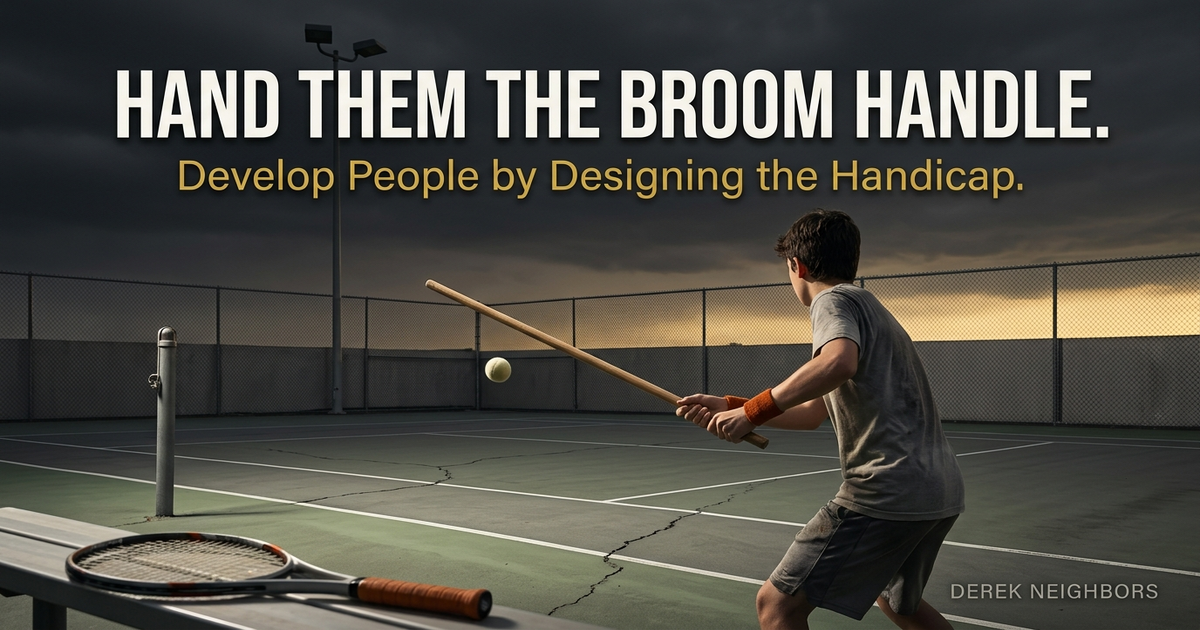
The version I read, in the Admired Leadership newsletter, goes like this. Arthur Ashe as a junior player was not allowed a racket. He practiced with a broom handle. A thin wooden stick makes a tennis ball almost impossible to hit, so the only way to make contact was to watch the ball all the way onto the wood. The racket, when he finally got it, felt enormous. He could see the ball.
I cannot find that story in the biographies, and I am telling you that up front. What I can tell you is that I hand people the racket every day, and the mechanism in that story is real whether or not the biography is. Remove the help, and the capability underneath has to carry the load or show that it cannot.
At my desk the racket is an agent that drafts anything, a template for every document, last quarter’s deck, a runbook for every incident, and the full ticket history for every estimate. I want people on all of it. I go as fast as the tools let me and I want the people around me doing the same. And I keep meeting people who can operate every tool we own and cannot tell you why the ball went where it went. They ship the thirty-slide deck and cannot say which slide the decision turned on. They run the runbook and cannot say what the runbook was protecting against.
They have only ever held the racket. Somebody should have handed them the broom handle for a week.
What developing someone actually looks like
The bar is a person who can produce the result when the help is gone, and who can explain why it worked.
That second half matters. Plenty of people can produce the result with the help present. That is what the help is for. Development is the difference between someone who can operate the template and someone who could write the template, and the only way I know to find out which one you have is to take the template away for one task and watch.
The Greek word for a practice like that is askesis: training, exercise, a drill built on purpose to grow a capacity. It was the athlete’s word before the Stoics borrowed it for the mind. The important part is the word “built.” An askesis removes one specific help so one specific capability has to carry the load, for a set time, so that the capability becomes what Aristotle called a hexis: a stable disposition you own, that stays when the drill ends. Random hardship builds nothing you can name.
A handicap, in this essay, is one specific help removed from one specific task for a set time to expose one specific skill. The whole test of a good one is what survives the racket coming back.
Here is what the broom handle looks like in the rooms I work in.
Three slides instead of thirty, presented to peers who are allowed to ask anything. A decision memo with two of the five numbers blacked out and a deadline of Thursday. A first draft of the design doc written with the agent closed for one hour, followed by the agent opened and told to tear the draft apart. An incident run in staging with the runbook closed. An estimate given before the ticket history is opened. A pull request reviewed by reading it, before running it.
None of those are how we do the work. Each one is a drill that takes a help away for a short time so a skill has to show itself: deciding what matters, deciding under missing information, structuring a problem from a blank page, diagnosing from first principles, sizing from judgment, reading code as an argument.
And here is the part that the cautious version of this essay would get wrong. The agent is the best racket ever built, and it is also the best broom-handle builder ever built. I have Claude strip a thirty-slide deck to three and hide the other twenty-seven. I have it black out the numbers in the memo. I have it play the hostile reviewer, the confused customer, the VP who wants the answer in one sentence. I have it grade the blank-page draft against the version the template would have produced and tell the person exactly where they lost. The model designs the drill and referees it. Then it goes back to being the tool. Some of the drills above do close the agent, for an hour or a week, with a date and a named skill, and the date and the skill are the difference between a drill and a ban. Anyone who reads “hand them the broom handle” as “take the AI away” has missed the point of the broom handle.
Why we keep handing over the racket
Because it is faster, and because it looks like kindness.
Their attempt with the broom handle looks like incompetence. Incompetence in front of you feels like a verdict on both of you, so you hand over the deck, the template, the agent with the good system prompt, and you get a clean result by Friday. The handicap gets you a mess by Friday and a different person by next quarter, and next quarter is not on the sprint board.
I have watched strong engineering leaders run this loop for years. They hire well, they give people every tool, they praise the output, and two years later the same people freeze the first time the tool is wrong. Nobody ever took the racket away long enough for them to find out they could see the ball.
There are also two fake versions of the handicap, and I want to name both so nobody reads this essay as permission for either.
The first is the permanent one: the tool ban, the team that “does not use AI here” because someone decided that hard builds character, the process that stays manual forever because manual is how the founder learned. A constraint with no end date and no named skill has stopped developing anyone, and that is the test, not the leader’s motive. My suspicion, most of the time, is that the leader is afraid of the tool and has found a growth story to tell about the fear, but you do not need to read minds to see that the date is missing. Ashe went back to the racket, and that was always the plan.
The second is the fake one. A budget cut, a headcount freeze, a tool nobody renewed, with a speech attached about how limits make us creative. Constraints on an organization can be an advantage, and that is a different essay. A handicap you design for someone’s growth has a person’s name on it, one skill, and a date. If it has none of those, the job got harder and nobody got better.
If you have already decided not to rescue people from a hard task (I wrote that piece last week), and if you have decided to put the tool in their hands instead of doing the job for them (that was the dead battery), then this is the move after both of those. Once you have decided to hand over the task, you still have to decide which version of the task to hand over: the one with the racket, or the one with the stick.
How to design the handicap
Four rules, and a broom handle that breaks any of them is a bad one.
It has a date. The racket comes back on that date whether or not they liked the drill, and whether or not you liked the result. Say the date when you hand over the stick. An open-ended constraint stops being a drill and starts being a policy, and a policy is the first fake version above.
It is safe. Nothing a customer or production touches. Staging, a tabletop exercise, a rehearsal in front of peers, a draft that nobody ships. The stakes of the drill are the person’s pride and your afternoon, and nothing else. If the constrained attempt can hurt a customer, you have taken a risk with someone else’s money and the training story does not change that.
It is aimed at one named skill. Say the skill out loud. “This is to practice deciding what matters” or “this is to practice diagnosing without the runbook.” Not “this is how we do things now.” A person who knows which muscle the drill is for can feel it working. A person who does not know just feels punished.
It is harder than the job, and then the job. The constraint sits above the bar. Three slides is harder than thirty. Deciding with two numbers missing is harder than deciding with all five. Then the real task, with the racket, feels easy, and the person can feel the difference between operating the tool and understanding the work.
Build the drill with the model. This is where the front edge and the broom handle meet, and it is the thing I would most like leaders to take from this essay. You do not have to hand-craft the constrained version of the task. Ask the agent to strip the deck, blank the numbers, hide the template, play the reviewer, score the attempt. The drill that used to cost a leader an evening now costs ten minutes, which means you can run one per person per month instead of one per team per year.
Which hand gets the broom handle is judgment, and so is how high to set the stick. The Greek word for that judgment is phronesis: practical wisdom, knowing the right move for this person in this week. A constraint too far above someone’s reach teaches them only that they failed, and a five-year-old with a broom handle is not in training. A junior in their first month gets the racket, because they have not yet built anything with it that a constraint could reveal. A senior who has never had to decide without the data gets the stick. A person who freezes when the tool is wrong gets the drill where the tool is closed. A person who cannot stop adding slides gets three.
Four challenges for this week:
-
Pick one person, one skill, one date. Write all three down before you say anything to them. If you cannot name the skill, you do not have a handicap yet. You have an urge to make something harder.
-
Build the stick with the agent. Hand it the real task and ask for the constrained version: fewer slides, missing numbers, no template, no runbook. Ask it to write the brief the person will get, and the rubric you will grade against.
-
Stay for the ugly attempt. Do not grab the racket back when they struggle. Ask for the why before you look at the result. “Why did you cut slide twelve?” is the question that tells you whether they saw the ball.
-
Hand the racket back on the date. Then watch the next real task. That is where the drill either paid or did not.
How you know it is working
The racket comes back and the work is better than it was before the handicap.
That is the only test that counts. If the work was only better while the stick was in their hand, you built dependence on the stick, which is the same failure as dependence on the racket with worse ergonomics. The constraint only ever mattered for what it left behind. You control the drill, the date, the question, and the return, and none of those controls whether the disposition forms. The return day tells you whether it took, and nothing in the design can promise that it will.
Listen for the why. A person who has been through a good askesis narrates decisions differently. “I cut slide twelve because nobody in that room decides on slide twelve.” “I called it a database problem before I opened the runbook because the error pattern was the same as March.” The tool is back in their hand and they can still see the ball.
Then there is the marker I trust most. They start asking for the broom handle. A senior engineer who has done a few blank-page design docs with the agent closed will, a couple of months in, tell you they are doing the first draft of the next one the same way, on their own, because the thinking was better. That is the moment the askesis became a hexis. The drill turned into a disposition, and it took reps, not one afternoon.
Which is also the reminder that the duty does not wait for a leader. Nobody needs permission to close the agent for an hour on a draft, or to write the estimate down before opening the history, or to read the pull request before running it. Every drill in this essay costs nothing to run on yourself. If nobody is handing you the stick, pick it up.
The leader’s test is simpler. For each person you are responsible for, can you name the one skill you are currently handicapping for? If the answer is “none” for everyone, you are handing out rackets, and nobody on your team is getting a rep.
Which hand gets the broom handle
Mastery here is unglamorous. It is a leader who runs a small rotation of handicaps, one per person, each with a named skill and a date, and who hands the racket back on time every time.
What changes is where development lives. It stops being a speech at the offsite and a line in the training budget. It becomes a designed rep inside the real work, once a month, that costs an afternoon and produces a person who can operate the tools and understand the work under them.
The racket is not the enemy. I want to say that as plainly as I can, because the story invites the wrong reading. The fastest people I know use every tool we have, all day, and go faster every quarter. They use the tools exactly as much as the people who freeze. The difference is that somebody, at some point, took the racket out of their hands long enough for them to notice they could already see the ball, and then handed it back. The leader never supplies the sight, only removes what was covering it.
Final Thoughts
Ashe went back to the racket. The broom handle was a few weeks with the help removed so that one capacity had to carry the load, and then a lifetime of using the best equipment available with eyes that had always been able to track the ball, once the racket stopped doing it for them.
That is the leader’s job with the people who work for them. You do not take the tools away, and you do not hand them over and hope. You decide, for each person, which skill needs a stick this month, you build the stick with the best tool you have, you stay for the ugly attempt, and you hand the racket back on the date you promised.
FAQ
How do you develop people by designing constraints?
Pick one person, one skill, and one date. Remove the specific help that carries that skill for them, whether that is the template, the full data set, the runbook, or the agent, for one task that cannot hurt a customer. Name the skill out loud so they know what the constraint is for. Stay for the ugly attempt, ask them to explain why they made each call, then hand the tool back on the date. If the work is better after the tool returns than it was before the handicap, the constraint worked.
Is taking away AI tools a good way to develop junior engineers?
Taking them away for good is not. A permanent tool ban develops nobody and usually means the leader is afraid of the tool. A short, named handicap can work: one design doc drafted with the agent closed for an hour, then the agent opened to tear the draft apart. The agent is also the best tool for building the handicap itself. It can strip a deck to three slides, remove the numbers from a memo, play the hostile reviewer, and grade the attempt against the full version. Use the model to design the drill, then hand it back as the tool.
What is askesis in Greek philosophy?
askesis is the Greek word for training or exercise: a practice designed on purpose to build a capacity. It started as the athlete’s word and the Stoics borrowed it for the discipline of the mind. The key feature is design. An askesis removes a specific help so a specific capability has to carry the load, for a set time, so that the capability becomes a stable disposition, which the Greeks called a hexis. Random hardship does none of that.
How do you know if a constraint is developing someone or just making the job harder?
Four checks. It has an end date and the tool comes back on that date. It cannot touch a customer or production. It is aimed at one named skill the person knows about. And when the tool returns, the work is better than it was before the constraint. A constraint with no date and no named skill, or a budget cut with a growth speech attached, develops nobody. It makes the job harder and leaves the person the same.
If you want a room full of builders and engineering leaders who use every tool available and still design the drills that make people better at the work under the tools, MasteryLab is where that practice happens.