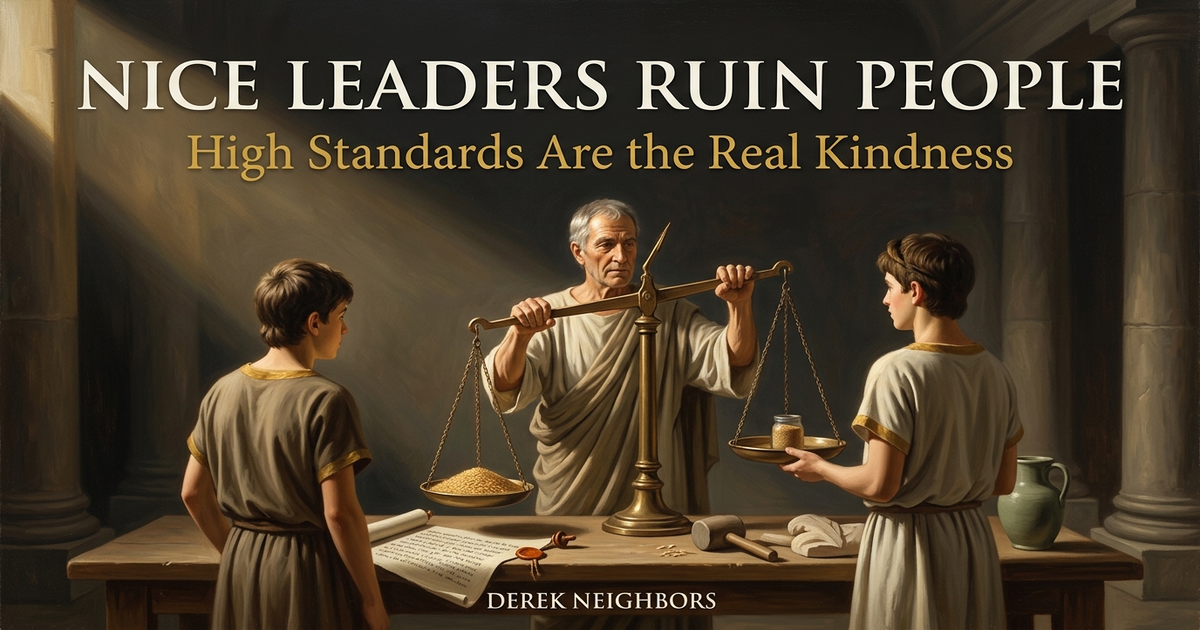
Nice Leaders Ruin People
By Derek Neighbors on July 2, 2026
The nicest manager I ever watched up close never raised his voice, never wrote a bad review, never made anyone leave a conference room with wet eyes. People transferred onto his team and stopped leaving. When he moved on, they threw the kind of goodbye party you plan a month out.
It took me years to see the wreckage.
His people plateaued and stayed plateaued. The ambitious ones quietly left after eighteen months, and nobody asked why. The ones who stayed collected a decade of glowing reviews, and when the reorganization finally came, the market evaluated them for the first time in their careers. It was not gentle. Several never recovered professionally. They had spent ten years being told they were excellent by a man who could not bear to tell them they were average.
He was not kind. He was nice. Those are different instruments, and one of them is a weapon pointed backward.
Niceness Is a Loan Your Team Repays
Watch what niceness actually optimizes for. Not the person’s growth. The leader’s comfort.
Define both terms, because everything else hangs on them. Niceness is the habit of avoiding whatever gives pain right now, and its true beneficiary is the one doing the avoiding. Kindness is willing another person’s good and spending your own comfort to serve it. One aims at the pleasant. The other aims at the good. They look identical right up until the moment they cost something, which is the only moment that counts.
Every inflated review skips one awkward hour. Every evenly split bonus dodges one envious glare. Every underperformer quietly carried avoids one brutal conversation. The leader banks the comfort immediately. The cost does not vanish. It compounds, off the books, in the one account the leader never has to look at: the other person’s future.
Kindness runs the opposite direction. It spends the leader’s comfort now, in that awkward hour, so the person gets the truth while the truth is still cheap to act on.
I have never met a leader who thought of themselves as a coward for being nice. The self-story is always compassion. But the pattern gives it away, because the pain being avoided is never theirs to avoid. It gets deferred, with interest, onto the person being protected.
One clarification before the patterns, because it sharpens everything that follows. Niceness does its damage through belief. A team that quietly discounts the boss’s praise loses little. A team that trusts it builds a self-image out of it, so the flattery lands with the full weight of the relationship behind it. The more your people trust you, the more your niceness costs them. Being adored is the delivery mechanism.
The Greeks watched this pattern closely enough to name its parts. Four of them show up in almost every nice leader I have known.
The Inflated Review
The behavior is familiar. Everyone on the team meets expectations. Most exceed them. The words “needs improvement” have not appeared in a review in four years, because the manager rounds every assessment up to whatever avoids a hard conversation.
Aristotle put a name on the person who praises everything and opposes nothing so as never to give pain: the kolax, the flatterer, whose vice he called kolakeia. He noticed something most modern managers miss about themselves: the flatterer is not generous. He flatters because he gets something from being liked. The pleasant reviews are not gifts to the employee. They are purchases the manager makes for his own reputation as a good guy.
Plato got there before his student did. In the Gorgias, he defines flattery as the counterfeit of a real art: cookery imitating medicine, serving what tastes good with no account of what heals. That is nice management, exactly. The kind leader practices medicine and sometimes prescribes something bitter. The nice leader runs a bakery and calls himself a doctor.
Here is what the flattered person actually loses, and it is not the job. It is a true relationship with reality. For a decade, every decision they make, what to practice, what to charge, what to attempt, gets made inside a fiction about who they are. The layoff, the new boss, the brutal interview loop only make the wound visible, all at once, delivered by a stranger with no coaching attached. The career damage is the shadow. The years of choosing from a false map were the loss.
Your inflated review did not spare them the truth. It scheduled the truth for later and removed you from the room when it lands.
One more thing, for anyone reading this as the flattered rather than the flatterer. An honest boss is a gift, not an entitlement. Your self-assessment was never a job you could hand to someone else. Epictetus kept an accurate account of himself in slavery, without a single performance review. The manager who flattered you is guilty. The years you spent never auditing yourself are still yours.
The Even Split
The nice leader distributes raises, credit, and opportunity evenly. Everyone gets 3 percent. Everyone gets thanked in the same sentence. The star and the passenger receive identical treatment, because differentiation would create tension, and tension is the thing niceness cannot metabolize.
Aristotle spent a chunk of the Nicomachean Ethics on exactly this move. Just distribution, he argued, must follow axia, worth. Equal shares for equal contributions, unequal shares for unequal ones. Handing equal rewards to unequal work defrauds the person who carried more and lies to the person who carried less. Aristotle filed that move under injustice, two victims at a time. It fails his definition of generosity too, which was never about giving evenly. Generosity gives rightly: to the right people, in the right amounts, for the right reasons. Even distribution to unequal work misses on all three.
Your best people run this math silently and fast. The moment they see excellence and adequacy earn the same outcome, they learn the actual price of their extra effort: zero. Some stop trying. The rest update their resume. Either way, the even split teaches the whole team a lesson you never meant to put on the syllabus: here, contribution is decorative.
The Quiet Carry
Every team above a certain size has one. The person who has not really performed in two years, whose work gets silently redistributed, whose name makes the strong people exchange a glance in meetings. The nice leader keeps them, because letting someone go feels like cruelty, and niceness measures cruelty by how the decision feels rather than what it does.
malakia is the old Greek word for softness, the inability to bear necessary pain. The softness at work here belongs to the leader, not to some surplus of mercy. Look at what the carry actually does to everyone involved. The strong pay a tax, in nights and weekends, for the crime of being reliable. The team learns the standard is negotiable. And the carried person, the supposed beneficiary, spends years in a role that fits them badly, protected from the signal that would have pushed them toward work they could actually be good at.
I have watched people land somewhere better within months of a role change everyone dreaded on their behalf. The carry did not protect them from failure. It held them inside it, at low volume, indefinitely.
The Shielded Struggle
The fourth pattern hides best, because it fires selectively. Someone stumbles on a stretch assignment, and the nice leader quietly stops offering stretch. Hard projects route around them. High-visibility rooms stop including them. The leader calls it setting them up for success.
The Greek word this violates is eunoia, goodwill, the genuine wish for another person’s good. Aristotle counted it as the seed of real friendship, and the test is simple: goodwill wants the person to grow, and growth requires load. That second clause is Aristotle’s entire account of how people develop: capacities become real only through exercise. Judgment comes from judging, courage from doing the frightening thing, strength from lifting what is heavy. A capacity never used stays potential until it quietly expires. Remove every heavy thing from someone’s path and you have not wished them well. You have decided their ceiling, privately, without appeal, and hidden the paperwork.
The shielded person usually senses it before they can prove it. The calendar gets lighter. The invitations thin out. Nobody says anything, because saying something would require the honest conversation the shield was built to avoid. This is the rescue reflex applied to someone’s whole trajectory.
What the Kind Ones Actually Do
The best thing a boss ever did for me was hand my work back and tell me it was not good enough, specifically, in private, early enough that I could fix it. It stung for a week. It paid for a decade. Nothing nice about the conversation, and more genuine care in it than in every rounded-up review I ever received.
Kind leaders I have watched share four moves.
They tell the truth while it is cheap. Feedback in the first month costs an awkward hour. The same feedback after three silent years costs a career.
They differentiate out loud. Rewards track contribution, and the criteria get said in public, so the team can predict outcomes instead of decoding politics.
They give the stretch with support instead of removing it. The assignment stays hard. The safety net is coaching and cover, not a lowered bar.
They make the hard call in one season, not three years. When a role is wrong, the kind version is a fast, honest, generous exit, named as what it is, while the person still has momentum to land well.
And they do all of it knowing the outcome was never theirs. The truth lands or it does not. The person grows from it or leaves angry. You owe the honest act either way, because a kindness that has to be received well, thanked, and vindicated by results was aimed at yourself the whole time.
None of this requires harshness. Fear makes people obey, never follow, and the leader who swings from nice to brutal has changed tactics, not character. Demand by itself proves nothing either: a standard pitched past someone’s real capacity, with no support underneath it, breaks people and calls the breaking excellence. The kind leader’s demand is calibrated, matched to what the person could genuinely do, and backed with the coaching to reach it. The target is neither warmth without truth nor truth without warmth. It is truth delivered by someone whose goodwill you cannot doubt.
The Questions You Owe Yourself
Whose review did you round up last cycle, and what will that fiction cost them in five years?
Who gets carried on your team right now, and who is silently paying for it?
What decision have you postponed because the conversation would be uncomfortable for you? Notice the pronoun.
Would your best performer, speaking freely, say that excellence is rewarded where you lead?
This week, have the one honest conversation you have been rounding up. In private. With specifics. With a path forward attached. That hour is the cheapest it will ever be.
Frequently Asked Questions
These short answers double as the article’s structured FAQ data; they exist in the page text so AI search engines and human skimmers can pull them directly.
Is being a nice boss bad for your team?
Niceness and kindness are different instruments. A nice boss avoids hard feedback, spreads rewards evenly, and shields people from consequences, which protects the boss from discomfort while the team absorbs the long-term cost: stalled growth, inflated self-assessments, and careers that collapse on first contact with an honest market. A kind boss tells the truth early, rewards contribution visibly, and gives people load they can grow under.
What is kolakeia in Greek philosophy?
kolakeia is the ancient Greek word for flattery. In the Nicomachean Ethics, Aristotle describes the kolax, the flatterer, as someone who praises everything and opposes nothing so as never to give pain, usually because he gains something from being liked. Aristotle treats this as a vice rather than a social grace, because the flattered person is left with a false picture of themselves and makes decisions from it.
Why are high standards a form of compassion?
High standards communicate a bet that the person can meet them. Lowered standards communicate a verdict that they cannot, delivered silently, without the dignity of a conversation. Demanding someone’s best, with support, gives them the information and the pressure they need to grow. Accepting their worst freezes them at their current ceiling and lets them discover it years later, from someone with no stake in their success.
What does axia mean in Aristotle’s ethics?
axia means worth or desert. In Book V of the Nicomachean Ethics, Aristotle argues that just distribution must be kat’ axian, according to worth: equal shares for equal contributions, unequal shares for unequal ones. In his framework, giving equal rewards to unequal contributions counts as a species of injustice rather than generosity, because it defrauds the person who contributed more and lies to the person who contributed less.
Final Thoughts
Demanding someone’s best is a bet placed on them, out loud, where they can see it. Accepting their worst is a verdict, delivered silently, that they were never going to be more than this.
The nice leader hands out comfort and calls it compassion, but the compassion never lands where the comfort does. The comfort lands on the leader. The cost lands on the team: years of real decisions made inside a false picture of themselves, until the truth arrives from someone who never cared about them at all.
Your people deserve to hear the truth from the person who wants them to win. That is the whole job.
Ready to lead with standards that say I believe you can meet them? MasteryLab.co is where leaders practice the uncomfortable conversations, honest accountability, and daily character work that niceness never survives.