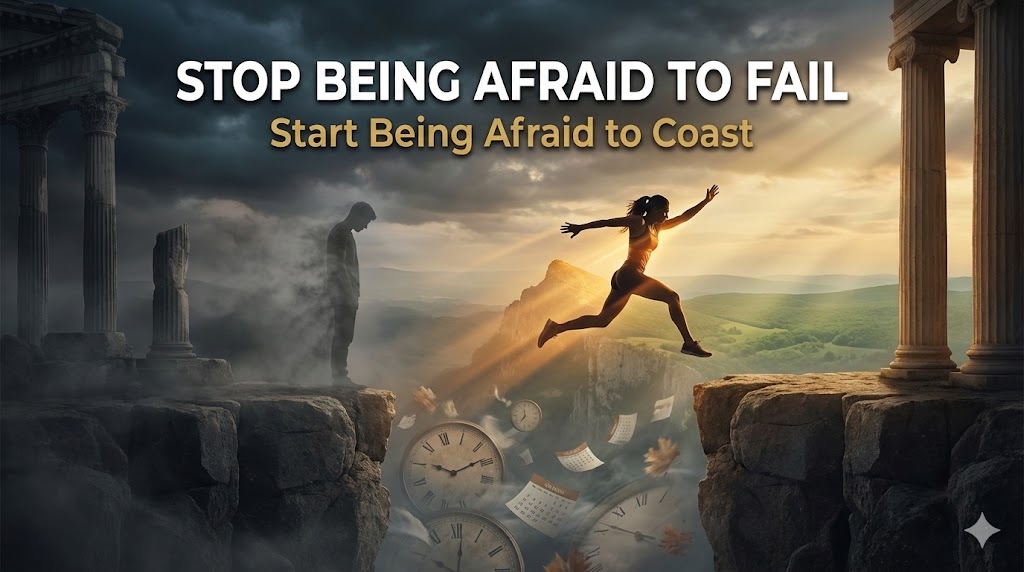
Stop Being Afraid to Fail. Start Being Afraid to Coast.
By Derek Neighbors on December 16, 2025
I sat with a spreadsheet open, three kids asleep down the hall. The numbers stared back at me. My business partner and I had been talking about starting a company for months. The idea was solid. The timing felt wrong.
The fear was loud. The reasonable voice in my head had a lot to say: You have too much to lose. Wait until the conditions are better. The timing will never be perfect, but it could be better than this.
That voice sounded responsible. It sounded wise.
It was lying.
The Comfortable Path
The job was fine. Stable. The kind of role where you know what next year looks like because it looks like this year.
I told myself stories. Once conditions change, I will have more flexibility. Once the risk is lower, I will feel ready.
Every “once” was a vote for “never.” I did not realize it at the time.
The comfortable path feels responsible. Staying put, minimizing risk. That is what reasonable people do to stay comfortable.
Except the comfortable path has its own costs. They just get paid differently.
The Accumulating Cost
I knew people who had taken shots and failed. They tested themselves and came up short.
Something strange about them: they seemed lighter. They had stories. Scars, sure, but scars they could explain. Lessons they could articulate. They knew something about themselves that only comes from testing.
I also knew people who never tested themselves. Optimized for security. Avoided anything with real downside risk.
Something heavier about them. A quiet wondering. What if I had tried? Who might I have become?
The people who tried and failed carried their losses like badges. The people who never tried carried their untaken shots like weights.
That is when I started to see it. The safe path was not actually safe. It just moved the risk somewhere else. Instead of risking failure, I would be risking something worse: never knowing.
Every year I waited made the move harder. The window does not stay open forever. Eventually the thing you were “getting ready” for becomes the thing you “used to want to do.”
The Turning Point
Aristotle wrote about andreia, the virtue we translate as courage. He understood something most people miss: courage is not the absence of fear. It is action despite fear. The courageous person feels the fear and moves anyway.
But Aristotle also understood something deeper. Courage exists between two failures. Recklessness on one side: the fool who feels no fear and charges blindly at anything. Cowardice on the other: the person who lets fear dictate inaction.
What separates courage from recklessness? The shot has to be worth taking. Something you genuinely care about. Something aligned with who you want to become. The reckless person bets randomly. The courageous person bets on themselves for reasons they can articulate.
The coward and the reckless person both fail to act virtuously. But only one has a chance to learn something.
Here is what crystallized for me: Failure from genuine testing teaches. It leaves marks that fade. You learn what works, what does not, what you are made of. Even spectacular failure gives you data about your capacity.
Playing it safe teaches nothing. It leaves questions that grow. You do not get fewer problems by avoiding them; you get worse ones. You never learn what works because you never test it. You never discover what you are made of because you never put it under pressure.
The wound from failure heals. The wound from wasted capacity does not. It just gets quieter while it spreads.
The Decision
I took the shot. Started the company with my partner.
The fear did not disappear. It got quieter once I was moving. There is something about action that changes the nature of fear. When you are sitting still, fear is a voice telling you what might go wrong. When you are moving, fear becomes information about what to watch for.
The path was not smooth. There were hard months. Close calls.
The alternative would have been worse. Not financially. The alternative would have been worse because I would have spent the rest of my life wondering.
That decision defined everything. My relationship with risk and agency changed. My understanding of what I was capable of changed. The outcome mattered less than the act of choosing. Whether the company succeeded or failed, the wondering would have been replaced with knowing.
I found out what I was made of. That knowledge exists independent of any external result.
The Principle
There are two kinds of fear when you face a big decision. One is loud: What if I fail? What if I lose? What if people see me fall?
The other is quiet: What if I never find out? What if I spend the rest of my life wondering? What if I become someone who had the shot and did not take it?
The loud fear gets all the attention. It is dramatic. It has specifics. The consequences feel vivid and immediate.
The quiet fear is abstract. It does not have a specific date when it arrives. It just accumulates. Each day you do not act, the question gets a little heavier. Each year you wait, the person you might have become gets a little further away.
Most people protect themselves from the loud fear and expose themselves to the quiet one. They play it safe to avoid failure, and in doing so, guarantee they will never know what they were capable of.
The real risk was never falling short. It was never finding out.
The Shot You Are Not Taking
You know what it is. The thing you have been “getting ready” for. The decision you have been researching. The leap you have been preparing to make.
The shot is not always entrepreneurial. It might be a hard conversation. A creative project. A relationship. A career change. A commitment to becoming someone different. Courage shows up in any domain where fear tells you to stay still.
You have good reasons to wait. The timing is not right. The conditions are not perfect. You need more information, more certainty.
Those reasons sound responsible. They might be lying to you.
Ask yourself: What would the version of you who took the shot and fell short say to the version of you who never tried? Which one carries the heavier weight?
Failure from genuine testing heals. The wound of never knowing does not.
The shot you take this week, hit or miss, teaches you something about your capacity. The shot you keep planning to take eventually teaches you nothing. Eventually is where capacity goes to die.
Final Thoughts
The fear of failure is loud. The fear of wasted capacity is quiet. Quiet fears are the dangerous ones because they accumulate without announcing themselves.
I sat with that spreadsheet years ago. The responsible voice said wait. The quiet voice asked: What if you never find out?
I took the shot. The other path had its own cost, and that cost never stopped compounding.
What shot are you not taking? What would change if you stopped being afraid to fail and started being afraid to coast?
Ready to stop coasting and take the shot? MasteryLab provides the framework and community for people who are done waiting and ready to find out what they are capable of.