Your Feeling Was Natural. That Doesn't Make It Right.
By Derek Neighbors on July 29, 2026
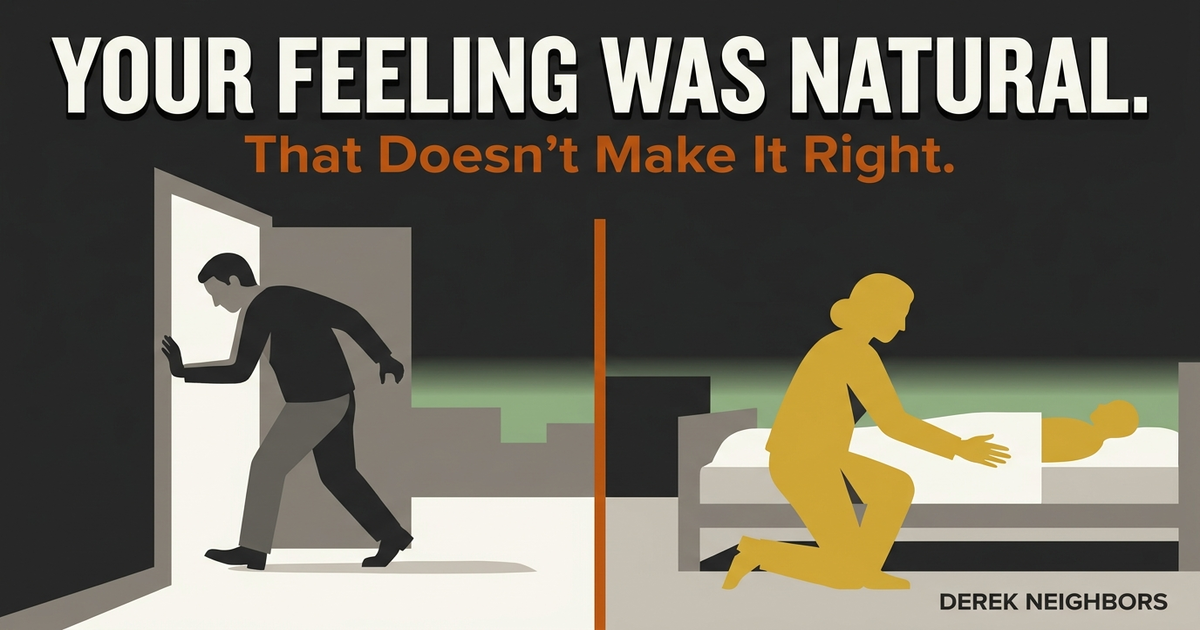
A father leaves his sick daughter’s bedside because watching her suffer is unbearable.
He does not call himself a coward. He calls the departure natural. The myth speaks through him: anyone would feel this, anyone would need air, anyone would have to go.
Epictetus hears the story in Discourses 1.11 and grants the first half. The impulse can be natural. Then he denies the conclusion people smuggle in after the word natural. Natural occurrence is not a moral certificate. Tumors grow naturally too. They are still not good.
That is the myth I want to break: if a feeling is authentic, acting on it must be right.
The Myth
Modern life gave the myth nicer names. We call it honesty. We call it knowing our limits. We call it “honoring what came up.”
The sentence underneath almost never changes: I had to.
I had to leave the room. I had to end the conversation. I had to hand the hard minute to someone else. I had to protect my peace. The feeling arrives with such force that it starts to sound like evidence. Intensity gets mistaken for instruction. If the urge is strong and unfakeable, it must be telling the truth about what virtue requires.
I have used that story. More times than I like admitting. The body spikes. The room gets ugly. A child melts down, a teammate falls apart, a firing conversation turns real, and something in me starts scanning for the door. The scan feels like wisdom while it is happening. Later it often looks like deilia, the Greek name for cowardice, spoken in the vocabulary of self-awareness.
The myth survives because it flatters. It lets you keep a clean identity while you exit. In the story you tell yourself, the exit proves authenticity rather than weakness, and listening to yourself replaces abandoning a role. Here authenticity means telling the truth about what you feel. The counterfeit version means obeying every feeling as if the feeling were already right.
The Reality Check
Epictetus is not arguing that parents should enjoy watching a child suffer. He is arguing that the job does not dissolve when your nervous system wants out.
The man in the discourse still has a daughter in the bed. The feeling that drove him through the door did not cancel the role. It only rearranged his priorities around his own relief. That is the pattern I keep seeing in ordinary rooms that never make philosophy books.
A manager starts a performance conversation, hits the first flash of tears or anger, and cuts the meeting short “to give everyone space.” Space arrives, and the truth stays unfinished. A partner hears something hard, stands up mid-sentence, and later explains the exit as emotional honesty. The honesty is real. So is the unfinished care. A caregiver stays for the photogenic hours and disappears for the ugly ones, then narrates the disappearing as self-preservation. Self-preservation can be wise when a real constraint forces a handoff, a return time, or a safety move that still serves the person in the room. Genuine emergency exits are not the target here. The target is relief renamed as integrity: leaving with a story and no logistics for the person who still needs care.
What actually happens in these moments is simpler than the branding. The dependent person still needs you. Your system wanted relief. You renamed relief as integrity.
physis matters here, and it is easy to misuse. The word names nature, the intrinsic character of a thing. People hear “nature” and think “whatever I feel strongly must be my true self speaking.” The Stoics meant something sterner when they said live kata phusin, according to nature. They meant according to rational human nature and the duties of the roles that nature assigns: parent, citizen, friend, leader. Feeling is part of the animal equipment. Choice is part of the human equipment. Confusing the two is how “natural” becomes a hall pass.
I watched myself do the cheap version years ago in a family crisis that was not mine to aestheticize. Someone needed a steady adult in the room. I needed the hallway. I took the hallway and told myself I was being honest about capacity. Capacity was not the issue. The choice under load was. Willingness is not a trait some people have and others lack. It is the decision still available after the spike. The honesty I advertised was a press release for an exit.
The Hidden Cost
The first cost lands on the people who depend on you. They learn, quietly, that your comfort outranks their need once the feeling spikes. Children learn it. Teams learn it. Patients and partners learn it. They may even protect your story for you, because confronting the exit costs them a second abandonment.
The second cost lands on your character. Every time you baptize flight as authenticity, you train the opposite of andreia. Courage, in the Greek sense that matters here, is not the absence of fear or disgust. It is remaining oriented to the noble aim while those feelings are present. Leave often enough when the aim is hard, and the faculty that could have stayed gets weaker. prohairesis, the moral choice still available after the impulse arrives, atrophies from disuse. You still have the theoretical ability to stay. Your practiced move is the door.
The third cost is cultural. Authenticity stops meaning truth-telling about feeling and starts meaning obedience to feeling. That swap is how whole companies and families end up governed by whoever has the loudest nervous system in the room. Intensity becomes authority. Duty becomes optional whenever duty hurts.
The obligation does not wait for a dependent in the chair. Refusing feeling-as-legislation applies when the only person you would abandon is the one you promised to be: the hard minute you already owed yourself, the practice you said you would finish, the promise with no audience. Virtue does not require a job description.
Your anger can pull the same trick. So can grief, if you confuse feeling it with performing an exit. Stoicism does not ask you to stop grieving. It asks you to stop using the feeling as cover for abandoning the living.
The Truth
Natural feeling is information. It is not legislation.
You do not control whether the spike arrives. You control whether the spike gets to legislate. The body spike is appearance, an impression with force. The measure is whether your choice accords with rational role-function after that impression hits.
You can feel the full urge to leave and still ask a better question: what does the person in front of me need in the next ten minutes, and what does my role require before I get to my relief? That question does not erase the feeling. It puts the feeling in the passenger seat. Leaving can be right when it serves the dependent’s need or safety with a handoff, not when it only purchases your relief.
Living kata phusin is not “do what comes naturally in the moment.” It is “act in accord with the kind of being that can reason about roles.” A parent who stays through the ugly hour is not faking authenticity. They are practicing the real kind: fidelity to the role when the impulse wants a smaller story. A leader who finishes the hard conversation is not being cruel for sport. They are refusing to outsource the cost of clarity to the person who can least afford the fog.
arete shows up here as excellence of function. Role fidelity under a spike is obligatory because humans actualize rational capacity by choosing under load. Making impulse sovereign leaves that capacity unactualized while you perform honesty. The function of a parent in a crisis hour is presence and care, not purity of internal comfort. The function of a manager in a truth hour is clean speech and steady attention, not a premature adjournment that protects everyone from reality. Feeling the desire to flee can still be human. Making the desire sovereign is how excellence dies in ordinary rooms.
This is also why raising the stakes clarifies a life. Responsibility does not invent duty. It reveals which feelings you have been treating as veto power.
The Shift
-
Name the impulse without baptizing it. Say, at least to yourself, “I want to leave.” Stop there before you add “so leaving is right.” The first sentence can be true while the second is false.
-
Ask the role-first question. Before any exit in a duty moment: what does this role require in the next ten minutes? If you cannot answer, you are not ready to leave. You are ready to negotiate with your discomfort.
-
Practice stay-five. When the spike hits, stay five more minutes and do one concrete care act: water, a clear sentence, a hand on a shoulder, a decision owned out loud. Then reassess. Most “I had to” exits fail this test because they never attempted the five minutes.
-
Run an “I had to” audit for a week. Every time the phrase appears in your mouth or head, rewrite it as “I chose relief over ___.” If the blank is embarrassing, good. Embarrassment is often the first honest label.
-
Use the witness test. Would you accept this exit story from someone you depend on? If their “I had to” would feel like abandonment to you, stop selling yourself the same line.
None of this requires theatrical toughness. It requires refusing the cheapest story available when the room gets hard. Small yeses become character. So do small exits.
Final Thoughts
Your feeling can be natural and still point you toward the wrong act.
Epictetus was not shaming the man for being overwhelmed. He was refusing to let overwhelm rewrite the moral math. The child remains. The role remains. The choice remains after the feeling arrives. Stay because assent after the impression is yours to give or withhold, not because the dependent will thank you or the room will look photogenic. Natural impulse is common. Right action under load is rarer, and it is the part arete actually cares about.
Stop treating authenticity as a permission slip for the door. Stay long enough to do the duty the feeling tried to veto.
Frequently Asked Questions
Did Epictetus say leaving a sick child can be natural and still wrong?
Yes. In Discourses 1.11, On Family Affection, Epictetus discusses a man who could not bear to watch his sick daughter and left. He grants that the impulse can be natural and still denies that the departure is good. Some natural growths are tumors. Natural occurrence does not certify moral rightness. The point is not to shame grief. It is to refuse the move that turns a feeling into a permission slip for abandoning a role.
What does kata phusin mean if not follow your feelings?
Kata phusin means living in accord with nature in the Stoic sense: reason and the duties of your roles, not the loudest impulse of the hour. Feeling belongs to human nature. So does the capacity to choose what the role requires after the feeling arrives. Following every natural urge is not Stoic nature. Aligning choice with rational human function is.
Is this arguing that I should suppress my emotions?
No. Naming the impulse is honest. Obeying every impulse as if it were legislation is not. You can feel the urge to leave a hard room, say the urge out loud to yourself, and still stay for the next ten minutes of care. Suppression pretends the feeling is not there. Character work lets the feeling be present without handing it the steering wheel.
How do I tell a real boundary from a cowardice exit?
Ask what the person who depends on you still needs in the next ten minutes, and whether your exit serves that need or only your relief. A real boundary often includes a handoff, a return time, or a concrete care act before you step out. A cowardice exit mostly produces a story that protects your comfort. The witness test helps: would you accept the same exit story from someone you depend on?
If you want a community that treats role fidelity under pressure as trainable rather than optional, MasteryLab.co is where that work gets practiced in public.


