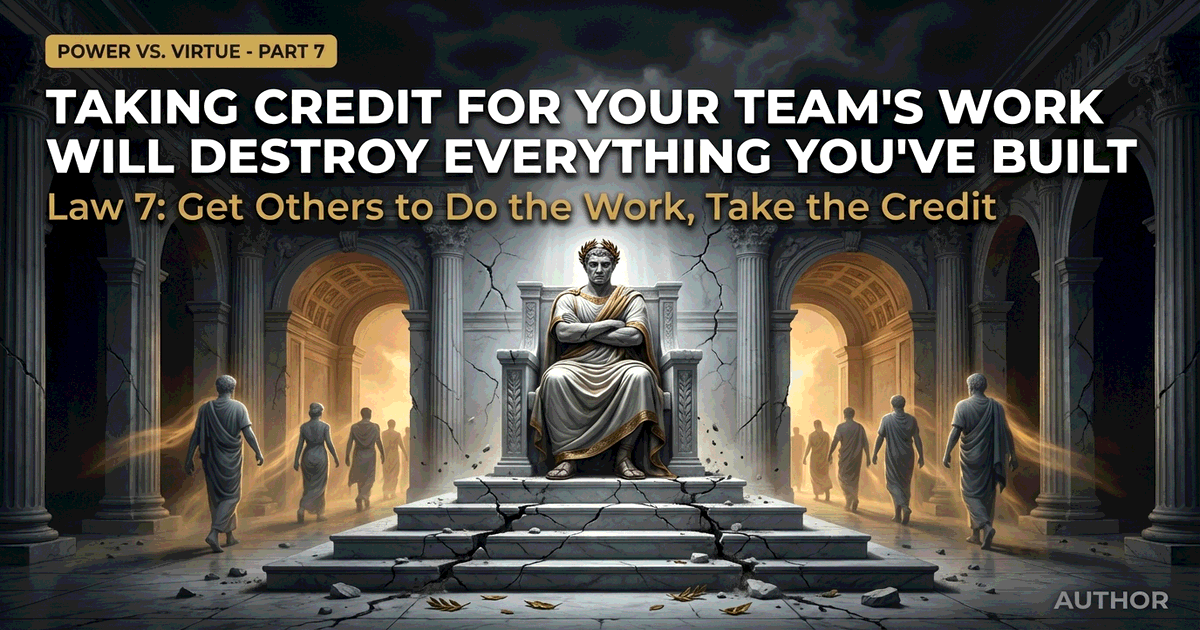
Taking Credit for Your Team's Work Will Destroy Everything You've Built
By Derek Neighbors on March 5, 2026
Power vs. Virtue: The 48 Laws Examined
A year-long examination of Robert Greene's 48 Laws of Power through the lens of ancient virtue ethics. Some laws we affirm, some we reframe, some we reject entirely.
Law 7 of Robert Greene’s The 48 Laws of Power:
Get others to do the work for you, but always take the credit. Use the wisdom, the knowledge, and the legwork of other people to further your own cause. Not only will such assistance save you valuable time and energy, it will give you a godlike aura of efficiency and speed. In the end, your helpers will be forgotten and you will be remembered. Never do yourself what others can do for you.
Greene wants you to be a parasite with good branding. The logic is seductive: position yourself as the visible source of outcomes you didn’t produce, and the reputation compounds faster than anyone can audit it. This is the law where Greene stops describing power dynamics and starts prescribing character destruction.
The Tactical Truth
Greene identifies something real about leverage. Leaders who try to do everything themselves become bottlenecks. No significant achievement in business was solo work. Every “genius” stood on a team’s collective capability. Recognizing that your role is to orchestrate outcomes, not execute every task, is a sign of maturity.
This part of the law is fine. Good, even. The problem is that Greene collapses two entirely different things into one instruction. Delegation is leadership. Claiming individual contributions as your own is theft. One builds organizations. The other hollows them out from the inside.
Watch the difference in practice. A VP who empowers her team to build a strategy, then presents it as “our team’s approach” with specific names attached, is practicing effective leadership. That same VP carrying the same strategy into the boardroom as “my analysis” has crossed a line that no amount of tactical justification repairs.
The first VP builds loyalty. Her team produces better work next quarter because they know their contributions will be seen. The second VP might get a short-term reputation boost, but she’s training her team to withhold their best thinking. Why would anyone pour their full capability into work that will carry someone else’s name?
The dividing line is attribution. Delegation says “my team built this.” Credit theft says “I built this.” Same outcome, different character.
Greene frames this as sophistication. As power literacy. It’s actually the most shortsighted play in the leadership playbook. It persists because the rewards are immediate and visible while the costs are delayed and distributed across people who leave quietly.
The Character Cost
When you take credit for work you didn’t do, the first thing that breaks is your own judgment. You start believing your own narrative. You lose track of what you actually contributed versus what you appropriated. You’ve chosen appearance over reality so many times that the line blurs. Your self-assessment goes unreliable, and every subsequent decision is built on fiction. This is the real character cost. Everything that follows is downstream.
Trust dissolves in calculations, not confrontations. People figure it out. Not in dramatic blowups. In small, private reckonings. The engineer who watched her architecture presented without attribution doesn’t storm into your office. She takes a recruiter’s call. The analyst who saw his market research appear in your quarterly review under your name doesn’t file a complaint. He stops sharing his best thinking. These aren’t emotional reactions. They’re rational decisions made by people who did the math on whether their effort is worth it.
Your strongest contributors leave first because they have the most options. They’ll find leaders who acknowledge what they bring. If money is the only reason people stay, money is why they’ll leave. What stays behind is a team of people who either can’t leave or have stopped investing enough to care. And once people learn their ideas will be absorbed, they bring fewer ideas. Meetings get quieter. The bold proposals that actually move organizations forward stop appearing. You get adequate work instead of exceptional work, and you never notice the gap because you never understood what produced the quality in the first place.
Meanwhile, everything you’ve “built” depends on people who resent the arrangement. Your operation is one honest conversation at a dinner party away from exposure. One departing employee who tells the full story.
The ARETE Alternative
The Greeks had a concept for the right relationship with honor: philotimia, the love of honor earned through genuine contribution. The drive to do work worth honoring, and to let the work speak.
Greene positions you as the source of outcomes you didn’t produce. philotimia asks what you actually contributed and honors that, specifically. These aren’t two versions of the same strategy. They produce completely different organizations.
Accurate attribution isn’t a leadership technique. It’s what honesty looks like when you’re the one with the power to distort it.
The leader who shares credit builds a team that generates more credit to share. People who feel recognized produce better work. They take bigger risks, stay longer, invest discretionary effort that no compensation package can purchase. Over any meaningful timeline, a team where credit flows accurately will outperform one where credit gets siphoned to the top.
The leader who steals credit creates the opposite cycle, and it accelerates. Each theft reduces the next contribution. The pool shrinks. Eventually there’s nothing left to steal, and the leader is left wondering why “the talent market is so thin” when the real answer is that talented people stopped volunteering for exploitation.
I’ve watched this play out in organizations more times than I can count. The leader with the best personal brand and the worst retention numbers. The executive who presents beautifully and whose team quietly transfers to other departments. The founder who tells great origin stories that the original team doesn’t recognize. The pattern is always the same. The credit flows up. The talent flows out.
Aristotle connected this to ergon, proper function. The leader’s ergon isn’t accumulating credit. It’s creating the conditions where excellent work happens. When you fulfill that function well, the results point back to you naturally. You don’t need to claim anything because the pattern is obvious to anyone paying attention.
Ancient Wisdom Connection
philotimia in the Greek world was the drive to earn honor through contribution to the community. Not vanity. The understanding that your standing should reflect your actual impact. Honor was something the community granted based on what they observed, not something you could seize for yourself.
The opposite is pleonexia: the insatiable desire to have more than your share. Aristotle considered it among the most destructive character flaws, and he saw it everywhere in Athenian politics. The leader who grabbed credit for military victories they didn’t fight. The politician who took praise for policies they didn’t draft. The Greeks had centuries of data on what pleonexia does to institutions, and the conclusion was consistent: it rots them from the center.
Credit theft is pleonexia applied to recognition. You’re taking more than your portion of something that belongs to the group. And like all forms of pleonexia, it’s never satisfied. One stolen success doesn’t quench the thirst. It intensifies it.
Marcus Aurelius demonstrated the alternative. The most powerful man in the ancient world opened his private journal, the Meditations, by spending the entire first book acknowledging what he learned from others. His father. His teachers. His advisors. He named them individually, described what each one gave him, and never once presented their wisdom as his own discovery. Nobody would have questioned the Emperor’s originality. He did it because accurate attribution was a matter of character.
What you claim when no one would challenge you reveals who you actually are. Marcus could have written the Meditations as pure personal insight. Instead, he opened with debts. That choice tells you more about his character than any military victory.
The Test
Ask yourself four questions:
- When your team delivers something exceptional, whose name comes out of your mouth first?
- Would the people who work for you say you fight harder for their recognition than your own?
- If someone recorded your meetings for a week, would the record show you amplifying others or absorbing their contributions?
- When was the last time you publicly credited someone for an idea you could have easily claimed?
If the honest answers make you uncomfortable, good. That discomfort is information. Sit with it. Pay attention to what it’s telling you.
Final Thoughts
Greene says get others to do the work and take the credit. He frames this as a law of power. The ancient Greeks would have called it a law of decline. Your wins aren’t about you. Earn your honor through what you actually contribute.
The need for credit is the clearest signal that you haven’t built anything worth crediting on its own. Leaders who generate real results don’t worry about attribution because results that matter point back to their source. The leader who creates conditions for extraordinary work gets recognized for that. You don’t have to claim it. The pattern is visible to anyone watching.
Your team knows who did the work. Your peers know. The only person confused about the credit is the one trying to redirect it.
philotimia isn’t about being selfless. It’s about being accurate. And accuracy, over time, builds a reputation that no amount of credit theft can match.
Ready to build the kind of leadership that earns its honor instead of stealing it? MasteryLab provides frameworks and community for leaders who know that the strongest teams are built by people who give credit, not take it.