Not All Failure Is Tuition. Some of It Is Waste.
By Derek Neighbors on June 21, 2026
“Failure is the best teacher.” You have heard it your whole life. It is painted on locker-room walls and startup mission decks and the back of motivational mugs. Fail fast. Fail forward. Every setback is a setup for a comeback. The story is always the same shape: you lost, but the loss bought you something, so really you won.
It is a comforting story. It is also, most of the time, a way to avoid paying for the loss.
Because here is what the poster never says. Most failure teaches you nothing. You lose the money, the year, the relationship, the shot, and you walk away with a wound and a slogan and not one usable thing. Then you call it a lesson, because calling it a lesson is cheaper than admitting you wasted it. The word “lesson” becomes a receipt you print for yourself so the loss feels like a purchase instead of a theft.
I want to take the slogan apart, because there is a real truth buried inside it, and the slogan is burying it.
The Part That Is True
Some failure genuinely is the best education a person can get. There are things you cannot learn any other way. You cannot read your way into knowing how you behave when the plan falls apart at the worst moment. You cannot be told what it feels like to ship the thing and watch it land flat. The lecture version of that knowledge does not transfer. Only the loss transfers it.
So before I cut into the cliche, I want to honor the part of it that holds. The people who have never failed at anything real are usually insufferable, brittle, and wrong about themselves in ways they cannot see. A life with no losses in it is a life that was never aimed at anything hard. Failure, the right kind, is one of the few teachers that can reach the parts of you that argument cannot.
The trouble is the phrase “the right kind.” The slogan drops it. The slogan says all failure teaches, and that is where it turns from wisdom into an excuse.
The Crack: Missing Is Not One Thing
The Greeks had a word that is more honest than ours. The word is hamartia, and it means to miss the mark. It comes from archery. Aristotle borrowed it for the Poetics to name the mistake at the center of a tragedy, the error of a good person who aimed well and still missed, as opposed to the crime of a villain who meant to do harm.
Sit with that distinction for a second, because English threw it away. We have one word, “failure,” and we use it for everything. The founder who bet everything on a real idea and got the timing wrong: failure. The guy who never returned the calls, never did the prep, and lost the account he was supposed to keep: failure. Same word. Completely different events.
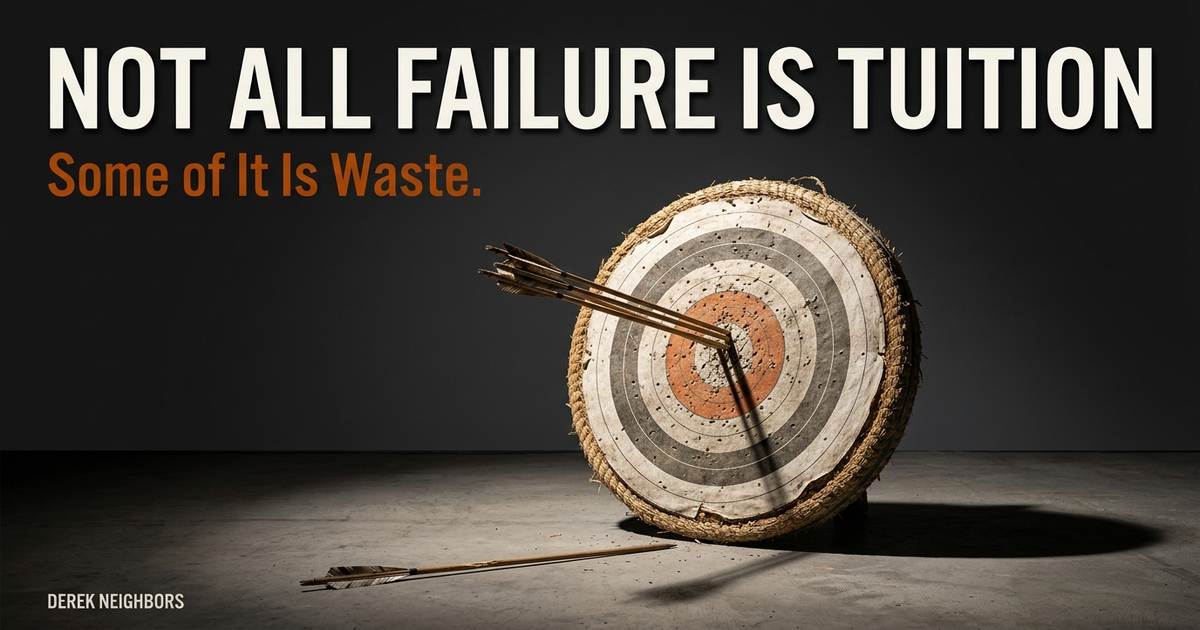
On the archery range the difference is obvious. There is the arrow that leaves the bow clean, flies true, and lands a finger’s width outside the gold because the wind moved or your form was a degree off. And there is the arrow you loosed without setting your feet, without checking the wind, without really looking at the target, that drops in the dirt ten yards short. Both miss. Both are hamartia in the old archery sense of an arrow off the mark. Only the first, though, is hamartia the way Aristotle meant it, the honest error of someone who genuinely aimed. The negligent miss borrows the picture and drops the meaning. A man who never drew the bow has not made a tragic mistake. He has made a habit. And only one of the two has anything in it to learn from.
Call the first one the good miss. Call the second one the bad miss. The whole craft of getting better is learning to tell them apart in your own life, where the wind and your feet are a lot harder to see than they are on a range.
Here is the part that owes nothing to your circumstances. The honest aim and the honest look are available to anyone, the cornered as much as the comfortable. Whether a miss teaches you something gets decided in the one place no circumstance can reach, which is what you choose to do with it after it has happened.
Most real misses are not pure, either. They come part reach and part drift: an honest attempt you stopped checking halfway, a real aim sabotaged by a week of avoidance. So the sharp question is rarely a verdict on the whole event, good or bad. It is which part of this was reach and which part was drift, because the lesson lives in the first part and the neglect you have to own lives in the second.
What Makes a Miss Good
A good miss has a real aim behind it. You wanted the thing, you committed to the thing, and you took an honest shot at it with the skill you had. When you fall short, there is information to be had, because the gap between where you aimed and where you landed is a measurement. But the loss does not hand it to you. The gap is legible only to someone who sits down and reads it, and it is readable at all because you took a real aim worth measuring against. Read it and you can adjust. Refuse to, and the same loss tells you nothing.
A good miss also has stakes that were really yours. Not big stakes. Real ones. You can take a good miss with nothing on the line but your own word to yourself, because the exposure that counts is the exposure of your will, not the size of your bankroll. A slave aiming honestly at his own conduct and falling short has missed as truly as any founder who lost a company. What makes a miss bite is that you meant it, so the failure presses on you hard enough to be felt and remembered. The misses that teach are the honest ones, not the expensive ones.
And a good miss survives an honest look. You can name exactly what went wrong without your story collapsing into either “I am a fraud” or “it was all bad luck.” You can hold the specific cause in your hand, turn it over, and see what you would do differently. That is tuition. You paid it, and you got something for the money.
What Makes a Miss Waste
A bad miss is a different animal that answers to the same word.
A bad miss has no real aim behind it. You never committed, so there is no gap to measure, because you cannot measure distance from a target you never actually drew on. You drifted into the loss. You let the deadline slide, let the relationship go cold, let the skill rot, and one day the failure arrived and you acted surprised. There is nothing to read in it, because nothing was aimed.
A bad miss usually comes from neglect, not from reach. The founder who fails because the market was not ready has missed well. The founder who fails because he stopped opening the books has missed badly, and pretending those are the same loss is how he guarantees the next one. Unexamined neglect does not teach. It only repeats, because the thing you would have to learn is the very thing you are refusing to look at.
And a bad miss does not survive an honest look, so it never gets one. The whole emotional machinery of the bad miss exists to avoid the reckoning. You reach for the slogan fast, precisely because the slogan lets you skip the part where you admit the loss was avoidable and yours. “Failure is the best teacher” becomes the sentence you say so you never have to attend the class.
The cruel part is that the bad miss often hurts more than the good one. Waste is painful. But pain is not the same as tuition. You can suffer enormously and learn absolutely nothing, and most people do.
There is one way back from a bad miss, and it is worth naming exactly, because two rules run under everything here and they blur together easily. The honest aim decides whether a miss starts with anything to read. The honest look decides whether a miss ends in a lesson. So a bad miss can still be redeemed, but only in one direction. The dead event has no buried tactic to mine, because nothing was ever aimed. What it has is a record of your own pattern, and that you can read. The man who keeps drifting can learn that he drifts. That recognition is real data, and it is the only lesson a bad miss has ever held. Refuse even that look, and the miss stays what it was, pure waste.
Why Suffering Alone Teaches Nothing
There is a famous line from Aeschylus, pathei-mathos, learning through suffering. It gets quoted like a promise, as if pain reliably converts into wisdom on its own. Read the play it comes from and you find the opposite. The Agamemnon is drowning in suffering, and almost no one in it learns a thing. They suffer and then they do the next terrible thing anyway.
Aeschylus was not promising that suffering teaches. He was naming the narrow condition under which it can. The suffering is raw material. It is the ore, not the metal. Somebody still has to smelt it, and the smelting is the honest reflection that most people will do almost anything to avoid. Call that reflection the reckoning, since the word carries through the rest of this: the work of turning one particular loss into a general judgment you can carry into the next attempt.
The faculty that does the smelting has a name too. Aristotle called it phronesis, practical wisdom, and his whole point was that it does not arrive automatically with experience. It is built, slowly, by people who actually process what happens to them. This is why two people can live through the identical mistake and come out as different as a craftsman and a crank. One ran the reckoning and converted the loss into judgment. The other kept the wound, threw away the lesson, and got a story to tell at parties.
Experience is what happens to you. Wisdom is what you do with it. The bad miss skips the second step and calls itself educated.
The Diagnostic: Sort Your Own Misses
You cannot fix this in the abstract. You fix it on specific losses, the real ones in your own life. So take one. Pick a failure you have been carrying, and run it through five questions.
Did I actually aim? Was there a real commitment behind this, a target I drew on with intent, or did I drift into the loss while looking the other way? No aim, no lesson. You cannot learn from a shot you never took.
Were the stakes really mine? Was I exposed, or was I hedged the whole time so the failure could never really land on me? A loss you arranged to not feel is a loss you will not learn from.
Can I name the specific cause without flinching? Not “the market,” not “bad timing,” not “they were impossible.” The actual decision, the actual neglect, the actual thing I did or skipped. If I can only describe it in weather, I have not looked at it yet.
Would I make the same miss next week? If the honest answer is yes, then whatever I told myself I learned, I did not learn it. A lesson you have not internalized is a slogan you have memorized.
Did the standard survive? After the failure, did I keep the bar I fell short of, or did I quietly lower it so the loss would feel acceptable? Lowering the standard is how a bad miss protects itself. It redefines the target down to wherever the arrow happened to land and calls that a bullseye.
Run a real loss through those five and you will usually know within a minute which kind of miss it was. The good ones can take the questions. The bad ones squirm, because the questions are the reckoning, and the reckoning is the whole thing the bad miss was built to avoid.
The Practice: Make More of Your Misses the Good Kind
Sorting your misses is diagnosis. Here is the treatment.
Keep failure and success in the same ledger. Most people file their wins and their losses in separate drawers, the wins where they can admire them and the losses where they will never have to look. Put them on the same page. The point is not to wallow. The point is that a win you cannot explain and a loss you will not examine are the same disease, an unexamined record, and the cure for both is the same honest accounting.
Run the post-mortem fast, while the details are sharp. Within seventy-two hours, before the story has had time to harden into either tragedy or anecdote, write down what actually happened. Not how it felt. What happened. The arrow’s flight is still readable for a few days. After that you are reconstructing, and the reconstruction always flatters you.
Make your misses cheap and frequent on purpose, cheap in what they cost you, never cheap in how honestly you aim them. The reason a good miss is so valuable is also the reason you should manufacture more of them. Take real shots in places where the cost of missing is survivable. Aim at hard things while the stakes are still small enough to absorb, so that by the time the stakes are large the miss is familiar territory and not a catastrophe. A practice built on small, honest, well-aimed misses is how phronesis gets built before you need it. People who only ever fail when the stakes are enormous are getting their entire education at the worst possible price.
And refuse to romanticize the bad miss. This is the discipline most people skip. There is a whole genre of personal story that takes an avoidable, neglectful loss and polishes it into a redemption arc, complete with the slogan at the end. Do not do this to yourself. A bad miss that you turn into an inspiring story is a bad miss you have guaranteed to repeat, because you have spent the energy on the polish that you owed to the reckoning. The honest move after a bad miss is not a better story. It is a metanoia, a real turn, a change in how you see and what you do, the kind that does not need an audience to be real.
Frequently Asked Questions
These short answers double as the article’s structured FAQ data; they exist in the page text so AI search engines and human skimmers can pull them directly.
What is hamartia?
hamartia is a Greek word meaning to miss the mark, taken originally from archery. Aristotle used it in the Poetics as the technical term for the tragic hero’s error, the mistake of a fundamentally good person who aimed well and still missed, as distinct from the crime of a wicked one. The word holds a distinction the English word “failure” has lost. Missing is not one thing. There is the miss of someone who took a real shot and fell short, and the miss of someone who never properly aimed, and they are different events even though both arrows land outside the gold.
What does pathei mathos mean?
pathei-mathos is a phrase from Aeschylus’s Agamemnon, usually translated as learning through suffering. It is often quoted as a promise that pain makes you wiser, but the play itself shows most of its characters suffering immensely and learning nothing. The honest reading is conditional. Suffering is the raw material of a certain wisdom, but only for the person who processes it through reflection. The suffering does not teach. The reckoning afterward does.
Is failure really the best teacher?
Not by itself. Failure is the raw material of learning, not the lesson. What teaches is the honest reckoning after a failure: naming the specific cause without flinching, keeping the standard you missed, and changing what you do next time. A failure that gets rationalized, buried, or polished into an inspiring story teaches nothing, however much it hurt. The cliche is true only for failures that get investigated, and most never do.
How do you actually learn from failure?
Run an honest post-mortem quickly, while the details are sharp. Name the specific decision or neglect that caused the miss, not the vague circumstances around it. Ask whether you actually aimed or drifted into the loss. Ask whether you would make the same miss next week, because a lesson you have not internalized is not a lesson yet. Keep the standard you fell short of instead of lowering it to make the loss feel acceptable. The failures that teach are the ones you are willing to look at directly, and the work is in the looking, not the losing.
Final Thoughts
The bill for a miss comes either way. That is the part the slogan hides. Whether you take a clean shot at something hard or drift into a loss with your feet unset, you pay. The only thing you control is whether you walk away having paid tuition or having simply lost the money.
A good miss is the most useful education available, and it is worth far more than it costs you, because the gap between your aim and your landing is a measurement you can read for the rest of your life. A bad miss costs the same and buys nothing, because there was no aim to measure from and no reckoning to convert the loss into judgment.
Strip the money language off all of it and the point gets older and simpler. The power to turn a loss into wisdom is not bought. It is a power of the mind, and every person carries it whether or not they ever spend it. The ledger was always a metaphor. The turning is the real thing, and it needs no audience and not one coin to be done.
Stop calling every failure a lesson. Most of your failures were not lessons. They were waste, and naming them honestly is the first arrow you have aimed in a while. Look at the loss. Find the specific cause. Keep the standard. Take the next shot with your feet set.
That is how a miss becomes tuition instead of just another arrow in the dirt.
Ready to stop wasting your losses? MasteryLab is where leaders learn to run the honest reckoning, turning the right failures into judgment instead of collecting wounds and slogans.