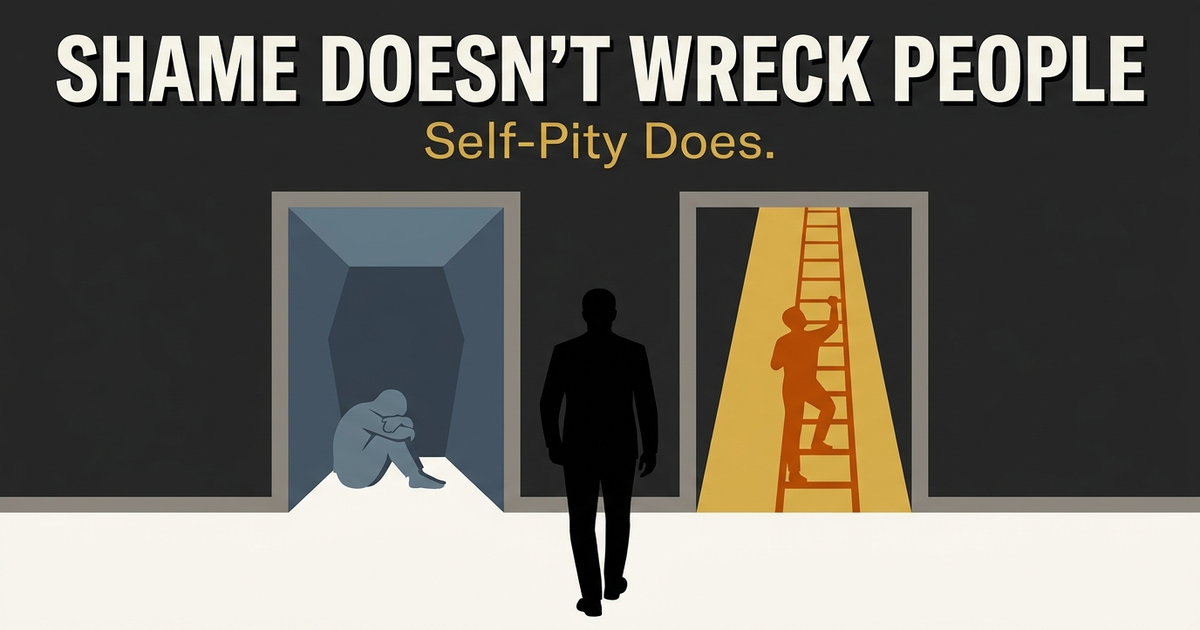
Shame Doesn't Wreck People. Self-Pity Does.
By Derek Neighbors on June 4, 2026
There is a moment after every visible failure that almost nobody talks about.
The conference room exit. The text you sent and immediately regretted. The decision your team is now living with. The number on the scale you have not stepped on in a year.
Underneath the visible failure is the quieter event most people miss. Call it shame. Call it the moment you recognize that the person you just acted as is not the person you wanted to be. That gap is the actual event. The visible mistake was downstream.
Most people experience the shame as one undifferentiated bad feeling and try to make the feeling go away.
The Greeks were more precise. They had a word for the inward sense of falling short, aidos, and they treated it not as an emotion to be managed but as a faculty of moral perception. The shame is information. The information is accurate. The question is what you do with the information.
There are two doors out of aidos. Most people walk through the wrong one for the same reason most people pick the wrong door in any unfamiliar room. The wrong one is closer.
The Paradox
The same shame, in two people facing the identical failure, produces two opposite trajectories.
Person A gets smaller. The shame becomes who they are. “I am a person who fails at this.” The gap between actual and ideal self closes, but it closes by lowering the ideal to meet the actual. The pain stops eventually because the standard has been quietly relocated.
Person B gets larger. The shame becomes instruction. “I fell short of who I am trying to become.” The gap stays open, but it stays open with work in front of it.
Same input. Different output. The variable is not the shame. The variable is the response.
The response most people pick is self-pity. Self-pity feels like care for the wounded self. It frames the gap as evidence that the standard was unfair, the world was stacked, the moment was a fluke. The shame turns inward not as fuel but as resignation.
The other response is self-respect. Self-respect feels harder in the moment because it refuses to lower the bar. It says: I fell short of me. Not of the world’s standard. Of mine. That refusal is what the Greeks meant by treating aidos as a moral faculty rather than a wound.
Why the Same Input Produces Opposite Outputs
Self-pity has three moves.
First, it externalizes the cause. The failure was not your character, it was the circumstance. The economy. The boss. The unfair scoring. This feels like compassion. It quietly removes your prohairesis, the faculty of moral choice, from the situation.
Second, it generalizes the verdict. The single event becomes a permanent property of who you are. “I always do this.” The shame compounds into identity. Each round is shorter than the last because the identity arrives faster.
Third, it lowers the standard. Eventually the gap closes because the ideal drops. The relief is real. The cost is that the version of you the aidos was pointing at, the version that could have done better, disappears.
Self-respect has three opposite moves.
First, it locates the failure inside your prohairesis. Not “the situation was hard” but “I did less than I knew I could.” This is uncomfortable because it returns ownership of the gap to the only place the gap can actually be closed.
Second, it specifies the gap. Not “I always fail” but “I fell short of this specific standard in this specific way.” The shame stays event-shaped instead of becoming identity.
Third, it keeps the standard. Do not lower the bar. Do not relocate the ideal closer to the floor. The work is to rise to the standard, not to bring the standard down.
| Move | Self-Pity | Self-Respect |
|---|---|---|
| Locate the cause | Externalize (the situation, the boss, the deck) | Locate inside the prohairesis (I did less than I knew I could) |
| Frame the verdict | Generalize (I always do this; I am that kind of person) | Specify (I fell short of this standard in this way) |
| Adjust the standard | Lower the bar until the gap closes by the ideal coming down | Keep the bar; close the gap by the actual rising up |
| Net result over decades | A formed hexis of resignation; the ideal has been quietly relocated to the floor | A formed hexis of climbing; the ideal has stayed put while the actual has risen toward it |
The mechanism difference is whether the aidos is allowed to function as moral perception or whether it gets re-interpreted as identity threat. If you let it remain perception, it points at the gap and shows you the work. If you let it become identity threat, the only way to make the threat stop is to redefine yourself downward.
Aristotle made a careful distinction here that modern self-help has lost. energeia is what you did once. hexis is who you become through doing it many times. One act of falling short does not yet name your hexis. Many acts of self-pity in response to falling short eventually do.
The Diagnostic
How to tell which response is running in real time. Three short questions to ask the next time you feel the gap.
What is the standard I just fell short of? If you can name it specifically, aidos is functioning as moral perception. If you can only name a feeling, “I just feel like a failure,” the response has already started to generalize. The specific gap has become an undifferentiated self.
Am I lowering the bar or planning the climb? Notice the next sentence in your head. “Maybe I am just not the kind of person who…” is the bar coming down. “What would I do differently the next time something like this happens?” is the climb being planned. The two sentences sound similar from outside the head. They are opposite responses from inside it.
Whose voice is talking? Self-pity sounds like a sympathetic friend who wants you to feel better right now. Self-respect sounds like a coach who respects you enough to tell you the truth. If the voice in your head is purely soothing, the door you walked through is the wrong one. The soothing is the lowering of the bar in a soft register.
The three answers will tell you, inside thirty seconds, which response is operating. The discipline is to catch the wrong one within hours, not years, and to switch doors before the lowered bar becomes who you are.
The Discipline
What to actually do once the gap opens.
Honor the aidos as data. Do not try to make the feeling go away. The feeling is correct. You did fall short. The work is to use the information, not to silence it. The instinct to bury aidos under reassurance is the first move toward self-pity.
Refuse the verdict, keep the data. A single event is a single event. The gap is real and the event is bounded. Self-respect distinguishes what you did from who you are with the same precision Aristotle distinguished energeia from hexis. One act does not yet name the hexis. Many acts can.
Name the next move out loud, specifically. Not generally. Specifically. “The next time I am in a meeting where I disagree with the senior person, I will say so before the meeting ends.” Self-respect is a specific plan against the specific gap. Self-pity is a vague feeling that drifts into identity over time because vagueness has nowhere else to go.
Do the small thing today. The shame’s relief is not in talking about the shame. It is in the first small act that moves the gap. Self-pity sits in the gap and decorates it. Self-respect closes it one inch at a time.
Refuse the sympathetic narrators. Some friends, some therapists, some self-help vocabulary, and almost all online comment culture are calibrated to make the aidos go away by lowering the standard. Be careful whose comfort you accept. The cheapest comfort is the one that hands you back exactly the person who fell short, unchanged, and tells you the failing was the world’s fault. The pattern resembles the self-doubt that becomes a tax on everyone around you when it is allowed to set up house, and it is the inverse of the Stoic discipline of grieving without performing the grief that the Greeks took seriously enough to distinguish propatheia from eupatheia.
Common Questions
What is the difference between self-pity and self-respect in handling failure?
Two opposite responses to the same shame. Self-pity externalizes the cause, generalizes the verdict, and lowers the standard until the gap closes by the ideal coming down to meet the actual. Self-respect locates the failure inside the prohairesis, specifies the gap, and keeps the standard so the gap closes by the actual rising to meet the ideal. Same input, opposite outputs.
What is aidos in Greek philosophy?
The pre-Aristotelian Greek concept of shame understood as a faculty of moral perception rather than a wound to be silenced. It is the inward signal that the person you just acted as is not the person you wanted to be. The Greeks treated it as data about a real gap, not as an emotion to be processed away. Aristotle discussed it in Nicomachean Ethics IV.9.
Is shame a useful emotion?
Useful when treated as information, harmful when treated as identity. The information is morally accurate. The damage happens when the information gets re-interpreted as identity threat. Once the gap becomes a property of who you are rather than a description of what you did, the only way to make it stop hurting is to lower your sense of who you are until the failure no longer represents a gap. That is what self-pity does. The useful response keeps the shame event-shaped, names the specific standard, and treats the gap as the next move.
How do you tell whether you are responding to a failure with self-pity or self-respect?
Three questions, run in the first thirty seconds. What is the specific standard I just fell short of? Am I lowering the bar or planning the climb? Whose voice is talking? If you can name a specific standard, the next sentence is a climb question, and the voice sounds like a coach who respects you enough to tell the truth, self-respect is operating. If only a feeling shows up, the next sentence lowers the bar, and the voice is purely soothing, self-pity has already started.
Final Thoughts
The most painful sentence available to a human being is the honest one. “I fell short of myself.” It does not blame the world. It does not name the universe as the enemy. It locates the gap inside the only place the gap can actually be closed.
The Greeks did not romanticize shame. They treated it as a tool. aidos was the inward signal that your acts had moved away from your arete. The signal was the gift. The wound was what happened when the signal got mishandled.
You will fall short again this week. The gap is going to open. The only question is which door you walk through when it does. The door that closes the gap by lowering the bar feels gentle in the moment and is the most expensive door in your life over decades. The door that closes the gap by climbing the bar feels harsh in the moment and is the only door that produces the person you actually want to be.
Daily character work is what MasteryLab.co is built around. The discipline of treating shame as moral perception rather than identity threat, day after day, is what builds the stable disposition the Greeks called the formed character.