Tonos (τόνος): Meaning, Definition & Modern Application
TOH-nos
The vital tension or inner straining that maintains the integrity and coherence of the soul, body, or cosmos. In Stoic physics, the pneumatic force that holds all things together and gives them their distinctive character.
Etymology
From the Greek teinein, meaning ‘to stretch’ or ‘to strain.’ Originally a musical term denoting the tension of strings that produces pitch, tonos evolved in Stoic philosophy to describe the cosmic breath (pneuma) that permeates all matter with varying degrees of tension. The Stoics extended this concept from physical phenomena to psychological states, where proper tension maintains moral strength and mental clarity.
Deep Analysis
The concept of tonos represents one of the Stoics’ most sophisticated contributions to both physics and psychology. To understand it properly requires grasping how they unified these domains through their theory of pneuma.
For Chrysippus and the early Stoics, the cosmos is pervaded by a divine breath or spirit (pneuma) that consists of a mixture of fire and air. This pneuma moves in a distinctive way, simultaneously extending outward and contracting inward, creating what they called ‘tensional motion’ (tonike kinesis). The degree of tension in the pneuma determines the nature and quality of every entity. Rocks possess minimal tension, giving them mere cohesion (hexis). Plants possess greater tension, granting them growth and nutrition (physis). Animals have still greater tension, enabling perception and impulse (psyche). And rational beings possess the highest tension, which maintains their capacity for reason and virtue.
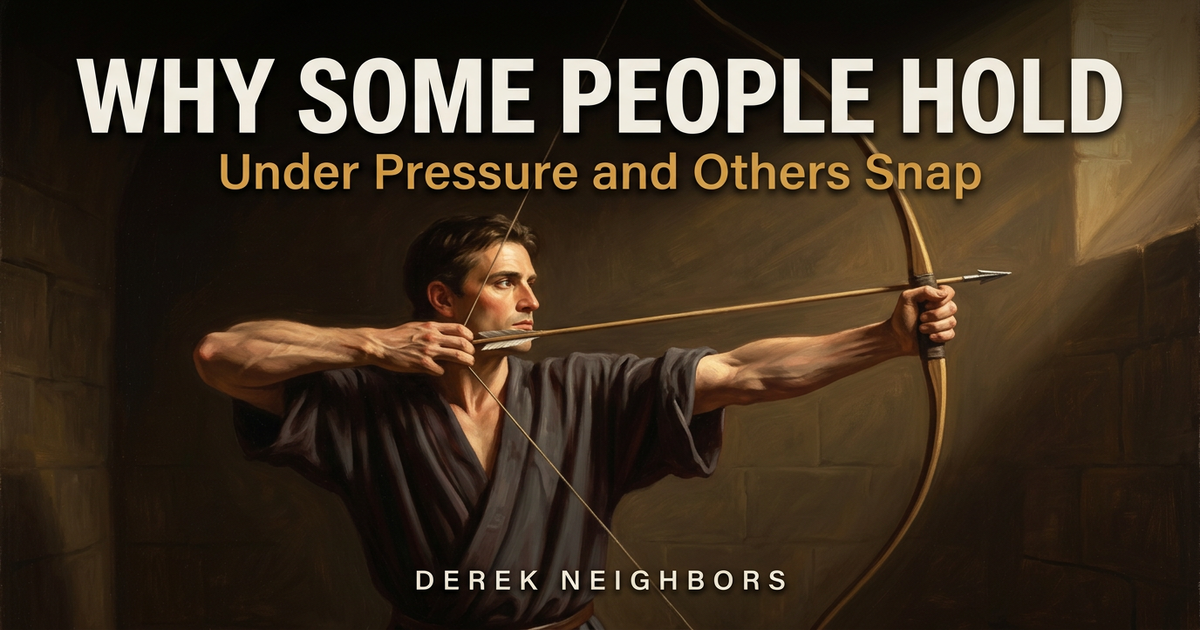
This physical doctrine has immediate psychological implications. Just as a lyre string must maintain proper tension to produce its correct note, the human soul must maintain proper tonos to function excellently. When tension slackens, the soul loses its coherence. Galen, reporting Stoic doctrine, notes that the passions were understood as a kind of collapse or weakening of the soul’s tension. Fear, for instance, represents a ‘contraction’ where the soul pulls back and loses its vigorous outward extension. Grief is a ‘sinking’ where tension falls away entirely.
The ethical implications are profound. Virtue, for the Stoics, requires maintaining appropriate tension across all circumstances. This is not the same as rigidity. A properly tuned string is not infinitely tight but calibrated to its proper pitch. Similarly, the wise person maintains tension sufficient to hold their principles and judgments intact without becoming brittle or breaking under pressure.
Cleanthes, in his Hymn to Zeus, praises the divine fire that ‘straightens what is crooked’ and ‘makes order from disorder,’ suggesting that cosmic tonos serves as the model for individual psychological discipline. The sage participates in this cosmic tension by keeping their own pneuma taut and coherent.
This connects deeply to the Stoic practice of prosoche, or attention. Attention maintains tension. When attention lapses, tension slackens, and the soul becomes vulnerable to impressions that would otherwise be evaluated and rejected. Epictetus frequently emphasizes staying ‘awake’ and ‘alert,’ language that directly invokes the maintenance of tonos.
Marcus Aurelius provides practical illustrations throughout the Meditations. His repeated exhortations to maintain his principles, to hold fast to what reason dictates, to not be ‘dyed’ by external impressions, all reflect the effort to preserve proper tonos. When he writes of returning to himself after distraction, he describes the restoration of tension that had temporarily slackened.
A crucial tension within the concept itself emerges here. How does one maintain tonos without exhausting oneself? The Stoics would answer that proper tension is sustainable precisely because it is proper. The untrained soul exhausts itself through alternating extremes of excessive tension and total collapse. The trained soul finds the sustainable level of tension that maintains coherence without strain.
This has implications for the relationship between tonos and apatheia. The Stoic goal of freedom from destructive passions is not a slackening into indifference but rather the achievement of such stable tension that external circumstances cannot cause collapse. The person with strong tonos does not need to struggle against temptation because their integrity holds its shape automatically.
Finally, tonos illuminates the communal dimension of Stoic ethics. Just as pneuma pervades the cosmos, creating sympathetic connections between all parts, individuals exist within a field of shared tension. When one person maintains strong tonos, they contribute to the coherence of the whole. When they slacken, they weaken the social fabric. Leadership, in this light, becomes the maintenance of tension that others can rely upon.
Modern Application
You need sustained inner tension to hold your principles intact when circumstances push against them. When you feel scattered or compromised, recognize that your *tonos* has slackened. Cultivate deliberate strain in your commitments, your standards, and your attention. The goal is not relaxation but calibrated tension that keeps you coherent across contexts.
Historical Examples
Cato the Younger exemplified extraordinary tonos throughout his political career and final hours. Plutarch records that during the civil war, when many Roman senators accommodated themselves to Caesar’s rising power, Cato maintained unyielding opposition despite the personal costs. His famous refusal to accept Caesar’s pardon after Pharsalus, choosing death in Utica instead, demonstrated tension maintained to the ultimate point. Plutarch notes that Cato spent his final night reading Plato’s Phaedo on the immortality of the soul, an intellectual and spiritual preparation that sustained his resolve. His integrity held its shape even when the entire Roman political order had collapsed around him.
Socrates at his trial provides the canonical philosophical example. As Plato presents in the Apology, Socrates faced a jury that would likely spare him if he simply moderated his position, showed contrition, or ceased his philosophical questioning. Instead, he maintained the exact tension of his lifelong commitments. He told the jury he would not stop philosophizing even if released, and proposed being rewarded rather than punished. Plato portrays this not as stubbornness but as the natural expression of a soul whose tonos had been trained over decades to hold a single consistent shape.
Marcus Aurelius demonstrated tonos through the grinding circumstances of his reign rather than a single dramatic moment. As recorded in Cassius Dio and evidenced in his own Meditations, Marcus spent years on military campaigns along the Danube frontier in conditions of disease, cold, and constant pressure. His private writings from this period show continuous effort to maintain philosophical principles against fatigue, irritation, and the temptations of power. He writes of returning to his principles repeatedly, suggesting the constant work of restoration that maintains tension over extended time. His reign illustrates that tonos must be sustainable across decades, not merely intense in moments of crisis.
How to Practice Tonos
Begin each morning by identifying one principle you will hold in tension today. Write it down physically. State what pressure might cause it to slacken. Throughout the day, conduct three tension checks: morning, midday, and evening. Ask yourself: Am I still holding to my stated commitment, or have I let the string go slack? Track the specific moments when you felt your resolve weaken. Note what caused the slackening. Was it fatigue? Social pressure? Convenience? Build a tension inventory over two weeks. Identify your patterns of loosening. Practice deliberate resistance exercises. When tempted to skip a commitment, pause and physically tense your muscles for ten seconds while mentally affirming your intention. This somatic anchor reinforces psychological tension. Weekly, choose one area where you have been too loose and consciously tighten your standards. Review your boundaries and ask: which ones have I allowed to become permeable? Restore them with specific, observable criteria. Create accountability structures that maintain external tension when internal tension flags.
Application Examples
A company’s stated values include transparency, but facing a quarter of disappointing results, leadership debates how much detail to share with employees and investors. The temptation to soften the message or delay full disclosure represents a slackening of organizational tonos.
Tonos reveals that each compromise loosens the string further, making the next compromise easier. Organizations with strong tonos hold their standards precisely when circumstances make deviation attractive.
You committed to a morning exercise routine, but after several weeks, you notice yourself finding exceptions. One day you are too tired, another day too busy. The exceptions multiply. Your original commitment has lost its tension.
Tonos shows that the issue is not any single missed day but the gradual slackening that makes each subsequent miss more likely. Restoration requires consciously re-tightening, not merely resuming.
A team leader has established clear expectations about meeting preparation. One team member consistently arrives unprepared but performs well otherwise. The leader faces pressure to let the standard slide for this valuable contributor.
Tonos exposes how selective enforcement weakens the entire structure. The standard either holds for everyone or it becomes mere suggestion, losing the tension that made it meaningful.
Two business partners agreed to complete honesty about concerns regarding their venture. Over time, one begins withholding small doubts to avoid difficult conversations. The partnership’s foundational tension has begun to slacken.
Tonos illuminates how relational integrity requires continuous maintenance. The withheld concern is not isolated but symptomatic of weakened tension that will eventually affect larger matters.
During a public relations crisis, a nonprofit faces pressure to issue carefully hedged statements that technically satisfy legal requirements but avoid full accountability. The organization must decide whether its stated commitment to honesty holds under fire.
Tonos is only truly tested under pressure. The crisis reveals whether the organization’s values have genuine tension or were merely words that collapse when stretched.
Common Misconceptions
Many people equate tonos with constant strain or effort, imagining the Stoic sage as perpetually tense and exhausted. The Stoics actually taught that proper tension is sustainable precisely because it is properly calibrated. A well-tuned string does not require continuous adjustment. The goal is finding the level of tension that maintains integrity without requiring heroic effort.
Another error is assuming tonos means inflexibility. A taut string can still vibrate and respond to touch. Similarly, strong psychological tonos allows appropriate response to circumstances while maintaining essential shape. The person with weak tonos is actually more likely to become rigid in some areas while collapsing in others, compensating for lack of consistent tension with occasional overcorrection.
Some interpret the concept as purely individual, missing its cosmic and communal dimensions in Stoic thought. The Stoics understood tonos as pervading all existence, creating sympathetic connections between parts. Maintaining one’s own tension contributes to the coherence of family, organization, and society. Slackening is never merely personal.
I spent years misunderstanding what consistency actually meant. I thought it meant doing the same things, following the same routines, maintaining the same practices. What I learned through painful experience is that consistency is about maintaining tension, not repetition.
Working with teams going through agile transformations, I watched the same pattern repeatedly. Organizations would commit to new practices with genuine enthusiasm. They would do daily standups, retrospectives, transparent planning. Then pressure would arrive. A deadline. A difficult stakeholder. A crisis. And the practices would quietly disappear. Not dramatically abandoned, just gradually loosened until they meant nothing.
The revelation came when I noticed the same pattern in myself. I would commit to giving hard feedback directly rather than letting it fester. For weeks, I would hold to it. Then someone would react badly, or I would be tired, or the relationship felt too fragile. I would tell myself this particular situation was an exception. The string had slackened, and I had convinced myself it was wisdom rather than weakness.
What changed was recognizing that my job as a coach and leader is primarily about maintaining tension. Not creating it. Not increasing it infinitely. Maintaining it at the level that keeps commitments meaningful. This means being attentive to the small slackenings before they become complete collapses. It means having regular practices that restore tension when it inevitably weakens.
I now start my week by asking: where have I let the string go slack? Where have I allowed standards to erode? Where have I traded coherence for convenience? The question itself restores some tension. But the real work is in the retightening. Recommitting specifically. Making the standard visible again. Often apologizing to someone for a slippage they noticed before I did.
The hardest lesson is that no one maintains perfect tension. The goal is not to never slacken but to notice quickly and restore deliberately. That capacity for restoration, practiced regularly, becomes its own form of strength.
Frequently Asked Questions
What is tonos in Stoic philosophy?
In Stoic philosophy, tonos refers to the tension of the pneuma (breath or spirit) that pervades all matter and gives things their cohesion and distinctive qualities. At the psychological level, it describes the strength and consistency of one's character, maintained through mental discipline and rational attention.
How is tonos different from willpower?
Willpower implies effortful resistance in moments of temptation, while tonos describes an ongoing state of calibrated tension that maintains integrity continuously. Strong tonos means your principles hold their shape naturally, like a well-tuned instrument, rather than requiring constant struggle.
How do you strengthen your tonos?
The Stoics strengthened tonos through philosophical training, attention (*prosoche*), and voluntary hardship. Practically, this means regular examination of your commitments, deliberate practice of holding standards under pressure, and building habits that maintain tension even when your conscious attention lapses.