Atonia (ἀτονία): Meaning, Definition & Modern Application
ah-toh-NEE-ah
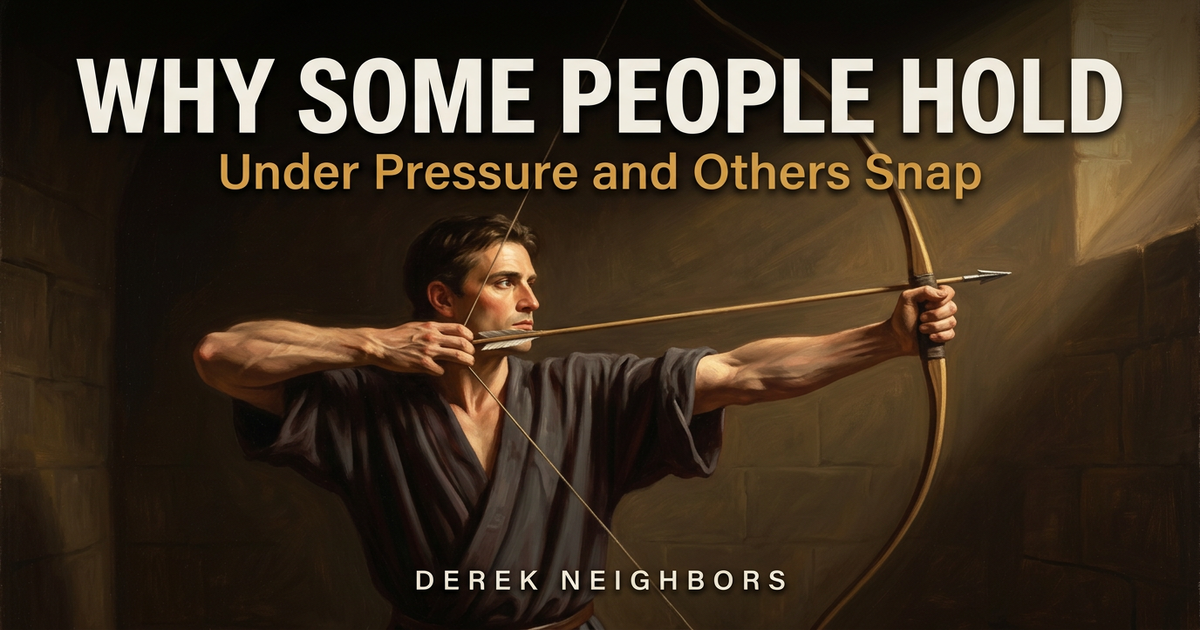
The absence of tension, tone, or vital force in the soul. In Stoic philosophy, atonia represents a slackening of the pneuma that leads to moral weakness, emotional instability, and the inability to maintain rational judgment under pressure.
Etymology
Derived from the Greek privative prefix a- (without) combined with tonos (tension, tone, stretching). The root tonos comes from teinō (to stretch), reflecting the Stoic conception of the soul’s pneuma as requiring proper tension for healthy function. The term evolved from medical usage describing muscular weakness to philosophical usage describing psychic and moral debility.
Deep Analysis
The concept of atonia sits at the intersection of Stoic physics, psychology, and ethics, revealing how deeply the ancient philosophers understood the embodied nature of moral life. For the Stoics, particularly Chrysippus and later Galen in his medical writings, the soul was not an ethereal substance separate from the body but a material pneuma (breath or spirit) that permeated the physical form. This pneuma required proper tension to maintain its healthy function, much as a musical instrument requires properly tuned strings.
Chrysippus argued that virtue itself could be understood as a kind of tensile strength of the soul. In his fragments preserved by Galen and Plutarch, he describes the virtuous soul as one possessing eutonia, the appropriate degree of tension that enables clear perception, sound judgment, and consistent action. Atonia, then, represents not merely a psychological state but a physical-spiritual condition where the pneuma has become slack, loose, and unable to maintain its proper form.
This framework resolves a puzzle that troubled ancient ethics: why do people who know the good fail to do it? The Socratic position that virtue is knowledge seems to founder on the obvious fact of moral weakness. The Stoic answer, developed through their theory of pneumatic tension, suggests that knowledge alone is insufficient. The soul must possess the tone, the tensile strength, to maintain its grasp on correct judgments when passions arise. Atonia describes the condition where this capacity has deteriorated.
Galen, writing centuries later but drawing on Stoic sources, connected atonia to specific pathological states. In his medical texts, he describes how physical illness, excessive pleasure-seeking, and prolonged emotional disturbance all contribute to a slackening of the vital pneuma. This is not merely metaphorical. The Stoics genuinely believed that moral education was a kind of physical training for the soul-substance.
The implications extend to Stoic therapeutic practice. If atonia is a loosening of psychic tension, then the cure must involve systematic tightening. This is why the Stoics emphasized askesis (training), not as mere self-denial but as a regimen for restoring proper tone. Marcus Aurelius’s Meditations can be read as exercises in tensioning. His repeated reminders to himself, his morning preparations, his evening examinations, all serve to maintain the pneuma in its proper state of readiness.
Epictetus takes a more pedagogical approach, but the underlying concern is identical. His emphasis on the discipline of assent, the careful examination of impressions before accepting them, functions as a practice for maintaining psychic tone. The person who carelessly accepts every impression, who reacts immediately to every stimulus, displays the characteristic signs of atonia. The disciplined practitioner who pauses, examines, and chooses their response demonstrates healthy tension.
There is a productive tension between the Stoic ideal of apatheia (freedom from destructive passions) and the necessity of tonos. Some readers misunderstand apatheia as a kind of slack indifference, but this interpretation inverts the Stoic meaning. True apatheia requires tremendous inner tension. It is the capacity to maintain rational judgment precisely when external circumstances would normally trigger reactive emotions. The slack soul cannot achieve apatheia. It will be buffeted by every passing impression.
The concept also illuminates the Stoic understanding of vice. Vice is not simply choosing badly. It is a chronic condition of the soul where the pneuma has lost its proper tension and become deformed. This explains why the Stoics insisted that virtue and vice admit no degrees. Either the soul possesses proper tone and thus virtue, or it has slackened and thus remains in vice. The apparent gradations we observe in human behavior reflect varying severities of atonia, not partial virtue.
For contemporary application, atonia offers a diagnostic framework. When we observe patterns of inconsistency, reactivity, and failure to follow through, we are not seeing simple moral failure but a condition requiring specific treatment. The modern tendency to address such patterns through willpower alone misses the Stoic insight. Willpower is itself a manifestation of psychic tone. If the tone is weak, no amount of willing will compensate. The work must address the underlying condition through consistent, embodied practice.
Modern Application
When you feel scattered, reactive, or unable to follow through on your commitments, you are experiencing atonia. Recognizing this state is the first step toward recovery. You must actively cultivate the opposite quality, eutonia, through deliberate practices that restore tension and focus to your inner life. Without this awareness, you drift through decisions rather than making them.
Historical Examples
The historian Thucydides provides a devastating portrait of collective atonia in his account of the Plague of Athens during the Peloponnesian War. As the disease ravaged the city, Thucydides reports that Athenians abandoned their traditional laws and customs. ‘Men now coolly ventured on what they had formerly done in a corner,’ he writes, because ‘no fear of god or law of man had a restraining influence.’ This was not simply moral failure under pressure. It was the dissolution of the civic pneuma that had sustained Athenian virtue. The tension that maintained social order slackened, and behavior that had been unthinkable became commonplace. Pericles himself, who had rallied the city’s resolve, died in the plague, and with him went much of Athens’s capacity for sustained strategic focus.
Plutarch’s Life of Marcus Antonius (Mark Antony) presents an individual case study. Plutarch carefully traces how Antony, once a capable general and administrator, progressively lost his psychic tone during his years with Cleopatra in Alexandria. This was not the rapid corruption of a weak man but the gradual slackening of a strong one. Plutarch describes Antony abandoning military campaigns, neglecting correspondence, losing interest in the practical governance that had defined his earlier career. His own soldiers noticed the change. At Actium, Antony’s forces were physically capable but psychically slack, their commander’s atonia having infected the entire army. They surrendered without serious resistance.
Seneca documents his own struggle with atonia in his Letters to Lucilius. In Letter 55, he describes a period of illness that left him not merely physically weak but spiritually depleted. ‘I felt,’ he writes, ‘that I had lost not merely my strength but my very identity.’ His recovery required not just bodily rest but deliberate exercises to restore the tension of his philosophical commitments. Seneca’s honesty about his own vulnerability makes this account particularly valuable. Even a practiced Stoic, he demonstrates, can experience atonia and must actively work to counter it.
How to Practice Atonia
Begin each morning with a tension-setting exercise. State aloud three commitments for the day and visualize yourself maintaining resolve through anticipated challenges. This creates the initial tone your soul requires.
Track moments of slackness throughout your day. When you notice yourself drifting, avoiding decisions, or seeking distraction, mark it. Review these moments each evening to identify patterns. Are you losing tone after meals? During certain meetings? When facing specific people?
Practice voluntary discomfort for ten minutes daily. Cold exposure, holding a difficult position, or sitting with an uncomfortable emotion without escape. This strengthens your capacity to maintain tension when it matters.
Establish non-negotiable boundaries and defend them. Each time you let a boundary slip, you reinforce atonia. Each time you hold it, you build tone.
Review your day using the Stoic evening examination. Ask: Where did I lose tension? Where did I maintain it? What triggered each state? Write your observations.
Seek accountability partners who will notice when your commitments slacken. Give them explicit permission to name your atonia when they see it.
Application Examples
A startup founder keeps announcing new strategic directions at all-hands meetings, only to abandon them within weeks when challenges arise or new opportunities appear. The team has learned not to invest in any initiative until it survives at least three executive pivots.
This pattern reveals organizational atonia. Without sustained executive tension around priorities, the entire company develops a slack, reactive culture where nothing meaningful can be built.
You have started the same morning routine four times this year. Each time begins with enthusiasm, lasts about two weeks, then dissolves without conscious decision. You never actively quit. You simply wake up one day and realize you stopped.
The dissolution without decision is the signature of atonia. The soul lacks the tension to maintain commitments across the natural fluctuations of motivation.
A department head avoids difficult performance conversations by continuously finding reasons to delay. When finally forced to act, they soften the message so thoroughly that the employee leaves confused about whether there is actually a problem.
Leadership requires the capacity to hold discomfort without dissipating it. Atonia in leaders cascades through organizations, leaving chronic problems permanently unaddressed.
A competitive runner performs brilliantly in training but consistently underperforms in races. Under the pressure of competition, their form deteriorates, their pace collapses, and they make tactical errors they would never make in practice.
Physical and psychic tension are interconnected. The athlete’s soul cannot maintain its tone when the stakes increase, revealing that training has developed the body but neglected the pneuma.
A novelist has been ‘working on’ the same book for seven years. They have extensive notes, multiple partial drafts, and detailed character sketches. What they do not have is the sustained focus to push through the difficult middle sections where inspiration fails.
Creative work requires maintaining tension across long periods of uncertainty. Atonia masquerades as perfectionism, as waiting for the right moment, as needing more research. The real deficit is inner tone.
Common Misconceptions
Many assume atonia describes laziness or lack of motivation. This misses the structural nature of the condition. A person with atonia may feel highly motivated, may genuinely want to follow through, may expend tremendous energy in brief bursts. What they lack is the underlying psychic tension that sustains effort across time. Treating atonia as a motivation problem leads to useless interventions: inspiration, incentives, external pressure. The real work requires rebuilding the soul’s capacity for tension itself.
Some interpret the Stoic emphasis on tonos as advocacy for constant striving, for a life of perpetual exertion. But healthy tension is not the same as chronic strain. A well-tuned string can be played beautifully precisely because it holds its tension without being overstretched. The Stoics sought eutonia, right tension, not maximum tension. Atonia is problematic not because relaxation is bad but because without proper baseline tone, the soul cannot respond appropriately to what circumstances require.
There is also confusion about atonia and depression. While the conditions may present similarly, their nature differs. Depression, in modern understanding, involves neurochemical and psychological factors that may require medical intervention. Atonia, as the Stoics understood it, is a condition of the soul’s relationship to its own judgments, addressable through philosophical practice. Treating one as the other leads to inappropriate responses: philosophical exhortation for clinical depression, or medication for what is fundamentally a spiritual condition.
I first encountered atonia not through philosophy but through watching teams collapse. Years ago, I worked with a product team that had everything going for it. Talented people, clear market opportunity, sufficient resources. Yet nothing shipped. Every sprint began with energy and ended with excuses. Features got ninety percent complete, then languished. I kept looking for external explanations: unclear requirements, technical debt, organizational dysfunction. They all played roles, but none explained the pattern.
Then I started paying attention to the team’s energy through the sprint. Day one: focused, decisive, engaged. By day three: scattered meetings, side conversations, growing ambiguity. By day eight: resignation dressed as reasonableness. ‘We’ll get it in the next sprint.’ The physical posture changed. People literally slumped. Eye contact decreased. Voices grew quieter.
When I later encountered the Stoic concept of pneumatic tension, I recognized what I had been seeing. The team was experiencing collective atonia. Their psychic tension could not sustain itself across a two-week cycle. Every sprint was a new morning routine started with enthusiasm and abandoned by week’s end.
The intervention that finally worked was not process improvement. It was daily tension-setting. Short morning standups where each person stated not just what they would do but what obstacles they anticipated and how they planned to maintain focus through them. We added a midday check-in specifically to notice and name any slackening. When someone said, ‘I’m losing the thread,’ we treated it as valuable information rather than weakness.
I have come to believe that most organizational dysfunction is atonia at scale. We build elaborate systems to compensate for what disciplined psychic tension would provide naturally. The alternative is not grinding willpower but genuine cultivation of the soul’s capacity to maintain itself under pressure. This is trainable. I have seen it trained. But it requires naming the condition first.
Frequently Asked Questions
What is atonia in Stoic philosophy?
Atonia is the Stoic term for a slackening or weakness of the soul's vital tension. The Stoics believed the soul, like the body, requires proper tone to function well. When this tension weakens, we become susceptible to emotional disturbance, poor judgment, and moral failure.
What is the difference between atonia and akrasia?
While both involve failure of will, they differ in mechanism. Akrasia is acting against your better judgment while knowing what is right. Atonia is a prior condition where the soul lacks the tension needed to form and maintain strong judgments in the first place. Atonia makes akrasia more likely.
How do you overcome atonia?
The Stoics prescribed askesis (disciplined training), prosoche (attention), and deliberate exercises that strengthen the soul's tone. Regular practice of voluntary hardship, strict attention to impressions, and consistent follow-through on commitments gradually restore healthy tension to the psyche.