Eutonia (εὐτονία): Meaning, Definition & Modern Application
eu-toh-NEE-ah
The state of proper tension or healthy tone in body and soul, describing the optimal degree of firmness that enables effective action without rigidity or slackness.
Etymology
Derived from eu (good, well) and tonos (tension, stretching, tone), eutonia literally means ‘good tension.’ The root tonos comes from teinein (to stretch), evoking the taut string of a bow or lyre. The Stoics adopted this term to describe the soul’s capacity to maintain its integrity under pressure, extending the physical metaphor into psychology and ethics.
Deep Analysis
The concept of eutonia emerges most distinctly in Stoic physics and psychology, where it describes the optimal tension of the soul’s commanding faculty, the hegemonikon. Chrysippus, the third head of the Stoic school, developed an elaborate pneumatic psychology in which the soul consists of breath (pneuma) held at various degrees of tension. This tension determines not merely psychological resilience but the very capacity for rational action.
What makes eutonia philosophically rich is its rejection of the common assumption that more strength is always better. The Stoics recognized that excessive tension produces its own pathology: the person strung too tight becomes brittle, reactive, unable to adapt. They break precisely because they cannot bend. Seneca addresses this dynamic in his letters, warning against the kind of rigid self-discipline that exhausts the spirit. Even virtue, pursued with excessive intensity, becomes a vice.
Yet the opposite error, insufficient tension, renders a person equally incapable. The slack soul cannot maintain its commitments, drifts with circumstance, responds to every impulse without discrimination. This is the state Aristotle would recognize as malakia, softness or moral weakness. Eutonia occupies the crucial middle ground, the state of being ready without being rigid.
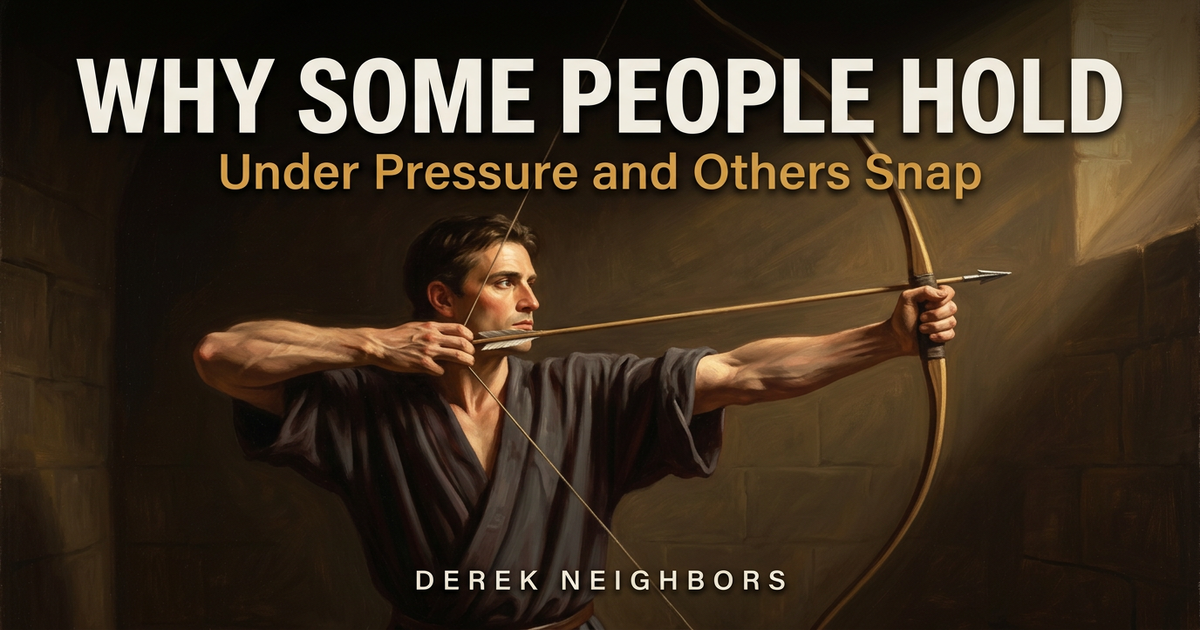
The bowstring metaphor deserves careful attention. A bow functions through the transformation of potential into kinetic energy. The string must be tight enough to store force, loose enough to release it cleanly. Too tight, and the bow itself cracks. Too loose, and the arrow falls short. The archer who understands eutonia knows that power emerges from calibrated tension, not maximum tension.
This insight connects eutonia to the broader Stoic understanding of tonos as cosmic principle. The Stoics believed that pneuma pervades all reality, holding the universe together through tension. Different levels of tonos produce different kinds of being: the lowest tension yields inanimate objects, higher tension produces plants, still higher produces animals, and the highest tension characterizes rational souls. Eutonia represents the proper tension for a human being, the degree that enables our distinctive activity of reasoned choice.
Marcus Aurelius, though he rarely uses the term explicitly, embodies eutonic thinking throughout the Meditations. His repeated exhortations to act without anxiety, to engage fully with duty while remaining detached from outcomes, describe the psychological posture of eutonia. He warns against both frantic activity and withdrawn passivity, seeking instead that alert composure that can respond appropriately to whatever arises.
The concept illuminates a persistent tension in ethical life. How do we maintain commitment without attachment? How do we care deeply without becoming brittle? Eutonia suggests that these apparent contradictions resolve not through intellectual gymnastics but through practical calibration. You learn the right tension through doing, through noticing when you are too tight or too loose and adjusting accordingly.
This connects to the Aristotelian insight that virtue is a hexis, a stable disposition acquired through practice. Eutonia is not a single achievement but an ongoing calibration. The circumstances that demanded one degree of tension yesterday may demand another today. The eutonically developed person has cultivated the sensitivity to recognize these shifts and the flexibility to respond.
Critically, eutonia applies to organizations as well as individuals. A team strung too tight operates in constant crisis mode, burning out its members, unable to sustain effort over time. A team too loose drifts without direction, accomplishes little, dissolves under pressure. The leader’s task often involves adjusting collective tension, tightening when focus is needed, loosening when creativity requires space.
The paradox at eutonia’s heart is that optimal tension feels like ease. The archer at full draw appears relaxed. The master musician plays demanding passages without visible strain. This effortless effort, what the Japanese call mushin, emerges only from precise calibration. It cannot be forced. It must be cultivated through patient attention to one’s own instrument.
Modern Application
You need to calibrate your internal tension like a master archer calibrates a bowstring. Too loose, and your decisions lack force; too tight, and you snap under pressure. Eutonia calls you to find that precise degree of readiness where you remain alert without anxiety, firm without brittleness, engaged without exhaustion.
Historical Examples
Epictetus, the Stoic teacher who had been born a slave, demonstrates eutonia through his entire philosophical approach. According to Arrian’s Discourses, Epictetus maintained remarkable equanimity despite his harsh early life and later physical disability. He neither raged against his circumstances nor collapsed into passive acceptance. Instead, he held his attention at the precise tension required for what he called the ‘proper use of impressions,’ engaged with life fully while releasing attachment to what lay beyond his control. His famous formulation about distinguishing what is ‘up to us’ from what is not represents eutonia applied to the whole of existence.
Pericles, as described by Thucydides, exemplified eutonia in political leadership during the early years of the Peloponnesian War. When the Spartans invaded Attica and citizens demanded immediate retaliation, Pericles held firm against the pressure while remaining flexible in strategy. He neither yielded to the mob’s passion nor rigidly imposed his will without persuasion. His funeral oration reveals a leader who could praise Athens’ virtues while acknowledging the genuine sacrifices the war demanded, holding patriotism and realism in productive tension.
The physician Galen, writing in the second century CE, explicitly connected eutonia to health. In his medical works, he described disease as arising from either excessive or deficient tension in the body’s systems. The healthy body maintains its parts in proper tone, neither too taut nor too lax. Galen extended this to psychological health, arguing that emotional disturbances represent failures of eutonia in the soul. His treatment protocols often aimed at restoring proper tension through regimen, exercise, and philosophical counsel, demonstrating how the Greeks understood physical and psychological calibration as fundamentally connected.
How to Practice Eutonia
Start each morning with a tension audit. Scan your body from jaw to shoulders to hands, noticing where you hold unnecessary tightness. Then examine your mental state: are you bracing against the day or collapsed into passivity?
Practice the bowstring exercise: when facing a difficult conversation or decision, ask yourself whether you are strung too tight (reactive, defensive, rigid) or too loose (avoidant, permissive, scattered). Adjust consciously toward the middle.
Track your energy signatures. Keep a brief log noting moments when you felt optimally engaged versus depleted or frantic. Look for patterns: certain people, tasks, or times that pull you away from eutonia.
Seek calibration feedback. Ask a trusted colleague to tell you when you seem wound too tight or checked out. External observation often catches what self-assessment misses.
Review your commitments weekly. Overcommitment creates chronic tension; undercommitment breeds slackness. Adjust your load to maintain sustainable readiness.
Physical practices reinforce mental eutonia. Engage in activities that require controlled tension: archery, yoga, swimming. Notice how your body learns optimal tone through repetition.
Application Examples
A startup founder faces a critical funding round while managing team morale during uncertainty. She notices herself oscillating between obsessive micromanagement and detached fatalism. Neither stance serves the company.
Eutonia reveals that sustainable leadership requires finding the tension that keeps her engaged without becoming consumed, present to reality without being paralyzed by it.
A parent preparing their teenager for independence struggles with when to hold firm and when to let go. Each conversation becomes either a rigid enforcement of rules or an anxious capitulation to avoid conflict.
The eutonic parent maintains enough tension to uphold important boundaries while remaining flexible enough to adapt as the child demonstrates readiness.
A project manager inherits a demoralized team that has been through three reorganizations in two years. They are simultaneously cynical and desperate for direction, testing every statement she makes.
Eutonia guides her to provide structure without rigidity, to hold expectations firmly while remaining responsive to legitimate concerns, rebuilding trust through calibrated consistency.
A novelist facing her second book struggles with the tension between commercial expectations and artistic vision. She finds herself either abandoning structure entirely or mechanically following market formulas.
Eutonia shows that creative excellence requires holding both demands in tension, letting craft discipline inspiration without strangling it.
A competitive archer notices that his accuracy degrades in tournament conditions. In practice he is fluid; in competition he tightens, his form becoming rigid, his arrows clustering high and left.
The literal application of eutonia: peak performance requires the same calibrated tension regardless of external pressure, a state achievable only through deliberate practice.
Common Misconceptions
Many assume eutonia means staying calm at all costs, a kind of emotional flatness that never rises to intensity. This misreads the concept entirely. Eutonia permits, even requires, strong responses when circumstances demand them. The bowstring at full draw is under enormous tension. The key is that this tension serves a purpose and releases cleanly. Suppressing appropriate intensity is just as far from eutonia as explosive overreaction.
Another error equates eutonia with mere stress management or work-life balance. These contemporary framings reduce a philosophical principle to a wellness technique. Eutonia concerns the soul’s fundamental posture toward existence, not tips for handling your inbox. It asks what degree of engagement allows you to act virtuously, not what degree of relaxation makes you comfortable.
A subtler misconception treats eutonia as a stable achievement rather than an ongoing practice. People imagine reaching some ideal tension and maintaining it indefinitely. But circumstances change constantly, and the tension appropriate to yesterday may strangle or abandon today’s demands. Eutonia requires continuous recalibration, a lifetime’s attentiveness to one’s own instrument.
I discovered eutonia the hard way, through years of mistaking intensity for effectiveness. Early in my coaching career, I believed that caring deeply meant gripping tightly. I would enter facilitation sessions coiled like a spring, ready to respond to any resistance, any conflict, any deviation from the plan. I thought this readiness made me responsive. It made me brittle.
The teams I worked with could feel it. My tension created tension. When I was wound tight, they held back, afraid to surface the real issues because my urgency made everything feel like a crisis. I was too present, too invested, and paradoxically, this made me less effective.
The shift came during a particularly difficult retrospective with a team that had just failed a major release. I was exhausted, too tired to maintain my usual vigilance. Something in me loosened. And in that slight relaxation, the team opened up in ways they never had before. They told me things they had been holding back for months. The session became genuinely transformative.
I realized that my tight grip had been a form of fear. I was afraid that if I relaxed, I would miss something, fail someone, prove inadequate. But that fear transmitted itself to everyone around me. My attempt at readiness created the very resistance I was bracing against.
Now I consciously check my tension before every engagement. Am I strung like a bowstring ready to release, or cranked past the point of effectiveness? Am I present or hypervigilant? The difference is subtle but transformative. The best facilitations, the deepest coaching conversations, happen when I am fully engaged but not grasping. Eutonia taught me that caring deeply and holding loosely are not contradictions. They are the same thing, rightly calibrated.
Frequently Asked Questions
What is eutonia in Stoic philosophy?
In Stoic philosophy, eutonia describes the soul's healthy tension that enables virtuous action. Chrysippus compared it to the proper tautness of a bowstring, arguing that the wise person maintains internal firmness that neither collapses under adversity nor snaps from excessive rigidity.
How do you practice eutonia daily?
Practice eutonia by regularly checking your physical and mental tension levels. Notice when you grip too tightly (anxiety, control) or too loosely (avoidance, indifference). Adjust through breath, movement, and conscious recalibration of your engagement with challenges.
What is the difference between eutonia and tonos?
Tonos refers to tension itself, the vital force or pneuma that holds things together. Eutonia specifies good or proper tension, the optimal degree. You can have tonos that is excessive or deficient; eutonia names the calibrated middle state that enables flourishing.