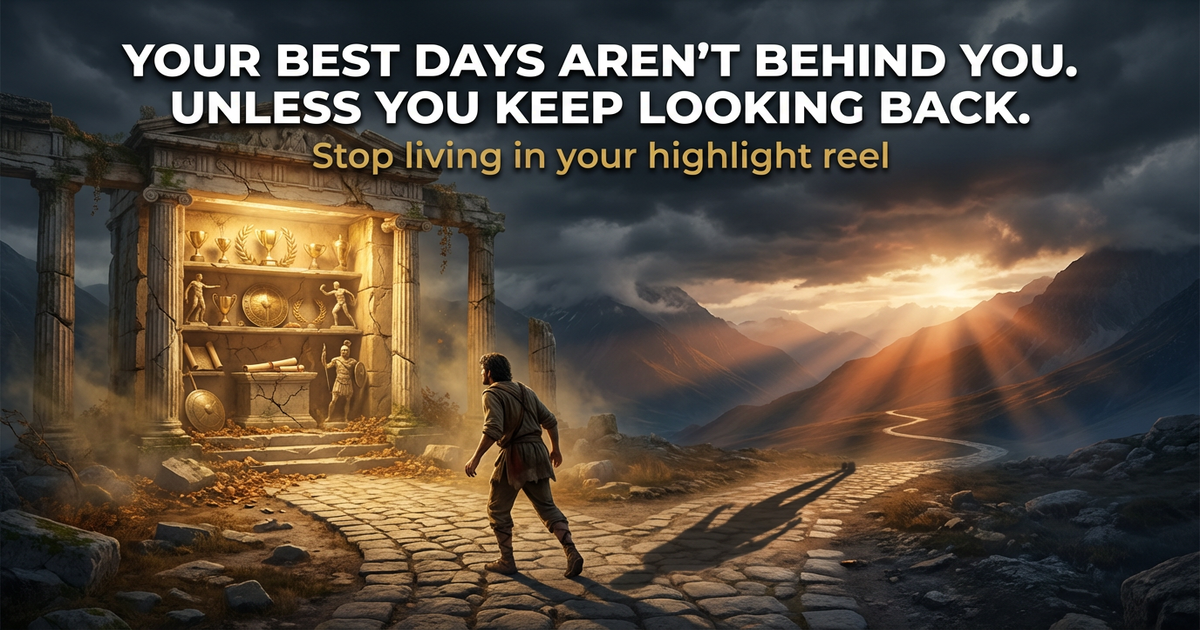
Your Best Days Aren't Behind You. Unless You Keep Looking Back.
By Derek Neighbors on January 27, 2026
Everyone has a glory story.
The deal you closed. The game you won. The year everything came together. The moment when you were undeniably, visibly excellent.
And there’s nothing wrong with remembering it. The problem starts when you live there.
The Myth
The glory days narrative runs deep in our culture. The former athlete who peaked at twenty-two. The entrepreneur who sold one company and never stopped talking about it. The leader who made their name in a different era and keeps referencing how things used to work.
We’ve been trained to believe that past achievements are proof of present worth. That remembering when we were excellent somehow makes us excellent now. That nostalgia is wisdom.
It’s a myth. Past success is documented, validated, proven. It feels like solid ground when everything else is uncertain. And since others acknowledged you then, why shouldn’t that acknowledgment extend to now?
Here’s what the myth doesn’t tell you: every minute spent polishing old trophies is a minute not spent earning new ones.
The Reality Check
Watch what actually happens to people who live in their glory days.
The executive who keeps referencing their startup success from fifteen years ago. The athlete who peaked at twenty-five and has spent fifty years telling the same stories. The musician who plays the hits instead of creating new work. The leader who made their name in one context and can’t adapt to another.
They share a common pattern. The more they reference old wins, the more everyone else wonders what they’re doing now. The conversation they think establishes credibility actually raises questions about current relevance.
The Greeks understood something we’ve forgotten. arete, excellence, is not a destination you reach. It’s a practice you renew. The moment you treat it as something you achieved rather than something you’re achieving, you’ve already begun to lose it.
The greatest breakthroughs tend to come from people who weren’t satisfied with their previous work. The most respected figures in any field are known for what they’re building, not what they built. Past success is a footnote, not a headline.
The pattern is consistent: dwelling on past success predicts future decline. The mind that treats yesterday’s wins as today’s identity becomes incapable of doing the work that created those wins in the first place.
The Hidden Cost
The glory days trap isn’t about memory. It’s about identity.
When you anchor your sense of self to past achievements, you create a false floor. You start protecting what you were instead of becoming what you could be. The comfort of proven success makes the risk of new failure intolerable. Fixating on past wins is insecurity about today disguised as pride. Why? Because proven identity feels safer than the vulnerable process of current striving. Past achievements can’t be taken away. Present attempts can fail.
This is why former champions often struggle more than people who never peaked at all. The person who hasn’t achieved much has nothing to protect. They’re free to try, fail, and try again. But the person with a trophy case? Every new attempt risks proving they’ve already peaked. Every new project threatens to reveal that the best is behind them.
The capacity for excellence exists independently of past achievements. Those without glory days aren’t advantaged. They simply lack this particular trap. The soul’s access to arete is not contingent on history.
So they don’t try. They coast. They talk about what was instead of building what could be.
The Greeks had a word for this: hexis, the stable disposition we develop through repeated action. When you practice looking backward, that becomes your disposition. Protection, not growth. Preservation, not creation.
The damage goes deeper than career stagnation. People tire of hearing the same stories. Opportunities pass by unseen because your eyes are fixed on the rearview mirror. And when past achievements inevitably fade in relevance, so does your sense of self.
Identity built on what you were is identity waiting to collapse.
The Truth
Your best days are only behind you if you decide to live there.
Yesterday’s wins have nothing to do with tomorrow’s potential. This isn’t motivational fluff. It’s the fundamental nature of excellence itself.
The Greeks called it energeia: actuality, the state of being at work. You are what you’re doing now. Not what you did. Not what you might do. What you are actively engaged in at this moment. Excellence is a verb, not a noun.
This means past achievements should inform confidence, not replace current effort. They’re evidence that you can, not proof that you automatically will. The fact that you once closed the big deal, won the championship, or built the company demonstrates capability. But capability without action is potential, not excellence.
Use your history as a foundation, not a fortress. Let it remind you what’s possible when you commit, not convince you that you’ve already committed enough.
The people who maintain excellence across decades demonstrate this through their behavior. They rarely talk about their past. They’re too busy working on what’s next. Their identity is built on trajectory, not trophies. On becoming, not having become.
The Shift
The hardest part of escaping the glory days trap is acknowledging what it protects you from.
If you’re not your past achievements, who are you? The question unsettles most people. Their entire sense of worth is wrapped up in what they’ve already proven. Strip that away and they don’t know what’s left. But the discomfort is not a barrier. It’s just a feeling. The choice remains available regardless.
But here’s the liberating truth: what’s left is everything you haven’t built yet.
Start catching yourself mid-story. When you reference an old win, ask yourself: am I sharing this to connect, or to prove something? There’s a difference between drawing lessons from experience and wielding achievements as credentials.
Apply a simple ratio test. No more than one in ten conversations should feature past achievements. If you find yourself steering every discussion back to your glory days, you’ve become the person everyone dreads at parties.
When tempted to reference old wins, redirect: what am I building now? What challenge am I currently facing? What’s the next version of myself I’m working toward?
Replace “I used to be” with “I am becoming.”
This may involve grief, but grief is not required. The shift is a choice. Letting go of the glory days means accepting they’re over. Not forgotten, not unimportant, but no longer your primary identity. You can simply stop identifying with the past and start building toward the future. The choice is available now.
The Test
Some honest questions.
When you meet someone new, how quickly do you reference past achievements? If it happens in the first five minutes, you’ve made your history your introduction.
If no one knew about your previous success, would you still feel valuable? If the answer is uncertain, you’ve outsourced your worth to a resume.
What percentage of your stories are about the past versus what you’re building now? Count them sometime. The ratio reveals where you actually live.
Are you more proud of who you were or who you’re becoming? One answer keeps you stuck. The other keeps you moving.
Final Thoughts
The glory days trap isn’t really about memory. It’s about where you locate your identity.
Living in the past is a form of self-protection that guarantees self-limitation. The Greeks understood this. arete demands continuous renewal, not comfortable reflection. Excellence is not a trophy you display. It’s a discipline you practice. The deepest cost of past-orientation isn’t career stagnation or social consequence. It’s the soul’s arrested development, the refusal to become what you’re capable of becoming.
Your best days aren’t behind you. They’re wherever you decide to build them.
The question isn’t whether you achieved something great in the past. The question is whether you’re achieving something great right now. And tomorrow. And the day after that.
Stop looking back. Start building forward. The only glory that matters is the kind you’re earning today.
If you’re ready to stop coasting on past achievements and start building the next version of yourself, MasteryLab.co is where people committed to continuous excellence come to forge what’s next.