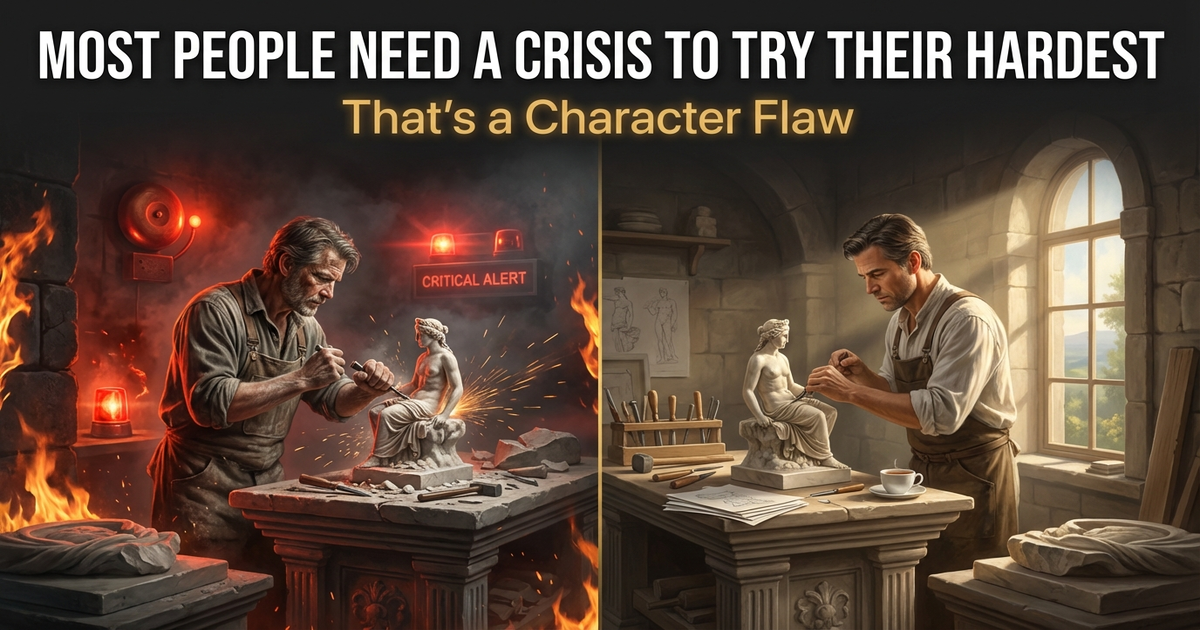
Most People Need a Crisis to Try Their Hardest. That's a Character Flaw.
By Derek Neighbors on January 23, 2026
Everyone has a story about the time they found another gear.
The deadline that seemed impossible until it wasn’t. The crisis that revealed capacity they didn’t know existed. The moment they surprised themselves with what they could do when everything was on the line.
These stories get told with pride. Look what I’m capable of when it really matters.
But there’s a question hiding inside that pride: If you’re capable of that level of performance, why does it take a crisis to unlock it?
The Apparent Contradiction
Here’s what seems like a paradox. Crisis genuinely does unlock extraordinary performance. The adrenaline, the clarity, the stakes. When the building is on fire, people move with a focus and intensity they never access in normal conditions. This is observable, repeatable, real.
And yet, needing crisis to access your best is a character flaw, not a feature.
These seem contradictory. If crisis works, isn’t it just a useful tool? Can’t “I work best under pressure” simply be an honest self-assessment rather than an excuse?
The confusion happens because people celebrate their crisis performance as proof of hidden potential. They treat the post-crisis version of themselves as their “real” self. Then they wait for the next emergency to feel that alive again.
But here’s what they’re actually revealing: their best self is held hostage by circumstances they don’t control.
“I work best under pressure” isn’t a personality trait. It’s an admission that you can’t command yourself without external force. “The deadline is the real motivation” means you’ve outsourced your intensity to factors outside your control. “Some people are just wired for crisis” is a comfortable story that avoids the harder truth.
The harder truth is that waiting for crisis is a form of self-abandonment.
The Deeper Truth
Both things are true simultaneously. Crisis does unlock capacity. And relying on crisis to unlock it is a character flaw.
The resolution lies in understanding the difference between having capacity and accessing it.
Aristotle made this distinction central to his philosophy. He called it dynamis versus energeia. dynamis is potentiality. The capacity that exists but isn’t being used. energeia is actuality. The capacity in motion, doing what it was meant to do.
A knife has the dynamis to cut. But a knife sitting in a drawer isn’t cutting anything. Only when it’s applied does it fulfill its purpose. The potential matters less than the actualization.
The same applies to human capability. Having the gear is one thing. Using it is another.
Crisis forces energeia. It takes the dormant capacity and drags it into action whether you like it or not. Your nervous system gets hijacked. Your focus sharpens. The trivial falls away and only the essential remains.
But here’s the problem: that’s not you doing the work. That’s your survival instinct responding to threat. The crisis deserves the credit, not your character.
Character is when you choose energeia without crisis forcing it.
This is why the paradox exists. Evolution optimized humans for threat response, not sustained excellence. Without external pressure, the default setting is conservation. Drift. Distraction. Comfortable output. The brain doesn’t want to burn resources when survival isn’t at stake.
So the person who operates at crisis-level intensity only during actual crisis isn’t demonstrating capability. They’re demonstrating that their biology controls their output instead of the other way around.
The Integration
Holding both truths requires a specific practice: accept that crisis works, but refuse to depend on it.
The Greeks had a word for this capacity to command yourself without external force. They called it enkrateia. Self-mastery. The ability to generate internally what most people wait for externally.
Epictetus put it bluntly:
no person is free who is not master of themselves.
Waiting for circumstances to push you into action means circumstances control you. The deadline owns your intensity. The crisis owns your focus. The emergency owns your best work.
Enkrateia is taking that ownership back.
This isn’t about pretending crisis doesn’t work. It’s about building systems that simulate crisis-level stakes without requiring actual catastrophe.
Manufactured urgency. Real deadlines with real consequences, even when the consequences are self-imposed. Public commitments that make failure visible. Constraints that remove the option of drifting.
Environment design. Eliminating escape routes. Making the path of least resistance the path of deep work. Removing the friction from focus and adding friction to distraction.
Identity reconstruction. The shift from “I rise to the occasion” to “I create the occasion.” From someone who responds to pressure to someone who generates it.
The practical question becomes: what would you have to change about your environment, your commitments, your self-image to access crisis-level intensity without waiting for crisis?
Because enkrateia is trainable. It’s not personality. It’s not genetic. The person who claims they can “only work under pressure” hasn’t developed the character to generate pressure internally. That’s a skill gap, not a fixed trait.
The Mastery
Advanced performers don’t have more capacity than everyone else. They’ve trained access to their capacity without needing external permission.
The difference isn’t in the gear. Everyone has the extra gear. The difference is in who holds the keys.
The Stoics framed this through the concept of prohairesis. Moral choice. The faculty that decides who you will be in each moment, independent of what’s happening around you.
prohairesis is the recognition that every moment contains a choice about whether to bring your full capacity or hold it in reserve. Waiting for crisis is abdicating that choice. Letting circumstances decide for you. Treating your best self as something that needs to be forced out rather than freely given.
The shift looks like this:
From “I rise to the occasion” to “I create the occasion.”
From reactive excellence to proactive excellence.
From capacity that needs permission to capacity that is sovereign.
The question stops being “what am I capable of under pressure?” and becomes “why do I need pressure to be capable?”
And when you sit with that question honestly, the character flaw becomes visible.
Needing crisis means your best work is held hostage. It means most of your life is spent operating below your potential while waiting for emergencies that may never come. It means outsourcing your intensity to forces you can’t predict or control.
The crisis response isn’t impressive. It’s baseline survival instinct. What’s impressive is the person who brings that same intensity to Tuesday morning when nothing is on fire. When no one is watching. When the only pressure comes from within.
That’s arete. Excellence as a way of being, not as an emergency response.
Final Thoughts
The extra gear exists. That was never the question. Everyone discovers capacity they didn’t know they had when circumstances demand it.
The question is who holds the keys.
Reactive excellence is common. Rise to the crisis, drift between them. Let external pressure dictate when you perform. Wait for circumstances to force what you should be choosing.
Proactive excellence is rare. Access the same intensity without permission. Generate your own urgency. Treat every day like the deadline is tomorrow, not because you’re anxious, but because you refuse to let your best work be held hostage by events outside your control.
The Greeks called this enkrateia. Self-mastery. The capacity to command yourself.
If you can only access your best when crisis forces it, your best isn’t really yours. It belongs to whatever circumstances happen to arrive.
Taking it back is character work. It’s the decision to stop waiting for permission to be excellent.
If you’re ready to stop waiting for crisis to bring your best and start building the character that makes excellence your default, MasteryLab is where that work happens.