Your Beliefs Are a Pain Tolerance Test. Most People Are Failing It.
By Derek Neighbors on June 25, 2026
I watched two founders take the same hit in the same quarter.
Same market contraction. Same category of customer churn. Same rough revenue drop, same sleepless stretch, same conversations with nervous investors. One kept shipping, kept the team pointed at the work, kept his standards intact even when the numbers were ugly. The other went quiet for weeks, then started rewriting the entire company every Monday as if a new identity would cancel the damage.
Same external pressure. Radically different capacity to hold it.
The easy explanation is temperament. One guy is tough. The other is soft. That story is comforting because it removes the question of responsibility. It also happens to be mostly wrong.
The difference I could see, once I stopped looking at personality and started listening to how each of them talked about what was happening, was not willpower. It was the belief system running underneath the willpower. One treated the quarter as hard material he had to work with. The other treated it as proof that the universe was personally hostile, that his prior confidence had been a fraud, and that the only move left was to escape the feeling.
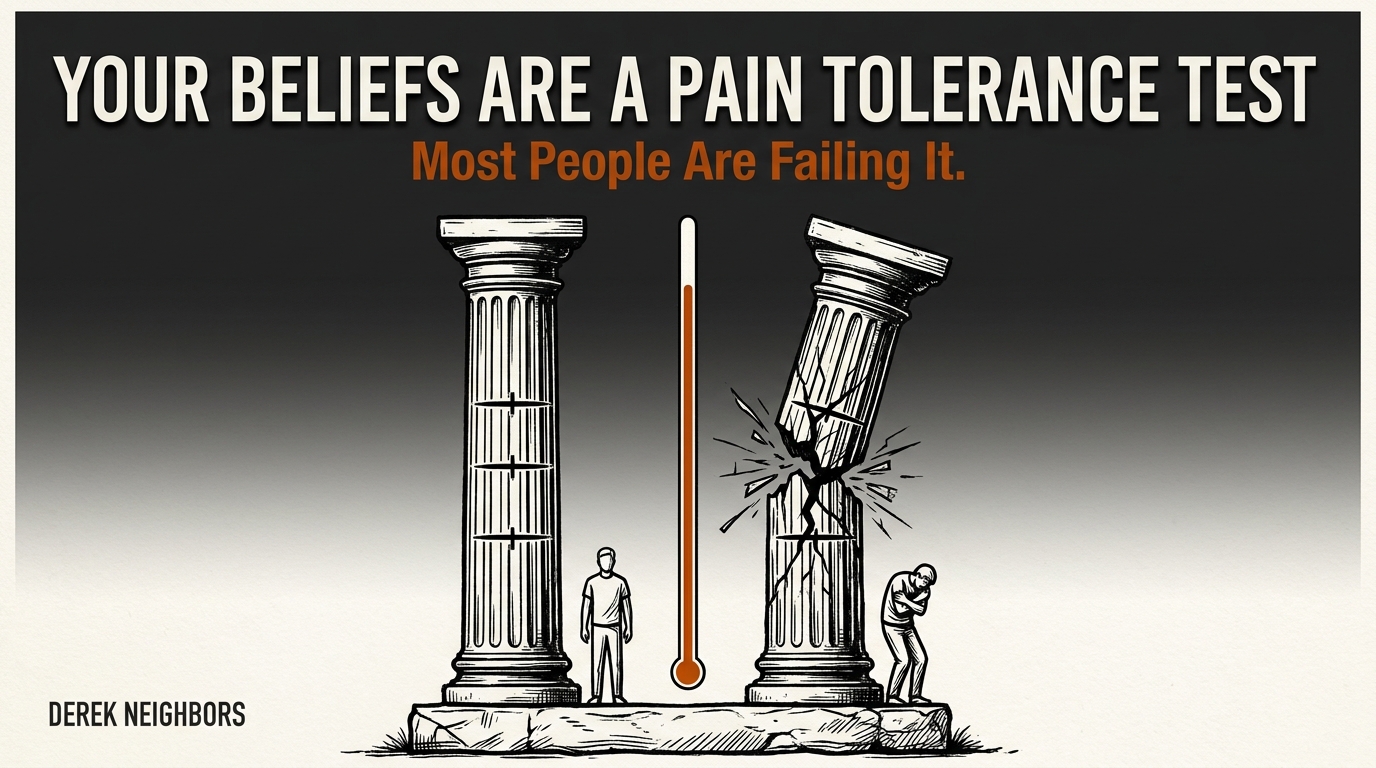
Beliefs are not decorations. They are load-bearing structure. And like any structure, they can be scored.
The Eternal Question
The ancients did not ask how to avoid pain. They knew better. Pain arrives for everyone: loss, illness, betrayal, aging, the ordinary friction of being alive in a body that breaks and a world that does not arrange itself for your preferences.
They asked a harder question: what kind of person can bear what must be borne?
That question assumes something modern culture tries hard to forget. Suffering is not optional. What varies is how much any given framework amplifies it.
Two soldiers with the same wound can ask for different amounts of morphine depending on what the injury means to them. I wrote about that mechanism in The Story You Tell About Pain Decides How Much It Hurts. The lever there is a single judgment about one event.
This article zooms out. Not one story about one injury. The whole operating system that generates those stories.
The Ancient View
The Stoics built a scorecard without calling it that.
First axis: locus of control. Epictetus opens the Discourses with the most practical division in philosophy: some things are up to us, some are not. What is up to us is prohairesis, moral choice, the faculty of assent and refusal. Your body can be injured. Your reputation can be attacked. The market can collapse. None of that is fully yours. What is yours is what you do with the impression once it lands.
Second axis: the ontological status of suffering. The Stoics used ponos for toil and affliction, and they did not treat it as proof the cosmos hates you. Hardship is material. Training weight. The mistake is not that pain exists. The mistake is the added verdict that pain means you are cursed, finished, or exempt from further effort.
Third axis: transcendence. Endurance without a telos becomes empty grinding until you break. Aristotle tied karteria, endurance, to the pursuit of the good life, not to masochism. You endure because something on the other side of the endurance is worth the cost.
Marcus Aurelius keeps running the audit in his private notebook. Remove the opinion you added. See what harm actually remains. Your doxa about the event does more damage than the event.
The Modern Problem
We live inside a culture that treats discomfort as a moral emergency. Every friction point gets a product promising you should not have to feel this. Some pain should be treated. Some situations should be exited. Not all endurance is virtue.
But a culture that cannot distinguish unnecessary suffering from ordinary hardship produces people with high expectations of comfort and low capacity for load. Then life applies load anyway.
Pain-avoidance outsources control and treats suffering as enemy number one. Nihilism keeps the pain and deletes the meaning. Identity-built victimhood can combine both: external locus, suffering elevated into who you are, no exit through action because action would threaten the identity. The pain is not something you are moving through. It is the room you live in.
None of this means suffering should be celebrated. The Stoics did not celebrate pain. They built capacity before they needed it through askesis, voluntary training in small doses, so the involuntary doses did not find them empty.
The Scorecard
Score yourself on three axes. Not what you think you believe. What your behavior under stress reveals.
When something goes wrong, does your speech go first to what you can still choose, or to what was done to you? Internal locus does not mean blaming yourself for everything. It means locating the next move inside your agency before you spend your remaining energy on the verdict.
Do you treat hardship as neutral material or as cosmic malice? The Stoic move is not pretending it does not hurt. It is refusing to let hurt become a final verdict on your life.
Is there something worth the cost beyond today’s mood? Craft, family, truth, service, a problem that matters when the feeling passes? If the answer is no, endurance becomes a countdown.
Stoic-leaning beliefs score high on all three. Pain-avoidance scores low: external control, suffering as enemy, transcendence through comfort. Nihilism scores lowest: no control that matters, pain as meaningless noise, nothing worth the cost. Same event, different structure, different total damage.
You can see the pattern in organizations too. Teams that treat every setback as proof of doom burn out faster than teams that treat setbacks as expensive data. Same quarter. Different operating beliefs.
The Application
Stop treating beliefs as taste, like music preferences or fashion. Beliefs are the columns holding your capacity when life applies weight.
Audit the three axes on paper after your next hard week. Not your stated values. Your first sentence about what happened. The founder who rewrites the company every Monday is not operating on internal locus even if his LinkedIn posts say otherwise.
Build meaning before you need it. Small voluntary hardship. Keep promises when nobody is watching. Finish things that are not exciting. Train the structure in low stakes so high stakes do not find you hollow. I have written about voluntary stripping and tensile character under load. Same discipline: capacity built in advance, not summoned from nowhere.
Refuse frameworks that make suffering the whole story with no exit through action. Sympathy without agency feels like care. It functions as paralysis.
And do not confuse apatheia with numbness. The Stoic goal is not to stop feeling. It is to stop being ruled by the passions that multiply suffering after the first blow. You still feel the hit. You stop adding three more hits with your own narrative.
Final Thoughts
You cannot opt out of pain. You can opt out of beliefs that multiply it.
Willpower is what you spend in the moment. Beliefs are the structure that determines how fast you spend it. Most people are failing the test because they were handed a system optimized for comfort, not capacity. Then life applied weight to columns never built to hold it.
Audit the structure. Change what fails under load. Build meaning before the next hit arrives.
If you are ready to build belief systems that hold under real pressure, not perform under easy conditions, MasteryLab provides the framework and community for people done with comfort-first philosophy.
Do beliefs really change how much suffering someone can bear?
Yes. Beliefs shape who you think holds the lever when things go wrong, what suffering means, and whether anything is worth enduring for. Those three variables determine whether the same event produces functional grief or total collapse. Willpower spends down. Structure holds or fails.
What is the Stoic approach to pain and hardship?
Internal control through moral choice, treating unavoidable hardship as training material rather than cosmic verdict, and aiming at virtue as the purpose that makes endurance worthwhile. Not numbness. Not denial. Structure that does not multiply pain into despair.
Why does avoiding pain make people less able to handle it?
Because avoidance removes the training that builds tolerance while leaving the pain that cannot be avoided. When divorce, illness, failure, or loss arrives, it meets a structure that never learned to hold weight. The suffering is the same. The capacity is not.
Does meaning require something worth suffering for?
Endurance without purpose becomes empty grinding until you break. The Stoics tied endurance to the good life. Frankl observed the same in extreme conditions: people with a reason to continue outlasted people without one under identical hardship. Meaning does not erase pain. It keeps pain from becoming the whole story.