Polis (πόλις): Meaning, Definition & Modern Application
POH-lis
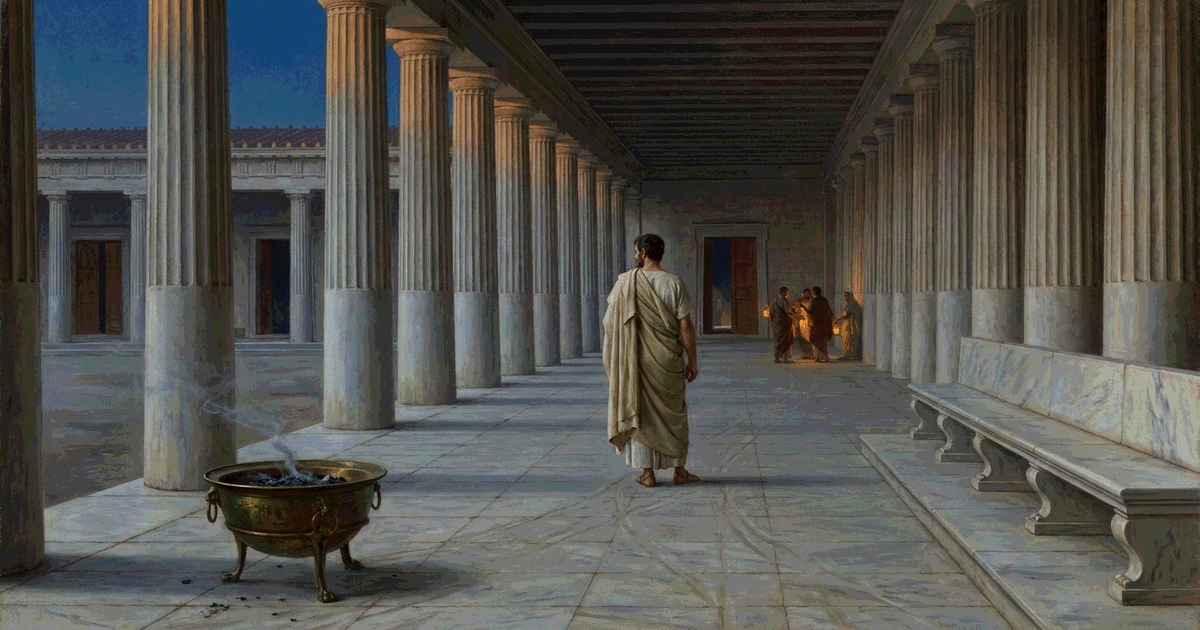
The city-state as the essential context for human flourishing. For Aristotle, humans are political animals by nature, and the polis provides the community structure within which virtue can be developed and practiced.
Etymology
From the Greek polis, meaning “city” or “city-state.” The root appears in “politics,” “police,” and “metropolitan.” For the Greeks, polis was more than a geographic location; it was the entire political, social, and moral community that made human flourishing possible. Aristotle famously declared that “man is by nature a political animal” (politikon zoon), meaning that humans can only achieve their full potential within the communal life of the polis.
Deep Analysis
Aristotle’s declaration in the Politics that “man is by nature a political animal” (zoon politikon) is one of the most cited and least understood claims in the history of philosophy. He did not mean that humans naturally gravitate toward government or that people enjoy politics. He meant that human beings can only fulfill their nature, can only achieve eudaimonia (flourishing), within the organized community that he called the polis. The polis is not a convenience for individuals who would otherwise be self-sufficient. It is the necessary context for the full expression of human capability.
The claim is grounded in Aristotle’s observation that human beings possess the capacity for speech (logos), which distinguishes them from other social animals. Bees and ants cooperate, but they do not deliberate about the good. Speech enables humans to discuss what is just and unjust, beneficial and harmful, and to organize their common life around shared judgments about these questions. This deliberative capacity can only be exercised within a community of other speaking, reasoning beings. The person outside the polis, Aristotle argues, is “either a beast or a god,” because only beasts and gods can be self-sufficient without community.
The polis differs from modern conceptions of “the state” in a crucial respect. The modern state exists primarily to protect rights, enforce contracts, and provide security. Aristotle’s polis exists for the good life, not merely for life. The polis that merely keeps its citizens alive and secure has fulfilled only the minimal function. The polis that enables its citizens to live excellently, to develop their intellectual and moral virtues, to participate in governance, and to flourish as complete human beings, has fulfilled its proper function. This is why Aristotle argues that the polis is prior to the individual: not chronologically, but in the order of purpose. The individual exists for the sake of the good life, and the good life is possible only within the polis.
The relationship between the polis and individual arete (excellence) is one of mutual constitution. The quality of the polis shapes the character of its citizens, and the character of the citizens determines the quality of the polis. A well-governed polis produces excellent citizens because its laws, institutions, and customs habituate people toward virtue. Excellent citizens produce a well-governed polis because they participate wisely in governance and hold the community to high standards. The virtuous circle is also a vicious one: a poorly governed polis degrades its citizens’ character, and degraded citizens govern poorly.
Koinonia (fellowship, partnership) is the mode of relationship that operates within the polis. The polis is not a collection of atomized individuals pursuing private interests within a shared legal framework. It is a koinonia, a partnership oriented toward the common good. Citizens of the polis participate in its governance, share responsibility for its decisions, and identify their own well-being with the well-being of the community. This conception stands in sharp contrast to modern liberal individualism, where the individual’s private interests are primary and the state exists to protect the space in which those interests are pursued.
Philotimia (love of honor) played a crucial role in the civic life of the historical Greek poleis. The desire for recognition motivated wealthy citizens to fund public works, equip warships, and sponsor festivals. It motivated ordinary citizens to serve in the military, participate in the assembly, and contribute to the courts. The polis harnessed the natural human desire for honor and channeled it toward public benefit. When philotimia was properly directed, the result was extraordinary civic contribution. When it was corrupted, the result was the kind of destructive political competition that contributed to Athens’s decline.
Modern Application
You cannot develop excellence in isolation. The polis reminds you that character is forged in community, tested by others, and expressed through contribution to something larger than yourself. Whether your 'polis' is your team, organization, or broader community, your flourishing is inseparable from theirs.
Historical Examples
Athens during the fifth century BCE, particularly under Pericles’s leadership, represents the polis at its most ambitious. The Athenian experiment in direct democracy required ordinary citizens to participate in governance, serve on juries, and deliberate on matters of war and peace. Pericles’s Funeral Oration, as recorded by Thucydides, describes Athens as a polis where citizens participate actively in public life and where private excellence serves the public good. The speech is both a description of Athenian ideals and an aspirational vision that the reality often failed to match, but it articulates the polis concept with unmatched eloquence.
Sparta provides the counterpoint: a polis organized almost exclusively around military excellence. The Spartan system subordinated every dimension of individual life, education, marriage, property, and daily routine, to the single purpose of producing superior warriors. The result was extraordinary military capability at the cost of intellectual, artistic, and commercial development. Sparta demonstrates both the power and the danger of the polis concept: the community that shapes character shapes it for better or worse depending on the vision of excellence that guides it.
The founding of the American republic represents a modern attempt to construct a polis in the Aristotelian sense. The Federalist Papers, particularly Federalist No. 10 (Madison) and No. 51 (Madison/Hamilton), grapple with the same questions Aristotle raised: how to structure a political community so that it promotes the common good rather than factional interest. The founders’ solution, institutional checks and balances rather than reliance on civic virtue, reflects a more pessimistic view of human nature than Aristotle held, but the project itself, designing a political community that enables human flourishing, is recognizably Aristotelian.
How to Practice Polis
Identify the communities that constitute your personal polis: your team, your family, your professional network, your neighborhood. For each one, ask what you contribute and what you receive. This week, make one deliberate contribution to each community that strengthens its capacity for shared flourishing. Attend to the health of your relationships as you would the infrastructure of a city. Build the systems, rituals, and shared standards that allow your community to hold its members accountable to excellence. Remember that your individual growth is inseparable from the growth of the groups you belong to. Examine which of your communities are thriving and which are decaying, then invest disproportionate energy into the ones most in need of renewal. Create one new ritual or practice this month that brings your community together around shared purpose rather than mere social obligation. Aristotle argued that outside the polis, a person is either a beast or a god. Test this by noticing how your character and motivation shift when you operate in isolation versus within a committed community.
Application Examples
A growing company reaches the size where informal norms can no longer sustain its culture. The founders must decide whether to codify values and create explicit cultural practices or to continue relying on organic cultural transmission. They choose to formalize, not as bureaucracy, but as the intentional construction of the community’s shared framework.
Every organization is a polis in miniature: a community that shapes the character of its members and is shaped by them in return. The founders’ decision to formalize culture acknowledges that beyond a certain scale, the polis must be intentionally designed rather than organically evolved. The question is not whether to structure the culture but whether the structure serves human excellence or merely organizational efficiency.
A remote worker realizes that after two years of working from home, they have lost the daily interactions that previously challenged their thinking, expanded their perspective, and held them accountable to a standard beyond their own. Their work is technically competent but has become narrower and less creative.
The person outside the polis cannot achieve their full potential because certain capacities can only be developed in relationship with others. The remote worker’s experience confirms Aristotle’s insight: excellence requires community. The solution is not necessarily returning to an office but intentionally constructing the network of relationships that provide intellectual challenge, honest feedback, and shared standards.
A new manager inherits a team where every member is individually talented but the team produces mediocre collective results. Investigation reveals that the team has no shared sense of purpose, no norms for how to work together, and no mechanism for resolving disagreements. Each person optimizes for their individual performance rather than the team’s collective output.
A group of talented individuals is not a polis. It is a collection of people sharing resources. The manager’s task is to transform the collection into a community by establishing shared purpose, collective norms, and mutual accountability. Until the team operates as a polis, its collective output will remain less than the sum of its individual capabilities.
A suburban neighborhood discovers that despite living in close proximity for decades, most residents do not know their neighbors’ names, have never participated in a local decision, and feel no connection to the community’s future. A small group proposes regular gatherings, shared projects, and a neighborhood council.
Physical proximity without shared purpose produces a neighborhood, not a polis. The proposal to create gatherings, projects, and governance structures is an attempt to transform proximity into genuine community. The Greeks would have recognized that this transformation requires not only structures but the willingness of members to subordinate some private interests to the common good.
A school redesigns its governance to include students in decision-making about curriculum, discipline policies, and school culture. Initially chaotic, the process gradually produces students who understand the complexity of institutional decisions, feel genuine ownership over their school, and develop the civic capacities that will serve them as adult citizens.
Including students in school governance is paideia for democratic citizenship. The polis requires citizens who can deliberate, disagree productively, and commit to decisions they did not initially support. These capacities are developed through practice, not through civics textbooks. The school that gives students genuine governance experience is forming the citizens its community needs.
An open-source software community operates with elected maintainers, a code of conduct, a dispute resolution process, and a shared vision for the project’s future. Contributors from dozens of countries participate not for compensation but because the community’s purpose aligns with their own. When internal conflicts arise, the governance structures resolve them. When external threats appear, the community responds collectively.
Open-source communities that function well are poleis in the Aristotelian sense: organized communities where members participate in governance, share a purpose that transcends individual interest, and develop their capabilities through their participation. The community shapes the character of its members, and the character of its members shapes the community.
Common Misconceptions
Translating polis as “city-state” is technically accurate but conceptually misleading. The polis is not a governmental entity in the modern sense. It is the total community within which human life achieves its fullest expression. The buildings, the laws, and the government are parts of the polis, but the polis itself is the community of citizens who share a life together. Another misconception projects modern individualism onto the Greek concept. Aristotle did not argue that the individual should be subordinated to the state. He argued that individuals can only achieve their full potential within a community oriented toward the common good. The relationship is not one of subordination but of mutual constitution: the individual needs the polis, and the polis needs individuals of excellent character.
I have built and been part of many organizations, and the single greatest predictor of their quality is whether the people inside them experience the organization as a genuine community or as a shared workplace. The difference is palpable within minutes of walking through the door.
In the organizations that function as genuine communities, people argue about things that matter. They hold each other accountable not because a manager requires it but because they have internalized a shared standard. They invest in each other’s development because they understand that the quality of the community depends on the quality of its members. When someone leaves, the loss is felt as a gap in the community, not merely as a position to be filled.
In the organizations that are merely shared workplaces, people are polite and professional. They meet their individual objectives. They participate in team activities when required. But there is no shared purpose that transcends individual career advancement. No one challenges anyone because there is no shared standard to appeal to. People leave without the community noticing because there was no community to notice.
The difference is not accidental. It is the result of deliberate choices about how the organization is structured, what is valued, and what is tolerated. The organizations that function as genuine communities have leaders who understand, even if they have never read Aristotle, that the organization exists for the good life of its members, not merely for the production of goods and services. This does not mean they are soft or undemanding. The best communities I have been part of were the most demanding, precisely because the shared standard was high and everyone was committed to maintaining it.
Frequently Asked Questions
What is polis in Greek philosophy?
Polis is the Greek concept of the city-state as the essential context for human flourishing. For Aristotle, the polis was not merely a political structure but the communal environment within which virtue could be developed, practiced, and expressed. Humans achieve their full potential only within community. Aristotle famously declared that "man is by nature a political animal," meaning that human excellence requires the social structures and relationships that only communal life provides.
What does polis mean?
Polis means city or city-state. For the ancient Greeks, it described the entire political, social, and moral community that made civilized life possible. The word is the root of politics, police, and metropolitan, all reflecting the polis as the foundation of organized human life. The polis was more than a geographic location; it was the living web of relationships, laws, and shared purpose that allowed humans to develop virtues impossible in isolation.
How do you practice the principles of polis?
You practice polis principles by investing in your communities and recognizing that your flourishing depends on theirs. Contribute actively to your team, organization, and broader network. Build shared standards and systems of mutual accountability. Treat community health as inseparable from personal growth. Start by identifying one community you belong to that needs strengthening, and commit to one specific contribution this month that builds its capacity for shared excellence.
What is the difference between polis and koinonia?
Polis is the broader political and social structure that provides the context for flourishing. Koinonia is the deeper quality of fellowship and communion within any community. A polis provides the structure; koinonia provides the relational depth that makes the structure meaningful. A city can have the structure of a polis without the spirit of koinonia, and the result is a community that functions mechanically but fails to foster genuine human connection.