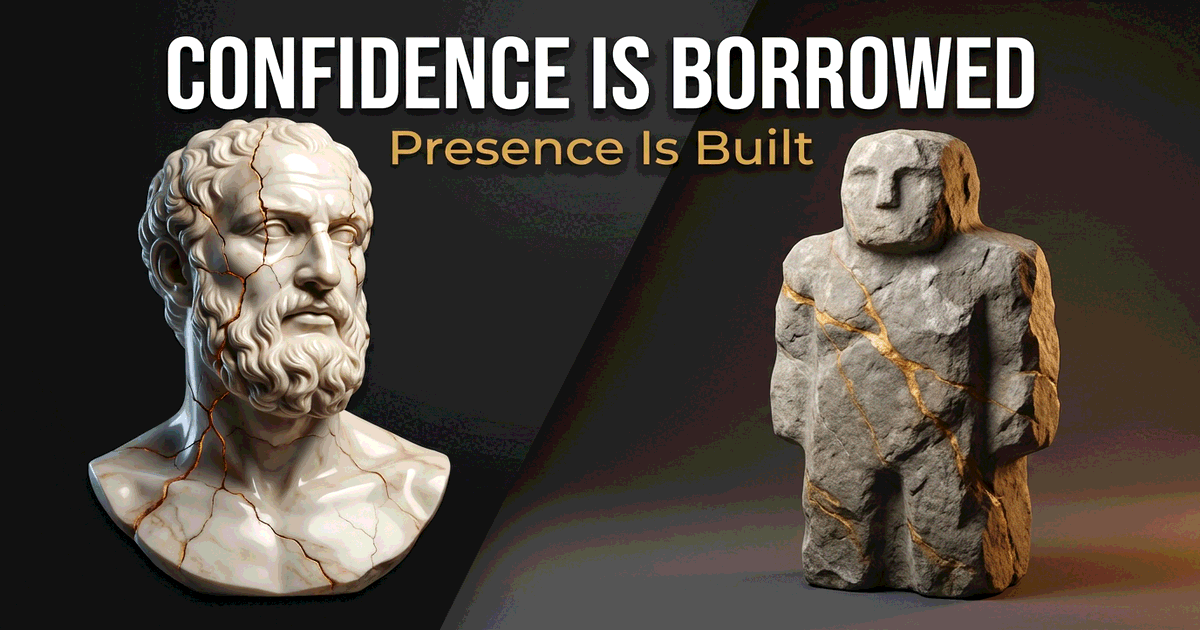
Confidence Is Borrowed. Presence Is Built.
By Derek Neighbors on May 1, 2026
The confidence industry is built on a premise nobody questions: you need more confidence.
More affirmations. More power poses. More visualization of your future self, standing tall, projecting certainty, walking into rooms like you own them. The pitch is always the same. Believe in yourself harder and reality will cooperate.
I bought it for years. Most high-performers do at some point. And here’s what I learned: confidence built on performance degrades the moment the performance stops. Miss the target, lose the deal, get the diagnosis you didn’t expect, and the confidence you spent months manufacturing evaporates in an afternoon. Because it was never yours. You were borrowing it from circumstances that happened to be favorable.
The ancient Greeks didn’t pursue confidence. They pursued something that sounds similar but operates on entirely different physics. They called it prosoche, disciplined attention to what is happening right now. Not certainty about the future. Not evidence from the past. Attention. To this moment. To what it requires.
That distinction changed how I approach every high-stakes situation I walk into.
The Confidence Problem
Confidence is conditional. It depends on evidence.
You feel confident after the successful presentation, not before it. You feel confident when the numbers are good, the feedback is positive, the circumstances are confirming what you hoped was true about yourself. Remove the evidence and the feeling collapses. The person who was “confident” in the Monday meeting crumbles when the Thursday data contradicts everything they projected.
This is the dirty secret of the confidence industry. Outcome-confidence is a lagging indicator. It follows success. It doesn’t precede it. Competence-based confidence can precede a specific success if you carry relevant skill from adjacent domains. But the confidence most people chase, the feeling of certainty about a specific outcome, only arrives after the outcome has already gone well. Which means the moments that matter most, the situations where you’re facing genuine uncertainty, entering unfamiliar territory, confronting stakes you’ve never encountered, are precisely the moments confidence abandons you. Your evidence bank is empty. There’s nothing to borrow from.
What most people call “confidence building” is really evidence accumulation. You’re stacking wins so you can draw against them later. The account has a balance, and every setback is a withdrawal. The bankruptcy is predictable. It’s just a matter of when the withdrawals outpace the deposits.
I’ve watched this cycle play out in executives who rise through a specific domain, accumulating confidence from years of demonstrated competence, then step into a new role and fall apart. The competence was real. The confidence it generated was real. But both were domain-specific. Neither transferred to the new context, and without something deeper underneath, the leader who looked unshakeable in their old role looked lost in the new one.
The problem isn’t that confidence is useless. Within its domain, confidence functions. A surgeon who has performed a thousand procedures should feel confident performing the thousand-and-first. And there’s a deeper form of confidence that doesn’t borrow from outcomes at all: the confidence that comes from knowing you’ve aligned your actions with your values, regardless of results. Epictetus had this confidence as a slave. It didn’t come from winning. It came from character. But outcome-confidence, the kind most people chase, the kind the industry sells, has no foundation beneath it. It’s a house built on the last few months of weather. Change the weather and the house comes down. And in the moments that define careers and characters, the weather always changes.
What Presence Actually Is
Presence is not confidence’s gentler cousin. It’s a fundamentally different orientation toward reality.
prosoche in the Stoic tradition was the practice of sustained, disciplined attention. Not meditation in the modern sense. Something more active. The continuous exercise of bringing your full awareness to whatever is in front of you, whether that’s a conversation, a crisis, a meal, or a decision that could reshape the next decade of your life.
The person with presence in a crisis doesn’t feel confident. They feel alert. They feel the weight of the situation without needing to pretend it’s lighter than it is. They’re not performing certainty for the room. They’re actually here, registering what’s happening, asking what it requires.
Marcus Aurelius never wrote about confidence in the Meditations. Not once. He wrote about attention. About returning to the present task when the mind wanders toward anxiety or ambition. About the discipline of engaging with what is rather than what might be.
Here’s the practical difference. Confidence says: “I can handle this because I’ve handled things like it before.” Presence says: “I’m here. This is what’s happening. What does it need from me?”
The first statement depends on a match between past and present. When the match holds, confidence works. When the situation is genuinely novel, confidence has nothing to say. Presence doesn’t need a match. It only needs you in the room, awake, paying the kind of attention that most people have stopped practicing.
Why Presence Wins
Confidence has a ceiling: your evidence bank. Run through enough unfamiliar situations without winning and the bank empties. Presence has no ceiling because it draws from nothing external.
This difference becomes obvious in novel situations. First leadership role. Unfamiliar market. Personal crisis. Conversation you’ve never had before and hope you never have again. Confidence has nothing to draw from in these moments. Presence operates regardless because the question it asks never changes. Am I here? Am I paying attention? What is this situation telling me?
The leader with presence can say “I don’t know” without it destroying their authority. The leader running on confidence can’t, because admitting ignorance depletes the very resource they depend on. Watch a confident person get asked a question they can’t answer and you’ll see the entire performance stutter. Watch a present person get asked the same question and you’ll see them lean in. The gap in knowledge doesn’t threaten them because their authority was never built on knowing. This doesn’t mean presence substitutes for competence. You still need to know your craft. But presence without competence is a beginner engaging honestly with their limitations. Confidence without presence is an expert performing certainty while missing what’s actually happening.
Presence is anti-fragile in a way outcome-confidence can never be. Pressure demands more attention, and composed attention is presence. The harder the situation, the more material there is to engage with, the more presence has to work with. Outcome-confidence weakens under novel pressure. Presence sharpens.
And here’s the relationship the binary framing misses: presence, practiced over time, generates the only confidence worth trusting. Years of genuine engagement build phronesis, practical wisdom, the capacity to read situations accurately and respond well. That capacity produces earned confidence, not borrowed from outcomes but built through sustained attention to reality. Presence doesn’t replace confidence. It produces the kind that has a foundation under it.
I’ve noticed this in the leaders I respect most. They’re not the most confident people in the room. They’re the most attentive. They hear what others miss. They notice the shift in energy before anyone names it. They ask the question that reframes the entire conversation, not because they’re smarter, but because they’re actually listening while everyone else is rehearsing what they’re going to say next.
Building Presence
Presence isn’t a personality trait. It’s a practice. This distinction matters because it means it’s available to anyone willing to train it.
askesis, the Stoic discipline of training, applied to presence means something specific: the daily practice of returning your attention to what’s in front of you. Not once. Repeatedly. The mind wanders. You bring it back. It wanders again. You bring it back again. The muscle develops through the repetition, not through a single heroic act of focus.
Three practices that build presence:
The pause before responding. Not for dramatic effect. Not as a power move. A genuine pause to register what was actually said before constructing your response. Most people in conversation are not listening. They’re loading their next sentence while the other person is still talking. The pause breaks this pattern and forces actual engagement.
Single-tasking. The fragmented attention of modern work is the enemy of every form of depth. Do one thing. Finish it or reach a natural stopping point. Then do the next thing. This feels inefficient until you notice that the quality of each task improves dramatically when your full mind is on it.
Sitting with discomfort instead of performing past it. When the hard conversation happens, when the news is bad, when the room is tense, the confident person performs calm. The present person actually engages with the discomfort. They feel it. They name it if appropriate. They stay with it rather than rushing to resolve it. This builds a tolerance for difficulty that no amount of affirmation can replicate.
Presence compounds the way confidence never does. The person who has spent years genuinely engaging with hard conversations, difficult decisions, and uncomfortable silence develops a quality of perception that the confidence-chaser never builds. They see things others miss. They read rooms before the room reads itself. That capacity wasn’t downloaded from a motivational seminar. It was built, one moment of sustained attention at a time.
There’s something else the long-term practitioners of presence report that goes beyond better meetings and sharper perception. Sustained attention, practiced for years, changes what you see. You start noticing patterns beneath patterns. You perceive motivations people haven’t articulated to themselves. You develop a relationship with reality that the distracted mind can never access, not because you’re smarter, but because you’ve spent enough time actually looking.
The presence audit: think back to your last difficult conversation. Were you listening or rehearsing? Were you in the room or in your head? The honest answer tells you exactly where your practice stands.
Final Thoughts
Presence is available to you right now. Not after the next win, not after the certification, not after the promotion. Right now. It asks nothing of your history and nothing of your future. It only asks whether you’re here.
You don’t need more affirmations. You don’t need another morning routine designed to pump you up before the day starts deflating you. You need the discipline to be where you are, with what’s happening, fully engaged with whatever it demands. That capacity doesn’t deplete. It compounds.
The most reliable people aren’t the most confident. They’re the most present. They heard what others missed. They stayed when others performed. They could say “I don’t know” and the room trusted them more for it, not less.
That’s the foundation confidence pretends to be. And unlike confidence, it doesn’t need last month’s wins to hold you up today.
If you’re ready to build the kind of presence that doesn’t expire when circumstances change, MasteryLab.co is where that practice begins.


