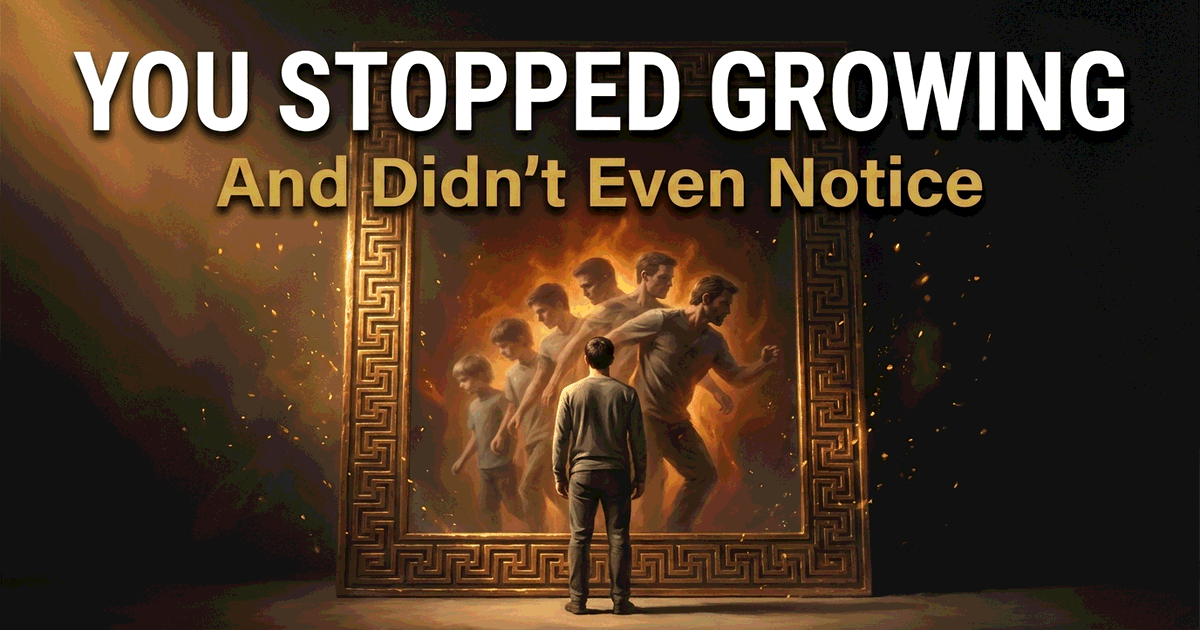
You Stopped Growing and Didn't Even Notice
By Derek Neighbors on February 21, 2026
Think about who you were ten years ago. Your beliefs, your priorities, the things you were certain about. If you’re honest, that person feels like a stranger. You’ve changed so fundamentally that your past self’s convictions now seem naive, incomplete, or flat out wrong.
Now here’s the question that should unsettle you: why do you assume the process stopped?
The End of History Illusion
Psychologist Daniel Gilbert spent years studying a phenomenon he called the “end of history illusion.” His research, conducted across thousands of participants ranging from teenagers to retirees, revealed something remarkable. People at every single age acknowledged that they had changed enormously over the previous decade. Their values shifted, their personalities evolved, their preferences transformed.
And at every single age, those same people predicted that they would change very little in the coming decade.
Read that again. The pattern held whether the subject was 18 or 68. A fifty-year-old could look back at forty and see a different person. But looking forward to sixty? “I’m pretty much who I’m going to be.”
The data says otherwise. When Gilbert measured actual change over time, it matched the magnitude of remembered change. The forty-year-old who felt settled would, by fifty, have transformed as much as they had in the previous decade. They were wrong about being finished, and they were wrong at every checkpoint along the way.
This isn’t a flaw in certain personality types. It’s a feature of being human. Your brain confuses familiarity with finality. You know your current beliefs, preferences, and values so intimately that you mistake “knowing yourself” for “being done.”
I’ve seen this play out in accomplished leaders with decades of experience. A CEO who built a company on aggressive growth refuses to consider that the next chapter demands a fundamentally different approach to leadership. A senior engineer who mastered one paradigm dismisses emerging approaches without real investigation. A founder who identified so completely with scrappy startup culture that they couldn’t evolve when the organization outgrew it. In each case, self-knowledge became a cage rather than a compass. The very thing that once helped them grow became the barrier to growing further.
What the Greeks Understood
The ancient philosophers never made this mistake.
Aristotle defined eudaimonia, the Greek concept usually translated as “happiness” but more accurately rendered as “flourishing,” as an activity, not a state. Not something you achieve and protect. Something you practice and renew. He was explicit: flourishing is an ongoing act, not a destination where you park and collect rewards.
This wasn’t philosophical abstraction. It was a fundamental claim about human nature. Aristotle’s framework of dynamis and energeia captures the truth that Gilbert would prove with data two thousand years later. dynamis is potentiality, your capacity to become something you are not yet. energeia is actuality, but not in the way we typically use that word. energeia means “being-at-work.” It’s the active, ongoing expression of your potential.
You are always in dynamis. There is always more of you that hasn’t happened yet. And energeia isn’t the moment you arrive. It’s the process of arriving. Perpetually.
The Greeks understood that treating yourself as a finished product wasn’t maturity or self-knowledge. It was the end of flourishing. The moment you stop becoming, you stop living in the way that matters most.
Why Certainty Feels So Good
If the evidence is this clear, why do we keep falling for the illusion?
Because being done feels earned. After decades of struggle, growth, and reinvention, the idea that you’ve “figured yourself out” is deeply appealing. It feels like the payoff for all that work. You’ve found your values. You know your strengths. You’ve built a life that reflects who you are.
The problem isn’t that any of that is wrong. The problem is what happens next. Self-knowledge hardens from a tool into a territory. “I know myself” becomes “I’m done learning about myself.” And from there, everything that challenges your self-concept gets filtered out. Not consciously. Not maliciously. Automatically.
You stop trying things because they’re “not you.” You dismiss feedback that doesn’t match your self-image. You avoid situations where you might discover that your carefully constructed identity has gaps.
The Greeks had a word for this kind of transformation too. metanoia, literally a change of mind, a radical shift in how you see yourself and the world. They didn’t treat metanoia as something that happens to you in a crisis. They treated it as a discipline. A practice of holding your identity loosely enough that new truths can get through.
Marcus Aurelius, ruling the most powerful empire on earth, wrote private journals filled with self-correction. Not from a position of weakness. From a position of understanding that the most dangerous thing a leader can believe is that their current perspective is complete.
His journals weren’t confessional exercises. They were a technology for staying in motion. Every evening, Marcus would review where his thinking had been rigid, where his reactions had been automatic rather than chosen, where he had confused the comfort of a familiar response with the rightness of it. He understood that leadership demands a mind that remains responsive to new information, even when that information contradicts years of accumulated certainty.
The Museum and the Forge
Here’s the practical fork in the road.
You can treat your identity like a museum. Curate it. Protect it. Put velvet ropes around your beliefs and “do not touch” signs on your self-concept. Museums are beautiful. They’re also dead. Nothing in them changes or grows. They exist to preserve what was, not to create what could be.
Or you can treat your identity like a forge. Hot, uncomfortable, constantly reshaping. A forge doesn’t preserve. It transforms. The raw material goes in one thing and comes out another. And the process never has a final product, only the next version.
The question “who am I?” builds a museum. The question “who am I becoming?” fires up the forge.
The forge mindset shows up in small decisions. It’s the leader who takes on a project outside their expertise, not because they need to prove something, but because the discomfort of not knowing is where the next version of themselves lives. It’s the experienced professional who asks a junior colleague to challenge their assumptions, not as a performance of humility, but as a genuine practice of staying unfinished. It’s choosing the conversation that makes you uncomfortable over the one that confirms what you already believe.
This doesn’t mean identity instability. It doesn’t mean reinventing yourself every quarter or chasing novelty for its own sake. It means treating your edges as permeable rather than permanent. It means recognizing that the beliefs you hold most tightly might be the ones most due for examination.
Think about it this way. Every identity you’ve outgrown once felt permanent. Every conviction you’ve abandoned once felt like bedrock. The pattern has repeated itself across every decade of your life. The only question is whether you’ll acknowledge that it’s still happening.
The Test
Here’s a diagnostic worth taking seriously.
Pick your strongest held belief right now. The one that feels most “you.” The conviction you’d defend without hesitation.
Now imagine a version of yourself in 2036 who sees that belief differently. Not because they’re worse or less informed, but because they’ve had experiences and encounters and realizations that your current self can’t predict.
If you can’t imagine that person, the illusion has you. If you can, you’ve found the edge where growth is waiting.
Try a second test. Look at your calendar from the past month. How many of the things you did were inside your established competence? How many pushed you into territory where you might fail, look foolish, or discover you were wrong about something? If the ratio skews heavily toward the familiar, the illusion isn’t operating in the abstract. It’s shaping your days. The end of history illusion doesn’t announce itself with a dramatic refusal to change. It whispers through a thousand small choices to stay comfortable.
The people who transform most consistently aren’t the ones with less self-knowledge. They’re the ones who hold their self-knowledge loosely enough that new information can still get through. They’ve learned to respect their current identity without defending it against the person they’re becoming.
Final Thoughts
The end of history illusion persists because it’s comfortable. And comfort, as the ancients understood, is the most reliable sign that you’ve stopped doing the work that matters.
eudaimonia demands continuous becoming. Not because your current self is wrong, but because flourishing is a verb. The moment you turn it into a noun, something you “have” rather than something you “do,” it begins to decay.
The person you’ll be in a decade is already watching your current certainties. They’re watching with the same mix of tenderness and disbelief that you feel when you look back at who you were ten years ago. The kindest thing you can do for that future self is to leave the door open.
You haven’t stopped changing. You’ve only stopped noticing. And the gap between those two things is where growth goes to die.
If you’re ready to stop defending yesterday’s version of yourself and start building tomorrow’s, MasteryLab.co is where transformation meets practice.