You're Not Too Intense. Everyone Else Is Too Comfortable.
By Derek Neighbors on January 31, 2026
Someone told you that you’re “too much.” Too intense. Too driven. Too obsessed with something that doesn’t seem to matter that much to anyone else.
The implication was clear: something is wrong with you.
But notice the hidden assumption. Their comfort level is the measure of sanity. Their energy is the baseline. Anyone operating above it has a problem. Anyone below it is just relaxed.
They have it backwards.
The Two Paths
Everyone faces the same fork, usually multiple times.
Path A: Dial it back. Fit in. Be “reasonable.” Match the energy of the room, which almost always means lowering yours. Pursue comfort and call it balance.
Path B: Stay intense. Pursue excellence. Accept that you’ll be misunderstood, probably for years. Build something that matters more than approval.
Path A feels safe. It isn’t. It’s the most dangerous choice you can make. The soul atrophies in comfort the way muscles atrophy in bed rest. But it’s socially rewarded, so it feels like wisdom. Every time you match the room’s low expectations, you reduce friction. People stop calling you difficult. You get invited to more things. The pressure eases. And something essential in you goes quiet.
Path B feels isolating in the moment. You get labeled. Too much. Obsessed. Unable to relax. People stop inviting you to things, or they invite you but roll their eyes when you leave early to work. The friction never fully eases. But the isolation is temporary. The connection to excellence, to truth, to your own becoming, is the deepest connection there is. The loneliness of the path is real. The loneliness of arriving is not.
So most people choose Path A. And most people spend their lives with a quiet hum of dissatisfaction they can never quite name. But it has a name. It’s the soul recognizing its own betrayal.
The Comfortable Life
Here’s how Path A works in practice.
You optimize for friction reduction. You match your energy to whatever environment you’re in, and that matching almost always moves in one direction. Down. You start treating ambition as something to outgrow, like it was a phase you went through in your twenties. You define success as “work-life balance” without ever defining what the life is for.
The surface benefits are real. Less conflict. Social acceptance. Reduced anxiety about performance. Simpler decisions, because you just do what everyone else does.
But the costs are hidden.
There’s a chronic low-grade dissatisfaction that never quite rises to crisis level. It’s not dramatic enough to force change, just persistent enough to drain color from things. There’s the nagging sense that you’re capable of more, which you learn to dismiss as ego. There are relationships built on mutual limitation, where the unspoken agreement is that neither of you will challenge the other to grow. And there’s the destination you’re quietly approaching: dying with potential still inside you.
The Greeks had a word for what’s missing here. They called it telos, the purpose or end toward which something naturally aims. A knife’s telos is to cut. A knife that doesn’t cut isn’t just underperforming. It’s failing as a knife. A human’s telos is to flourish through the full expression of their rational and moral capacities. A human who doesn’t pursue that isn’t just underperforming. They’re failing as a human.
Life without telos isn’t wrong in some cosmic sense. It’s just empty in a personal one. And emptiness, pursued long enough, becomes its own kind of failure.
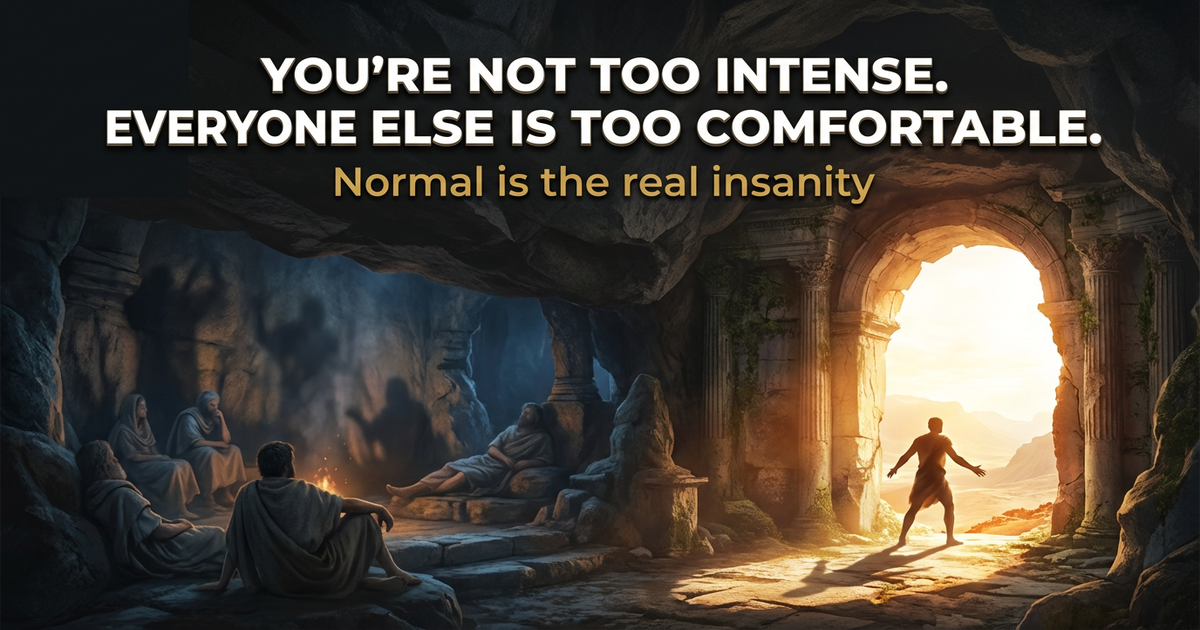
Plato understood this. His cave allegory depicts people who’ve lived their entire lives watching shadows on a wall, convinced the shadows are reality. They’re comfortable. They agree with each other about what they’re seeing. Everything makes sense within their frame.
When someone escapes and sees actual light, then returns to describe it, the cave-dwellers think he’s gone mad.
The Intense Life
Path B works differently.
You orient around a vision that exceeds your current capacity. You accept that growth requires sustained discomfort, that the person who can build what you’re imagining doesn’t exist yet and must be forged. You choose excellence over approval. You treat difficulty as the path, not an obstacle to the path.
The benefits here are not surface-level. They’re structural.
You get alignment between your values and your actions. No internal contradiction, no energy wasted managing the gap between who you claim to be and what you actually do. You get the satisfaction of becoming what you’re capable of becoming, which is a different satisfaction than feeling good. It’s the satisfaction of capacity realized, potential converted into actuality.
You get relationships with people who understand what you’re building, who don’t need you to be smaller for them to feel comfortable. And you get the destination you’re aiming for: dying empty, having spent yourself fully, with nothing left over that should have been used.
The costs are real. They’re also the price of admission.
Being misunderstood, often for years. Losing relationships that required your smallness. Periods of doubt when progress is invisible and the intensity feels like madness even to you. The loneliness of pursuing what others won’t. These aren’t unfortunate side effects. They’re the forge.
This is arete in action. Excellence. The relentless pursuit of your highest potential as a human being. And this capacity exists in every rational soul. It isn’t a gift some people have and others lack. It’s a capacity everyone possesses that some choose to develop and others choose to let atrophy.
This is what eudaimonia actually requires. Not happiness as feeling good, not the pleasant emotional state that comfort chases. Flourishing. Fulfillment. Becoming good, which is harder than feeling good but more lasting.
The Real Difference
Here’s what actually matters about these two paths.
Path A optimizes for the feeling of comfort now. Path B optimizes for the reality of becoming over time.
These aren’t equally valid lifestyle choices. One fulfills human nature. The other diminishes it.
The Greeks understood that humans have a telos, a purpose built into our nature the way sharpness is built into a knife. Aristotle called this our ergon, our function. Just as the function of a knife is to cut, the function of a human is to exercise reason toward excellence. Fulfilling that function requires sustained effort. It requires discomfort. It requires growth and the friction that growth produces.
The “mad” ones pursuing excellence are actually aligned with human nature. They’re doing what humans are designed to do. The “sane” ones pursuing comfort are the ones living against their design.
Look at the long-term trajectories.
Path A compounds into regret. The unlived life accumulates weight. What you didn’t do becomes heavier than what you did. The ceiling you accepted becomes the ceiling your children inherit as the family norm.
Path B compounds into capability. The intensity builds capacity. What felt impossible becomes possible, then easy, then the baseline from which you reach for the next impossible thing.
The comfortable majority will tell you you’re wrong. They need you to be wrong for their choice to make sense. Your intensity threatens their peace, not because you’re judging them, but because your existence is evidence that more is possible and they chose less.
The Integration
Intensity without direction burns out. telos matters. The intensity must serve something beyond itself or it becomes its own form of avoidance, endless striving that never connects to meaning.
Intensity without rest breaks down. Recovery is part of the path, not a deviation from it. Strategic rest that enables more intensity is wisdom. Rest as default is surrender.
Intensity as escape from self is just another cave. If you can’t be still, if every moment must be filled with striving, you’ve traded one shadow show for another.
This isn’t about everyone pursuing the same form of intensity. The obligation isn’t to match someone else’s path. It’s to pursue your own highest capacity, whatever form that takes. A philosopher’s intensity looks different from an athlete’s. A parent’s intensity looks different from an entrepreneur’s. The expression varies. The requirement to pursue excellence in your domain does not.
When is comfort appropriate?
When it’s strategic. When it’s recovery between periods of focused effort. When it’s presence with people you love, presence that requires the capacity you built through discipline. Comfort in service of continued intensity is part of the path. This is rest as fuel, not rest as destination.
But comfort as the goal is the problem. Comfort as the measuring stick. Comfort as the reason to dial back something that matters. This is comfort as avoidance, and the soul knows the difference even when the mind pretends not to.
The advanced understanding is this: the choice isn’t intensity versus comfort. It’s what the intensity serves.
Intensity in service of arete builds character. Comfort in service of continued intensity is strategic. The error is treating comfort as the goal rather than the fuel.
How do you know which path you’re on?
If your life requires defending to yourself, if you have to keep explaining to yourself why this is fine, you’re on the wrong one.
If the people calling you “too much” are doing less with their lives than you are, their opinion is projection. They’re describing their ceiling and calling it a diagnosis.
If you’re more afraid of regret than difficulty, more afraid of the unlived life than the hard one, you already know which path you belong on.
Final Thoughts
You were told you’re too intense. That was someone else defending their comfort.
The real question isn’t whether you’re too much. It’s whether you’re enough for what you’re building. Whether the intensity matches the vision. Whether you’re willing to be misunderstood for as long as it takes.
Plato’s cave-dwellers called the one who saw the light “mad.” He was the only sane one in the room.
Normal is the real insanity. It just has better marketing.
If you’re done apologizing for your intensity and ready to channel it toward genuine excellence, MasteryLab.co is where people who refuse to be comfortable come to build what matters.