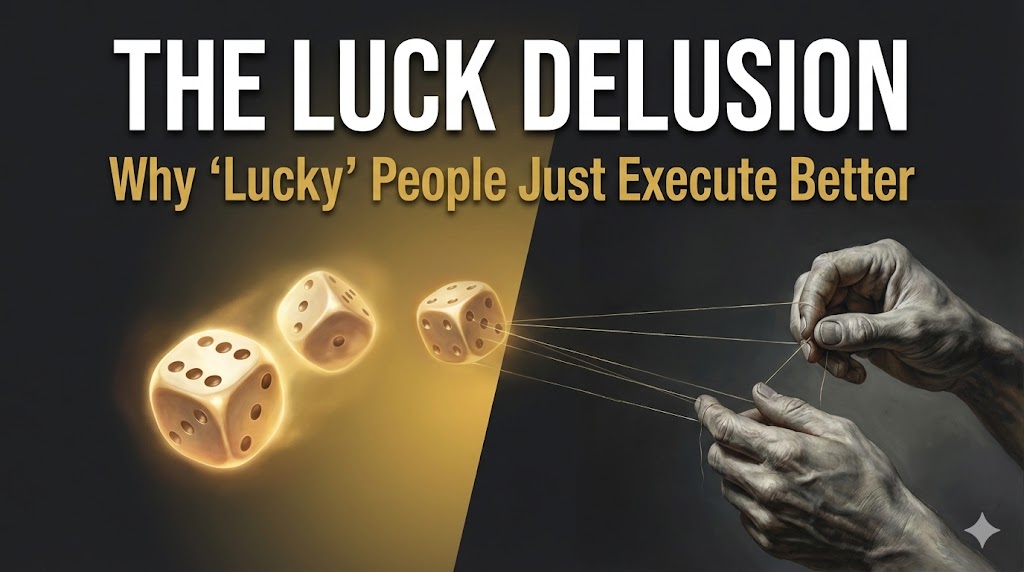
The Luck Delusion: Why 'Lucky' People Just Execute Better
By Derek Neighbors on December 8, 2025
April 1, 1976. Three men sign papers to form Apple Computer Company.
Ronald Wayne holds 10% of the new venture. Steve Jobs and Steve Wozniak hold the rest. Same room. Same company. Same moment.
Twelve days later, Wayne sells his stake for $800. He’s worried about liability. He’s being sensible. At the time, he looks like the smart one. Jobs looks reckless.
That 10% stake today would be worth over $300 billion.
But here’s what makes the story interesting. Jobs didn’t just “get lucky” once.
1985: John Sculley ousts Jobs from his own company. Everyone says he’s finished. 1986: Jobs buys a struggling graphics division from Lucasfilm. Critics laugh. It becomes Pixar. 1997: Apple is 90 days from bankruptcy. Jobs returns. “Lucky” timing. 2001: Jobs launches the iPod. “Who needs another MP3 player?” Lucky again. 2007: Jobs unveils the iPhone. “No physical keyboard? It’ll never work.” Impossibly lucky. 2008: The App Store launches. “A walled garden? Developers will never go for it.” Lucky.
Every single move was mocked, doubted, dismissed. Then it dominated. And the same word appeared every time: lucky.
But even meeting Wozniak wasn’t luck. Jobs met him through a mutual friend who recognized they shared an obsession with electronics. That friend existed because Jobs had spent years immersed in the Silicon Valley electronics scene. At twelve, he’d cold-called Bill Hewlett from the phone book asking for spare parts, and Hewlett was so impressed he gave the kid a summer job at HP. At nineteen, Jobs showed up at Atari’s office and told them he wouldn’t leave until they hired him. They did.
Jobs didn’t stumble into opportunities. He put himself in environments where opportunities existed and engaged relentlessly while others waited for permission.
Meanwhile, Ronald Wayne made the sensible choice in 1976. He’s been watching Jobs “get lucky” for fifty years.
At what point does luck stop being a useful explanation?
The Pattern Nobody Wants to See
The ancient Greeks had a goddess of luck: Tyche. They built temples to her. They prayed for her favor. They understood that fortune plays a role in human affairs.
But Aristotle understood something deeper. “We are what we repeatedly do,” he wrote. Excellence isn’t an act but a habit. And what looks like fortune is usually the visible result of invisible patterns.
When you investigate “lucky” people instead of dismissing them, the same pattern appears across domains.
The entrepreneur who “got lucky” with timing? Look closer. You’ll find years of attempts, pivots, failed launches, and network building that nobody documented. When the “right opportunity” appeared, they were positioned to capture it. The timing wasn’t luck. The positioning was preparation.
The colleague who always gets the promotion, the project, the recognition? Look closer. They volunteer for the unglamorous work. They build credibility through tasks nobody photographs. When visibility opportunities arise, they’ve already earned trust through invisible contribution. Not favoritism. Compounded reliability.
The athlete who catches the “lucky bounce”? Look closer. They put themselves in positions where bounces favor them. They practice scenarios others dismiss as unlikely. When chance goes their way, they’re prepared to capitalize. Not fortune. Preparation meeting probability.
Richard Wiseman spent a decade studying people who considered themselves exceptionally lucky or unlucky. He found four distinct patterns that separated them. Lucky people maximize chance opportunities by being open to new experiences. They listen to intuition developed through attention. They expect good fortune, which creates persistence through setbacks. They transform bad luck to good by finding opportunity in adversity.
The mechanism is straightforward: openness increases exposure to opportunity. Attention helps you notice what others miss. Expectation sustains effort through failure. Reframing extracts value from setbacks. Each behavior multiplies the probability of favorable outcomes.
Every single pattern is a behavior. Not an external event. Not cosmic favor. Choices that compound into what appears to be fortune.
The Execution Gap
Here’s what the evidence reveals.
The gap between “lucky” and “unlucky” people isn’t circumstance. It’s the space between seeing an opportunity and acting on it. Execution means moving before the path is clear. It means acting on partial information when others are still gathering data. It means making the call, sending the email, showing up at the door while everyone else is planning to do it someday.
Lucky people execute on partial information. They move when they have 60% certainty. They know that waiting for 95% certainty means waiting forever, because certainty that high never arrives. By the time the path is obvious, someone else has already walked it. Strategic imperfection beats perfect paralysis every time.
Unlucky people wait. They research. They plan. They discuss. They analyze. And while they’re perfecting their approach, someone less prepared but more willing to act captures the opportunity they were studying.
Jobs didn’t know the iPhone would work. He moved anyway. Wayne calculated the risks and concluded they were too high. He was right about the risks. He was catastrophically wrong about what that information demanded.
This is where the Stoics become useful. Marcus Aurelius wrote that we control our choices and actions, not outcomes. The person who focuses on execution rather than results puts more attempts into the world. More attempts create more opportunities for favorable outcomes. Not luck. Volume of execution.
You can’t get lucky if nobody knows you exist. You can’t catch a break if you’re not in motion when it happens. The “lucky” people aren’t blessed. They’re visible. They’re active. They’re positioned where opportunity flows.
The Comfortable Lie
Here’s why we call others lucky instead of studying their execution.
It protects our ego.
When someone succeeds, we have two choices. We can examine what they did and ask why we’re not doing it. Or we can attribute their success to external forces beyond anyone’s control.
The second option is comfortable. It explains their rise without indicting our inaction. We can feel sophisticated about our analysis while never having to change anything about our approach.
The luck narrative is a psychological safety blanket. It lets us stay spectators, afraid to coast but equally afraid to commit.
Daniel Kahneman’s research on cognitive biases reveals how deeply this runs. We attribute our own successes to skill and our failures to circumstances. But we flip the pattern for others. Their successes become luck. Their failures become incompetence. This asymmetry keeps us comfortable and keeps us stuck.
Every time we call someone lucky, we abdicate agency. The explanation trains us to wait for fortune instead of creating it. We become observers of lives we could be living, hoping for breaks instead of manufacturing them.
Yes, genuine randomness exists. Someone wins the lottery. Someone is born into wealth. Someone happens to sit next to the right person on a plane. But focusing on the rare truly random events is itself a form of waiting. It’s another way to avoid the uncomfortable truth that most of what we call luck isn’t random at all.
Years pass. Nothing changes. Your last 90 days of inaction become your next 90 days of wondering why luck never finds you.
What Actually Creates “Luck”
If luck is manufactured, the question becomes how to manufacture it.
Start by auditing how often you attribute others’ success to fortune. Each attribution is a missed opportunity to learn from their execution. Replace “they got lucky” with “what did they do that I’m not doing?” The shift reveals patterns you were hiding from yourself.
Increase your surface area for luck. Put more work into the world. Show up in more places. Talk to more people. Try more things. Every attempt is a ticket. You can’t win a lottery you didn’t enter, and you can’t catch a break from a position nobody notices.
Build before you need. The skills you develop now determine the opportunities you can capture later, because excellence is rented, not owned. The relationships you nurture in obscurity become the “lucky connections” when they matter. Preparation isn’t waiting. It’s loading the dice so they land where you want.
None of this requires Jobs’ advantages. The principle applies regardless of the size of opportunity in front of you. Someone with no access to Silicon Valley can still execute on whatever door exists in their world. The person who makes one phone call today is manufacturing more luck than the person with every advantage who makes none. Execution scales to your circumstances. Small moves count.
The Greeks called this arete, excellence of function. Not excellence of outcome. Excellence of execution, repeated until results become inevitable. The goal isn’t the material success. It’s becoming the kind of person who executes. The wealth, the recognition, the “lucky breaks” are evidence of character, not the point of developing it.
The Questions That Matter
How often do you call others lucky when they simply executed better than you?
What are you waiting for before you act? What level of certainty would finally be enough?
If luck is manufactured through execution, what are you manufacturing right now?
What would change in your life if you stopped hoping for breaks and started creating them?
Final Thoughts
Ronald Wayne made a sensible decision in 1976. He minimized his risk. He protected himself from potential liability. He made the choice that any reasonable person examining the odds would have made.
Jobs made the reckless decision. He took on the liability. He bet on an uncertain future. He executed repeatedly on partial information, through failures that would have stopped most people, through mockery that would have broken most egos.
One of them spent fifty years watching the other “get lucky.”
Luck isn’t what happens to you. It’s what you’re positioned to capture when circumstances shift. The people we call lucky aren’t blessed by fortune. They’ve built the conditions where fortune flows to them.
You don’t find luck. You build it through execution that others dismiss as reckless until it works.
Pick one thing you’ve been waiting on “the right moment” to pursue. Execute on it this week with incomplete information. See what happens when you stop hoping for luck and start creating it.
The results might look lucky to everyone watching from the outside.
Building the execution capacity to create your own luck is hard when you’re surrounded by people waiting for breaks instead of making them. MasteryLab is the community for people who understand that fortune follows action. Join others who’ve stopped hoping and started manufacturing.


