Why Progress Feels Like Nothing Until It Feels Like Everything
By Derek Neighbors on December 13, 2025
When I started trail running, I couldn’t run up the hills. I could barely run down them. The flats were just for catching my breath.
I’d feel like maybe there was some progress, then I’d try to push the distance from three miles to four and just die. On days I attempted a 10K, I felt like I was going to collapse. It was so hard. But I kept showing up.
Walk the ups. Jog the flats. Stumble down the descents.
Then: walk the ups, jog the flats, run the downs.
Then: jog the ups, run the flats, sprint the downs.
Trying to get out every day. Trying to increase the distance every so often. It felt like no progress. The math said I was improving. My legs disagreed.
Then I entered a 10K race. I pinned on the bib. I ran through the San Tan Mountains as hard as I could push.
I didn’t finish last. I did decent. And for the first time, I felt the progress. All of it. At once.
I felt like a runner.
The breakthrough didn’t arrive gradually. It had been building the entire time. I just couldn’t see it.
The Apparent Contradiction
Here’s what doesn’t make sense: you can work consistently, follow the process, do everything right, measure obsessively, and see nothing change. Then suddenly, disproportionate results appear from what looks like nowhere.
The math feels broken.
You put in months of effort. Nothing. Then one day, everything shifts. Observers call it luck. You know it wasn’t luck. But you also can’t explain why last Tuesday looked identical to every other Tuesday, and this Tuesday changed everything.
This confusion comes from linear thinking. We expect effort to produce proportional, immediate results. We’ve been trained by instant feedback loops and real-time metrics. When we don’t see progress, we interpret silence as failure.
The either/or thinking kicks in: Either I’m making progress, or I’m wasting time. Either results should be visible, or my approach is wrong. Either it’s working, or it isn’t.
But both can be true at the same time. You can be making real progress while seeing nothing. The invisible accumulation and the sudden breakthrough aren’t separate events. They’re the same event, experienced at different moments in time.
The Physics of Transformation
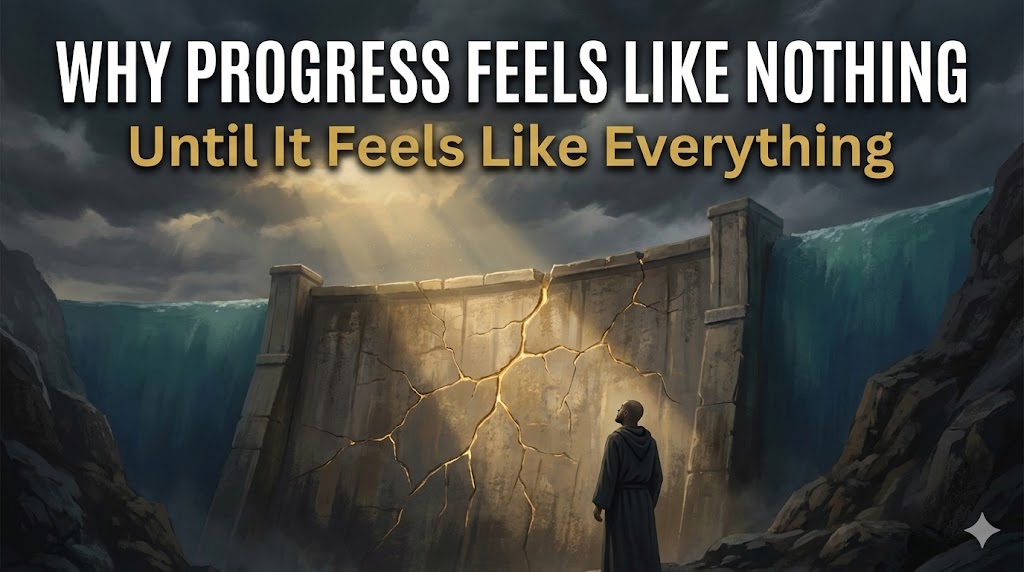
Think about a dam.
Water pressure builds behind it constantly. Silent. Invisible. The dam holds and holds and holds. Nothing appears to be happening. Then one day, it doesn’t hold anymore.
When the dam breaks, the release is catastrophic. All that accumulated pressure explodes at once. But the breakthrough IS the buildup. They’re not separate. The pressure that seemed like nothing was everything, compressed.
This is why transformation is nonlinear.
Small inputs don’t create proportional outputs. They create exponential ones. Systems absorb pressure until they hit critical mass. Water doesn’t get “a little boiling” at 99 degrees. It’s water. Then it’s steam. The transition looks instantaneous, but it required every single degree that came before.
The Chinese bamboo tree spends five years growing underground. Nothing visible. Five years of watering a patch of dirt. Then in the sixth year, it shoots up 80 feet in six weeks.
Was it growing for five years or six weeks? Both. Neither separately. The invisible phase wasn’t delay. It was construction.
The Greeks had a concept for this: karteria, patient endurance. Not passive waiting. Active persistence through uncertainty. The discipline of sustaining effort without visible reward. It’s the character quality that separates those who break through from those who break down.
karteria isn’t hoping things will work out. It’s understanding the physics. The dam doesn’t care about your timeline. It cares about pressure.
How to Navigate the Invisible Phase
The question becomes practical: How do you maintain effort when you can’t see results?
Start by recognizing the difference between accumulation and stagnation. If your effort is consistent, if you’re seeing small improvements in process even without visible outcomes, if discomfort is increasing because you’re at the edge of your current capacity, you’re not stuck. You’re building. Resistance that feels personal often signals the final test before breakthrough.
Then shift what you measure. Excellence is rented, not owned, so stop asking whether you’ve become a runner. Ask whether you ran today. Stop measuring whether the business has succeeded. Measure whether you did the work this week. Results are lagging indicators. Effort is the leading indicator.
Build discipline that doesn’t require motivation, because willpower always fails when you need it most. On the days I didn’t feel like running, the commitment carried me. Not external props. The internal decision, made once and honored repeatedly. Motivation fluctuates. Will doesn’t have to.
Understand that your doubt doesn’t stop accumulation. Only quitting does. You can question whether it’s working while you’re working. The dam fills regardless of your faith in dams. Doubt is just weather. Keep building pressure.
The Greeks called the opportune moment kairos, the convergence of accumulated preparation with opportunity. You can’t create kairos. You can only be ready when it arrives. And readiness requires the invisible work.
The Wisdom of the Final Test
Here’s what nobody tells you: resistance intensifies right before breakthrough.
The system pushes back hardest when it’s about to give. Maximum doubt occurs at maximum progress. The moment when quitting seems most rational is often the moment when you’re closest.
This is the tragic math of transformation. Most of the work is invisible accumulation. And most people seem to quit during the invisible phase. They interpret “no visible results” as “not working.” They walk away right before the dam breaks.
When I was trail running, the hardest days were right before the race. My body felt beaten. My mind said I wasn’t improving. The evidence seemed clear: months of effort, still struggling on the hills.
But the struggle was the work. The hills that felt impossible were building the capacity that would carry me through the San Tans. The invisible phase wasn’t blocking my progress. It was my progress.
Before quitting anything significant, add meaningful time. When resistance intensifies, lean in instead of retreating. When doubt peaks, examine your effort, not your results. When others quit, stay. Most people are afraid to coast but not willing to endure the invisible phase. The field is clearing.
The Question Worth Asking
Stop asking “Am I making progress?”
Start asking “Am I still accumulating?”
The first question demands visible evidence that may not exist yet. The second question only requires honesty about effort.
Pick one thing you’ve been working on that feels stalled. Ask yourself: Am I still putting in consistent effort? If yes, you’re in the invisible phase. The dam is filling. The bamboo is growing underground. The water is heating toward boiling.
If no, restart the accumulation. The clock resets when you stop.
Progress doesn’t announce itself until it’s done building. The breakthrough was never sudden. It was silent. The only way to fail is to stop before the dam breaks. This assumes you’re building the right dam. Persistence in the wrong direction just accelerates your distance from where you need to be.
Final Thoughts
That race through the San Tan Mountains didn’t make me a runner. The months of invisible work made me a runner. The race just made it visible. The same physics applies to character. Virtue doesn’t announce itself until the crisis arrives. The invisible work of building integrity, discipline, courage compounds the same way, feeding the momentum machine that eventually makes breakthrough inevitable.
Every breakthrough you’ll ever experience works the same way. The results arrive all at once because they were built all along. You couldn’t see them because transformation doesn’t send progress reports.
The question isn’t whether your efforts are working. The question is whether you’ll still be there when the dam breaks.
Your timeline is irrelevant. Your persistence is everything. The breakthrough is already under construction.
You just can’t see it yet.
Ready to stop quitting during the invisible phase and build the persistence that leads to breakthrough? MasteryLab provides the framework and community for people done interpreting silence as failure, ready to trust the physics of transformation.