Build Habits for Your Worst Day, Not Your Best
By Derek Neighbors on December 10, 2025
Discipline Creates Obsession
Why discipline is the forge that creates what people call passion and obsession, not the opposite
I’ve had more “this time I’m really going to do it” moments than I can count.
Couch to 5K lasted exactly one week. Gym membership collected dust while I collected excuses. Atkins, keto, intermittent fasting. Start. Stop. Start. Stop. Meditation apps deleted. Journals abandoned after three entries. Books half-read, stacked in piles of good intentions.
Every time I designed the perfect system. Every time I was motivated. Every time it collapsed within weeks.
What finally changed wasn’t discipline. It wasn’t motivation. It wasn’t finding the right program. Willpower always fails when the system depends on it.
It was learning to design for the version of me that shows up at 5am when motivation is nowhere to be found.
The Symptoms You Already Recognize
You know the pattern. Constant restart cycles. The familiar internal monologue: “This time I’m really committed.” Guilt spirals when habits break. Every broken promise to yourself erodes the integrity loop that confidence depends on. A growing collection of abandoned productivity systems, each one promising what the last one couldn’t deliver.
The common complaint: “I know what to do, I just can’t stay consistent.”
akrasia, the Greeks called it. Weakness of will. Acting against your own better judgment.
But here’s the thing. The problem isn’t weak will in the moment. It’s arrogant design before the moment arrives.
Why arrogant? Because you have evidence. You’ve watched yourself fail at Couch to 5K, abandon diets, delete meditation apps. You know exactly what happens when tired-you meets ambitious-system. Yet you design the next one as if that evidence doesn’t apply. That’s not naive optimism. That’s arrogance: willful disregard of what you already know about yourself.
Yes, choosing fantasy-design over reality-design is still a failure of judgment. But it’s a failure that happens once, during system design, not a battle you have to win every morning at 5am. Get the design right with clear thinking, and you don’t need heroic willpower daily. That’s the engineering advantage: fight the battle once, not forever.
And if you keep designing for best-day even after you know better? That’s akrasia too. But now you have a name for it and a solution. The comfortable lie is designing for motivated-you. The uncomfortable truth is in your failure history. This article is the mirror. What you do after looking is on you.
The Diagnostic Questions
Before you design another system destined to fail, run your current habits through these tests.
The Monday 6AM Test. Could you execute this habit on a Monday at 6am after a bad night’s sleep, with a stressful week ahead, when you’d rather do anything else? If not, it’s designed for fantasy-you.
The Sick Day Test. Could you do a version of this on a day you’re fighting a cold? If the minimum viable version doesn’t exist, the habit is too fragile.
The Emotional Hangover Test. Could you execute this after a fight with your spouse, bad news at work, or a night of poor decisions? If it requires emotional equilibrium, it won’t survive contact with real life.
The Travel Test. Does this habit require specific conditions that disappear when your environment changes? Gym, home office, morning time, specific equipment?
Be honest about what you find. Habits requiring motivation, energy, or ideal conditions. Systems with no fallback version. Routines dependent on everything going right.
The gap between who you designed for and who actually has to execute.
The Diagnosis
You’ve been designing habits for the version of you that exists after good sleep, with plenty of time, full of motivation, and operating in ideal conditions.
That version shows up maybe 20% of the time.
The habit design industry sells you on the aspirational version. “Morning routine of highly successful people.” “The perfect evening wind-down.” It’s seductive because it lets you imagine yourself as someone you’re not yet.
Philautia in the wrong direction. We love the imagined future self more than we understand the actual present self. We design for who we want to be, not who we are at 2pm on a Tuesday when everything’s going wrong.
The uncomfortable truth: your worst day isn’t the exception. It’s probably closer to your baseline than you want to admit. Tired, stressed, distracted, time-crunched. That’s the real operating environment, not the Sunday night fantasy.
What Actually Worked
Let me tell you what finally broke the cycle.
The Exercise Breakthrough. CrossFit at 5am. Non-negotiable. Clothes laid out the night before. The key: I was on complete autopilot until I was already 20 minutes into the workout. No decisions. No motivation required. Just movement before my brain could generate excuses.
Six days a week for years. Excellence is rented, not owned, so the rent never stops. Only after that foundation was unshakeable did I have the discipline to add flexibility. Powerlifting. Trail running. The expansion came after the baseline was automatic, not before.
The Nutrition Breakthrough. Got a nutritional coach. Started tracking macros. Logged every fucking thing I put in my mouth for over five years. Not some of it. Everything.
I still battle sweets. Boredom eating still shows up. But I can always dial right back in by tracking. The system survives my bad days because tracking is simple enough to do even when discipline is gone.
The Reading Breakthrough. I’ve always been an avid reader. That wasn’t the problem. The problem was the pattern: binge reading. Sit down, devour an entire book cover to cover while ignoring everything else in my life. Then not read for weeks.
All or nothing. Feast or famine. Sound familiar?
The shift: 15 minutes before bed. Or 15 minutes before getting out of bed. Every day. Not marathon sessions. Burstable consistency. Small enough to survive the bad days. Automatic enough to happen without motivation. The same number of books get read, but without the neglect cycles on either side.
The Annual Reset. 75 Hard every year. Not because I need to prove anything, but because it resets my preparation for bad days. It’s training for powering through the tired spots and the complete absence of motivation. Practice being uncomfortable so comfort isn’t required.
The pattern across all of them: dumbing shit way down. Not being optimistic about who I’d be when execution time came. Discipline built into routines, not summoned in the moment. Your last 90 days reveal whether your systems actually survive contact with real life.
The Treatment
Four interventions that work.
The Autopilot Design. Remove all decision points between you and the habit. Clothes out. Time locked. Route automatic. You should be 20 minutes into the behavior before your brain fully wakes up and starts generating objections.
The research backs this up. Roy Baumeister’s work on decision fatigue shows willpower depletes throughout the day. Every choice you make before the habit is one more drain on the tank. Peter Gollwitzer’s research on implementation intentions found that pre-deciding the when, where, and how of a behavior nearly doubles follow-through rates. Remove the decision, remove the failure point.
The Expansion Discipline. Start stupidly simple. Stay there for months or years. Only expand when the baseline is so automatic you couldn’t skip it if you tried. Most people reverse this: design the ideal, scale back when they fail. Flip it.
BJ Fogg’s research at Stanford confirms this. His Tiny Habits method starts with behaviors so small they’re almost embarrassing. Two pushups. One sentence. Floss one tooth. The point isn’t the behavior itself. It’s wiring the neural pathway until it runs without conscious effort. Only then does expansion make sense.
The Tracking Anchor. Track everything, not just some things. Partial tracking lets you lie to yourself. Complete tracking makes the truth unavoidable. “Log every fucking thing” works because there’s no negotiation about what counts.
Self-monitoring is one of the most replicated findings in behavior change research. A 2011 meta-analysis in Health Psychology found that people who tracked their behavior were significantly more likely to change it. But partial tracking creates loopholes. Complete tracking eliminates the negotiation that derails progress.
The Reset Practice. Regular resets that remind you what you’re capable of when you commit. Whether it’s 75 Hard, a quarterly challenge, or an annual discipline sprint. The reset isn’t punishment. It’s training for the hard days that are coming.
This mirrors what athletes call periodization. Deliberate cycles of intensity followed by recovery, building the greatness flywheel that turns discipline into momentum. The intense periods don’t just build capacity. They recalibrate your sense of what’s possible. After completing something hard, the baseline feels easy by comparison.
hexis: stable disposition forms through repeated action, not ambitious intention. Small consistent action builds character. Grand sporadic action builds nothing.
This isn’t just productivity advice. It’s how virtue develops. Epictetus was a slave. Marcus Aurelius was an emperor. Both understood the same truth: excellence is owed by everyone, and it’s built through daily practice, not grand gestures. Your circumstances don’t change the obligation. They just change the form your practice takes.
Staying Healthy Long-Term
Monthly audit: Is your baseline still achievable on your worst realistic day? Expansion triggers: Only add to habits that have been 100% consistent for 30+ days. Shame elimination: Missing an expanded version is fine. Missing the baseline gets attention.
The long-term health check: Are you building systems for your actual life or an imagined one? Do your habits survive travel, stress, illness, and chaos? Is consistency measured against baseline or aspiration?
Enkrateia, self-mastery, isn’t just about forcing yourself to do hard things through sheer will. At its highest form, it’s applying that will once to design systems where the right thing requires no forcing at all. Reason conquers desire in the moment. Better design eliminates the need for that daily conquest.
Willpower isn’t unnecessary. It’s too valuable to waste on daily battles that could be won once through better design. Conserve it. Deploy it strategically during system creation, not repeatedly during system execution. Mastery means you’ve made excellence the path of least resistance.
Final Thoughts
Writing became a non-negotiable daily habit too. Not because I found more discipline. Because I stopped designing for the motivated version of me and started designing for the tired, distracted, would-rather-do-anything-else version.
That version is who actually has to show up.
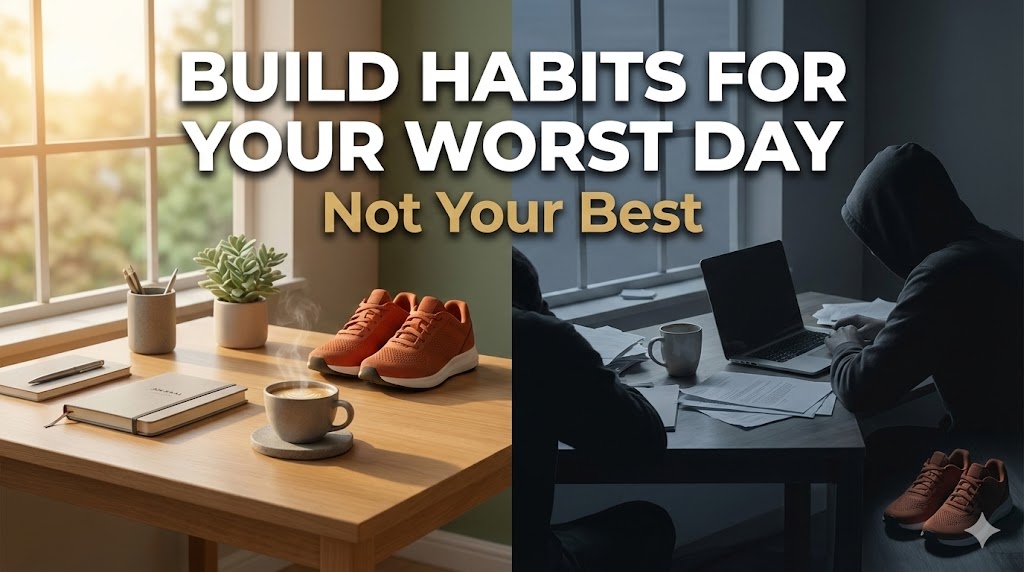
Audit your current habits. For each one, apply the Monday 6AM test. If it fails, redesign it for your worst day, not your best. Dumb it down until it’s embarrassingly simple. Then dumb it down more.
The person you are at your worst is the person you need to design for. That’s not pessimism. It’s engineering. Build for the floor, not the ceiling, and you’ll discover consistency was never about willpower.
It was about honesty about who you actually are when execution time comes.
Ready to build systems that survive contact with real life? MasteryLab provides the framework and community for people done with restart cycles.