Arche vs Telos: Key Differences in Greek Philosophy
Every serious inquiry eventually confronts two questions that most people collapse into one. Where does this come from? And where is it going? Arche addresses the first question. It is the origin, the foundational principle, the starting point from which something emerges. Telos addresses the second. It is the end, the purpose, the ultimate aim toward which something develops. Aristotle placed both at the center of his explanatory framework. To understand anything fully, you need to know its arche (what set it in motion, what constitutes its foundation) and its telos (what it is for, what completion looks like). A seed has an arche in its genetic material and the soil that sustains it. Its telos is the mature plant it is becoming. When you apply this distinction to your own life, the implications are immediate and uncomfortable. Most people fixate on one at the expense of the other. Some become obsessed with origins: where they came from, what shaped them, what constraints their background imposes. They spend years analyzing the causes of their current situation without ever asking what they are building toward. Understanding your arche is valuable, but it can become an excuse to remain defined by your starting conditions. Others fixate on destinations. They set goals, build strategies, and pursue outcomes relentlessly, but never examine the foundations those goals rest on. They chase a telos without understanding whether the principles grounding their pursuit are sound. A career built on unexamined assumptions can reach its destination and still feel hollow, because the arche was never interrogated. In Aristotle’s four causes, arche connects to the material and efficient causes (what something is made of and what initiates its change), while telos is the final cause (the purpose that explains why it exists at all). The architect’s plan is the telos of the house. The wood, stone, and the labor of builders constitute the arche. You need both to explain why this particular structure stands. The tension between arche and telos appears in organizational life as well. A company that understands its founding principles but has no clear purpose drifts. A company with ambitious goals but no understanding of its own foundations makes promises it cannot keep. The most resilient institutions maintain a living relationship between origin and aim, regularly asking whether their foundational principles still serve their purpose, and whether their purpose still honors their foundations. You face this same question every time you set a new direction. Are you building on solid ground? And does the destination you are aiming for deserve the foundation you have laid? Getting one right while ignoring the other produces structures that either collapse under pressure or arrive at destinations nobody wanted.
Definitions
Arche
(ἀρχή)
ar-KAY
The first principle, origin, or ruling source from which all else flows. In Greek philosophy, arche represents both the fundamental beginning of something and the authority or sovereignty that governs its ongoing nature.
Telos
(τέλος)
TEH-los
The ultimate end, purpose, or goal toward which something naturally develops and at which it reaches completion. For Aristotle, every action and pursuit aims at some telos, with eudaimonia being the highest telos of human life—that for the sake of which all else is done.
Key Differences
| Aspect | Arche | Telos |
|---|---|---|
| Temporal Direction | Arche looks backward and downward to the source, the origin, the foundation from which something emerges. It asks: where did this begin? | Telos looks forward and upward to the destination, the completion, the purpose toward which something develops. It asks: where is this going? |
| Philosophical Function | Arche provides the explanatory foundation. It tells you what something is made of and what set it in motion. Without understanding arche, your explanations have no grounding. | Telos provides the guiding aim. It tells you what something is for and what counts as its completion. Without understanding telos, your actions have no direction. |
| Relationship to Identity | Arche defines what something is at its core. The first principle reveals the essential nature of the thing, the irreducible reality from which everything else follows. | Telos defines what something is for. The final cause reveals the function and purpose that give the thing its significance within a larger order. |
| How Discovered | Arche is discovered through analysis, by breaking something down to its fundamental components and tracing its origins. You find arche by digging into foundations. | Telos is discovered through deliberation about purpose. You find telos by asking what completion looks like and what end would fulfill the thing's nature. |
| Practical Application | Understanding arche means grasping the causes and conditions that produced the current situation. It grounds your decisions in reality rather than wishful thinking. | Understanding telos means choosing a direction that aligns with your nature and circumstances. It orients your decisions toward meaningful completion rather than aimless motion. |
Temporal Direction
Arche looks backward and downward to the source, the origin, the foundation from which something emerges. It asks: where did this begin?
Telos looks forward and upward to the destination, the completion, the purpose toward which something develops. It asks: where is this going?
Philosophical Function
Arche provides the explanatory foundation. It tells you what something is made of and what set it in motion. Without understanding arche, your explanations have no grounding.
Telos provides the guiding aim. It tells you what something is for and what counts as its completion. Without understanding telos, your actions have no direction.
Relationship to Identity
Arche defines what something is at its core. The first principle reveals the essential nature of the thing, the irreducible reality from which everything else follows.
Telos defines what something is for. The final cause reveals the function and purpose that give the thing its significance within a larger order.
How Discovered
Arche is discovered through analysis, by breaking something down to its fundamental components and tracing its origins. You find arche by digging into foundations.
Telos is discovered through deliberation about purpose. You find telos by asking what completion looks like and what end would fulfill the thing's nature.
Practical Application
Understanding arche means grasping the causes and conditions that produced the current situation. It grounds your decisions in reality rather than wishful thinking.
Understanding telos means choosing a direction that aligns with your nature and circumstances. It orients your decisions toward meaningful completion rather than aimless motion.
When to Apply Each Concept
When to Choose Arche
Lean on arche thinking when you need to understand why things are the way they are. Before attempting to change any system, relationship, or pattern, you must first understand what created it. Arche thinking is essential when diagnosing problems, because treating symptoms without understanding root causes produces solutions that do not last.
When to Choose Telos
Lean on telos thinking when you need to set direction and define what success looks like. Once you understand the foundations, you need a purpose to build toward. Telos thinking is essential when you face choices between competing priorities, because it provides the criterion for deciding which path serves the larger aim.
Frequently Asked Questions
What is the difference between arche and telos?
Arche is the first principle, origin, or foundational cause of something. Telos is the ultimate purpose, end, or final cause toward which something develops. Arche explains where something comes from and what constitutes its foundation. Telos explains where something is going and what counts as its fulfillment. Aristotle considered both essential for complete understanding of any phenomenon.
Arche vs telos in Greek philosophy?
In Greek philosophy, arche was the term pre-Socratic thinkers used for the fundamental principle underlying all reality. Thales proposed water, Anaximander the boundless, Heraclitus fire and *logos*. Telos became central in Aristotle's system as the final cause that explains why things exist and develop as they do. Together, arche and telos frame reality between its origin and its purpose.
How do arche and telos relate in Aristotle?
In Aristotle's framework of four causes, arche connects to the material cause (what something is made of) and the efficient cause (what initiated its development). Telos is the final cause, the purpose that explains why something exists. Aristotle held that full understanding requires grasping all four causes, meaning arche and telos are complementary, not competing, explanatory principles.
What are first principles vs final causes?
First principles (arche) are the foundational truths or starting points from which reasoning proceeds. They are the bedrock that does not require further explanation. Final causes (telos) are the purposes or ends that explain why something exists or occurs. First principles tell you what is fundamentally true. Final causes tell you what something is ultimately for. Both are necessary for sound reasoning and effective action.
Articles Exploring Arche or Telos (29)
Three Rules Beat Thirty Pages
Every incident adds a paragraph to the process doc and nobody ever removes one. Underneath is a belief almost every leader holds without saying it: complex results need complex systems. Starlings, a four-rule universal computer, a city with no written law, and the file that runs the agents on my desk say otherwise.
The Load Already Had a Job
I came off a long run and opened the watch before I sat down. The hills did not register. The number did. The old load already had a job. The watch applied for it.
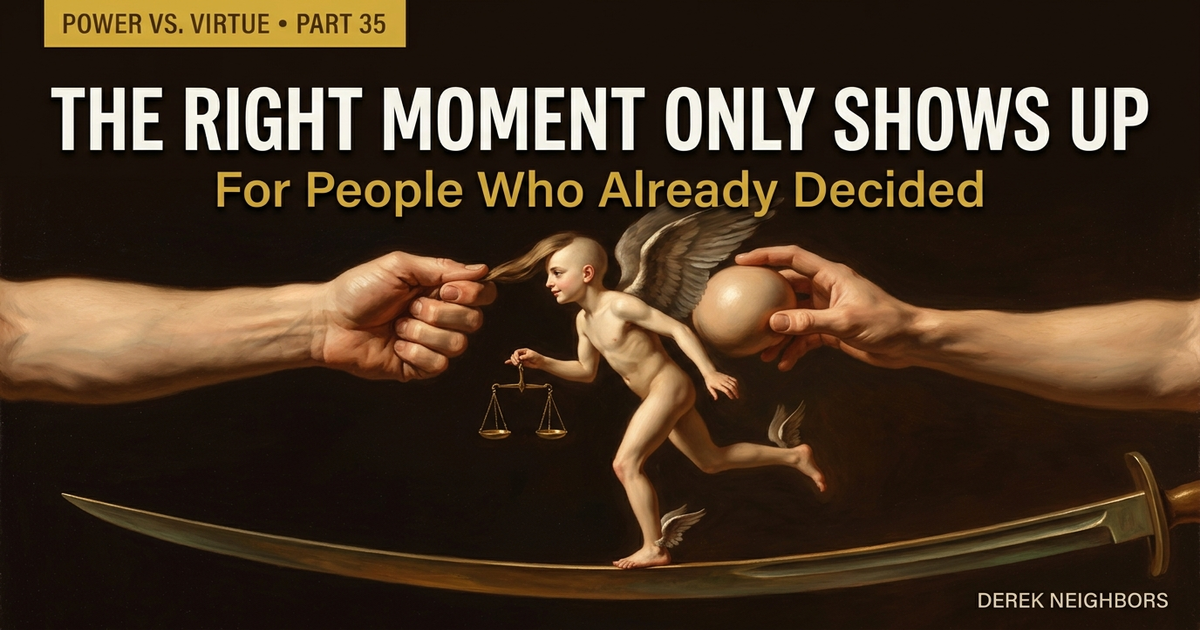
The Right Moment Only Shows Up for People Who Already Decided
Law 35 of the 48 Laws of Power tells you to master the art of timing, and this series agrees with it. The same move lands or dies on when you make it, hurry reads as fear, and rooms punish people who cannot wait. Then the law tells you to seem patient and to sniff out the spirit of the times, and its hero is a man who survived every regime by standing for nothing. Kairos is the right moment for something. Decide the something first, or the moment never comes.
Your Five-Year Plan Is Built From Last Year
I sat through an offsite that wrote 2029 as last year with nicer fonts. The futures worth living stay invisible until you stack skills, relationships, and harder rooms.

Play to Their Fantasies and You Train Them Off Reality
Law 32 of the 48 Laws of Power tells you to play to people's fantasies: become the oasis of romance in a harsh world, avoid ugly truth, and gain power from the hunger for soft stories. The tactical truth is real. Pleasant pictures gather crowds, and disenchantment makes people angry. The character cost arrives when fantasy becomes your operating system. You train judgment off reality. When the mirage breaks, you earn the rage. The ARETE alternative keeps hope aimed at a hard path people can walk, and restores frank speech that can still lead.

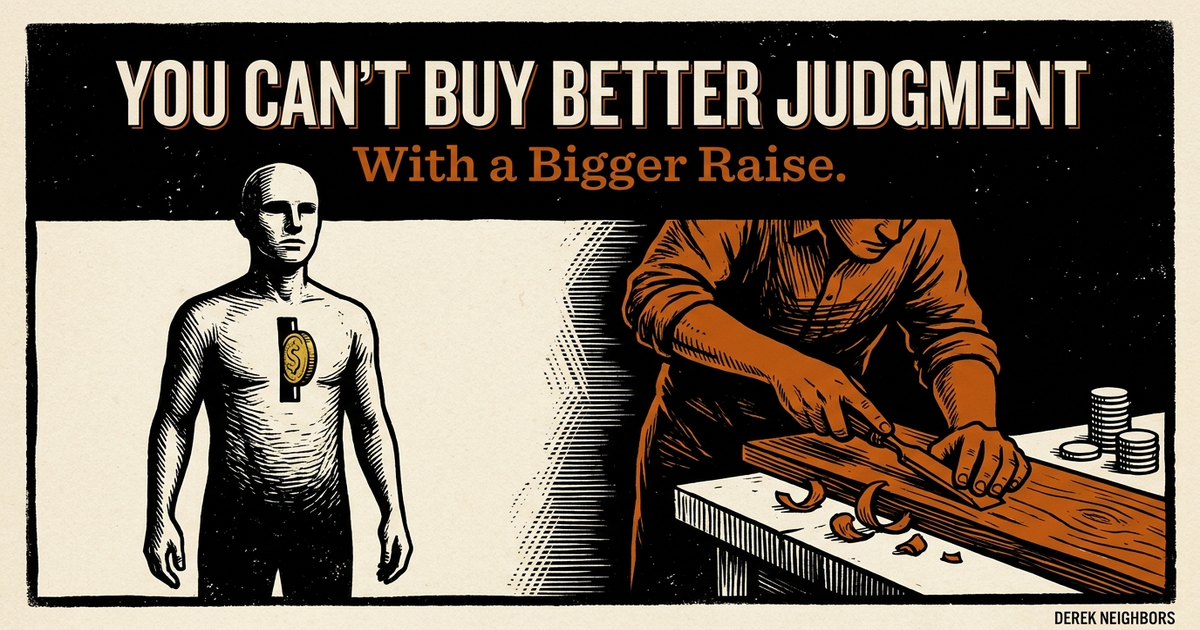
You Can't Buy Better Judgment With a Bigger Raise.
When every task gets read through the paycheck, excellence has already left. Fair pay removes the money crisis. Using raises as a lever for complex work buys worse judgment.
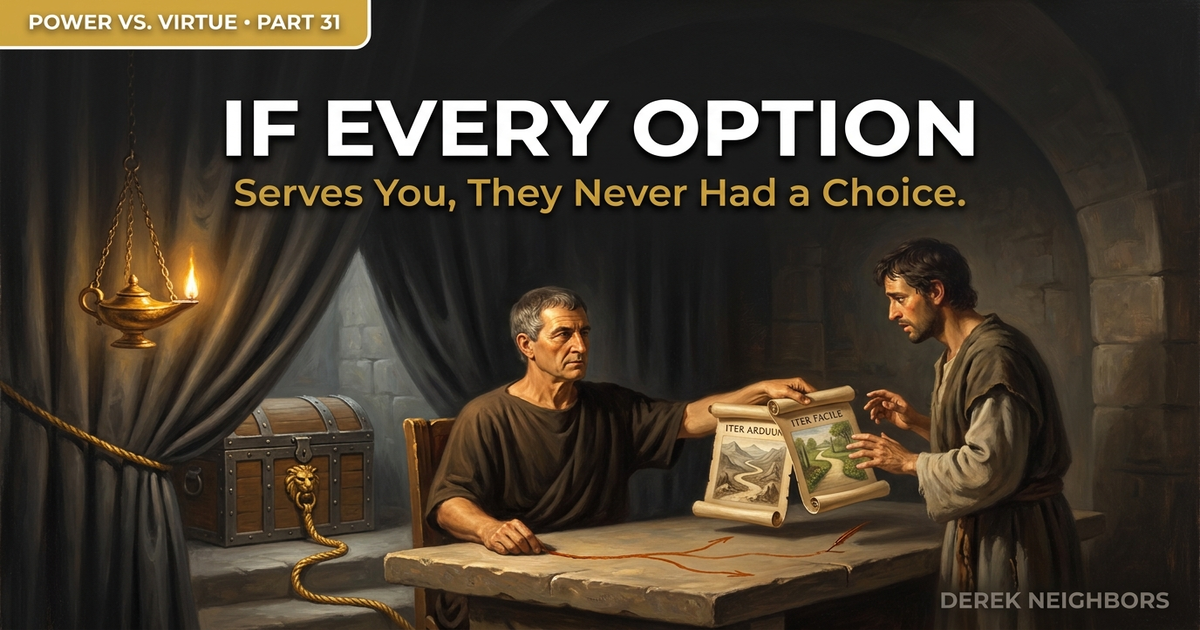
If Every Option Serves You, They Never Had a Choice
Law 31 of the 48 Laws of Power tells you to control the options: get others to play with the cards you deal. The tactical truth is real. Unstructured choice stalls rooms, and people defend outcomes they believe they chose. The character cost arrives when the menu is a rigged deck. Every door already belongs to the dealer. Discovery bankrupts trust. The operator trains contempt for other people's judgment. The ARETE alternative keeps framing as craft and restores real prohairesis: honest constraints, a shared end, and at least one exit that is not already yours.
Most People Plan the Opening. Almost Nobody Plans the Stop.
Law 29 of the 48 Laws of Power tells you to plan all the way to the end, and this series agrees with it. Vague plans collapse into improvisation, improvisation is crisis-to-crisis living, and the people who cannot name a stop get owned by whoever can. Greene's evidence is Balboa, who discovered the Pacific and still lost his head, versus Bismarck, who unified Germany and then refused the siren of more. The ancient correction is simple: the ending has to be a worthy end, not just a clever exit, and naming it is what makes bold action safe to start.

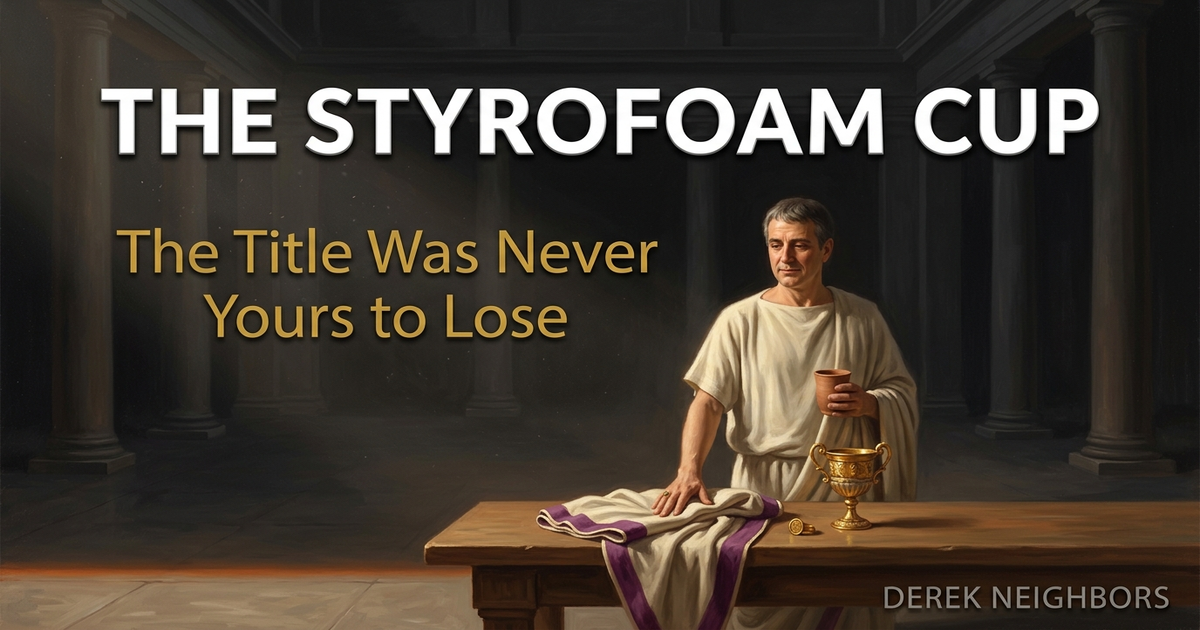
The Styrofoam Cup: The Title Was Never Yours to Lose
The ceramic cup, the car service, the upgraded seat, the jokes that got funnier with every promotion. All of it arrived as you rose, so it reads like a measurement of you. It never was. The deference is addressed to the chair, and the chair is on loan. The Stoics kept a running audit of exactly this, and the Greeks had a job title for the right way to hold borrowed power. Confuse the trappings for yourself and the confusion bills you twice: once while you hold the title, and once, brutally, on the day you hand it back.
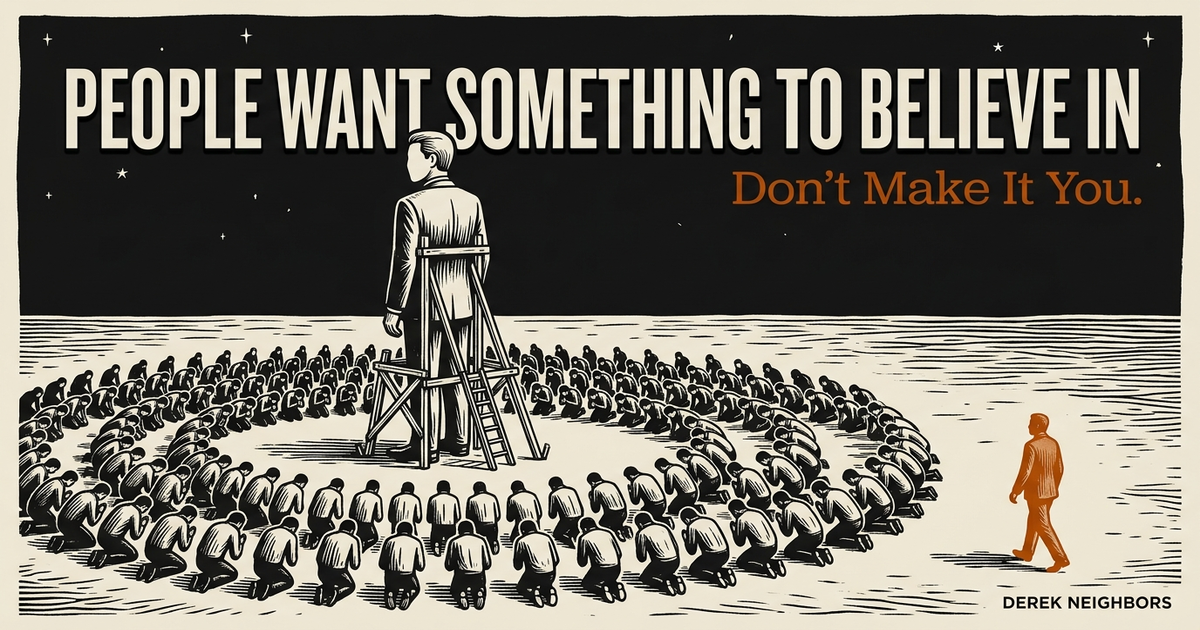
People Want Something to Believe In. Don't Make It You.
Law 27 of the 48 Laws of Power tells you to play on people's need to believe and create a cultlike following. Keep your words vague, favor enthusiasm over thinking, hand out rituals, collect the devotion. The need Greene identified is real. People are starving for something worth believing in. The law fails at the harvest. The Greeks called his method goeteia, the enchanter's craft that bypasses judgment instead of building it, and they left us a portrait of exactly where it ends: a con man with a puppet snake god who opened his rites by expelling every skeptic in the crowd, because one honest question would have brought the whole thing down.
Recreate Yourself. Just Don't Mistake the Mask for the Self.
Law 25 of the 48 Laws of Power tells you to recreate yourself by seizing control of your image, becoming a memorable, protean figure who never bores the audience. The Greeks had a word for the thing you put on to face a crowd: prosopon, the mask an actor wore on stage. Greene's reinvention is mask-work, and a mask worn long enough fuses to the face. There is a real kind of self-recreation, but it runs the other direction. You forge the substance and let the appearance follow.
Your Beliefs Are a Pain Tolerance Test. Most People Are Failing It.
Two people take the same hit. Same diagnosis, same year, same loss of income. One keeps showing up. One disappears into the couch for six months. The difference is rarely willpower. It is the belief system running underneath, and belief systems can be scored. The Stoics built a scorecard without calling it that: internal control, suffering as training material, virtue as something worth the cost. Most modern frameworks fail on all three axes and then wonder why life feels unbearable.
Concentrate Your Forces. Just Don't Make Them Someone Else's.
Greene's Law 23 welds two opposite ideas together. Concentrate your forces at their strongest point is some of the most virtue-aligned advice in the book. Find the one patron, the fat cow to milk, is the trap. Both feel like focus. One builds a foundation you own. The other lends your forces to a hand that can drop you.
What You Sacrifice First Is What You Actually Love
Most people believe they hold their values in balance: family, work, health, growth, all weighted more or less equally. Plato argued that nobody actually lives this way. Every soul is ordered by a single ruling love, and everything else gets ranked beneath it. The proof is not in what you claim to value. The proof is in what you sacrifice first when two of your loves collide, because the thing you protect last is the thing you actually love.
Your Work Family Has an Expiration Date. Most People Discover It Too Late.
The retirement party promise was honest in the moment. The silence three months later is structural. Most workplace bonds rest on four scaffolds that disappear the day the project does, and the bitterness most leaders carry into their late careers comes from expecting utility friendships to behave like virtue friendships. Aristotle mapped three kinds of philia 2,400 years ago. The leadership move is to know which kind you have, identify the one or two candidates for the third kind, and invest on purpose outside the project's calendar.

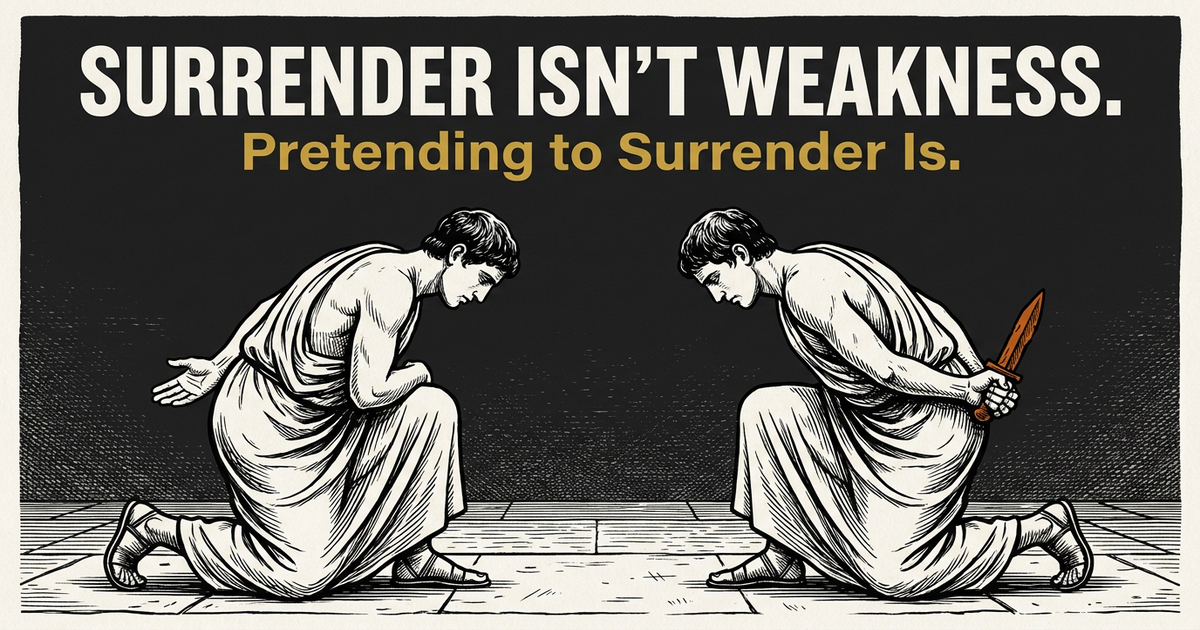
Surrender Isn't Weakness. Pretending to Surrender Is.
Greene's Law 22 tells you to surrender as a counter-trap. The tactic is real, and the Stoics knew the moves it copies. But Marcus Aurelius yielded to preserve his prohairesis. Greene's reader yields to spring an ambush. The heads can look identical; the ends diverge. The test that separates them is whether you could name, out loud, what you yielded for.
Acting Dumb to Get Ahead Works. Until You Can't Stop Acting.
Greene's Law 21 tells you to play the fool so your marks lower their guard. The tactic is real. The Greeks invented it. But Socrates played dumb to make people wiser, and Greene plays dumb to make people poorer. The mask is identical. The cost of running the wrong one is that you eventually cannot take it off.
The Future You're Killing Yourself For Doesn't Include You
The next milestone always arrives on schedule, but the person it was supposed to arrive for has already moved on to the next pursuit. The engine producing your wins is the engine evicting you from the life they were meant to build. The paradox is structural, not personal, and most ambitious people have been paying for it for decades without noticing the bill.

If Your Team Never Disagrees With You, You're Not Leading. You're Indoctrinating.
A team that always agrees with you is not aligned. It has been worn down. Most leaders are quietly running a sophistic operation, training reciters when they think they are developing thinkers. The Socratic test still applies, and most modern leaders fail it.

You Don't Have to Be the Best. You Just Have to Still Be Here.
You probably aren't the best in your field. That matters far less than you think. Almost everyone you compare yourself to has already quit, or is about to. The strategy that compounds is staying.

Your Potential Isn't Waiting. It's Disappearing.
We talk about untapped potential like it's a savings account, sitting there earning interest while you figure things out. Aristotle had a different word for it. And his version has an expiration date.

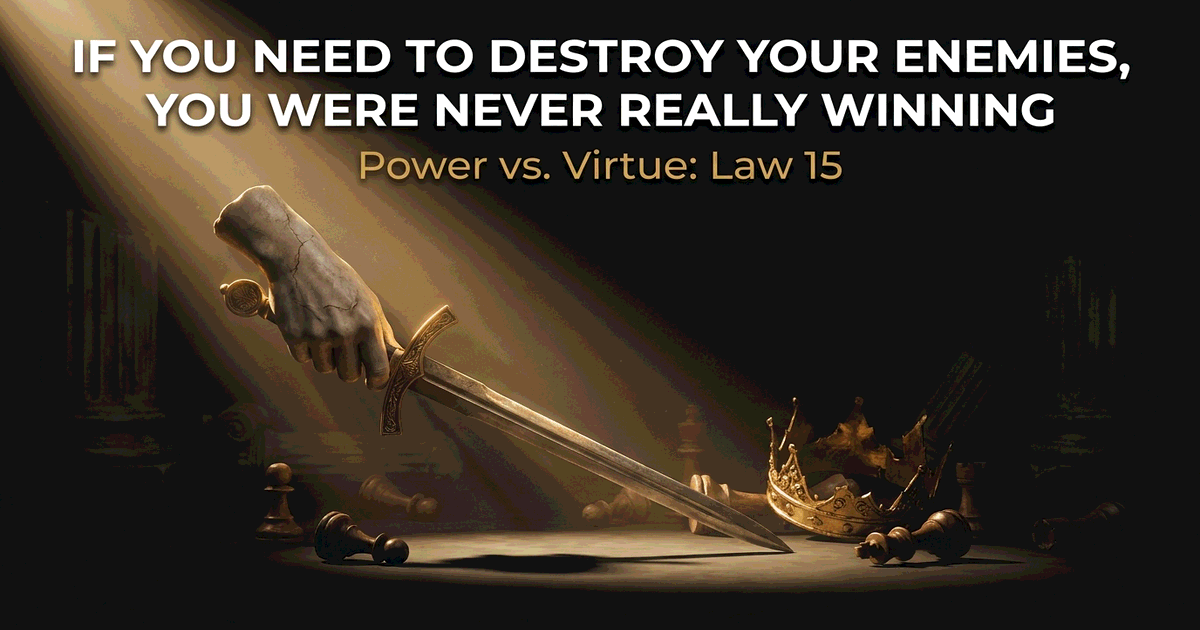
If You Need to Destroy Your Enemies, You Were Never Really Winning
Greene says leave nothing to chance and annihilate your opponent completely. But total destruction requires total obsession with another person's existence. The Greeks called this failure of character, not strength. Megalopsychia, greatness of soul, means your purpose is too large for any single enemy to define.
You Know Exactly What You Don't Want. That's Why You're Stuck.
Ask someone what they want and watch them struggle. Ask what they don't want and the words pour out. All that clarity is pointed backwards, and it's the reason you can't move forward.

You're Not Too Intense. Everyone Else Is Too Comfortable.
What society labels 'crazy' or 'too intense' is actually the natural fulfillment of human purpose. The real madness is accepting a diminished life. Normal isn't sanity. It's collective surrender.

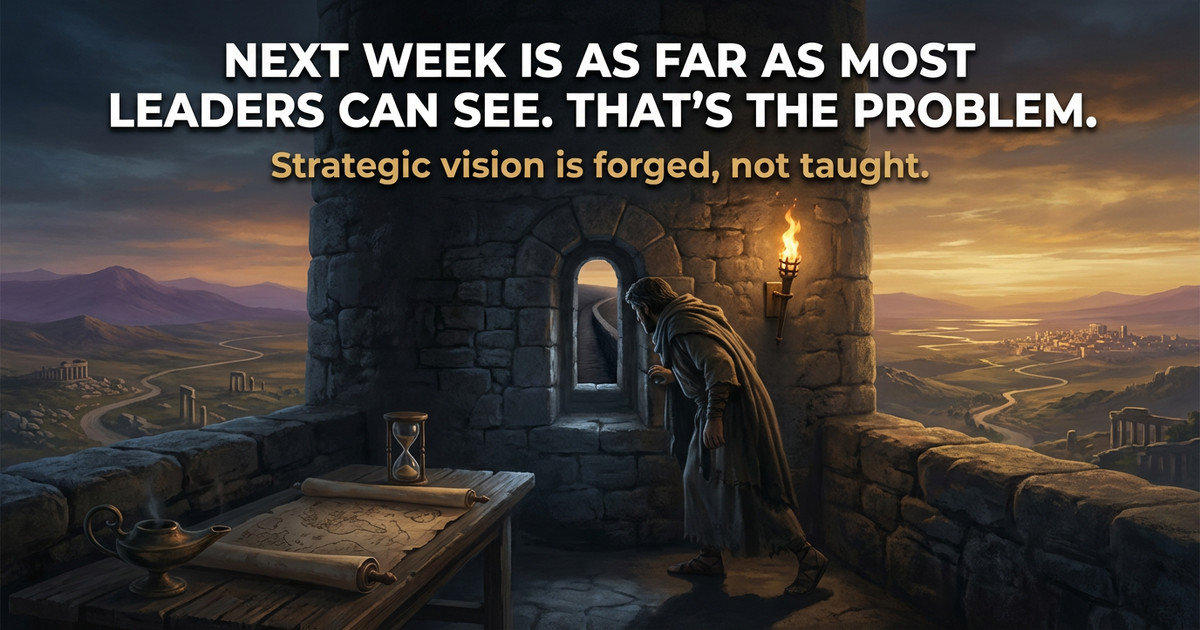
Next Week Is As Far As Most Leaders Can See. That's the Problem.
The inability to see beyond immediate tasks isn't a skill gap. It's a character limitation. Strategic vision is a cultivated virtue, not an innate talent. Small picture thinking is underdeveloped character.
What Do You Actually Want? (Most People Never Answer This)
You're not anxious. You're unclear. The mind that hasn't decided what it wants will constantly point out what's missing. Clarity isn't a luxury. It's the foundation.

Want Better Leaders? Stop Naming Them.
The best coaches figured this out decades ago. Saban's Process. Belichick's expectations. Cignetti's explicit no-captains policy. When you designate leaders, everyone else stops leading.

The Brutal Honesty Test: Do You Really Want What You Say You Want?
Most people torture themselves pursuing goals they don't actually want. The framework for distinguishing authentic desire from sophisticated self-torture.

The Completion Paradox: Why Finishing Matters More Than Starting
You don't have a motivation problem. You have a completion problem. Every unfinished project is evidence that you can't trust yourself to follow through. Here's how to build the character that finishes what it starts.