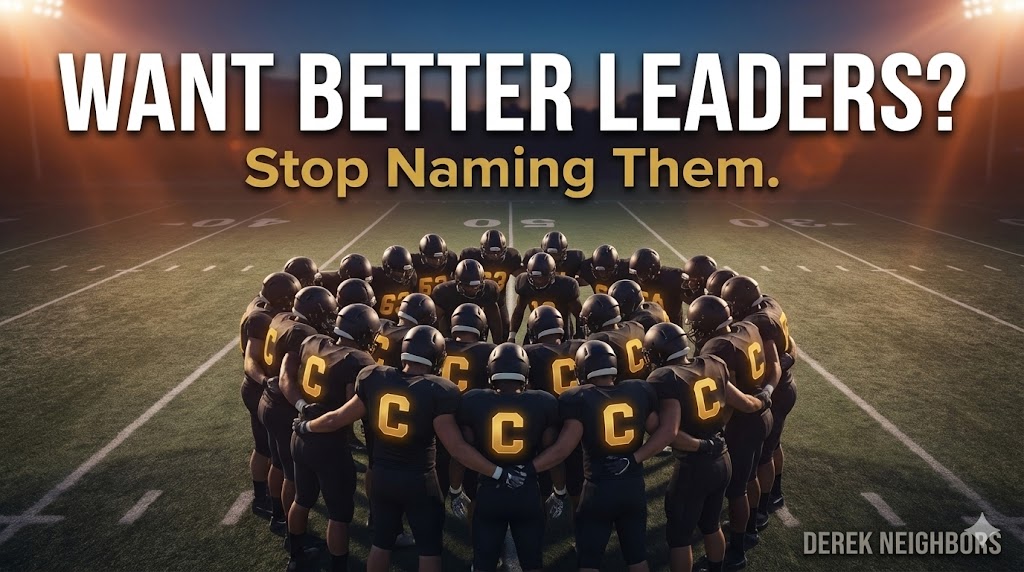
Want Better Leaders? Stop Naming Them.
By Derek Neighbors on December 14, 2025
Distributed leadership isn’t a trendy management concept. It’s what the most successful coaches have practiced for decades.
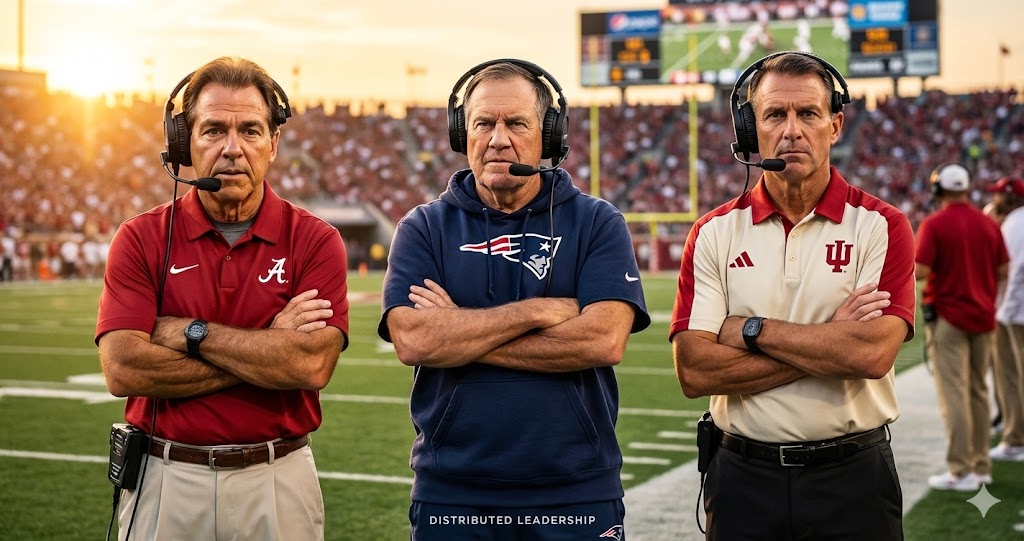
Saban’s Process. Belichick’s expectations. And now Cignetti at Indiana, who made the principle explicit by eliminating captain designations entirely.
The insight is counterintuitive but the evidence is overwhelming: when you designate official leaders without universal expectation, everyone else becomes a follower by default. The title doesn’t create leaders. It creates permission for everyone else to stop leading. Unless universal expectation neutralizes the designation entirely.
What Most Organizations Get Wrong
Walk into any organization struggling with leadership and you’ll hear the same diagnosis: “We need to identify our best leaders and give them authority.” The prescription follows predictably. Send people to leadership workshops. Create “emerging leaders” programs. Add more team leads. Rotate captain responsibilities.
None of it works. Most leadership development gets it backwards by focusing on skills before character. The same 2-3 people still carry the entire leadership burden. Everyone else waits for direction. Leadership training graduates return and do nothing different. The few loud voices get louder while everyone else defers.
The problem isn’t that organizations lack leaders. The problem is that most people use designation systems as an excuse to check out. Bad systems make checking out easy.
The Coaching Lineage That Figured This Out
The best coaches understood this decades ago.
Saban’s Process at Alabama: Six national championships. The most dominant dynasty in modern college football history. Built on a philosophy where leadership isn’t a position. Everyone is expected to hold everyone else accountable. The Process doesn’t care about your title. It cares about your behavior.
Belichick’s Expectations in New England: Six Super Bowls. He names captains, but his culture is famous for expecting leadership behavior from every player, every practice, every play. “Do your job” applies to everyone equally, regardless of title or tenure. The captain patch is ceremonial because the universal expectation renders it meaningless. This is the key insight: it’s not the naming that creates followers. It’s the absence of universal expectation. When expectation is universal, designation becomes irrelevant.
Cignetti’s Explicit Move at Indiana: Learned under Saban at Alabama from 2007-2010, including the 2009 national championship. Recruited Julio Jones and Mark Ingram. Absorbed the underlying philosophy. Then took it further by eliminating captain designations entirely. The result? Indiana went from Big Ten bottom-dweller to College Football Playoff in one season.
This isn’t coincidence. It’s cause and effect.
The System That Creates Followers
The moment you name someone “captain” or “leader,” everyone else decides they’re off the hook. Nobody told them this. They chose to believe it. The designation doesn’t create followers. It provides cover for a choice they were already inclined to make.
Watch how the system works:
A captain is named. Everyone else feels off the hook. The non-captains start deferring. The captain feels responsible for everything. The captain burns out trying to carry the load alone, often serving from weakness instead of strength. The team underperforms. The solution? Name MORE captains. The cycle continues. Still too few people leading.
The hidden dynamics are predictable. People use the designation as permission to check out. Title holders become gatekeepers rather than catalysts. “Leadership” becomes something you GET rather than something you DO.
The Greeks had a word for this: arche. It meant both “leadership” and “origin.” To them, a leader wasn’t someone with a title. A leader was someone who originated action. The source. The beginning. Aristotle took this further: humans are rational, social beings. Our nature is to initiate, to participate, to contribute. Leadership behavior isn’t a special activity reserved for the designated. It’s what you owe to any group you’re part of. To refuse leadership isn’t humble. It’s refusing to be fully present.
When you make leadership a designation instead of an origin point, you strip it of its essential nature. Leadership becomes something you’re given rather than something you initiate.
Every “high potential” program has the same fatal flaw. The moment you tell someone they’re being groomed for leadership, you’ve told everyone around them they’re not. You’ve created a class system. The chosen few develop. Everyone else waits their turn. Then organizations wonder why only 3 people in a department of 30 ever step up. It’s the organizational excellence delusion playing out in real time.
The Leverage Points
Small changes in the right places create massive impact.
Remove the designation entirely. When there’s no official leader, there’s no official follower. The absence of hierarchy creates universal responsibility. This is Cignetti’s insight made structural.
Shift from selection to expectation. Stop asking “who should lead?” Start expecting “everyone will lead.” Belief and expectation are powerful motivators in the hands of a skillful leader. The best teams are player-led because EVERYONE enacts the everyday functions of leadership.
Make leadership actions, not positions. Define leadership as behavior: accountability, standard-setting, peer support, raising hard truths, supporting struggling teammates. Anyone can do these things at any moment. Position becomes irrelevant when actions define leadership.
The highest leverage comes from changing the narrative entirely. Leadership is not granted. It’s enacted. Every person, every day, in every interaction.
“But If Everyone’s a Leader, No One Leads”
You’ll hear this objection. It sounds logical. It’s wrong.
Leadership isn’t decision authority. Distributed leadership is about behavior: holding standards, supporting peers, taking initiative, providing accountability. Decision rights still exist. Someone still makes the call. But leadership behavior isn’t reserved for the person making calls.
The empirical evidence destroys the objection. Alabama: dynasty. New England: dynasty. Indiana: immediate transformation. These programs produce more people holding standards, calling out failures, supporting struggling teammates, and initiating action without waiting for permission. That’s what more leadership looks like. The results aren’t theoretical.
The opposite is actually true. When you name leaders, everyone else STOPS leading. The real risk isn’t “no one will lead.” It’s that only 2-3 people will lead while everyone else waits for instruction. That’s what happens in most organizations right now.
Peer accountability is stronger than hierarchical accountability. When everyone owns the standard, there’s nowhere to hide. Tolerating mediocrity becomes impossible when the whole team enforces excellence. When only the captain can call you out, most behavior goes unchecked. A room where everyone enforces excellence is more powerful than a room where one person tries to.
Nature abhors a leadership vacuum. Someone always steps up. The question is whether it’s one person (because they were named) or several (because it’s expected of everyone). Remove the designation and watch who rises. Usually more people than you expected.
Special forces already know this. The military units with the highest stakes practice distributed leadership specifically BECAUSE missions require everyone to be able to lead when the situation demands it. When lives depend on it, they don’t create single points of failure.
What Changes When You Fix the System
The results are predictable once you understand the system.
More leaders, period. When everyone is expected to lead, more people do. Not because they were given permission. Because they were given expectation.
Better distributed load. Leadership burden spreads across the team. No more burned-out captains carrying dead weight.
Faster development. People learn leadership by practicing it, not by watching. paideia, the Greek concept of character formation, happens through action. You don’t become excellent by understanding what excellence is. You become excellent by doing what excellence requires. Treat people as leaders and they start acting like leaders.
Resilience. The team doesn’t collapse when one “leader” leaves or is absent. Leadership capacity is distributed throughout the system.
The ripple effects compound. Culture shifts from dependency to ownership. Peer accountability becomes normal. Innovation increases because everyone feels empowered to initiate. Engagement improves because ownership is more engaging than following.
There’s a deeper effect. The Greeks called it eudaimonia: human flourishing. People who lead are more alive than people who defer. Distributed leadership isn’t just more effective. It creates conditions where more people can flourish.
The Questions That Matter
Before you dismiss this as sports metaphor stretched too far, ask yourself:
How many people on your team are currently “allowed” to lead? What happens when your designated leaders are absent? Who steps up? Who waits for instruction? What would change if you told everyone, explicitly, “You’re all leaders now”?
Most organizations have far more leadership capacity than they’re using. The system made deferring easy. But the capacity was always there.
Final Thoughts
The path forward isn’t to develop better leaders. It’s to create systems where everyone leads.
The best coaches figured this out decades ago. Saban built a dynasty on it. Belichick sustained excellence with it. Cignetti made it explicit and transformed a program in a single season.
The principle isn’t complicated. When you name leaders, you create followers. When you expect leadership from everyone, you get it.
Pick one team or context in your life. Remove the designation. Set the expectation. Watch who rises.
Ready to build systems that develop leaders at every level? MasteryLab provides the frameworks for creating cultures where excellence isn’t designated. It’s expected.