If You Don't Say What It Means, Someone Else Will
By Derek Neighbors on September 17, 2026
The architecture review ran ninety minutes and ended on time. Good discussion. People asked real questions and got real answers.
Three days later the team is building the thing you thought you had talked them out of.
You were in that room. You were right in that room. You answered every question accurately, cited the benchmark, corrected the number somebody had wrong. And the version of that meeting that survived into Monday was assembled by someone less sure than you, because what they said was easier to repeat.
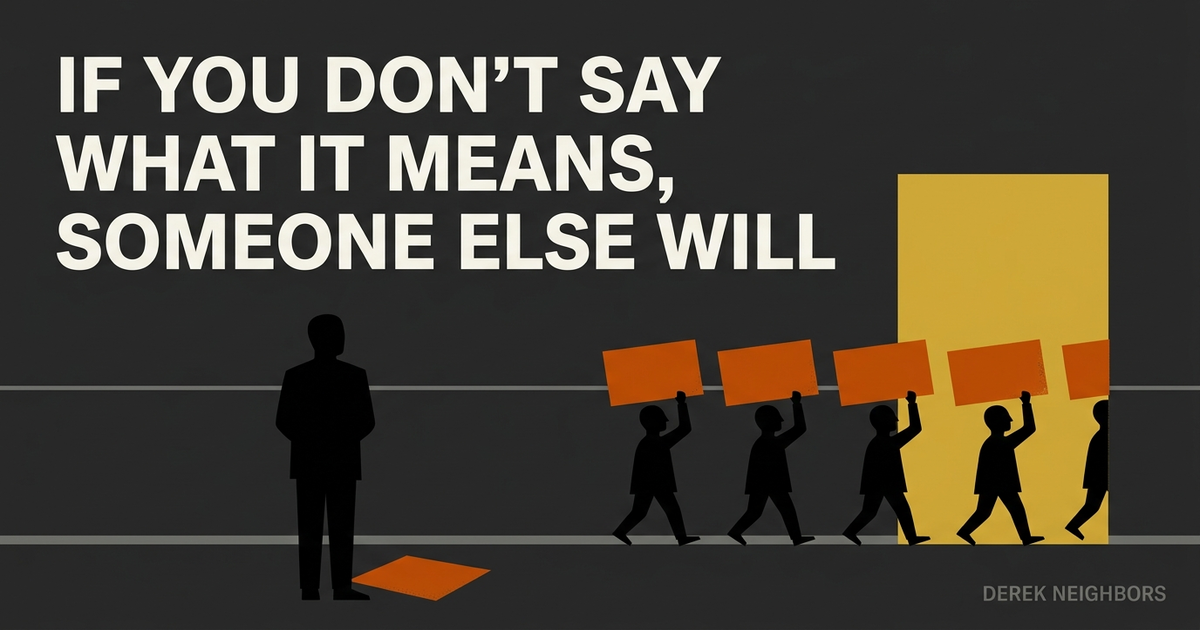
A room never leaves with nothing. There is always a version, and the only open question is whose.
The frame is that version: the interpretation sitting in other people’s heads on the way to the parking lot, rather than the sentence anybody said at the end. You can influence it. You never own it outright.
The beginning: why being right does not change what a room believes
Every expert starts in the same place, and it is a good place to start. You know the material. You use it to correct things. Somebody says the migration will take two weeks and you know it is six, so you say six and you are right and everybody nods.
This feels like the job. For a while it is the job, because the alternative is an expert who lets bad numbers stand.
The tell that you have outgrown it is specific. You leave meetings satisfied with your answers and then get surprised by what people do next. That gap is the whole diagnosis. If your accuracy and the room’s behavior keep coming apart, the problem is not that they failed to listen, because listening was never the mechanism.
I spent years in the first stage without knowing there was a second one. In a review I would win the exchange about the number and lose the quarter, and I read that as a people problem. They were not technical enough, or they had already decided, or somebody had politics. Any of those was easier than the actual explanation, which is that arguing your point is a losing strategy when nobody in the room is keeping score the way you are.
Being right is the entry fee. It buys you nothing on its own.
The progression: why the simplest sentence in the room wins
The shift starts when you stop listening to the meeting and start listening to the hallway.
Do this once and it will bother you for months. Find out what people actually repeated afterward. It is almost never your best point. It is whatever sentence was shortest and easiest to repeat to somebody who was not there. Sometimes that sentence is wrong. It still travels, because a sentence that travels beats a sentence that is correct and heavy.
What the room walks out with is doxa, the version of things that seems true, as against the version you could actually defend. Plato spent a great deal of energy on the distance between those two, and his worry was not academic. People act on what seems true. They fund it, staff it, and build against it for a quarter before anyone checks.
So the expert’s job grows a second half. The first half is knowing, and the second is making sure the version that leaves the room resembles what you know.
That second half asks for something most experts find genuinely uncomfortable, which is why so many stall on the edge of it. Answering the question you were asked is safe, and saying what the answers add up to when nobody asked feels like overstepping your lane. You were invited to give an assessment of the data model, not to tell six people what the meeting meant.
That hesitation feels like modesty from the inside. From outside it reads as a gap, and gaps get filled by somebody. They are usually confident, usually senior, and usually working from about forty percent of what you know.
This is different from the vocabulary problem, where a team shares words without sharing definitions. You can fix every definition in the room and still watch the meaning walk out attached to the wrong conclusion. Shared words are the floor, and the interpretation is what gets built on top of them.
The advanced state: how experts close a discussion
Mastery here looks unglamorous. Near the end of the discussion, in plain language, you say what happened and what matters.
It is not a recap, because a recap lists what was said in order and helps nobody. What the room needs is a logos, an account of the thing rather than an inventory of it. Something like: the migration is fine, the data model is not, and the data model is what bites us in March.
One sentence somebody can carry into a room you are not in. That is the whole deliverable.
Before any of the craft, one constraint. Say it only if you would defend it under questioning from someone who knows more than you. Skill at producing belief, cut loose from any obligation to what is actually true, makes you the confident person from the opening of this piece. That person is the problem, and being better at it is worse.
Three things make it work.
Reduce until one more cut would make it wrong, then stop. The target is simple without being crude, and the distance between those two is a real skill that takes years to build. Most experts avoid the risk of oversimplifying by refusing to simplify at all, which guarantees the loss. A room handed complexity will simplify it themselves, badly, using whatever heuristic is nearest.
This is also the answer to an obvious objection. If short and repeatable is what travels, speaking does not win anything by itself. A careful, accurate, four-minute close loses to a wrong sentence somebody can say in one breath. Being the expert wins nothing here. What wins is the most repeatable version that also happens to be true, which is harder than either one alone and is the actual job.
Pick the moment. kairos is the opening in time when an action lands, as opposed to whatever the clock says, and closing a discussion has one. It arrives when people begin restating each other’s positions in slightly different words. That is the signal the discussion has stopped producing new information. Close there. Let the clock run out instead and the final frame goes to whoever happened to be talking when the calendar interrupted, which is a function of seating and confidence.
Close the meaning, not the decision. This is the line, and it is the one people cross. Your frame answers what happened and what matters. It does not answer what we are going to do about it. Naming the stake is owed by anyone with expertise in the room. Choosing the response usually belongs to whoever owns the outcome, and a person who uses the closing slot to install their preferred plan gets exactly one or two turns at it before the room stops giving them the floor.
There is a cost, and it is worth being honest about it. A recap cannot be wrong, while a frame can be wrong out loud, in front of people, in a way that is checkable next quarter. When you say the data model bites us in March and March comes and nothing bites, that is on the record. Most trailing off is about avoiding that.
Credibility works the way you would expect. It comes from a history of having been right before, one accurate frame at a time, and it can be spent. What it buys is how easily people take the sentence from you.
Whether the sentence is owed is a separate question, and it is worth being exact about that, because experts use the first one to get out of the second. If you are the newest person in the room and you can see that the plan rests on something false, you owe the sentence today, with no standing at all, and you will probably be handled badly for it. Waiting until you have earned the right is a decision to let people act on something you know is wrong, and the discomfort you are avoiding is a worry about how you are received, which was never yours to control anyway.
The failure mode: framing things you do not understand
The advice has an obvious way to go wrong, and I have watched people run straight into it after deciding to be more decisive in meetings.
They start closing everything. Every discussion gets a confident summary, including the ones outside their competence, including the ones where the honest answer is that nobody in this room knows yet. It takes about a month for the group to notice that the closing sentence arrives at the same volume whether or not it is backed by anything.
After that, the closing sentence stops landing even when it happens to be right. A person who always sounds certain has removed their own ability to tell you when something matters.
Two habits keep this straight. Say plainly when you are outside your lane, then close on the part you do own. And build the frame out of what you actually verified rather than what you assume, which means a frame you cannot source is a frame you do not say.
There is a third close that people forget is available. Nobody in this room knows yet, here is the specific thing we would have to find out, and here is who is going to go find it. That counts as closing. It is the accurate account of a meeting where the honest state of the world was uncertainty, and it stops six people from each inventing a confident private version on the walk back to their desks.
A clean, confident, wrong frame is more expensive than silence. It moves people.
The integration: how to hand the last word to someone else
All three stages stay live. Stage one accuracy is load-bearing, because the frame is only as good as the facts under it. Stage two helpfulness is how you find out what the room does not know, and you cannot close well for people you have not listened to.
The last part is giving the close away.
The move is small. Instead of framing it yourself, ask someone less senior to say what just happened. Then correct their version rather than replacing it. “Close, and the piece I would add is that the March date is the constraint, not the team size.” They keep authorship and they take the exposure, and you spent thirty seconds transferring something that moves no other way.
What you are handing over is phronesis, practical wisdom, the judgment about what this particular situation calls for. Technique would be easier. Technique you write down once and hand over, and the person can run it Tuesday without you. Practical wisdom is the read on this room, this week, these people, and it is different every time, which is why it only moves through repetition and correction and why nobody has ever learned it from a document. This is close to the reason the best people are hard to teach from: the knowing is buried in the doing, and the only way out is to make somebody else do it while you watch.
A team where four people can close a discussion accurately is faster than a team where one person can, and it is the only version that survives you being on vacation.
The last word is a job. Whoever can be trusted with it should be doing it.
Five things to do this week
-
Write your closing sentence before the meeting starts. One line: what matters and why. Edit it live as the discussion changes your view. If you cannot write it afterward, you did not understand the meeting, and that is useful to know before anyone asks.
-
Close at the drift point. When people start restating each other, the new information is gone. Take the slot then instead of waiting for the calendar to take it from you.
-
Use three clauses in plain words. What matters, what it costs, what happens next. A stranger to the project should be able to repeat it after hearing it once.
-
Kill the trail-off habits. “So, yeah.” “Lots to think about.” “We can take this offline.” Each one is a handoff, and the person who picks it up is not chosen by you.
-
Check whether the frame survived, and know what that tells you. Ask one person the next day what they took away. The saying is yours and the landing is not, because a tired person on Monday was never inside your control. One miss is information, not a verdict. A pattern of misses is a real signal about your clarity, and that part you can fix.
The test: who wrote the sentence your team repeated?
Think about the last meeting where you were the most knowledgeable person in the room.
What is the one sentence people repeated afterward? Not the thing you wish they had taken, but what they actually said in the hallway, on Slack, to the person who missed the meeting.
If you know the answer and you wrote that sentence, you are doing the work. If you know the answer and somebody else wrote it, you were outsourced without noticing. And if you have no idea what people took away from a room where you knew the most, you have been measuring your contribution by whether your answers were correct, which is a standard that lets you be right and useless in the same hour.
Final Thoughts
There is a version of expertise that stops at knowing, and it is comfortable. You read the thing, you understand the thing, you answer correctly when someone asks, and nobody can fault your work. It also leaves the most consequential minute of the meeting to whoever is least equipped to handle it.
Practical wisdom is the read on what this situation needs from you right now, which is a different capacity from knowing the material. In a room full of people who are about to go act, what it usually asks for is one true sentence, said out loud, by the person who can see furthest.
That sentence costs you something real. You can be wrong in a way that is checkable, in front of people who will remember, and no amount of care removes that risk. It is the price of the job. People who will not pay it spend their careers watching their own work get explained by somebody else.
Say what it means. Somebody is going to.
Saying the hard sentence in the room gets easier around people who will tell you when your version was the wrong one. That is what MasteryLab is for.