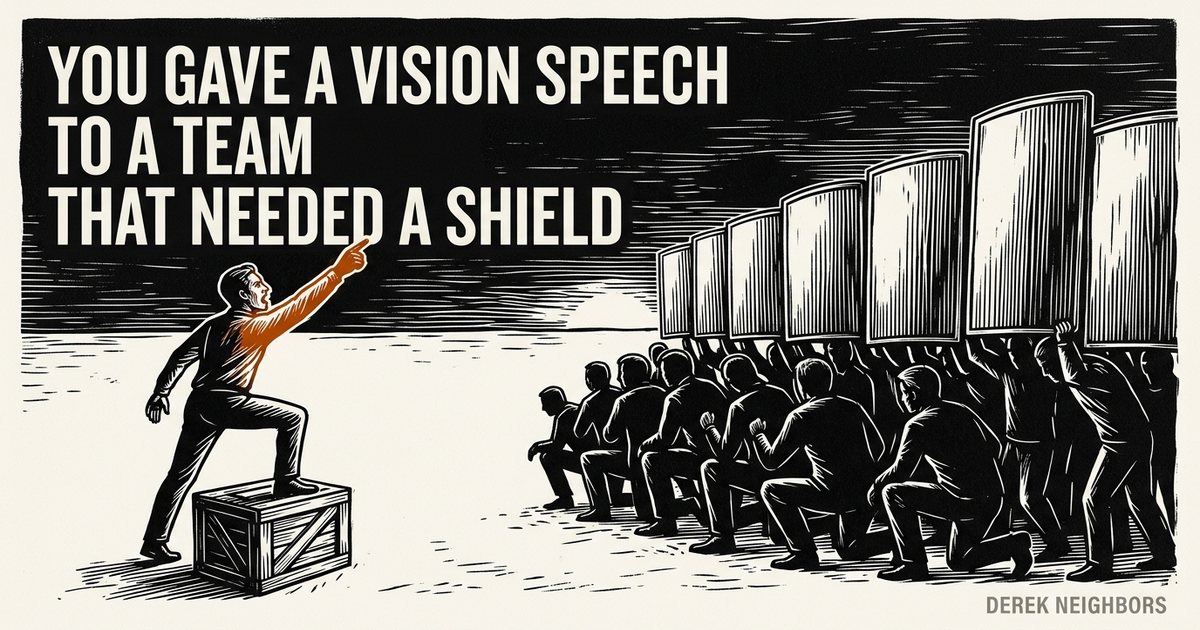
You Gave a Vision Speech to a Team That Needed a Shield
By Derek Neighbors on September 18, 2026
Tuesday the rumor got around. Somebody’s friend at a partner company heard a number. By lunch the number had a department attached to it.
Thursday was the all-hands, and you gave your team the best talk you have given all year. The new platform. The customers it opens up. Where this is in eighteen months and what it will feel like to have built it. You worked on those slides. You meant every word.
The room did not move. Cameras off, two polite questions, and then a Slack thread you were not in that ran the rest of the afternoon, and none of it was about the platform.
Nothing you said was wrong. That is the part worth sitting with, because the usual explanations for a talk that dies are that it was vague, or dishonest, or badly delivered, and this one was none of those. It was true and clear and it landed like a dropped plate.
The pattern that does not add up
Widen the frame and the same thing is happening everywhere. Companies have never spent more on leadership: coaching, offsites, frameworks, training budgets, a book a quarter. Across the same stretch, trust in leaders has been falling and engagement has dropped. When Mark van Vugt and his colleagues published in Harvard Business Review this May, they opened on exactly that gap: companies had never spent more on their leaders, and employees had never trusted them less.
If all that training were producing bad leaders, at least the story would be coherent. Mostly it is not. More often than I expected, the leaders I watch get rejected are doing what the books say: communicating the vision, sharing context, running the retro, keeping the door open. And the room still goes cold on a Thursday.
Something else is being graded.
What followers actually check for in a leader
In 2026, Xiaotian Sheng, Wendy Andrews, and van Vugt published a validated instrument in the Journal of Applied Psychology called the Fundamental Follower Needs Inventory. Six studies, 3,514 working adults across the United States, the United Kingdom, and China. Their question was simple: when people decide whether a leader is worth following, what are they checking?
Six things, and they hold across countries and settings.
Protection. Someone is standing between me and the thing that could hurt me.
Fairness. The rules apply to everyone, and credit and pain go where they belong.
Vision. I know where we are going and why it matters.
Expertise. The person leading me knows how this work is done and can help when I am stuck.
Affiliation. I belong here. Someone would notice if I were gone.
Status. My contribution is seen, and my standing is going somewhere.
The finding that matters for the room above is what predicts effectiveness. It tracks fit, the match between what the leader supplies and what the follower needs at that moment, more than it tracks style. And the way leaders miss is specific. They do not ignore the list. They over-supply the need that is not pressing at the expense of the one that is. The HBR example is almost the room I described: a restructuring creates uncertainty about jobs, the leader delivers an energetic speech about a bold new direction, and the team needed protection.
Vision, handed to a frightened room, is the wrong gift, and a very good version of the wrong gift does not become the right one.
The oldest case study we have
Homer’s standing epithet for Agamemnon is shepherd of the people. The Iliad is, among other things, a study of a shepherd who keeps handing the flock the wrong thing.
Book 1. A plague is running through the camp, and to end it Agamemnon has to give back a captive. He agrees, then takes Briseis from Achilles to make up the loss. The army’s fairness problem, who bears the cost of the king’s mistake, gets answered with a status move: I outrank you, so I take yours. Achilles walks out. The central catastrophe of the poem follows from that one substitution.
Book 2. Agamemnon has a dream promising victory and decides to test the army before the attack. He will propose that they give up and sail home, expecting the men to shout him down and demand to fight. Nine years in, plague barely lifted, they run for the ships. Odysseus has to go down the lines and physically turn them around. Agamemnon had read his own mood, fresh off a good dream, and supplied a loyalty test to men who needed someone to stand in front of them and say when this ends.
Two need failures by the same leader open the most famous war story in the West. Homer was not writing a management book, and the mismatch is still the first thing that happens in the poem.
The same room, three ways
Take the engineering org version, which I have watched play out at company after company.
Comp bands leak, and a team learns a peer was promoted over two of them. The VP of engineering shows up to the next team meeting with next year’s architecture roadmap. Expertise, supplied to a fairness problem. The team nods through it, and the roadmap goes unheard.
On-call is drowning. Pages every night, the same three services, the same two people. The all-hands has a slide thanking that team by name. Status, supplied to a protection problem. The applause is real and the pages continue.
A team has three top priorities from three directors and no idea which one is real. The manager plans a happy hour. Affiliation, supplied to a vision problem.
Each of these leaders brought something people generally want, brought it well, and got graded against something else.
I ran a company through a bad economy in my thirties, and I know the speech because I gave it. People wanted to know whether they had jobs. I told them where the company was going. I believed the direction and I still think it was right, and I remember reading the silence in that room as doubt about the plan, when it was a question about payroll that I had not answered.
The hidden pattern: your favorite move
Leaders default to the need they are best at supplying. The vision person gives vision, the expert gives expertise, the warm leader gives belonging, and the process person runs a fair process. You have a favorite move because it is the one that got you here, and under pressure you reach for it because it is the one that works in your hands.
Here is the problem with that. Your favorite move is a fixed trait, and the team’s need is a moving state that shifts with the quarter, the rumor, the reorg, the launch that slipped. So the mismatch is your own strength, applied on a schedule the room does not share, and calling it bad luck is how you avoid seeing that.
There is a second layer, and it explains why the true speech fails rather than merely underperforms.
Aristotle, in the Rhetoric, says an audience believes a speaker when they see three things: practical sense, good character, and eunoia, goodwill toward them specifically, the belief that you have their interests in view. Miss any one and the true things you say stop landing. A team that heard the layoff rumor Tuesday and got a growth speech Thursday learned one of two things about you. Either you did not notice, or you noticed and chose the platform anyway. Both spend goodwill, and a pattern of them removes it. Once it is gone, your competence and your honesty cannot carry the talk by themselves. The choice of content told the room what you were looking at, and it was not them.
That is the mechanism under the cold room. The wrong supply is evidence that you were reading your own state instead of the room’s, which is what Agamemnon did with his dream. Your favorite move is you looking at yourself, and the read only happens when you look at the people in front of you.
Steadiness is the authority you accumulate over years, and fit is what you do with it this week. Steady leaders with one move lose rooms too.
What this changes
Leadership becomes diagnosis before delivery. Your strongest move is your most dangerous one, because it is the one you reach for without checking.
This is owed at every level, not only by people who give all-hands. A lead running a two-person on-call rotation cannot promise anything about budgets, and can still say what they know, what they do not, and when they will know more, which is the whole of protection at that level. Rank changes what you can promise, and it does not change whether you owe the read.
The needs move. The same team wants protection in March and status in June, and a leader with one move is right on a schedule they do not control. Being a vision leader means you will be exactly right a few times a year.
Reading the room turns out to be a skill with a checklist, and the checklist is short. Exposure points to protection. Complaints about who got what point to fairness. Confusion about what matters points to vision. Being stuck points to expertise. Isolation points to affiliation. Feeling unseen points to status, which is the need the steady people on your team are quietly failing to get. The signal almost never comes to you directly. It lives in the sideways complaint, what people say to each other in the channel you are not in, and part of the job is having someone who will tell you what is in that channel.
Protection deserves its own paragraph, because it is the need engineering leaders most often try to answer with something else. Protection looks like this. Say the true thing about jobs, or say you do not know yet and name the day you will. Take the hit upward on the date instead of passing it down. Say no to the product org out loud, in the meeting, with your name on the refusal. None of that is a speech, and all of it is what the room was waiting for on Thursday. The vision can wait a week, and it cannot substitute for any of it.
Fairness has the same shape. People carry hard outcomes they disagreed with when they were heard first, and no roadmap fixes the feeling that the rules moved for someone else.
And when vision is the live need, when the confusion is real and the directors are not aligned, give it. Just point it at the work rather than at yourself, and give it because the room asked, not because it is the talk you like giving.
One boundary, because fit can be misread as obedience. Supplying the live need means answering the question the room actually has, honestly, and sometimes the honest answer is no. You owe the team protection from a rumor, and you do not owe them protection from the consequences of their own bad release, and a team asking for the second kind needs to hear the difference from you, plainly, in the same meeting. Read the need every time, and grant the want only when granting it is right.
Five moves this week
-
Write the need in one word before you talk. Protection, fairness, vision, expertise, affiliation, status. If you cannot pick, you are not ready to open your mouth in front of the team, and the meeting can wait a day.
-
Read the sideways signal. What are people complaining about to each other, not to you? Ask the one person who will tell you. Map what they say to the six and believe the map over your own preference.
-
Name your default and treat it as the suspect. If you always reach for the roadmap, assume the room needs something else until it proves otherwise. Your favorite move gets the burden of proof.
-
Supply the live need first, then earn your favorite. Say the job-security sentence before the platform slide. Fix the promotion before the architecture review. You buy the right to give the talk you love by paying the one they need.
-
Check by behavior, not by applause. A week later, did the sideways complaining stop? Did people ship? If the room clapped and nothing changed, you supplied the wrong thing well, and the clapping was the polite version of the cold room. Keep the ledger honest here. The read and the supply are yours, and the reception is not. A correct read that still gets a cold room is information about the situation, maybe the rumor is true or the trust was spent months ago, and it is not a verdict on the method.
The test
Think about the last time your team went quiet after you talked to them.
Which of the six were they waiting for? And which one did you give them?
If those are the same answer, you read the room. If they are different, you now know what your favorite move is, and you know what it cost.
Final Thoughts
Leadership as a fixed style is a story leaders tell because it flatters the thing they are good at. Visionary leader, servant leader, player-coach: every one of those is a favorite move with a name on it, and every one of them is right some weeks and wrong the rest.
The team is grading, week by week, whether the thing you brought is the thing they needed. That check is older than any framework, and Homer already knew what it costs to fail it.
Read the room first. Then decide what to say.
The hardest part of this is hearing which need is live before you have already picked your move. That takes people around you who will say what is in the channel you are not in, which is what MasteryLab is built for.