Right After You Win, You Ask for Too Much
By Derek Neighbors on November 23, 2026
Power vs. Virtue: The 48 Laws Examined
A year-long examination of Robert Greene's 48 Laws of Power through the lens of ancient virtue ethics. Some laws we affirm, some we reframe, some we reject entirely.
Law 46 ended by saying this one was next. Law 47 of the 48 Laws of Power is Do Not Go Past the Mark You Aimed For; In Victory, Learn When to Stop. It is one of the few laws in the book this series can mostly sign.
Anyone who works with coding agents has lived a version of it. You give the agent a clear job with a clear finish: make the failing checks pass on one service, without changing the public interface. Soon the checks are green, and the work is good. Then you type the sentence that ruins the afternoon: “While you’re in there, can you also clean up the retry logic?” An hour later the change touches dozens of files, two other services, and a config nobody asked about. Each step looked like a small extension of a win. By the end you can no longer tell which parts you would ship. The first stretch was the best work of the day, and the rest of the afternoon went past it.
The Law: Do Not Go Past the Mark You Aimed For
Law 47: “Do Not Go Past the Mark You Aimed For; In Victory, Learn When to Stop.”
Greene’s argument goes like this. The moment of victory is often the moment of greatest danger. A win makes you feel that you cannot lose, so you push past your goal into fights you never planned for, and you make enemies faster than you can handle them. The cure is to set a goal before you start, and when you reach it, stop. Take the win, consolidate it, and wait before you choose the next goal.
His warning story is Cyrus the Great, the Persian king who had conquered most of the world he knew. Near the end of his life Cyrus decided he wanted the Massagetae too, a nomad people ruled by a queen named Tomyris. His good example is Madame de Pompadour, who kept her place at the court of Louis XV for about twenty years by not reaching for more.
The Tactical Truth
Greene is right that winning changes how you judge risk, and the research agrees with him. In 1990, Richard Thaler and Eric Johnson studied how people bet after they had just won or lost money. People who had just won took more risk on the next bet, as if the gain were not really theirs and losing it would not count. Casino players call that playing with the house money. The effect has a name now, and it describes the meeting right after a big launch as well as it describes a craps table.
The strongest case for Law 47 comes from Thucydides.
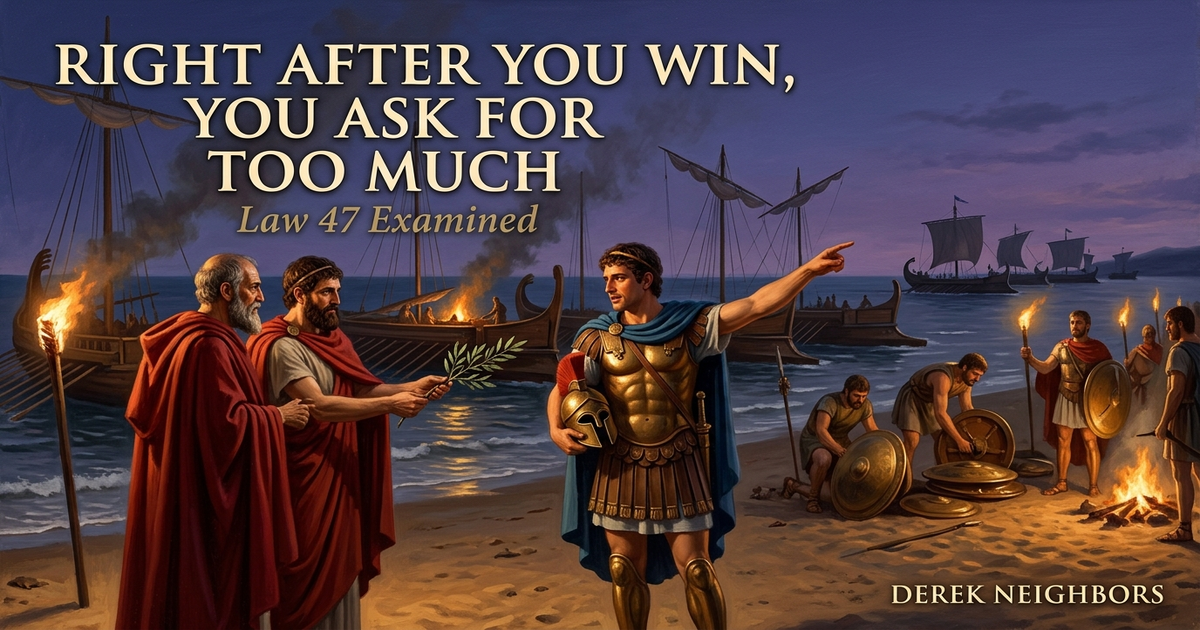
In 425 BC, during the war between Athens and Sparta, the Athenians trapped a force of Spartan soldiers on the island of Sphacteria, off the coast at Pylos. It was one of the strongest positions Athens held in the whole war. Sparta sent envoys to Athens to offer peace and an alliance. Their speech, in Book IV, has advice in it that Greene could have written: people who have had good luck should treat it as uncertain, and the time to make a good peace is while you are winning. Thucydides says the Athenians “grasped at more.” Pushed by the politician Cleon, they demanded that the trapped men hand over their arms and be brought to Athens as prisoners, and then that Sparta give up four places it had no intention of giving up. The talks failed. Sparta made more offers later, and Athens turned those down too.
A year later Thucydides shows what the winning had done to Athenian judgment. In Book IV, chapter 65, the Athenians punished their own generals, accusing them of taking bribes to come home from Sicily when they could have conquered it. Thucydides says this happened because their run of success had persuaded them that nothing could stand against them, and that they could do the possible and the impossible alike. Pericles had warned them years before not to try to grow the empire during the war. Nine years later they sent a huge fleet to conquer Sicily. In 413 BC it was destroyed, and Thucydides says that of the many who went, few came home.
Tech had its own version a few years ago. In 2021, a lot of tech companies were winning. The pandemic pushed everything online, revenue jumped, and leaders treated the jump as the new normal. They hired as if the curve would never bend. In November 2022, Stripe’s Patrick Collison wrote that the company had “overhired for the world we’re in” and cut about 14 percent of its staff. A week later Meta cut about 11,000 jobs, and Mark Zuckerberg wrote that he had expected the surge to last: “I got this wrong, and I take responsibility for that.” Both are smart leaders, and both were writing about decisions made right after a big win.
And then there is the afternoon with the agent. The model was fast and good, and it never got tired, so speed had nothing to do with what went wrong. I am all in on letting agents run as fast as they can. What went wrong is that nothing in the setup said “done,” so the session kept going on the momentum of the first win, and the person at the keyboard let it.
Before you use any of this, sort out what is yours. Whether the win holds, whether the market turns, whether the other side accepts terms, those are not up to you. Whether you stop at the mark you set is.
The Character Cost
Greene writes about the cost of going too far as a cost to you: you lose what you won. Start with the act itself. Going past the mark lets appetite make a decision that belonged to your judgment, and that is a loss even when the only thing you bet is your own weekend. The larger harm is that the push past the mark almost always spends other people. Cyrus died, and so did most of the army he led across the river. The Athenians who sailed to Sicily mostly did not come back. Many of the people hired in 2021 for a curve that was never going to last got the layoff email in 2022. The leader who goes past the mark is betting with chips that belong to other people, which is the house money problem with a worse moral. The wrong is in the bet, whether or not it pays.
The first cost is that the win turns into a story about you. The Greeks called this hubris, and it means something sharper than arrogance. Arrogance is a high opinion of yourself. In the Rhetoric, Book II, chapter 2, Aristotle defines hubris as an act: doing or saying things that shame another person, not for any gain, but for the pleasure of feeling superior. He says the young and the newly rich are especially given to it, because they think that treating others badly shows how far above them they are. Look at how a team behaves the quarter after a big win. Some of it is ordinary greed, like harder terms for partners. The hubris is the part meant to shame: the team that missed its date gets mocked in the all-hands, and the vendor who doubted you gets a public told-you-so. Cleon’s first demand at Pylos, that Spartan soldiers be marched to Athens as prisoners before any talk of peace, was built to shame Sparta in front of Greece, and a side being shamed in public rarely signs.
The second cost is the appetite that moves the goal after you hit it. The Greek word is pleonexia, wanting more than your share, and it gets its most famous defense in Plato’s Gorgias. Callicles argues that nature’s justice is for the stronger to have more, and that the rules about enough were written by the weak to hold them back. Socrates answers that Callicles has ignored proportion, the kind of measure that holds the world together. He also gives Callicles a picture of the life he is praising: a person filling leaky jars with a sieve, pouring all day and never full. Thucydides, describing the civil war on Corcyra in Book III, names pleonexia and ambition as the cause of all of it. At work it sounds like “if we hit that number, imagine what we could do.” The mark you set in January gets rewritten in March to whatever you can now see. Once that happens, no win can ever count as enough, because the goal moves every time you get close.
The third cost is that the next push gets decided by momentum instead of by a case. A win produces energy, and energy needs somewhere to go. “We should keep going while we have momentum” is a reason to move fast and says nothing about which way to go. Athens voted for Sicily on a run of luck, and Thucydides says most Athenians did not even know how big the island was or how many people lived on it. He adds a complication worth keeping. In Book II he says the expedition failed less because Athens misjudged the enemy than because the people at home fought among themselves and did not back the army they had sent. The vote to go was made in a mood, and the loss had more than one cause. The decisions made the week after a big win are often the least examined decisions a company makes, because nobody wants to be the one asking hard questions at the party.
The fourth cost is the lesson you never collect. A win is information. It tells you something worked, and if you stop, you can find out what. When you roll straight into the next fight, the win never gets studied, and the next push gets planned from a story (“we’re good at this”) instead of from what happened. The agent session is the small version. The first stretch worked because the job was tight and the checks were clear. Nobody learns that from the session, because by the time anyone looks up, the tight job is buried under dozens of files.
Greene’s version has one crack, and it matters. Nearly every reason he gives for stopping is about protecting what you took: going on makes enemies, luck turns, and you can lose your gains. Those are true, and they are reasons of fear, and fear-based rules give way the moment stopping looks expensive. That is why Law 47 sits so badly next to Law 15, where Greene tells you to crush your enemy totally. Both laws reach for whatever keeps you safest, so whichever looks safer that week wins, and neither one says what the right amount is. The practices below also ask who loses if you go on, but for a different reason. Concern for the people carrying your bet is justice toward them, and it holds even on the days when going on would be perfectly safe for you.
And Greene never mentions the other way to miss. Some leaders stop short of the mark. They hit eighty percent of what they promised, feel the risk of the last stretch, and stop there, telling themselves they are being careful. A team that ships the safe half of the plan and declares victory has missed the mark as surely as Athens did, just on the other side. An agent run you stop before the checks pass leaves unfinished work for someone else.
The ARETE Alternative
The Greek virtue for hitting the mark is sophrosyne, and it has little to do with caution. It is often translated as temperance or moderation, but the word means something closer to a sound mind: a mind that knows its own measure and keeps to it. The inscription at Delphi, “nothing in excess,” is its motto. Solon, the Athenian lawgiver, put the danger it guards against in one line: excess breeds hubris when great prosperity comes to people whose minds are not sound. Prosperity is the trigger, and sophrosyne is what keeps it from going to your head. In the Republic, Book IV, Plato describes it as an order inside a person, where the parts of the soul agree that reason should rule. On that account, stopping at enough is good for the one who stops, before it is good for anyone’s gains or anyone’s team.
Aristotle gives the shape of it in the Nicomachean Ethics, Book II, chapter 6, using an archer’s language. There are many ways to miss, he says, and only one way to hit, which is why missing is easy and hitting is hard. Every virtue is a mean between two misses, one by too much and one by too little. That covers the gap in Greene. Going past the mark is a miss, and so is falling short of it. Aristotle’s own account of sophrosyne is narrower, about bodily pleasures, but his archer’s picture covers every virtue, and it fits the older Greek sense of the word. sophrosyne is the skill of knowing where the mark is and landing on it, which sometimes means pushing through the last stretch.
That changes why you stop. Greene stops to protect his gains, while a leader with sophrosyne stops because the mark was the right amount, and more than the right amount is worse, even when you could get away with it. The mark is also usually a promise. The team planned their quarter around it, and partners and customers made their own plans on top of it. Rewriting it in the middle of a win breaks a promise to all of them, which is why the stop belongs to your character and not only to your strategy.
So what makes an amount right? Aristotle says the mean is relative to the thing and to us, and that reason sets it the way a person of practical wisdom would. For a goal at work, the right amount is what the purpose of the work actually requires, judged against the people relying on it, and decided before the win, when the mood is not doing the deciding. Sometimes the mark itself was wrong. You set it too low, or the world changed. Fixing a wrong mark is legitimate, and it looks different from going past a right one: it is a new decision, made cold, in the open, with the people who planned around the old one.
A bigger goal after a win is fine on the same terms: a new decision, made on its own merits, after the win has cooled. I made the case for naming the end before you start in Law 29. Law 47 is about the harder moment, when you have reached that end and everything in the room is telling you to keep going.
At work, that comes down to five practices.
Write the mark so it can say “done.” “Grow the platform” can never be finished. “Move the three biggest customers onto the new API by March” can. If you cannot tell from the goal whether you have hit it, the win will rewrite it for you.
When you hit it, stop for a day. A day is enough. Ship the win, tell the team, and do not choose the next goal in the same meeting. Decisions made at the party are the ones Thucydides wrote about. The next morning, the room is calmer and the case for the next push has to stand on its own.
Put the stop in the harness, then go fast. For agent work, the mark belongs in the setup, where it does not depend on anyone’s willpower. The acceptance checks pass and the run ends. Anything else you want becomes a new run with its own mark and its own checks. The model stays as fast as it can go. What changes is that every run finishes at a line you can judge. Ten small runs that each land are worth more than one long session that drifted past the point where anyone could say what it did.
Ask whether you would start this if you had just lost. This is the house money test. Take the win off the table and look at the next push as if you were starting cold. If you would not hire those people, enter that market, or start that rewrite after a bad quarter, the only thing recommending it is the mood.
Name who pays if the next push fails. Before you go past the mark, write down whose chips you are betting: the people you would hire, the team that would carry the pager, the customers who would get the half-built version. If you could not explain the bet to the people on that list and defend it to their faces, stop at the mark.
None of this depends on rank. The engineer who points the agents at one bug and then has them rewrite the module around it is going past the mark. So is the manager who gets the headcount they asked for and immediately asks for more, and the founder who closes a round and doubles every plan the same week. The staff engineer whose design review goes well and who then adds three features to the proposal on the spot is doing it in miniature. And stopping short works at every level too: the junior engineer who gets the agents through the hard part and leaves the last acceptance check failing for someone else has missed the mark on the other side.
Often the person who moves the mark is above you. Leadership sees the win and doubles the target. That decision is theirs. Your part is to say plainly what the original mark was, what the new one will cost, and who will carry it, and then do your own work honestly against whatever goal stands. Being pushed explains a bigger goal, and it gives you no excuse for staying quiet about what that goal will cost.
Ancient Wisdom: the queen, the island, and the archer
Herodotus, Histories, Book I, chapters 201 to 214, tells the end of Cyrus. Tomyris sends word that he should stop, rule his own people, and let her rule hers. Cyrus crosses the river instead. Herodotus calls the battle that followed the fiercest fought between non-Greeks that he had heard of. Cyrus dies in it, and Tomyris fills a skin with blood and puts his head in it, telling him to drink his fill.
Thucydides, History of the Peloponnesian War, Book IV, chapters 17 to 21, has the Spartan peace offer after Pylos and the Athenians grasping at more. Chapter 65 has the run of success that persuaded them the possible and the impossible were alike. Book VII, chapter 87, has Sicily, and Book II, chapter 65, has his own verdict on why it failed. Book III, chapter 82, names pleonexia and ambition as the cause of the civil war on Corcyra.
Plato’s Gorgias has Callicles praising the strong who take more and Socrates answering him with proportion and the leaky jars. The Republic, Book IV, describes sophrosyne as the parts of the soul agreeing that reason should rule. Aristotle’s Rhetoric, Book II, chapter 2, defines hubris as shaming others for the pleasure of feeling superior. The Nicomachean Ethics, Book II, chapter 6, gives the archer’s picture of virtue: many ways to miss, one way to hit.
Side by side, for a leader who has just won:
| Greene’s Law 47 | The sophrosyne version | |
|---|---|---|
| Why you stop | To protect your gains | Because the mark was the right amount |
| When stopping looks costly | Switch to Law 15 and finish them | Stop anyway, the mark was a promise |
| Stopping short | Never mentioned | A miss, the same as going past |
| The next goal | Chosen after you consolidate | Chosen cold, as a new decision |
| Who pays for going too far | You | Everyone you were betting with |
The Test
What was the last goal you hit, and what happened to it in the week after you hit it?
Did you choose your current goal on purpose, or did it grow out of the last win?
If you had just lost instead of won, would you still start the thing you are about to start?
Who would pay if your next push failed, and have they agreed to the bet?
And the one that decides: when you set a goal, can anyone on your team tell, from the goal alone, the moment you have hit it? If not, you will not stop there, because nothing in the goal will tell you to.
Final Thoughts
Greene is right about Law 47. The moment you win is when your judgment is most at risk. Athens had peace in its hand at Pylos and asked for more, and the same appetite later sent its fleet to Sicily. Leaders in 2021 hired for a curve that was never going to last. A good agent run can turn into a mess in an afternoon when nobody writes down where it is supposed to stop.
Greene’s reason for stopping is to keep what you took, and that reason gives way the first time stopping looks costly. The better reason is sophrosyne: the sound mind that knows its measure, stops at the mark because the mark was right, and counts stopping short as a miss too. Set a mark that can say done. When you hit it, stop for a day, and choose the next one cold.
Law 48 is next, the last in the series: Assume Formlessness.
Knowing when the work is done is part of doing it well. That is what MasteryLab is for.
Frequently Asked Questions
What is Law 47 of the 48 Laws of Power?
Law 47 is Do Not Go Past the Mark You Aimed For; In Victory, Learn When to Stop. Robert Greene argues that the moment of victory is often the moment of greatest danger, because success makes you overconfident and pushes you past your original goal into new enemies and new risks. His advice is to set a goal and stop when you reach it. This series affirms the law, with one correction: Greene’s reason to stop is protecting your gains, and the Greek virtue of sophrosyne gives a better one.
What does do not go past the mark you aimed for mean?
It means that when you reach the goal you set, you stop, instead of letting the momentum of a win carry you into a bigger goal you never chose on purpose. Greene’s main example is Cyrus the Great, who had conquered a huge empire and was killed after refusing Queen Tomyris’s offer to leave the Massagetae alone.
What is the difference between hubris and arrogance?
Arrogance is an inflated opinion of yourself, while hubris, in its Greek sense, is something you do. Aristotle defines it in the Rhetoric as doing or saying things that shame another person for the pleasure of it, because it makes you feel superior, and he says the young and the newly rich are especially given to it. A person can be arrogant without ever acting on it, and hubris always shows up in how you treat people, often right after a win.
What is pleonexia?
Pleonexia is the Greek word for wanting more than your share, or grasping. Thucydides names it, together with ambition, as the cause of the civil war in Corcyra. In Plato’s Gorgias, Callicles praises it as the natural right of the strong, and Socrates answers that he has ignored proportion. In the context of Law 47, it is the appetite that rewrites your goal after you reach it, so that no win is ever enough.