Chronos (χρόνος): Meaning, Definition & Modern Application
KROW-nos
Sequential, quantitative time measured by clocks and calendars. Unlike kairos (the opportune moment), chronos represents arbitrary, mechanical time that passes regardless of meaning or readiness.
Etymology
From the Greek chronos, meaning “time” in its sequential, measurable sense. Often conflated with the Titan Kronos who devoured his children, though the words have different origins. Chronos gave rise to “chronology,” “chronicle,” and “chronic,” all pointing to time as a linear, quantitative progression. The Greeks distinguished this mechanical, indifferent form of time from kairos (the opportune moment), recognizing that not all moments carry equal weight.
Deep Analysis
The Greeks maintained two distinct words for time because they recognized two fundamentally different relationships with it. Chronos is quantitative time: the ticking of the clock, the turning of the calendar, the mechanical progression of seconds into minutes into hours into years. It measures duration without regard for significance. An hour of waiting in line and an hour of transformative conversation occupy the same amount of chronos. The clock does not care which hour matters more.
The mythological association between Chronos and the Titan Kronos who devoured his children carries philosophical weight even if the etymological connection is debated. Time as chronos is destructive. It consumes everything it touches. Youth gives way to age. Memory fades. Civilizations rise and fall. The person who relates to time purely as chronos lives under the constant pressure of something being taken away. Each moment that passes is a moment consumed, and no force can retrieve it.
Aristotle treated time as an object of physical inquiry in the Physics. He defined chronos as “the number of change with respect to the before and after,” meaning that time is how we measure change. Without change, there would be no time. Without time, there would be no measure of change. The two are inseparable. This definition has a practical implication: if you want to understand where your time goes, look at what has changed. If nothing is changing, you are consuming chronos without producing anything. If everything is changing chaotically, you are being consumed by chronos without directing it.
The relationship between chronos and kairos reveals the poverty of a purely chronological orientation. Modern productivity culture is obsessed with chronos: calendar management, time-blocking, hourly billing, velocity metrics, quarterly targets. Each of these treats time as a uniform resource to be allocated efficiently. The assumption is that if you fill every hour with productive activity, you will maximize your output. The Greek understanding was that some moments carry qualitative weight that no amount of efficient scheduling can create. Kairos arrives on its own terms, and the person whose attention is entirely consumed by managing chronos will often miss it entirely.
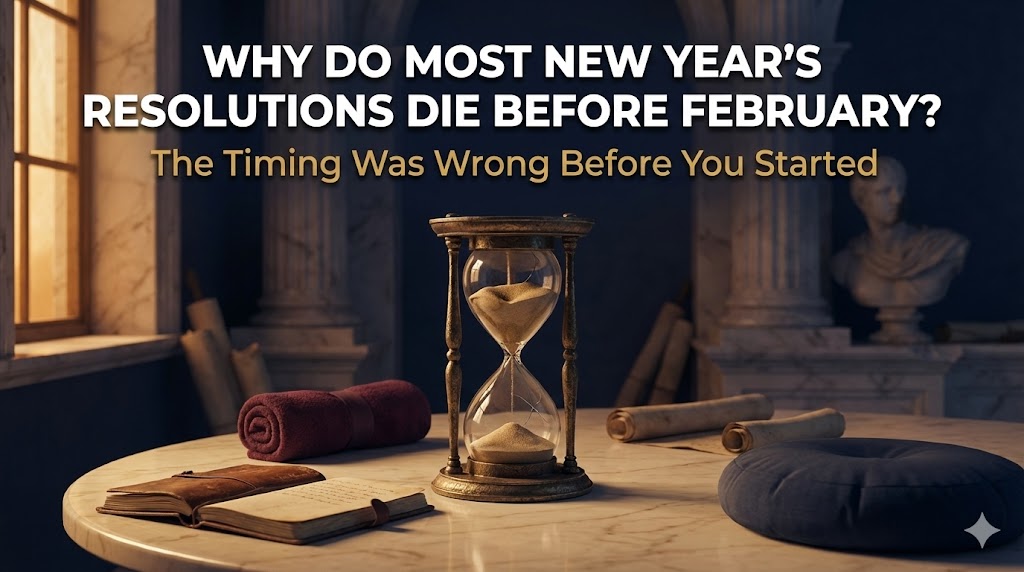
The modern calendar creates an illusion of significance where none exists. January 1st is not meaningfully different from December 31st. Monday morning does not contain properties that Sunday evening lacks. Yet people routinely treat these arbitrary markers as though they carry transformative power. The “I’ll start Monday” phenomenon is chronos thinking at its most deceptive: the belief that a calendar date can provide the motivation or readiness that your current moment lacks. Prosoche, the practice of present attention, is the antidote to this illusion. When you are fully present to the current moment, you stop deferring action to future calendar dates because you recognize that the quality of the moment depends on what you bring to it, not when it falls on the schedule.
Schole, the Greek concept of leisure as productive contemplation, offers an alternative to the chronos-driven relationship with time. Modern culture treats all time as either productive (filled with work) or wasteful (filled with idleness). The Greeks recognized a third category: time spent in contemplation, reflection, and intellectual engagement that is neither productive in the economic sense nor idle. Schole is time liberated from the tyranny of chronos, time that is not measured by what it produces but valued for the quality of engagement it permits. Aristotle argued in the Politics that “we work in order to have leisure,” inverting the modern assumption that leisure exists to recover from work.
The practical challenge of living with chronos awareness is resisting two extremes: the anxiety of time scarcity and the complacency of assumed abundance. The person who lives under constant time pressure makes hurried decisions, neglects relationships, and sacrifices depth for speed. The person who assumes time is abundant defers, procrastinates, and discovers too late that the resource they treated as infinite was shrinking the entire time. Neither extreme reflects the reality that time is limited but sufficient if directed wisely. The discipline is to treat each period of time as an opportunity for the best use you can make of it, without the anxiety that comes from trying to squeeze maximum output from every minute.
Modern Application
Chronos thinking traps you into believing that calendar dates carry inherent power, that January 1st or Monday morning creates transformation. Real change respects kairos, not chronos. Stop waiting for convenient dates and start recognizing when you're actually ready to move.
Historical Examples
The development of mechanical clocks in medieval Europe fundamentally altered humanity’s relationship with chronos. Before mechanical timekeeping, time was experienced through natural rhythms: sunrise, sunset, seasons, and the calls to prayer that structured monastic life. The mechanical clock, first appearing in European monasteries around 1300 CE, externalized time into an objective, quantifiable resource that could be measured, divided, and sold. Lewis Mumford, in Technics and Civilization, argued that the clock rather than the steam engine was the key machine of the industrial age because it made possible the coordination of human activity on a scale that natural time-keeping could never support. The Greeks’ dual concept of time, chronos and kairos, became culturally invisible once mechanical clocks reduced all time to uniform, quantifiable units.
Benjamin Franklin’s famous maxim “time is money,” published in Advice to a Young Tradesman in 1748, represents the full colonization of the Western time concept by chronos. Franklin’s equation was literal: an hour of idle time equals the income that hour could have produced. This framework, which became the foundation of modern productivity culture, would have been incomprehensible to Aristotle, who argued that work exists to create the conditions for leisure, not that leisure represents lost productive capacity. The contrast between Franklin’s chronos-only framework and the Greek dual-time system reveals what was lost in the transition to modern industrial time.
Marcus Aurelius, writing in the Meditations, engaged with chronos through the Stoic practice of memento mori: the deliberate contemplation of mortality as a tool for right living. His reflections on the passage of time are not anxious but sobering: “Think of the life you have lived until now as over and, as a dead man, see what is left as a bonus and live it according to Nature.” Aurelius used awareness of chronos, specifically its finitude, as a catalyst for present engagement rather than a source of anxiety. This Stoic approach treats the knowledge that time is limited not as a reason to fill every moment with activity but as a reason to ensure that the moments you do fill are directed toward what genuinely matters.
How to Practice Chronos
Audit how you relate to time this week. Notice every instance where you postpone action to a future date (“I’ll start Monday,” “next quarter”). Write these down. For each one, ask: am I waiting because the timing is genuinely not right, or because I am using the calendar as a shield against discomfort? Reclaim agency over your schedule by blocking time for your most important work first, before obligations fill the space. Practice treating time as a resource to be invested with intention, not a river carrying you passively toward deadlines. Track how many hours each day you spend on activities that move you toward your purpose versus activities that merely fill time. At week’s end, calculate the ratio and make one concrete change to improve it. Examine your relationship with deadlines: do you use them as motivation or as permission to procrastinate until the last moment? Redesign your workflow to front-load effort rather than back-loading it against arbitrary calendar dates.
Application Examples
A company operates on quarterly goals, with every initiative evaluated against ninety-day timelines. A team proposes a research project that will take two years to produce results but could transform the company’s competitive position. The proposal is rejected because it does not fit the quarterly evaluation cycle. The company’s relationship with chronos, specifically its quarterly measurement rhythm, has made it unable to invest in anything that does not produce results within an arbitrary time window.
Organizational chronos thinking creates structural bias toward short-term action. The quarterly cadence is a chronological convenience, not a natural law. When the measurement period determines what work is valued, the organization has subordinated its strategy to the calendar rather than the reverse.
A man who turned fifty realizes he has been telling himself for fifteen years that he will write a book ‘when things settle down.’ Things have never settled down and never will. The calendar pages have turned, each one carrying the same promise that the next period will be better. He has consumed fifteen years of chronos waiting for conditions that chronos will never deliver.
Chronic deferral is the most common way chronos thinking destroys potential. The person who waits for the right time on the calendar is waiting for chronos to deliver what only kairos can provide: the readiness to act. Kairos does not appear on the schedule. It appears when you decide the moment is now.
A team lead schedules back-to-back meetings from 8am to 6pm every day, believing that filling every hour with scheduled activity maximizes her productivity. She has no unscheduled time for reflection, creative thinking, or responding to unexpected opportunities. When a critical insight about a product pivot emerges during a casual hallway conversation, she cannot act on it because her calendar has no room.
The fully scheduled calendar is chronos management taken to its logical extreme: every hour accounted for, every minute allocated. The cost is the elimination of the unstructured time where the most important insights and opportunities emerge. The Greeks valued schole precisely because it created the space that rigid chronos management destroys.
A student prepares for a certification exam by following a strict study schedule: two hours per day for six months. She adheres to the chronos plan perfectly but feels unprepared on exam day because the rigid schedule prevented her from spending additional time on topics she found genuinely challenging. She treated all study hours as equal when they were not.
Chronos treats all hours as equivalent. The reality of learning, and of most meaningful work, is that some hours are worth more than others depending on what you bring to them and what they demand. The student who adapts her effort to the difficulty of the material rather than the rigidity of the schedule learns more effectively because she is responding to the qualitative demands of the work rather than the quantitative demands of the calendar.
Common Misconceptions
The most pervasive misconception is that better chronos management, filling hours more efficiently, solving productivity problems. The problem is rarely that you do not have enough time. It is that you do not bring enough presence, discernment, or courage to the time you have. Another error is treating chronos as the only dimension of time and ignoring kairos entirely. The person who manages their calendar perfectly but never recognizes when conditions have ripened for decisive action has mastered the less important dimension. A third misconception is that chronos is the enemy. Time is not against you. It is neutral. The anxiety about time scarcity is a judgment about time, not a property of it. The Stoics would classify this anxiety as a passion arising from a false judgment about something that is, in the deepest sense, an adiaphoron, a morally indifferent thing.
I spent years as a chronos optimist, believing that better time management would solve my productivity problems. I tried every system: Pomodoro, time-blocking, calendar color-coding, hourly tracking. Each system helped temporarily and then failed because it addressed the symptoms of chronos anxiety without treating the cause.
The cause was my relationship with time itself. I treated time as a resource that was perpetually scarce, and this scarcity mindset produced a constant low-grade urgency that made everything feel like a deadline. I could not distinguish between genuinely time-sensitive work and work that merely felt urgent because I had placed it on a calendar.
The practice that changed my relationship with time was deliberately unscheduling. Three times a week, I blocked two hours with the label “nothing.” No agenda, no goals, no tasks. The first few weeks were agonizing. I felt guilty for wasting time. I kept reaching for my phone or opening my laptop. Over time, I noticed that the “nothing” blocks were producing my best ideas, my clearest thinking, and my most creative problem-solving. The unstructured time was not waste. It was the space where my mind could process what my scheduled hours had been stuffing into it.
I now think of chronos as the container and kairos as the content. The calendar provides structure. The quality of what happens within that structure depends on whether I am present to the moment or merely occupying it. A two-hour meeting can be either chronos consumed or kairos seized, depending on whether the people in the room are genuinely engaged or simply waiting for it to end. The discipline is not to fill every hour but to bring full presence to the hours that matter.
Frequently Asked Questions
What is chronos in Greek philosophy?
Chronos is the Greek concept of sequential, quantitative time, the kind measured by clocks and calendars. It represents the mechanical passage of moments regardless of their significance or meaning, in contrast to kairos, which captures the quality of a specific moment. The Greeks distinguished chronos from kairos because they recognized that treating all moments as equal blinds you to the moments that actually matter.
What does chronos mean?
Chronos means time in its linear, measurable sense. It is the root of English words like chronology, chronicle, and chronic. It describes time as an indifferent, continuous progression that flows at the same rate regardless of what is happening within it. The word is sometimes conflated with the Titan Kronos who devoured his children, though the two words have different origins.
How do you practice awareness of chronos?
You develop awareness of chronos by noticing when you treat calendar dates as inherently meaningful rather than as arbitrary markers. Audit your relationship with deadlines and schedules. Use time intentionally rather than letting it pass passively, and stop postponing action to future dates that carry no real significance. When you catch yourself saying "I will start on Monday," ask what makes Monday different from today, and if the answer is nothing, start now.
What is the difference between kairos and chronos?
Chronos is mechanical, quantitative time that passes at a constant rate regardless of context. Kairos is the qualitative, opportune moment when conditions align for decisive action. Understanding both helps you stop waiting for the calendar and start recognizing when the moment is genuinely right. Effective leaders navigate both dimensions of time, using chronos for planning and structure while remaining alert to kairos for decisive action.