Karteria (καρτερία): Meaning, Definition & Modern Application
kar-teh-REE-ah
The virtue of patient endurance and steadfast perseverance in the face of hardship, pain, or prolonged difficulty. Distinguished from mere courage (andreia), karteria emphasizes the capacity to bear what must be borne without yielding or complaint.
Etymology
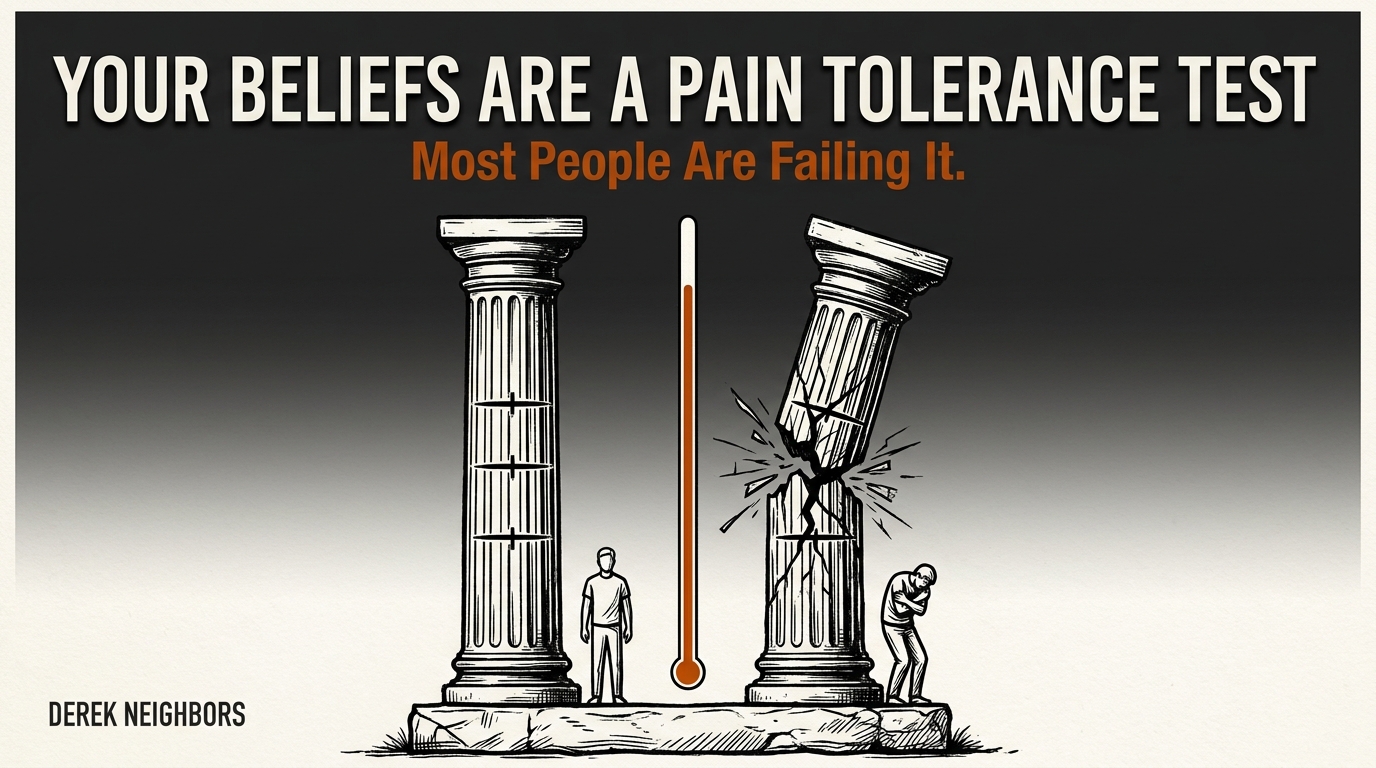
From karteros, meaning “strong,” “steadfast,” or “enduring.” Related to kratos (power, strength). Socrates was celebrated for his karteria during military campaigns, standing barefoot in snow while others bundled in cloaks. The Stoics elevated the concept to a core virtue, distinguishing it from andreia (active courage) by emphasizing the capacity to withstand over the capacity to charge forward. Karteria is the strength of the wall, not the sword.
Deep Analysis
Karteria in Stoic thought was not passive suffering but an active philosophical stance: the deliberate choice to endure what must be endured without complaint, resentment, or collapse. Epictetus, who spent his early life as a slave and bore a permanent disability from his enslavement, taught that the capacity to bear difficulty without being destroyed by it is among the most important virtues a person can develop. His distinction was precise: you do not choose what happens to you. You choose how you bear it. Karteria is the virtue of bearing it well.
The distinction between karteria and mere stubbornness is critical. Stubbornness persists in a course of action regardless of whether persistence serves any purpose. Karteria endures difficulty because the difficulty serves a purpose that remains worthy. The person who stays in a failing business out of pride is stubborn. The person who stays in a difficult business because the mission remains important and the obstacles are temporary is practicing karteria. The test is not the fact of endurance but the reason for it.
Epictetus’ teachings center on the concept of bearing and forbearing: anechou kai apechou (endure and renounce). Bear what must be borne without complaint. Renounce what is not within your control without resentment. These twin disciplines form the practical core of Stoic karteria. The first requires that you face difficulty directly rather than avoiding it or transferring it to others. The second requires that you release your attachment to outcomes you cannot control, which eliminates the resentment that makes endurance corrosive rather than constructive.
The relationship between karteria and andreia (courage) illuminates different temporal dimensions of moral strength. Andreia faces the acute moment of challenge: the decision to speak, to act, to confront. Karteria sustains you through the prolonged aftermath: the months of rebuilding after a failure, the years of developing a skill that shows no visible progress, the sustained effort of maintaining integrity when the daily cost is real and the reward is invisible. Most people can summon courage for a moment. Far fewer can sustain endurance through a marathon.
Ponos (productive toil) and karteria form a complementary pair that together describe the full scope of engagement with difficulty. Ponos is the active effort you invest. Karteria is the sustained capacity to keep investing when the effort extends beyond your initial estimate. A person with ponos but without karteria will attack a problem with energy and then abandon it when the problem proves larger than expected. A person with karteria but without ponos will endure passively without making progress. The combination of active effort sustained over time through patience and resolve is what produces the kind of achievement that most people find impossible because they lack one of the two.
askesis (deliberate training) builds the capacity for karteria through graduated exposure to difficulty. The Stoics prescribed specific practices: voluntary discomfort, the endurance of minor insults without retaliation, and the sustained practice of philosophical exercises even when they feel pointless. Each practice built the muscle of endurance in low-stakes conditions so that it would be available in high-stakes ones. The modern equivalent is any practice that deliberately introduces discomfort as a training stimulus: cold exposure, extended fasting, sustained meditation, or the deliberate choice of the harder path when an easier one is available.
The deepest function of karteria is to prevent premature abandonment of worthy pursuits. Most significant achievements require a phase where progress stalls, motivation wanes, and the temptation to quit is strongest. The person who lacks karteria will interpret the stall as evidence that the pursuit is not working. The person with karteria will recognize the stall as a normal phase of any extended effort and will continue. The difference between the two determines, over a lifetime, the difference between completing significant work and accumulating a graveyard of abandoned projects.
Modern Application
When your leadership journey stretches into months or years of uncertain progress, karteria is what keeps you steady. You cultivate this virtue not through dramatic moments of bravery, but through your daily refusal to abandon your purpose when results are slow and recognition absent. Practice holding your position when everything in you wants to quit—this patient endurance builds the foundation for lasting achievement.
Historical Examples
Epictetus’ life is the most direct historical embodiment of karteria as a philosophical virtue. Born into slavery and physically disabled, he endured conditions designed to break the human spirit and emerged as one of the most influential philosophers in Western history. His teaching, preserved in Arrian’s Discourses, consistently returns to the theme of bearing what must be borne without complaint. His famous response to his master twisting his leg, calmly predicting the break and then acknowledging it without distress, captures the Stoic ideal: endurance that does not pretend the pain is absent but refuses to let the pain determine the response.
Shackleton’s Imperial Trans-Antarctic Expedition of 1914-1917 demonstrates leadership karteria under conditions that tested the concept to its absolute limit. After the Endurance was crushed by pack ice, Shackleton kept twenty-seven men alive through months of camping on ice floes, an open-boat crossing of the Southern Ocean, and a mountain crossing on South Georgia Island. The endurance was not a single heroic act but a sustained daily practice of maintaining morale, rationing resources, and making incremental decisions that collectively preserved every life. His achievement was not reaching the South Pole. He did not. His achievement was bringing every member of his crew home alive through nearly two years of continuous difficulty.
Harriet Tubman’s thirteen return journeys to the South to lead enslaved people to freedom through the Underground Railroad represent karteria combined with andreia at the highest level. Each journey carried mortal risk. The sustained campaign over years, while suffering from seizures caused by a childhood head injury, required the kind of endurance that goes beyond courage into a category of its own. Tubman’s karteria was not passive. It was the sustained application of active effort under conditions where failure meant death, repeated until the work was done.
How to Practice Karteria
Identify the long-term commitment in your life where progress feels slowest and most uncertain. This is your karteria training ground. Set a minimum daily action for this commitment that is small enough to sustain on your worst day: one page written, one conversation had, one practice completed. Track your streak. When the urge to abandon arrives, sit with it for twenty-four hours before making any decision. Notice that the urge passes. Build endurance the same way you build physical stamina: through progressive exposure to sustained effort, not through dramatic single performances. Study the story of Socrates standing barefoot in snow during military campaigns while others bundled in cloaks. His karteria was not dramatic heroism but quiet, sustained refusal to yield to discomfort. Apply this principle by choosing one area of prolonged difficulty in your professional life and committing to a minimum viable effort every single day for ninety days. At the end, review how your relationship with sustained difficulty has changed.
Application Examples
A startup founder is three years into a five-year product development cycle. Revenue is minimal. Competitors with simpler products are growing faster. Investors are skeptical. She continues building because the engineering progress confirms that the deeper technical approach will produce a superior product, even though the market has not yet validated the conviction.
Karteria in entrepreneurship means sustaining effort through the period between conviction and validation. The founder has evidence that her approach is sound but not yet evidence that the market will reward it. Enduring this gap requires patience grounded in reason, not blind persistence.
A man caring for a parent with dementia has been doing so for four years with no prospect of improvement. The daily routine is exhausting and largely invisible to others. He does not complain. He continues because the care serves his parent and honors his own values. He has built support systems, maintains his own health, and has accepted that this commitment will extend for years.
Caregiving is one of the purest expressions of karteria because the difficulty is sustained, the improvement is absent, and the endurance serves someone else’s wellbeing rather than your own achievement.
A school principal implements reforms that she knows will take five to seven years to produce measurable results. Parents, board members, and politicians pressure her for quick outcomes. She maintains the reform trajectory, provides evidence of leading indicators, and endures the political pressure because she understands that reversing course would restart the clock.
Institutional karteria means sustaining a long-term strategy through the period when short-term metrics contradict it.
A novelist spends six years on a book that her agent doubts will find a commercial audience. The writing is slow and difficult, with extended periods where the work feels purposeless. She continues because the book represents her best work and the story demands to be told.
Creative karteria is endurance applied to work whose value may never be externally validated. The novelist endures not because she is certain the book will succeed but because the quality of the effort itself is worth sustaining.
Common Misconceptions
The stubborn person and the enduring person look similar from the outside, but the resemblance is superficial. The critical difference is the presence or absence of a worthy purpose. Karteria endures because the endurance serves something. Stubbornness endures because stopping would feel like failure. If the purpose has dissolved but you continue out of ego, you have crossed from karteria into stubbornness. The periodic reassessment of whether your endurance still serves a worthy purpose is what keeps karteria honest. A second misconception is that karteria means suffering in silence. The Stoics did not advocate for the suppression of pain but for the refusal to let pain determine your choices. You can acknowledge difficulty and seek support while maintaining resolve. A third error treats karteria as a permanent trait. Even the most enduring person has limits. Recognizing when you have reached yours and adjusting your strategy is not a failure of karteria. It is the exercise of practical wisdom.
Karteria became real to me during a period of organizational transformation that was supposed to take eighteen months and took nearly four years. The plan was sound. The execution was painful. Every quarter, something went wrong: key hires fell through, market conditions shifted, a critical vendor collapsed. Each setback was individually manageable. Collectively, they tested my capacity for sustained effort in a way no individual challenge ever had.
What I learned is that endurance is not a single decision. It is a daily practice. Every morning, I chose to continue. Some mornings the choice was easy because progress was visible. Many mornings it was hard because progress was invisible and the accumulation of difficulty felt overwhelming. The practice that sustained me was a weekly review listing three things that had moved forward, however small. In the worst periods, the list was sparse. But it was never empty.
The other lesson was that karteria requires honest assessment of whether the endurance is serving a worthy purpose. During the third year, I conducted a serious evaluation of whether the transformation was still the right strategy. The answer was yes, but arriving at it required genuinely considering whether the answer might be no. Karteria that does not periodically question its own purpose becomes stubbornness. The difference between the two is the willingness to honestly examine whether the difficulty you are enduring still serves something that matters.
I now apply a quarterly purpose check to every extended commitment. Is the original purpose still valid? Has new information emerged that changes the calculus? Am I enduring because the work demands it or because my ego refuses to admit the work should stop? These questions protect karteria from degrading into persistence that serves nothing except the avoidance of admitting you were wrong.
Frequently Asked Questions
What is karteria in Greek philosophy?
Karteria is the Greek virtue of patient endurance and steadfast perseverance in the face of prolonged difficulty. The Stoics distinguished it from active courage (andreia), emphasizing the capacity to bear hardship without yielding or complaint over extended periods. Socrates was celebrated for his karteria during military campaigns, standing barefoot in freezing conditions while his fellow soldiers marveled at his composure.
What does karteria mean?
Karteria means steadfast endurance or patient strength, from karteros (strong, enduring). The word is related to kratos (power, strength), reflecting the Greek understanding that endurance is itself a form of power. It describes the capacity to hold your ground through prolonged difficulty, maintaining your commitment when results are slow and recognition absent.
How do you practice karteria?
You practice karteria by maintaining minimum daily actions on your most important long-term commitments, especially when motivation fades. When the urge to quit arrives, sit with it for twenty-four hours before making any decision. Build endurance through progressive, sustained effort rather than dramatic bursts. Track your streak of consecutive days and let the growing number itself become a source of quiet motivation to continue.
What is the difference between karteria and andreia?
Andreia is active courage, the willingness to face danger and take decisive action. Karteria is patient endurance, the capacity to bear prolonged difficulty without yielding. Andreia charges into the storm; karteria stands firm while the storm rages around you for months. Most leadership challenges require more karteria than andreia, because the difficulty usually lies in sustaining effort over long periods rather than making a single bold move.