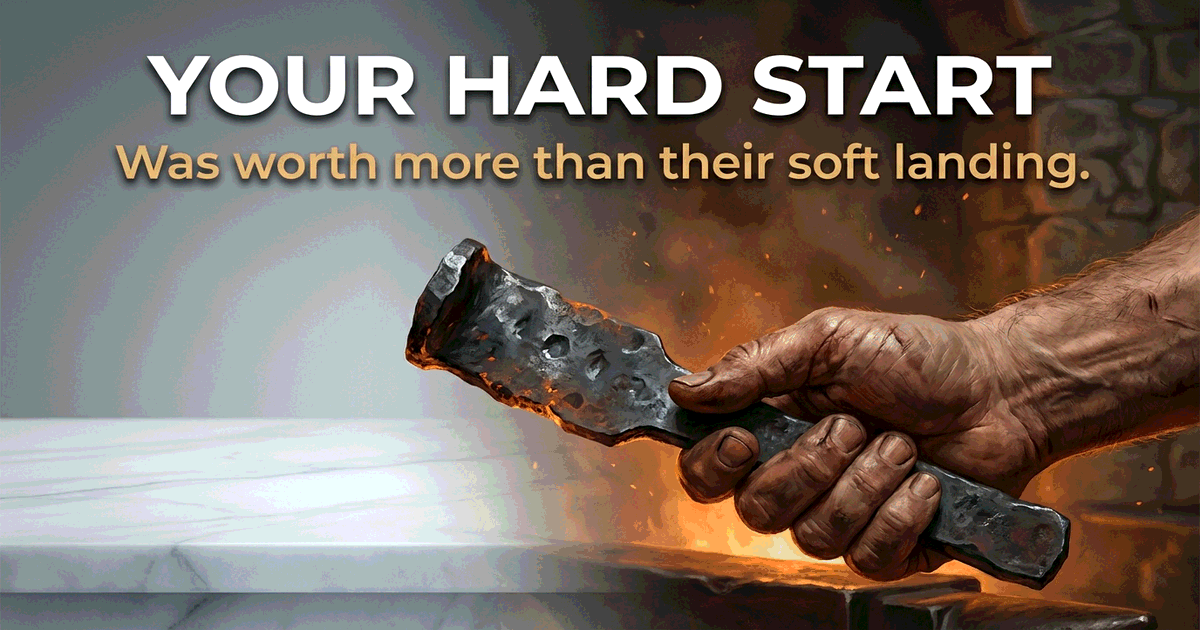
Your Hard Start Was Worth More Than Their Soft Landing
By Derek Neighbors on May 8, 2026
Two people walk into the room. One had a soft landing. The other had a hard start.
The soft landing got every door opened for them. The right family, the right network, the right zip code, the right introductions to the right rooms. By the time they were twenty-two, the path forward was already laid out and someone else was carrying the bags.
The hard start got every door slammed. No network, no buffer, no fallback. Every step required improvisation. Mistakes cost actual money. Quitting was not an option because there was nowhere to land.
Both of them are now thirty-five. They are looking at the same opportunity.
They are not seeing the same thing.
The Lie You Got Sold
Somewhere along the way, you absorbed a story. The story said hard starts are something to overcome, downplay, or apologize for. The story said the goal was to look like you came from the soft landing eventually. The story said hardship reads as low status, so the smart move is to edit it out of your bio.
You learned the language and the mannerisms. You learned what people expected when they asked where you went to school. You got good at hiding the formation that made you dangerous, because hiding it felt safer than leading with it.
The cost of that performance is high, and you have probably been paying it for years.
What the Hard Start Was Quietly Building
While you were busy hiding it, the hard start was installing capacities that no business school teaches and no soft landing ever produces.
Execution without permission. You could not wait for someone to authorize you, because there was no one with authority who cared. You learned to move. You learned to ship. You learned that nothing happens until someone decides it will, and the someone has to be you.
Resourcefulness. You had to build tools out of what was lying around. You learned how much you could accomplish with cheap inputs and unreasonable persistence. You stopped needing the right gear or the right office or the right title to begin work.
Tolerance for ambiguity. There was no map. There was no advisor. There was no one who had walked the exact path you were walking. You learned to take action under uncertainty, and you learned to keep adjusting after the first plan broke.
Pattern recognition under pressure. You read people fast because reading them slowly would have cost you. You learned to spot motives, signals, and risks long before someone with a buffer would have noticed.
Endurance. The Greeks had a word for the capacity to sustain effort through repeated frustration without quitting. They called it karteria. It is one of the underrated virtues, almost invisible until conditions get hard. You did not buy it. You did not study for it. The hard start was the test. Your prohairesis, the faculty of choice the Stoics named the only thing actually yours, was what passed the test. Many in your same conditions chose collapse, bitterness, or quitting. You chose to keep moving. The hardship gave you the occasion. Your response built the capacity.
There is a deeper Greek word for what could happen if you let it. The word is paideia. In its strict ancient sense, paideia meant deliberate cultivation under a teacher: arts, letters, music, philosophy, the slow shaping of a whole person across years. The hard start does not give you that automatically. It gives you the raw conditions. Whether those conditions become paideia or trauma depends on what you did with them while you were inside them.
The hardship is not the formation. The hardship is the test. The formation is what you became while you were taking it.
The Productive Toil
The Greeks also distinguished between two kinds of labor. They had a word for empty toil, the kind that exhausts you without producing anything. They also had ponos, productive labor, the kind that builds capacity. The fight you were in produced ponos. The friction was not pointless. It was forming you into someone who could operate when others could not.
This is the part the comfort culture cannot price correctly. From the outside, ponos and ordinary suffering look identical. Both involve effort, frustration, and lack of clear progress for long stretches. The difference is that ponos is producing something even when you cannot see it. As I wrote in you’re not struggling because something is wrong, the friction is often the proof that something finally matters. ponos is producing the operator you will need to be in fifteen years.
The soft landing never had to take this curriculum. Not because the people on it were lazy, but because the conditions never demanded it of them. They had handlers, advisors, fallbacks, capital, parents who could write a check, networks that could route around any mistake. The conditions invited softness. Many accepted the invitation. Some refused it and demanded of themselves what their conditions did not. Those people are doing the same internal work as anyone else; they just did not get the test handed to them by circumstance.
This is not bitterness. This is what the body and the character actually do. Capacity follows demand. No demand, no capacity. That is true for muscles, that is true for nervous systems, and that is true for the executive faculties that determine whether you can operate when nothing is working.
The Long Experiment
Reality runs a long experiment. It runs it across decades.
For the first decade, the soft landing wins on every visible metric. Better titles, faster promotions, larger networks, more obvious markers of arrival. The hard start watches and quietly wonders if effort is even the variable that matters.
By the second decade, the picture starts to shift. The people from the soft landing keep landing softly, but the gap between their results and their starting position is small. They have moved a few feet from where they were placed. The hard start, meanwhile, has covered ground that would have looked impossible from the original starting line.
By the third decade, the experiment is over. Conditions have changed two or three times. Markets shifted. Industries collapsed. Whole layers of management got cut. The economy ate the easy roles. AI ate the next layer of easy roles. Nobody is buffered anymore.
In that moment, the question reality is asking is brutally simple. Who has the muscles to operate when the scaffolding is gone? Who can move when there is no map? Who can stay in the room when it gets ugly?
The answer is not determined by who had the harder start. It is determined by who used the conditions they had to build something internal. The hard start is more likely to have demanded that work. The soft landing is less likely to have demanded it. But the demand has to be answered by the soul, not by the conditions, and either soul can answer or refuse.
The Recognition
This is the moment most people have somewhere in their forties. The thing they spent years trying to hide turns out to be the most valuable thing on their resume. Hardship is not romantic. The hard start was painful and unfair and you would not wish it on a child you loved. Many in your same starting conditions were not formed by it. They were broken by it. The same fire that forged you crushed others. The variable was not the fire. The variable was what you decided about the fire while you were standing in it.
If formation happened, it is real, and it is the asset.
You did not learn to operate without scaffolding from a course. You learned it because there was no scaffolding to lean on, and you chose to keep moving anyway. You did not learn pattern recognition under pressure from a book. You learned it because misreading a situation cost you, and you stayed in the room. karteria did not arrive by accident. The hardship was the test. Your decision to keep showing up was the formation.
The performance you have been doing, the one where you try to look like you came from the soft landing, is expensive. It is also backwards. You have been hiding the credential that actually proves you can do the work, in order to mimic credentials that mostly prove someone else’s family had money.
That is a bad trade. Stop making it.
The Test
Three questions worth sitting with.
What capacity did your hard start install that you have been treating as a disadvantage? Name it specifically. Write it down. The thing you have been embarrassed about is probably the thing you should be charging for.
What are you currently waiting for permission to do that the hard start already gave you the skills to do? You learned to move without permission. You stopped doing it somewhere along the way, because you got promoted into a culture that punished it. The skill is still there. The permission you are waiting for is not coming.
Where are you trying to look like the soft landing instead of leveraging the formation you actually have? Audit your bio, your speech, your professional self-presentation. Find the places where you are sanding the edges off the very thing that makes you dangerous. Stop sanding.
Final Thoughts
eudaimonia, the Greek word for the life that is actually flourishing, is not a function of starting conditions. The Greeks were specific about this. The slave Epictetus and the emperor Marcus Aurelius wrote from opposite ends of the social spectrum and converged on the same answer. The flourishing life is built by what you cultivate in yourself, not by what you were handed at the start.
Hard starts are not a verdict. They are an early curriculum. As I have argued before, comfort kills more dreams than failure ever did, and the inverse is also true: the privilege you spent years comparing yourself against came with a hidden cost the people on it could not see, because the cost only shows up when conditions change. The hardship you resented came with a hidden gift you also could not see, because the gift only shows up when the muscles you built are the ones the situation requires.
The soft landing has an expiration date. The formation does not.
If you are ready to stop hiding your formation and start leveraging it, that is the work I do at MasteryLab.co. The character work that turns hard starts into compounding advantage is the only education that holds up under pressure.