If You Explain Everything, They Learn Nothing
By Derek Neighbors on July 4, 2026
The most helpful person on your team might be the most expensive dependency in the building.
You know the one. Endlessly patient. Explains everything, start to finish, no step skipped. People leave their desk saying how generous they are with their time. And the same people come back next week, and the week after, with the same question wearing a different shirt.
I spent years being that person and calling it mentorship. It took me embarrassingly long to notice the pattern: the more completely I explained, the more often people came back. My thoroughness wasn’t building anyone. It was building a queue.
This is a diagnosable condition. Here is the workup.
The Symptoms
The questions never graduate. Different instances, same class, forever. If you taught someone how to fix the March report and they show up in April with the April report, no learning occurred. A transaction occurred.
Documentation grows and capability doesn’t. The binder of procedures gets thicker every quarter while the team’s ability to handle anything outside the binder gets thinner. You are writing an encyclopedia for people who are forgetting how to read the terrain.
A tool update breaks everyone. The vendor moves a menu, the model changes, the API deprecates, and work stops. That halt is the tell. It means people memorized the steps and never touched what was underneath them.
You are quietly proud of being needed. Somewhere along the way, the stream of questions started to feel like proof of your value. Dependence began to read as importance.
They reach for you before they reach for the problem. Your junior, your new hire, your kid with homework. The first move is your name, and it has been for a while.
Two or more of these and you don’t have a talent problem on your team. You have a teaching problem, and you’re it.
The Assessment
Five questions. Answer them honestly.
-
When did someone you taught last solve a problem from a class you never covered? A date would be good. If you can’t produce one, nothing you transferred has generalized.
-
What happens when you take a real vacation? If the answer is a backlog shaped exactly like you, you haven’t been teaching. You’ve been performing the work through other people’s keyboards.
-
What is your ratio of “here’s how” to “how would you find out”? Count it for one week. The first time I counted mine it ran about ten to one, and I would have guessed the reverse.
-
Have you ever left a gap on purpose and said so out loud? Withholding by accident is negligence. Withholding by design, announced, is curriculum.
-
When someone brings you a problem, do you ask what they tried before you touch it? Or is the fastest path through you, every time, with no toll?
The Diagnosis
Exhaustive explanation optimizes for today’s throughput. Handing over the answer takes two minutes; coaching the search takes twenty. Under deadline, the two minutes win, and they keep winning, daily, for years. The cost compounds off your books and lands on someone else’s development.
But the deeper problem is what you’re actually handing over. A complete procedure is an asset with a decay rate. It describes this tool, this quarter’s workflow. The half-life keeps shrinking, and AI has made the depreciation schedule brutal. A prompt playbook from eighteen months ago reads like instructions for a fax machine. People whose usefulness was a memorized procedure get repriced every time a model ships. Repriced, not devalued: markets grade utility, and utility was all the procedure ever held. People who can close a fresh gap get graded up on the same schedule.
And the market case is the smaller half of the argument. Suppose the tools froze tomorrow and no procedure ever expired again. Explaining everything would still stunt people, because the interruption cuts deeper than any workflow. Every gap you close for someone is a piece of their formation you did for them, and formation, unlike a procedure, can’t be handed over finished.
The Greeks had this figured out before any of our tools existed. Their word aporia means the impasse, literally the state of being without a path. Socrates treated it as his primary instrument. In the Meno, a slave boy confidently gives the wrong answer to a geometry problem, twice, and Socrates, who knows the answer the entire time, refuses to hand it over. He works the boy into open perplexity instead. Then he says something remarkable: the numbing did the boy no harm, because now, knowing that he does not know, he would be glad to search.
Aristotle made the mechanism explicit at the opening of Metaphysics Book III. The way through, which he calls euporia, belongs to those who have first been stuck well, because you cannot untie a knot you do not know is there. Read that as a teaching principle and it cuts hard: a complete explanation unties the knot before the student ever feels it. Untie every knot in advance and you haven’t removed the obstacles to learning. You’ve removed the doorways.
Real learning, what the Greeks called mathesis, runs on a loop. Meet the gap. Sit in it without panicking. Form a theory, test it, watch it fail, form another, and work your way out. Run that loop enough times and it settles into a hexis, a stable disposition, the thing a person reaches for automatically when the ground is new. There is no vicarious version. Nobody builds it by watching you run the loop on their behalf, and every answer you deliver on demand takes one repetition away from the only skill that survives the tools changing.
Which leaves the uncomfortable part of the chart. Why do we keep doing it? Because being the answer machine feels wonderful. At home it feels like love. At work it feels like leadership. Mostly it is the teacher meeting a need to feel necessary, billed to the student as help.
The Treatment
Teach one level up. Answer the class, never the lone instance. “Here is the answer” solves March. “Here is how I would find that, watch my screen” starts to solve every month after. If you only have two minutes, narrate your search for two minutes. It is worth more than the answer delivered silently.
Charge for answers. The price of your help is an attempt. What did you try? Where did you look? What is your current theory? Hold the line even when it would be faster to grab the keyboard. The point has nothing to do with hazing. Their narration of the search is the lesson, and you can’t debrief a search that never happened.
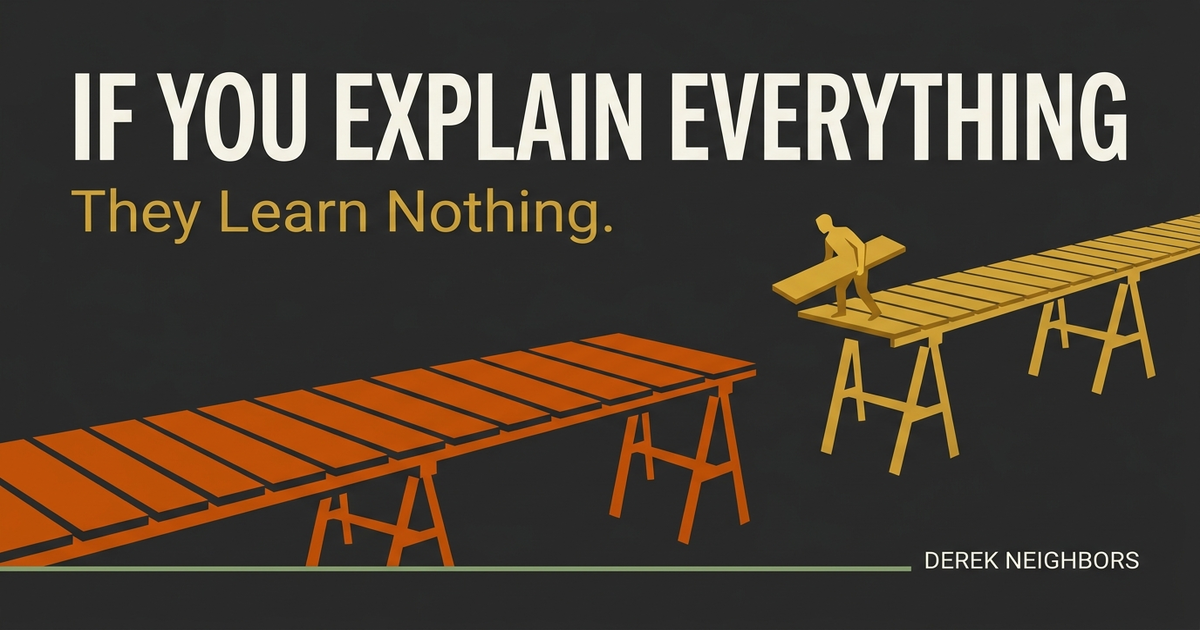
Leave gaps and announce them. “This gets you 80 percent of the way. The last part is findable, and finding it is the assignment.” An announced gap changes everything about how the struggle is received. Unannounced, it feels like abandonment. Announced, it becomes a bridge with one plank missing and the plank sitting where the crosser can cut it themselves. Be clear with yourself about the boundary here: the gap is yours to design. The crossing was always theirs.
Debrief the loop, never the result. When they come back with the solution, resist grading it. Ask what told them where to look. Ask what they would check first next time. The answer is already obsolete somewhere; the search that produced it is the transferable asset.
Let them watch you be stuck. This one costs the most and pays the best. Take a problem you genuinely don’t know how to solve and work it in front of them, dead ends and out-loud recalibration included. Junior people believe senior people skip the impasse. Showing them your live aporia, held calmly, teaches more than a year of polished explanations. What the watching transmits is the stance, how to stand inside the stuck without flinching. The reps that build the disposition are still theirs to do alone. I wrote before about why the best in the world can’t teach you what they know. The knowledge they can’t verbalize doesn’t transfer through words. The conduct inside confusion does.
The Prevention
Measure your teaching by output you never touched. The strongest evidence of transfer is someone solving a class of problem you never covered. The everyday proxy is the questions that stop coming, and even there, check which silence you’ve got. The student who learned stops asking. So does the student who quit.
Run the vacation test on yourself before circumstances run it for you. If a week of your absence produces a week of stalled work, start prescribing gaps today.
With kids and juniors, set the contract from day one: the deliverable is the search, not the solution. A kid who learns that Dad is a lookup service builds exactly one skill, and it makes them helpless the same way rescuing your team does.
One more thing, and it cuts the other way. If you’re the one doing the asking, none of this excuses you. Maybe you were over-explained your entire life. That explains the habit and excuses nothing, because the struggle was never something a teacher could do on your behalf. It can only be skipped, and whoever skips it, you pay for it. The next gap you hit, sit with it for thirty minutes before you reach for a human. That decision was always yours.
And keep phronesis in the loop, because this can curdle into something stupid. Answer-hoarding is not a pedagogy. Emergencies get answers, immediately and completely. Beginners get more scaffolding than veterans. Some things are pure lookup and deserve a lookup. Judgment decides where the gap goes. The discipline is that there is always, deliberately, somewhere, a gap.
Frequently Asked Questions
What does aporia mean in Greek philosophy?
aporia is the impasse, literally the state of being without a path. Socrates produced it deliberately, most famously in Plato’s Meno, because no one searches for what they think they already know. It is the doorway to learning, never the failure state.
Why is explaining everything a bad way to teach?
Complete explanations remove the struggle that does the teaching. Gap-closing is built through repetitions, and every on-demand answer takes one away. What gets transferred instead is a procedure, and procedures expire with the tools they describe.
How do you teach someone to learn on their own?
Teach the class of problem, not the instance. Require an attempt before helping. Leave announced gaps. Debrief how they found the answer rather than what they found. And let them watch you work a problem you can’t yet solve.
What is euporia?
euporia is the counterpart to aporia: the way through, a resourceful abundance of paths. Aristotle pairs them in Metaphysics Book III, arguing you reach the way through only by first being stuck well, since you cannot untie a knot you do not know is there.
Final Thoughts
Think back to the teacher who actually changed you. I’d wager what you remember has no procedure in it. What you remember is a problem they refused to finish for you, and the day you discovered you could finish it yourself.
That refusal was the gift. Every task you teach depreciates on someone else’s release schedule. The loop compounds for life. The Greeks called the whole project paideia, formation: what a person becomes by crossing their own gaps, building capability they own instead of renting yours.
Explain less. Leave the plank where they can reach the saw.
Teaching the loop instead of the task is the daily character work we practice at MasteryLab.co. Bring the people you’re tired of answering.