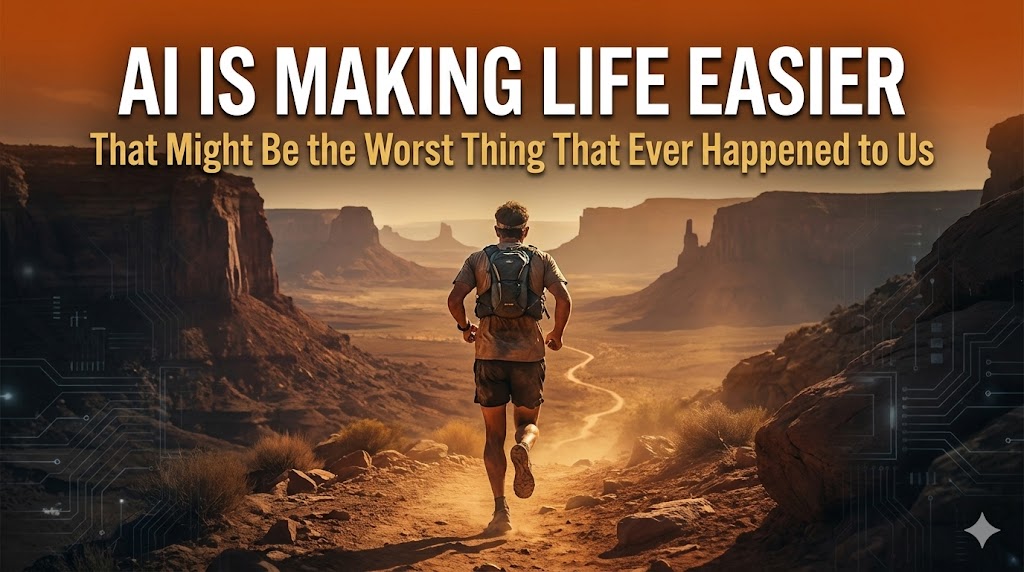
AI Is Making Life Easier. That Might Be the Worst Thing That Ever Happened to Us.
By Derek Neighbors on January 13, 2026
Three miles from the nearest aid station. Middle of a desert ultra. My calf muscle seized up completely, locked solid like someone had poured concrete into it.
No cell service. No shortcut. No Uber coming to rescue me. Just pain and a simple choice: keep moving or don’t finish.
I kept moving.
Not because I’m tough. Because I’d spent years building the capacity to keep moving when everything in my body screamed stop. That capacity wasn’t natural. It was built through thousands of small struggles that most people engineer out of their lives the moment technology offers an easier path.
And that’s the problem.
The Grind That Built This
The 4:30 AM alarm goes off. It’s dark outside. My body says stay in bed. I get up anyway because that’s what the training plan says. After work at 5:30 PM, I’m running into the night on desert mountains while everyone else is settling into their couches. I go to bed late because becoming capable of hard things requires doing hard things.
Not because it feels good. Because it’s the work.
Every one of those mornings, every one of those evening runs into darkness, every time I chose hard when easy was available, I was making deposits into an account I’d need to draw from later. The calf that seized up three miles from anywhere? I could handle that because I’d been handling smaller versions of that for years.
This capacity to endure wasn’t a gift. It was purchased through ponos, the Greek word for toil, for the labor that builds capability. Every struggle left a deposit. Those deposits compound over time into something that can’t be downloaded, can’t be outsourced, can’t be given to you by any algorithm.
And AI is systematically removing our opportunities to make those deposits.
What AI Is Actually Doing
Look at how the friction is disappearing.
Coding used to mean struggling through error messages for hours, building mental models through frustration, developing the pattern recognition that only comes from repeated failure. Now AI agents write the code. Humans define the problem to solve. The struggle is gone.
Writing used to mean staring at blank pages, wrestling with ideas that wouldn’t form into sentences, producing thousands of pages of garbage before anything good emerged. Now AI drafts. Humans edit. The blank page terror is optional.
Thinking used to mean sitting with incomplete information, synthesizing across domains, building the cognitive muscles that only develop under load. Now AI synthesizes. Humans approve.
Deciding used to mean weighing options with insufficient data, living with uncertainty, developing judgment through consequences. Now AI recommends. Humans click.
Hard thing after hard thing is being made easy. And most people see this as pure progress.
The cost is invisible until the easy path closes. Then it’s obvious.
The Hidden Cost
Friction wasn’t the enemy. It was the forge.
The struggle was never the obstacle to the point. The struggle was the point. When I learned to code by fighting with error messages, I wasn’t just learning syntax. I was building the mental resilience to solve problems that don’t have clear error messages. When I wrote thousands of terrible pages, I wasn’t just practicing sentences. I was developing the capacity to sit with discomfort until something emerged.
ponos was the price of capability. When AI pays that price for us, we never develop what the payment would have bought. We get the output without the transformation. We get the result without the resilience.
We’re outsourcing the very process that builds human capacity: the ability to persist when things are hard, to solve problems without clear solutions, to function when convenience fails. This is what struggle is FOR. Not suffering for its own sake. Building the capability to handle what life eventually requires.
Mile Sixteen
Sixteen miles into a race. Deep in the back half. Everything hurts. Not the sharp pain of injury, the dull ache of a body that’s had enough.
The body sends a clear signal: stop.
But here’s what years of choosing hard taught me: that signal is a governor, not a limit. The body lies. It tells you you’re done long before you’re actually done. The only way to know the difference is practice. Years of overriding that signal in smaller moments builds the capacity to override it when it matters.
Why does running hard build capacity for business decisions, for creative blocks, for life’s difficulties? Because the override mechanism is the same. The voice that says “quit” in mile sixteen is the same voice that says “give up” on a hard project. Physical training gives you hundreds of repetitions practicing the override. You build proof that the voice lies. That proof transfers.
Someone who never struggled wouldn’t have that override capability. Not because they’re weak. Because they never needed to develop it.
And that’s what AI is doing on a civilizational scale. It’s removing the need before the capacity develops. We’re not making life better. We’re making humans more fragile.
The Realization
Ultra running isn’t fitness. It’s askesis, the Greek concept of disciplined training of the soul. The ancients understood that the body was a vehicle for character development. You don’t run fifty miles to get in shape. You run fifty miles to discover what you’re capable of when every easy option has been removed.
But here’s what matters: askesis takes countless forms. Epictetus practiced it as a slave with no trail races, no gym membership, no 4:30 AM training block. He practiced it through how he responded to what he couldn’t control. The single parent working three jobs practices it by showing up when exhausted. The person with chronic illness practices it by engaging fully with what their body allows. The form varies. The obligation doesn’t.
Voluntary struggle is the antidote to involuntary weakness. The easier technology makes life, the more deliberately we must make it hard. This isn’t masochism. It’s survival.
Because disruption always comes. The easy path always eventually closes. And when it does, only what you built through struggle will matter.
What I Do Now
I use AI for everything. No guilt, no hesitation. Every benefit it offers, I take.
But I also deliberately seek hard things that AI can’t do for me.
Physical: I build things with my hands. I run trails that break me. I push my body past comfortable into the territory where growth lives.
Mental: I teach myself new skills on the computer, not because AI couldn’t help, but because the struggle of learning stretches me. I push into domains I don’t understand yet, actively hunting for the next thing I don’t know how to do.
The philosophy isn’t “avoid AI.” That’s stupid. The philosophy is “do hard things” alongside AI. Refuse to let technology remove all struggle from life. Use AI to clear the friction so you have capacity for challenges worth having.
The results speak for themselves. AI amplifies capability that was built through struggle. When AI handles the easy parts, I have capacity for harder challenges. The combination is technology leverage plus human resilience. Not choosing between AI and struggle. Choosing both.
The Antifragility Imperative
Nassim Taleb identified something crucial: some systems don’t just resist stress, they need it to strengthen. Bones need load to stay dense. Muscles need resistance to grow. Immune systems need exposure to pathogens to develop.
Humans can be antifragile. Given the right kind of difficulty, we grow through it. Remove all difficulty, you remove the growth mechanism.
AI is systematically removing our growth mechanism. Not maliciously. Helpfully. That’s what makes it dangerous.
The practice isn’t complicated. The discipline isn’t avoiding easy. It’s actively seeking hard.
The Stakes
This isn’t about productivity or efficiency. Those are the wrong frames entirely.
It’s about what kind of humans we become. A species that can’t struggle is a species that can’t survive disruption. And disruption, eventually, finds everyone.
The Stoics would say AI itself is adiaphora, indifferent. Neither good nor bad. What matters is your response. The question isn’t whether AI is useful. Of course it is. The question is whether you’ll let it remove all difficulty from your life, or whether you’ll use the freed capacity to pursue harder challenges.
Final Thoughts
The calf that seized up miles from anywhere taught me something no AI could: I am capable of more than my body wants to admit. That knowledge didn’t come from an algorithm. It came from years of proving it to myself, one hard thing at a time.
AI is making life easier. For most people, that will be the gift that keeps taking. The answer isn’t to reject it. It’s to use every tool available, then go do something that hurts. That’s how you get both the leverage and the resilience.
If you’re ready to build the kind of character that AI can’t replicate, MasteryLab.co is where people committed to deliberate difficulty come together. Not to optimize. To become.


