The More You Prove It, the Harder They Deny It
By Derek Neighbors on October 13, 2026
The engineer runs the service that keeps paging people at 2 a.m. In the first one-on-one about it, you bring the dashboard. They have an explanation: the traffic spike was a customer doing something unusual. Fair enough.
The next week you bring the incident list. Six pages in a month. They explain each one. Two were upstream. One was a bad config somebody else pushed. The rest were noise from an alert that needs tuning.
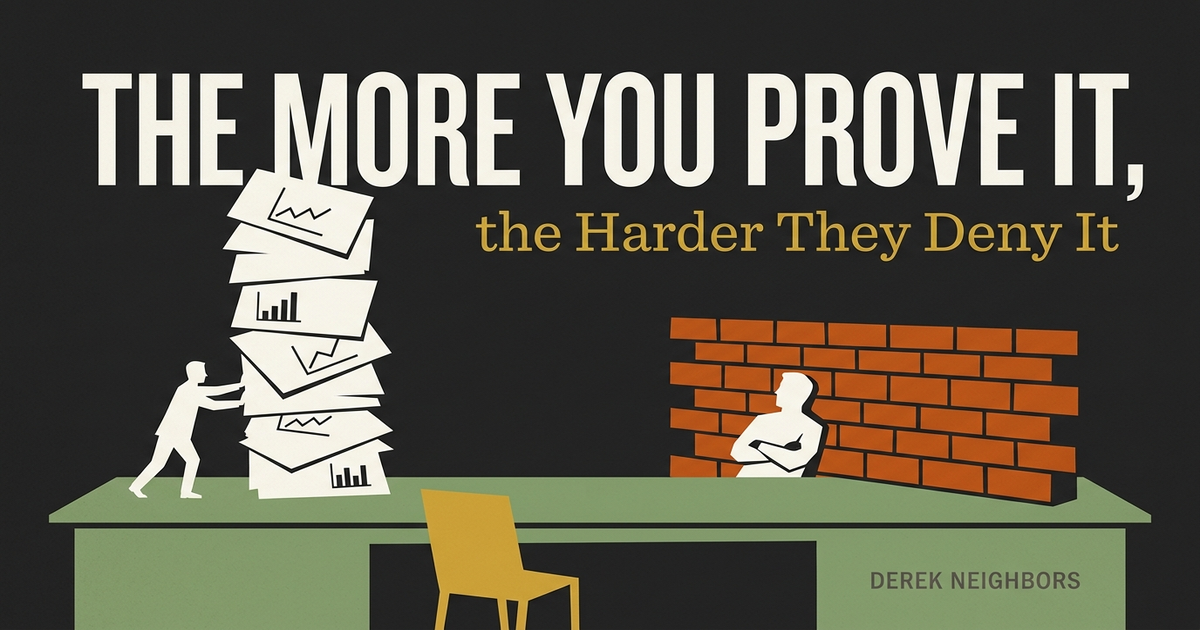
The third week you bring the queue graph, the incident list, the dashboard, and a two-page doc that ties them together. The case is airtight. They read it, go quiet, and then defend the service harder than they did in week one.
Somewhere in week three, if you are honest, you started writing the doc for yourself, so you could point to it later and say you told them.
Denial, in the sense that matters at work, means refusing to accept a fact about something you own because accepting it would cost you standing. When evidence arrives as a verdict on the person, agreeing with it costs them exactly that. They have to admit to their boss that they were wrong about the thing they own, and the stronger your case gets, the more they have to lose by saying yes.
Why Proof Backfires When Someone Is in Denial
In 1993, William Miller and two colleagues ran a study with problem drinkers. Each person got a check-up and feedback about their drinking. Half got that feedback from therapists using a directive, confrontational style. The other half got it from therapists who asked questions and drew out the drinker’s own reasons. The confrontational style produced more resistance in the room, and the more a therapist confronted, the more the client was drinking a year later.
Miller and Stephen Rollnick went on to build motivational interviewing on that finding. They have a name for the urge that ruins these conversations: the righting reflex. You see something wrong and you want to fix it, so you argue for the change. The other person, who is already uneasy, takes the other side. Now they are the one saying out loud why things are fine. People tend to believe what they hear themselves say.
The popular version of this idea, that facts make people dig in, was cut down by later research. Large studies found that facts rarely push people into believing the opposite, and most people update a little when you show them the data. The trouble starts when the data is delivered as a judgment about them, by someone with power over them, in a room where agreeing means losing face.
Socrates knew what that costs. In Plato’s Apology he describes questioning a politician who was famous for being wise. Through elenchus, his method of cross-examination, he concluded that the man only seemed wise, and then he tried to show the man so. In Socrates’ own words, the result was that the man “came to dislike me, and so did many of those present.” Socrates won the argument and gained an enemy, along with a few more in the audience.
The Four Ways Leaders Avoid the Real Work
We want the person to change, and then we do the thing most likely to make changing expensive. All four of these patterns feel like leadership while you are doing them, and all four spare the leader a harder conversation.
The Evidence Dump
Every week brings more charts, a longer doc, and maybe a link to a postmortem from another company with the same problem.
What you are avoiding is the conversation about what they are afraid of. Maybe they built this service, and admitting it is fragile feels like admitting they are not as good as their title says. Maybe they know the fix is a rewrite they do not have time for. You do not know, because you never asked. You were busy building the case.
The elenchus exposes a contradiction, and then the other person has to stand there with it. Do that every week and you teach them that one-on-ones with you are a cross-examination.
The Public Correction
You raise it in the incident review, or reply in the Slack channel with the graph, or bring it up at the team meeting “so everyone learns from it.”
What you are avoiding is a private conversation that might not go your way. Public settings feel safer for the leader because the room backs you up, and they are far worse for the person. Socrates’ politician had an audience, and the audience is what turned a disagreement into a grudge. Once other people watched them get corrected, agreeing with you means losing twice: once on the facts and once in front of their peers. Plenty of capable people will choose to keep defending, and that choice is still theirs.
The Recruited Chorus
You ask two peers and their tech lead to “mention it” when they get a chance. Within a week, three people have brought it up.
What you are avoiding is owning the message yourself. To the person on the receiving end it reads as an ambush. They can tell they are being worked on, and now the problem is a verdict with four signatures instead of one. Most people respond by finding out who started it.
The Quiet Route-Around
You give up. You move the critical work to someone else, add a second on-call to cover their service, or start planning the replacement without telling them, and you call it patience, or picking your battles.
What you are avoiding is the conversation altogether. Aristotle would call the evidence dump an excess and this one a deficiency. The person in denial gets the same result from both, because nobody is helping them see the thing they cannot see. The mean between them is to say the hard thing clearly, once, in private, and then do the slower work of making it safe to accept.
How to Help Someone in Denial at Work
What you can change is how much it costs someone to look.
In the Phaedrus, Socrates calls persuasive speech psychagogia, the leading of a soul. His point is that persuasion works on a particular person. A speaker has to understand what kind of person is in front of him and what that person can hear, or he is guessing. A doc you could send to anyone was written without this person in mind. Plato also meant leading a soul toward the truth and for its own good, and he had no use for the same skill aimed at winning a crowd. That gives a practical test for everything below: use only moves you would be comfortable explaining to the person while you make them.
Aristotle added the other half. In the Rhetoric, he says the speaker’s character, his ethos, is close to the most powerful persuasion there is. In Book II he names the three things that make people trust a speaker: good sense, good character, and eunoia, goodwill toward the listener. The person has to believe you want good things for them. An evidence dump tells them you want to be right.
1. Ask what would change their mind. Ask it straight: “What would you need to see to believe this service needs work?” Then ask what they are worried about if it does. If they say nothing would change their mind, more data will not help, because the problem is about identity or fear.
Socrates asked questions too, so be clear about the difference. He asked in front of an audience, already sure of the answer, to show a man he was not wise. This question is asked in private, and you have to want the answer. Ask yourself the same thing while you are at it. Some of their explanations might be true, and two of those six pages really may have been upstream. If you cannot name what would change your mind, the denial in the room might be yours.
2. Go first on your own miss. Before you ask them to admit anything, show them something you got wrong, like a bad call from last quarter or a project you defended too long. Leaders who have never been seen being wrong make being wrong look fatal. Show them it is survivable by surviving it in front of them.
3. Hand them the instrument, not the verdict. Give them access to the data and ask them to look at the last thirty days themselves, privately, and tell you what they see. People trust conclusions they reach on their own more than ones handed to them.
This applies to AI on your team right now. Every engineering org has a staff engineer who says the model cannot handle “our codebase.” Sending them benchmark threads and links to other companies’ wins is the evidence dump in a new form. Instead, sit down with them, pick a ticket from their own backlog, turn the model on, and let them drive. You watch. Do it once, privately, on their code. An afternoon on their own ticket usually does more than a month of links, and the conclusion is theirs because they reached it.
4. Make yes cheap. Point the conversation forward. Ask “What would the next version of this service look like?” and skip “Why didn’t you see this?”, which asks for a confession. Keep it private. Do not make them say “you were right.”
None of this moves the choice from them to you. Whether someone accepts a true thing about their own work is up to them, and they owe their team that acceptance even when their manager handled it badly. When you are the one across the table from the charts, that obligation is yours. What the leader controls is how the conversation is run: whether you asked, whether you went first, and whether agreeing was made affordable. If you have done that and the denial keeps costing the team, it becomes a decision instead of a conversation.
Some situations cannot wait weeks for any of this. If the denial is losing customer data, putting someone at risk, or burning money you cannot get back, stop leading and decide. Make the call, explain it plainly, and keep working on the person afterward. Not every decision is a discussion, and denial does not get a veto over safety.
This is the one-on-one version of a problem that also shows up across whole teams. When the denial belongs to an entire culture, you can’t talk a proud culture into changing either. And if your instinct runs the other way, toward softening the truth until it no longer lands, that has its own cost: soft feedback is kind to you and expensive to them.
Questions to Ask Yourself Before the Next One-on-One
- How many times have I shown them this evidence, and what did I expect to be different this time?
- Have I asked them what would change their mind, or have I only told them what should?
- Do they know about a time I was wrong, from me?
- Who else have I asked to bring this up with them, and would I be comfortable if they found out?
- If they agreed with me tomorrow, what would they have to admit, and to whom?
Final Thoughts
When someone you lead is in denial, the urge is to build a better case, and the case is rarely the problem. Many people in denial already suspect the truth. What stops them is the cost of saying so to you, sometimes in front of others, with their name on the thing that broke.
Lowering that cost is the part you control. Learn the person in front of you, let them see you be wrong first, let them find the data on their own, and give them a way forward that does not start with a confession. Socrates told his jury that years of questioning people in public had built the resentment that put him on trial. Once you have done your part honestly, what the engineer does next is theirs to own.
If you want to become the kind of leader people can change in front of, MasteryLab is built for that.
FAQ
How do you help someone who is in denial at work?
Stop building a stronger case and start lowering the cost of agreeing. Ask what evidence would change their mind and what they are worried about losing. Show them a mistake of your own first, so being wrong looks survivable. Give them the data to run themselves in private instead of presenting it as a verdict. Then make the next step forward-looking, so saying yes does not require a confession.
Why does showing someone the facts make them more defensive?
Facts alone rarely make people believe the opposite; large studies found the so-called backfire effect is uncommon. The problem in a one-on-one is that the facts usually arrive as a verdict about the person. When agreeing means admitting they were wrong in front of their boss, the stronger your evidence gets, the more they have to lose by accepting it. Research on motivational interviewing found that a confrontational style produced more resistance and worse outcomes than a style that drew out the person’s own reasons.
What is psychagogia?
psychagogia is Plato’s word in the Phaedrus for what persuasive speech does: it leads a soul. Because speech works on a particular person, Plato argues the speaker has to understand the kind of person in front of them and what moves that person. For a leader, it means fitting the conversation to the person you are talking to instead of delivering the same airtight case to everyone.
When should a leader stop trying to persuade someone in denial and just decide?
When the denial is putting customers, data, money, or people at risk right now. Patient influence is for patterns that can wait a few weeks. If the service is losing data or someone is getting hurt, you make the call, explain it plainly, and keep working on the person afterward. Denial does not get a veto over safety.