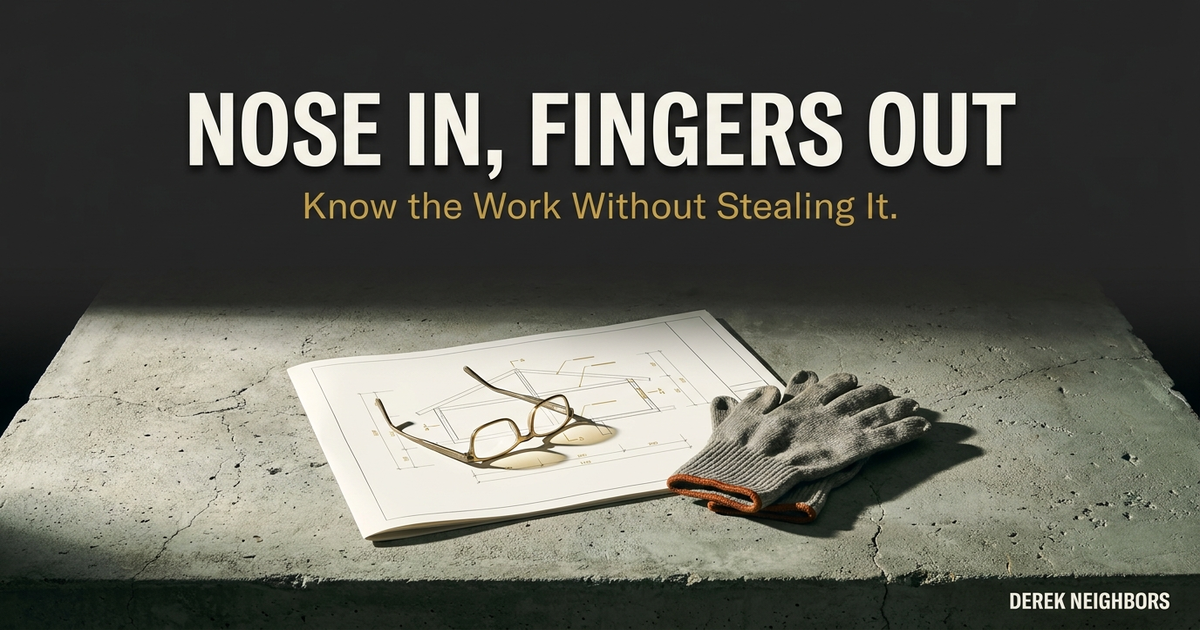
Nose In, Fingers Out. Know the Work Without Stealing It.
By Derek Neighbors on July 30, 2026
I got promoted out of the work and kept getting graded on it anyway.
That is the quiet trap after every real step up. Yesterday you could answer from muscle memory. Today the work lives in other hands, and the room above you still expects fluency on strategy, risks, and trajectory. Not vibes. Not “the team has it.” Actual understanding.
Most leaders meet that pressure with one of two failures.
They put their fingers back in. Or they take their nose out.
Both moves feel like leadership from the inside. Neither serves the work.
The Two Paths
Path A looks like care. You stay in every detail. You rewrite the draft. You join the huddle as the quiet executor who “just wants to help.” The calendar fills with work that used to be yours. Quality holds for a quarter. The team learns that excellence means waiting for your hands.
Path B looks like maturity. You say you trust people. You leave the room. You ask for updates after the decisions are already expensive to reverse. Your calendar frees. Your ego gets a story about empowerment. Then a board member asks a basic question and your answer is a status slide you did not understand until this morning.
Both paths solve a feeling. Path A soothes the fear of looking useless. Path B soothes the fear of looking controlling. The work needs a third stance: nose in, fingers out. Stay educated. Stop stealing choices.
People choose Path A because disappearing feels like negligence. People choose Path B because intervening feels like the micromanagement they swore they would never become. The false binary keeps both sides righteous and both sides wrong.
Path A: Fingers In
Path A works like this. Your title changed. Your nervous system did not. So you keep doing the old job at a worse hourly rate. Every ticket gets a drive-by. Every design review becomes a redesign. Every “quick sync” becomes you doing the thinking while someone else takes notes.
The short-term benefits are real. Defects drop. Your anxiety drops. You can brief anyone upstairs because you still own the work in practice. You feel useful again.
The costs compound quietly.
The team stops building judgment because judgment gets overruled. The bottleneck moves upward into you. Hiring slows because the role description is a fiction: the leader still executes. And the Greek name for this habit is older than your org chart. polypragmosyne is meddling in affairs that are not your proper work. Plato treated it as a form of injustice: each part of a city, or a soul, fails when it does another’s job. Calling that interference help does not change the category error about whose ergon the work is.
I know this from the inside. Early in consulting I measured value by how many rooms I was in. A client finally said the line that stuck: you are good at the thing we hired you for, and you are exhausting everywhere else. That was polypragmosyne with a laptop. I had confused presence with contribution.
Coach, don’t rescue names a cousin of this failure: you steal the reps that would have made them capable. Path A is that theft made permanent, then billed as standards.
Path B: Nose Out
Path B is the rebound from Path A, and it flatters you harder.
You announce trust. You stop reading the plan. You ask for outcomes and skip the mechanism. In meetings you perform distance: “I don’t need to be in the details.” It sounds evolved. It often means you no longer know the work well enough to spot a bad trade until the invoice arrives.
The benefits feel adult. Your team gets air. Your calendar opens. People above you hear the language of empowerment and nod.
The costs are quieter and worse.
You lose the ability to describe principle rather than theater. Surprises replace foresight. The people doing the work carry both the craft and the emotional load of an absent owner. And when someone above you needs fluency, you scramble. That scramble trains your team that “trust” was always contingent on your next panic.
The Greek name for this extreme is apragmosyne: quiet withdrawal from affairs. Healthy restraint stays literate while the hands stay off. Withdrawal stops learning and still expects the status deck to cover the gap.
Path B also fails the people you report to. They did not hire a translator of status decks. They hired someone who can see the arc of the work without needing to own every move inside it. If your successor cannot lead while you hover, that is one problem. If you leave and go blind, that is another. Leaving the room is half the craft. Staying literate while you stay out of the tools is the other half.
The Real Difference
Nose in, fingers out is not a compromise between the two paths. It is a different job description for your attention.
Nose in means you can describe the strategy, the major risks, the dependencies, and the trajectory without looking at a slide. You saw the plan before execution hardened. You were educated by the people doing the work, not reported to after the surprises. You know enough to ask the question that saves a month.
Fingers out means you do not seize the choice that belongs to them. You do not rewrite the draft to hear your own voice. You do not turn a review into a takeover. Your restraint is sophrosyne: soundness of mind that keeps your hands on your actual work. Your judgment about rare intervention is phronesis: practical wisdom about when a hand belongs in the work and when it only belongs on the steering question.
The working test is simple.
Can you brief the work upward without being able to name every decision inside it?
If yes, you are fluent. If you need every decision because you made them, you are still the executor with a bigger title. If you cannot brief at all, the empowerment story is covering an empty seat.
Knowing the details and owning them are different jobs. Confusing them is how Path A and Path B both get sold as virtue.
How to Practice It
1. See the plan before the decisions harden. Ask for the plan while it is still a plan. Not a postmortem. Not a victory lap. A pre-execution review where the team teaches you the shape of the work. Your job in that room is understanding, not redesign.
2. Require a teach-me brief. Once a week, have the owner walk you through risks, timing, dependencies, and definition of done in fifteen minutes. You listen. You ask clarifying questions. You do not replace their call with yours unless safety, legality, or irreversible cost demands it. Leaving deliberate gaps builds their judgment. Stealing the call destroys it.
3. Ask trajectory questions only. Default to four: What has to be true for this to work? What breaks first if we are wrong? What depends on what? What does done mean in plain language? If your questions keep turning into instructions, you drifted back to Path A.
4. Run a hands-off audit. For two weeks, tally every time you changed a choice that was not yours to change. Do not count questions. Count seizures. The number will embarrass you if you are honest. That embarrassment is data.
5. Take the fluency test without notes. Once a month, brief the work to a peer or to yourself out loud with nothing open. If you can name the arc, the bets, and the risks, your nose is in. If you can only recite vibes, your nose is out. If you can only recite because you secretly still own the tickets, your fingers never left.
FAQ
What does nose in, fingers out mean in leadership?
It means staying fluent in the strategy, risks, and trajectory of work you no longer execute, while refusing to seize the choices that belong to the people doing it. You get educated before execution hardens. You can brief upward without rewriting downward.
What is polypragmosyne and how does it relate to micromanagement?
polypragmosyne is meddling beyond your proper work. Micromanagement is that vice scheduled into your week. Plato treated the interference as injustice because each part fails when it does another’s job.
How do you stay fluent in work you no longer do?
Review plans early. Require teach-me briefs. Ask trajectory questions. Audit the choices you steal. Then test whether you can describe the arc without owning every move inside it.
What is apragmosyne?
apragmosyne is quiet withdrawal from affairs. In leadership it shows up as empowerment theater: distance without literacy. The person looks mature in the meeting and empty when a real question arrives.
Final Thoughts
The promotion did not remove the need for understanding. It removed your right to steal the work that creates it.
Path A keeps your hands in and hollows the people around you. Path B keeps your hands out and hollows your own mind. Nose in, fingers out is the harder discipline: learn the work deeply enough to lead it, and refuse to become the person who still does it.
That is arete in a managerial body. Excellence here is not omnipresence. It is literate restraint.
If you want a community that practices fluency without theft, MasteryLab.co is where leaders forge the craft of knowing the work without stealing it.