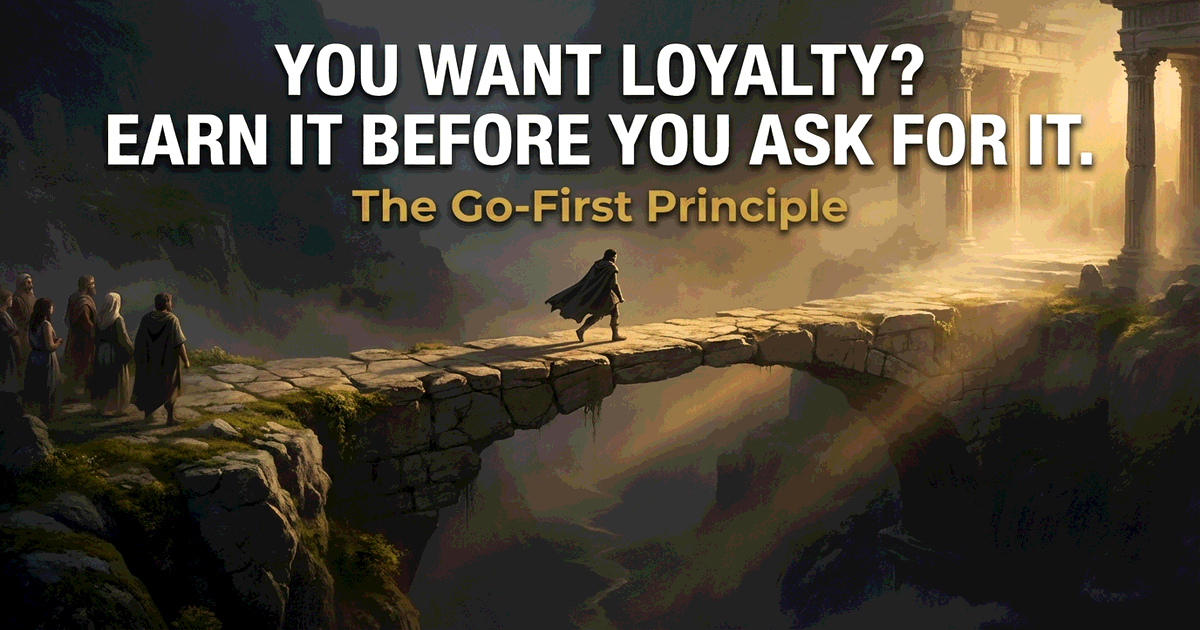
You Want Loyalty? Earn It Before You Ask for It.
By Derek Neighbors on March 31, 2026
I’ve worked with hundreds of leaders over two decades. The ones whose teams would walk through fire for them all share one trait. It has nothing to do with charisma, compensation packages, or company culture initiatives.
They move first. Leaders earn loyalty not through incentives or authority but by extending trust, taking risks, and showing vulnerability before asking anyone else to do the same.
They give trust before they have proof it will be returned. They take the hardest assignment before delegating it. They admit mistakes before the consequences force the conversation. They sacrifice their own comfort before asking anyone else to sacrifice theirs.
This pattern holds beyond org charts. The parent who apologizes to their child first teaches that child what integrity looks like. The friend who reaches out after a falling-out, without keeping score of who called last, builds the kind of bond that survives decades. Epictetus was a slave, and he understood this better than most executives: virtue doesn’t wait for position. It moves first, wherever it stands.
And the leaders who demand loyalty before demonstrating it? They get exactly what they pay for: polite compliance that evaporates the moment someone makes a better offer.
The Standard: What Earned Loyalty Looks Like
Aristotle spent more pages on philia than on courage, justice, or temperance. He considered the deep bond between people of mutual character to be the highest achievement of social life. Not romantic love. Not professional networking. The fierce, tested loyalty between people who have proven themselves to each other through action over time.
But Aristotle was precise about the conditions. philia only develops between people who have demonstrated virtue to each other over time. Not in a single grand gesture, but through repeated action. Not talked about it. Not promised it. Demonstrated it, under pressure, when it cost something. Going first once starts the process. Going first consistently, month after month, is what completes it.
The leaders I’ve seen build this kind of loyalty all extend trust before it’s been earned and sacrifice before asking for sacrifice. But the behavior that separates the good ones from the great ones is exposing their own vulnerability before the room feels safe enough for anyone else to do the same.
The result is a team that protects your reputation when you leave the room and tells you the truth when you’re in it. That combination is rare. Most leaders get one or the other.
The Gap: Why Most Leaders Wait
Most leaders operate from a rational-sounding principle: prove yourself, and I’ll invest in you. Show me results first. Demonstrate competence. Earn my trust through a track record of reliable performance.
This approach feels sensible. It looks like good risk management. It produces teams that do precisely the minimum required to maintain the transaction.
The gap between those leaders and the ones who inspire real philia comes down to andreia, the Greek concept of courage. Not the battlefield variety. The harder kind. The courage to be exposed first, with no guarantee of return.
Trusting someone who hasn’t proven themselves yet is a risk. Admitting a mistake to your team before anyone catches it is vulnerability with no guaranteed payoff. Taking the worst client, the ugliest project, the most thankless work before asking anyone else to is sacrifice without applause.
Most leaders dodge this because the math seems to favor caution. You wait for proof, the worst that happens is you move slowly. You extend trust early, you might get burned.
But caution has costs that don’t show up on a quarterly report. Gallup’s 2024 State of the Global Workplace report found that 70% of the variance in team engagement traces back to the manager, and that low-trust teams see turnover rates 50% higher than high-trust teams. The senior engineer who spent two years waiting for a stretch project leaves for a startup that believed in her before she had proof. The product manager who wanted real authority stops caring six months before he stops showing up. The designer who kept getting supervision instead of ownership takes her talent to a team that trusts her on day one.
The cautious leader pays a tax on every relationship, every day, in the form of people giving seventy percent of their capability because they’ve received seventy percent of the trust.
The Path: How to Go First
Extend Trust as a Starting Position
The default in most organizations is “trust is earned.” It sounds responsible. In practice, it means every new hire, every new team member, every new relationship starts from a deficit. People arrive in a hole and have to climb out before they can do their real work.
Flip the default. Start from “I trust you until you show me I shouldn’t.” Share information your team doesn’t technically need. Hand someone a responsibility that stretches them before they’ve proven they can handle it. Let a direct report make a decision you’d normally make yourself, and live with the outcome even if it isn’t what you would have chosen.
The ancient Greeks understood pistis, faithfulness and trust, as foundational to any functioning community. Without it, every interaction becomes a negotiation. With it, people operate from shared commitment rather than mutual surveillance.
You will occasionally get burned by this approach. Someone will take advantage. Someone will underperform. Those losses feel personal and concrete. But as Stephen M.R. Covey argues in The Speed of Trust, the cost of distrust is always higher than the cost of misplaced trust, because distrust taxes every interaction while trust accelerates them. The invisible cost of teams operating at seventy percent because nobody trusted them with one hundred always exceeds the occasional burn.
One distinction matters here. Extending trust as a starting position is not the same as extending trust without end. Aristotle defined andreia as the mean between cowardice and recklessness. Continuing to trust someone who has repeatedly demonstrated they will abuse that trust is not courage. It is foolishness wearing courage’s clothing. The go-first leader extends trust generously and withdraws it deliberately when the evidence demands it.
Sacrifice Before You Ask for Sacrifice
When the budget gets tight, what do you cut first? When a client is furious and someone needs to absorb the anger, who steps forward? These aren’t trick questions. The answers tell your team everything about how much skin you actually have in the game.
The go-first leader doesn’t announce these sacrifices. They don’t make a show of it. The sacrifices are so consistent they stop being noticeable. That is the point. andreia practiced as a habit, not a performance.
I watched a VP take a voluntary pay cut during a company downturn before anyone on his team knew cuts were being discussed. When the news came, his team saw the updated org chart. He was already in it. The team lost nobody. A peer VP on the other side of the building, who cut her team’s bonuses while protecting her own, lost four people in six weeks.
People have long memories for who moved first when things got hard. That memory becomes the foundation of loyalty no signing bonus can compete with.
Be Vulnerable Before the Room Is Safe
This is the hardest version of going first. Admit what you don’t know. Acknowledge a bad call before the data proves it, and ask for help before the situation demands it.
Every instinct tells leaders to project certainty. The unspoken rule in most organizations is that doubt is dangerous and showing weakness will undermine your authority. So leaders perform confidence whether they feel it or not.
The paradox: the leader who admits weakness becomes stronger in the eyes of the team, not weaker. Because they’ve demonstrated that truth matters more than image. That creates permission for everyone else to do the same.
I once watched a CTO open a quarterly review by saying, “I made three decisions last quarter that I now think were wrong. Here they are.” The room went silent. Then something shifted. Three other directors admitted their own mistakes in the same meeting. By the end, the team had identified and started fixing problems that had been buried for months because nobody wanted to be the first to acknowledge them.
Someone had to be exposed first. In a team, that someone is you.
The Test: How to Know If You’re Going First
Four diagnostics that tell you the truth about where you stand.
The departure test. When someone on your team gets a better offer, do they agonize over leaving or do they polish their resume before telling you? Go-first leaders create the agonizing kind of loyalty, the kind that makes people think twice about walking away from a relationship, not a compensation package.
The bad news test. Does your team bring you problems early, when they’re small and fixable? Or do you find out when it’s too late to do anything but assign blame? People bring bad news early only to leaders who have demonstrated they won’t punish the messenger. And the only way to demonstrate that is to go first: share your own bad news before anyone asks.
The silence test. When you leave the room, does the conversation change? If your team says different things about you when you’re absent, you haven’t built philia. You’ve built a performance that depends on your presence to sustain.
The volunteer test. When something hard, thankless, or risky needs to happen, do people step forward or do they wait for assignment? Teams mirror the leader’s relationship to discomfort. If you volunteer for the ugly work, your team will too. If you delegate it downward, expect silence when you ask for hands.
The Mastery: When Going First Becomes the Operating System
This is where the math flips. The go-first leader eventually stops being the only one who moves first, because they’ve built a team where going first is normal. Trust extends laterally, not only downward. People take ownership of problems that aren’t technically theirs because they’ve watched the leader do it so many times the behavior became contagious.
andreia invested early creates a culture where courage is the default, not the exception. The leader’s initial risk becomes the team’s operating system.
But here is the part most leadership advice gets wrong: the loyalty is not the reason. Going first is right even if nothing comes back. Even if the team never reciprocates, even if the trust gets abused, the leader who moves first has a better-ordered soul than the one who calculates. Marcus Aurelius wrote his meditations at 3am with no expectation that anyone would read them. The practice was the point, not the return.
That said, the irony is hard to miss. Leaders who go first end up with more loyalty than they ever asked for. Leaders who demand proof before investing end up with exactly the amount of loyalty they paid for, which disappears the moment someone offers a better price.
Final Thoughts
Other forces can produce loyalty. Shared hardship forges it. Extraordinary competence commands it. Strict accountability, consistently applied, earns a version of it. But the loyalty built by going first is qualitatively different. It is freely given rather than extracted, and it survives conditions that would dissolve every other kind.
The question for every leader is not whether their team is loyal enough. The question is whether they have given their team a reason to be.
Ready to build the kind of leadership that earns loyalty through character, not transactions? MasteryLab provides frameworks and community for leaders who understand that trust invested early compounds into something no compensation package can replace.