Sophia vs Episteme: Key Differences in Greek Philosophy
There is a difference between knowing a great deal and being wise, and sophia and episteme name the two sides of that difference with precision. Episteme is systematic, demonstrable knowledge within a specific domain. You have episteme when you can prove that something is the case and explain why it must be so. The mathematician who demonstrates a theorem has episteme of that theorem. The biologist who understands a causal mechanism through repeated observation and reasoning has episteme of that mechanism. Episteme is domain-bound, rigorous, and achievable through sustained study. Sophia is the highest form of intellectual understanding. Aristotle defined it in Book VI of the Nicomachean Ethics as the combination of episteme and nous, where nous is the intuitive grasp of first principles that cannot themselves be demonstrated. Sophia does not merely know truths within a domain. It grasps the foundational principles that make all domains intelligible. The person with sophia understands not only that things are the case but why they must be the case at the deepest level of explanation. This hierarchy matters because it exposes a failure pattern that is especially common in highly educated, technically competent people. You can accumulate vast episteme, becoming an expert in your field, mastering the evidence and methods of your discipline, and still lack sophia entirely. The expert who cannot see beyond their specialty, who knows everything about their domain but nothing about how it connects to the larger structure of reality, has episteme without sophia. They have knowledge without wisdom. Aristotle considered sophia the rarest and highest of the intellectual virtues precisely because it requires more than study. It requires the capacity to perceive first principles directly through nous, a capacity that cannot be taught the way domain knowledge can. You can train someone in biology or mathematics. You cannot train someone to perceive the principles that ground all knowledge. That capacity develops, if it develops at all, through a combination of deep expertise and philosophical reflection that most people never undertake. The practical significance is this: episteme tells you how things work within a system. Sophia tells you why the system exists and what it means. When you need to solve a problem within an established framework, episteme serves you well. When the framework itself is in question, when you face situations that cross disciplinary boundaries, or when you need to understand why something matters and not merely how it functions, episteme alone is insufficient. You need the broader, deeper understanding that sophia provides.
Definitions
Sophia
(σοφία)
soh-FEE-ah
Theoretical wisdom. The ability to see clearly, cutting through noise to identify what’s actually true and understanding the deeper principles beneath surface patterns.
Episteme
(ἐπιστήμη)
eh-pis-TAY-may
Scientific or systematic knowledge—understanding that grasps not merely that something is true, but why it must be so. For Aristotle, episteme represents demonstrable knowledge of causes and principles, distinguished from mere opinion (doxa) or practical skill (techne).
Key Differences
| Aspect | Sophia | Episteme |
|---|---|---|
| Scope | Sophia is universal in scope. It grasps the first principles and ultimate causes that ground all particular domains of knowledge. | Episteme is domain-specific. It provides demonstrable knowledge within a particular field, such as mathematics, biology, or physics. |
| Depth | Sophia penetrates to first principles, the foundational truths that cannot themselves be demonstrated but that make all demonstration possible. | Episteme demonstrates truths within a domain by reasoning from established premises. It works within a framework of first principles but does not itself grasp them. |
| Components | Sophia combines episteme (demonstrative knowledge) with nous (intuitive grasp of first principles). It requires both systematic reasoning and direct intellectual perception. | Episteme operates through logical demonstration alone. It proves conclusions from premises through valid inference without requiring intuitive insight into ultimate foundations. |
| Rarity | Sophia is rare because it demands a combination of extensive knowledge, philosophical reflection, and the capacity for nous, which cannot be taught through standard instruction. | Episteme is achievable through sustained study, disciplined inquiry, and mastery of a field's methods. While demanding, it is attainable by anyone with adequate ability and commitment. |
| Relationship to Understanding | Sophia understands why at the deepest level. It grasps the reasons behind the reasons, the principles that make the whole system of knowledge coherent. | Episteme knows that and can demonstrate that within its domain. It provides certainty about specific truths but does not necessarily grasp the ultimate ground of those truths. |
Scope
Sophia is universal in scope. It grasps the first principles and ultimate causes that ground all particular domains of knowledge.
Episteme is domain-specific. It provides demonstrable knowledge within a particular field, such as mathematics, biology, or physics.
Depth
Sophia penetrates to first principles, the foundational truths that cannot themselves be demonstrated but that make all demonstration possible.
Episteme demonstrates truths within a domain by reasoning from established premises. It works within a framework of first principles but does not itself grasp them.
Components
Sophia combines episteme (demonstrative knowledge) with nous (intuitive grasp of first principles). It requires both systematic reasoning and direct intellectual perception.
Episteme operates through logical demonstration alone. It proves conclusions from premises through valid inference without requiring intuitive insight into ultimate foundations.
Rarity
Sophia is rare because it demands a combination of extensive knowledge, philosophical reflection, and the capacity for nous, which cannot be taught through standard instruction.
Episteme is achievable through sustained study, disciplined inquiry, and mastery of a field's methods. While demanding, it is attainable by anyone with adequate ability and commitment.
Relationship to Understanding
Sophia understands why at the deepest level. It grasps the reasons behind the reasons, the principles that make the whole system of knowledge coherent.
Episteme knows that and can demonstrate that within its domain. It provides certainty about specific truths but does not necessarily grasp the ultimate ground of those truths.
When to Apply Each Concept
When to Choose Sophia
Seek sophia when the questions you face cross disciplinary boundaries, when established frameworks are failing, or when you need to understand not just how something works but why it matters. Sophia is the capacity required when the problem is not a lack of information but a lack of understanding at the level of foundational principles.
When to Choose Episteme
Rely on episteme when you need rigorous, demonstrable knowledge within a specific domain. When the problem is well-defined, the relevant field is clear, and the question can be answered through systematic investigation and logical demonstration, episteme is the appropriate intellectual resource.
Frequently Asked Questions
What is the difference between sophia and episteme?
Sophia is theoretical wisdom, the highest intellectual virtue, combining demonstrative knowledge (episteme) with intuitive grasp of first principles (nous). Episteme is systematic, demonstrable knowledge within a particular domain. Sophia encompasses episteme but goes beyond it by grasping the foundational principles that make all domain-specific knowledge possible.
Sophia vs episteme in Aristotle?
Aristotle defines sophia in Nicomachean Ethics Book VI as episteme plus nous: the combination of scientific knowledge with intuitive understanding of first principles. Episteme demonstrates truths within a domain. Sophia grasps why those truths hold by understanding the principles that ground them. Aristotle considered sophia the highest intellectual virtue because it deals with the most fundamental and universal objects of knowledge.
Is sophia higher than episteme?
In Aristotle's hierarchy, yes. Sophia is the highest intellectual virtue because it combines episteme with nous to achieve understanding of first principles and ultimate causes. However, this does not make episteme unimportant. Sophia requires extensive episteme as a prerequisite. The person who lacks domain-specific knowledge has nothing to synthesize into wisdom. Sophia builds on episteme; it does not replace it.
How does sophia relate to episteme and nous?
Sophia is the union of episteme and nous. Episteme provides the capacity for logical demonstration within specific domains. Nous provides the direct, intuitive grasp of first principles that cannot themselves be demonstrated. Sophia emerges when a person possesses both: the ability to reason rigorously from premises and the ability to perceive the foundational truths that ground those premises. Neither episteme nor nous alone constitutes sophia.
Articles Exploring Sophia or Episteme (18)
When the Boss Speaks First, the Room Stops Arguing
You opened the incident review with your best guess and asked the room to push back. Nobody did, and you took the quiet as agreement. The engineer who had the real cause in a dashboard never said it, because after you spoke, saying it meant disagreeing with you. Rank does not have to overrule anyone. Going first is enough.

Certainty Is How Ignorance Sounds Before the Work Corrects It
Two people answer the same question. One is sure. One says it depends, and names what it depends on. The room believes the sure one, and six weeks later the other one is cleaning it up. Certainty is a feeling, and it reports nothing about the world. Here is what the work does to it, and how to hear the difference.
If You've Never Questioned Your Beliefs, You Don't Actually Hold Them
Cicero's Academic Skeptics didn't doubt because they were weak. They doubted because they understood something about conviction that most people never will. Unexamined certainty disguises itself as strength while producing the brittleness that shatters under the first real challenge.
Solomon's Paradox: The Psychology of Being Wiser for Others Than Yourself
You dispense clarity to friends while drowning in your own confusion. Modern psychology calls it Solomon's Paradox. The ancient Greeks had a practice to fix it.
What If Your 'Personal Best' Is Actually Your Personal Belief?
Everyone treats their personal best as an objective measurement. But what if it's actually a prophecy? What if the limit you keep hitting is the limit you keep expecting to hit?

If You Can't Defend It, You Don't Believe It. You're Just Repeating It.
Most people defend positions they never chose. Socrates understood that repeating something doesn't make it yours. The unexamined belief is just someone else's script running in your head.

Why Do Smart People Overcomplicate Everything?
The Greeks understood something we've forgotten, true wisdom reveals itself through simplicity, not complexity. Intelligence is finding the simple truth, not creating elaborate frameworks.
The Craft Stage: When Skill Becomes Second Nature (Techne)
You don't have a knowledge problem. You have a craft problem. Most people understand excellence intellectually but lack the embodied competence to execute it consistently. Techne bridges the gap between knowing and doing.
The Information Architecture: Curating Input for Greatness
Most people consume information like they eat at a buffet, grabbing everything that looks appealing without considering nutrition or purpose. Then they wonder why their thinking is sluggish and their decisions are poor. Greatness requires intentional information architecture.

The Curiosity Lie: Why Your Questions Keep You Comfortable
Real curiosity isn't about asking smart questions, it's about pursuing the brutal ones you've been avoiding because they might change everything.
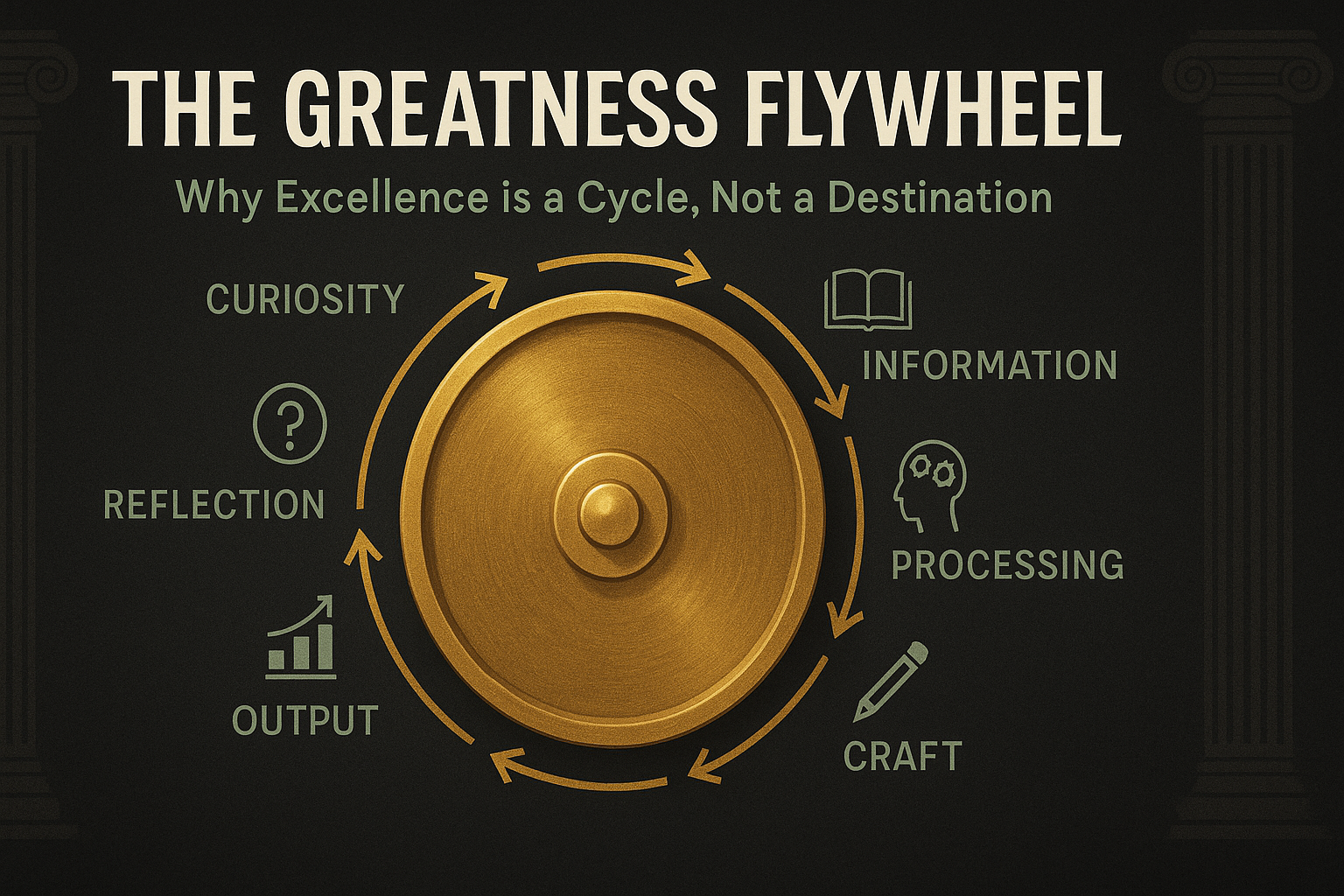
The Greatness Flywheel: Why Excellence is a Cycle, Not a Destination
Excellence isn't a destination you arrive at once and maintain through willpower. Excellence is a flywheel. The six-stage cycle that transforms ancient Greek wisdom into systematic excellence methodology.
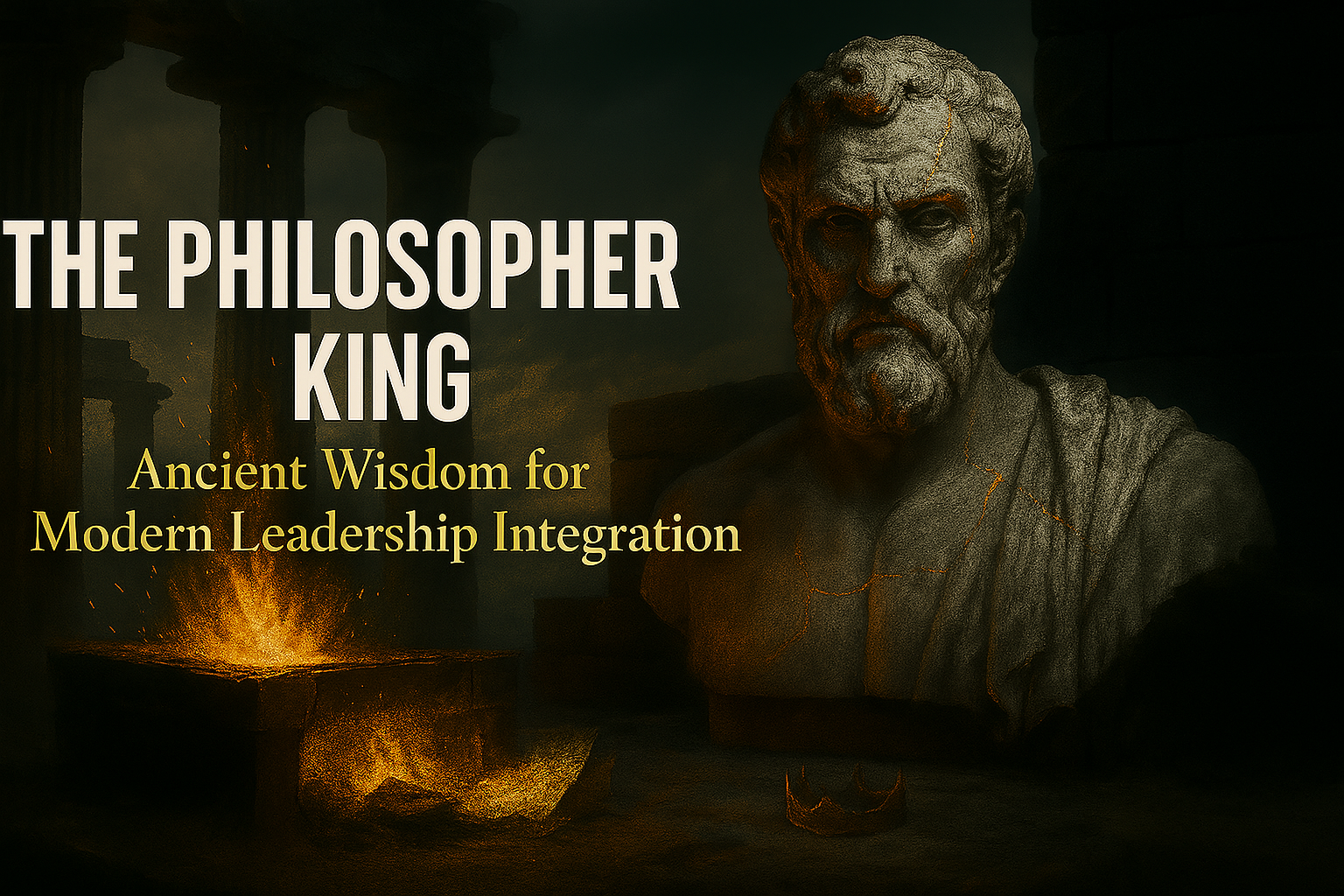
The Philosopher King: Ancient Wisdom for Modern Leadership Integration
Plato's most radical leadership idea wasn't about power or position, it was about character. The philosopher king represents the ultimate integration of wisdom, excellence, courage, and transformation. Here's how to stop managing systems and start transforming people.
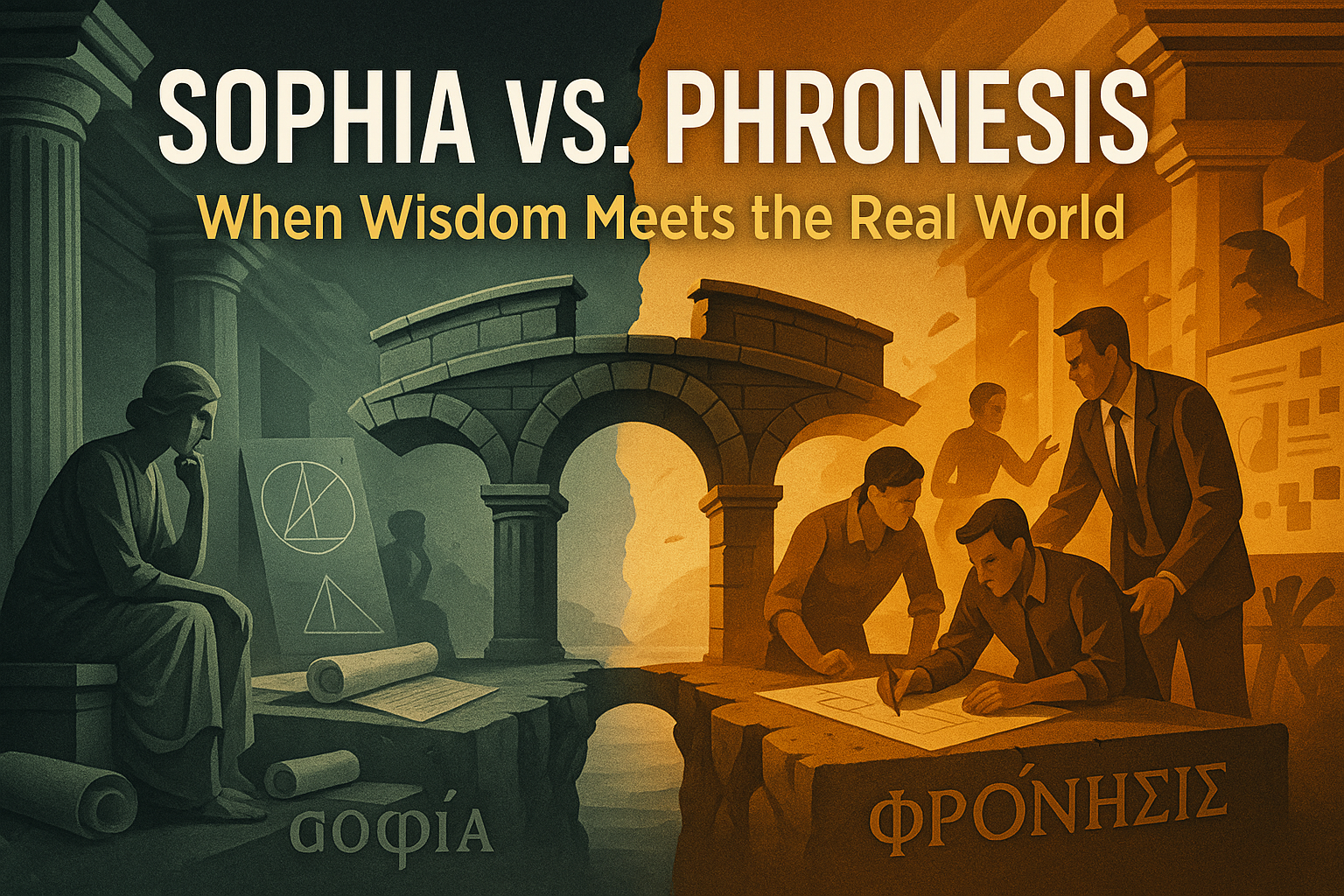
Sophia vs. Phronesis: When Wisdom Meets the Real World
Why brilliant strategies fail and how ancient Greek wisdom provides the solution through integrating theoretical and practical wisdom.
The Information Trap: Why Knowledge Without Action Is Just Entertainment
You don't need another course. You need to start doing. The journey itself holds every lesson you need to learn. The internet gave us infinite information and infinite excuses.

The Information Trap: Why Knowledge Without Action Is Just Entertainment
Most of your learning is actually entertainment in disguise. Here's why information without action is intellectual hoarding, and how to transform from consumer to creator through practical implementation.

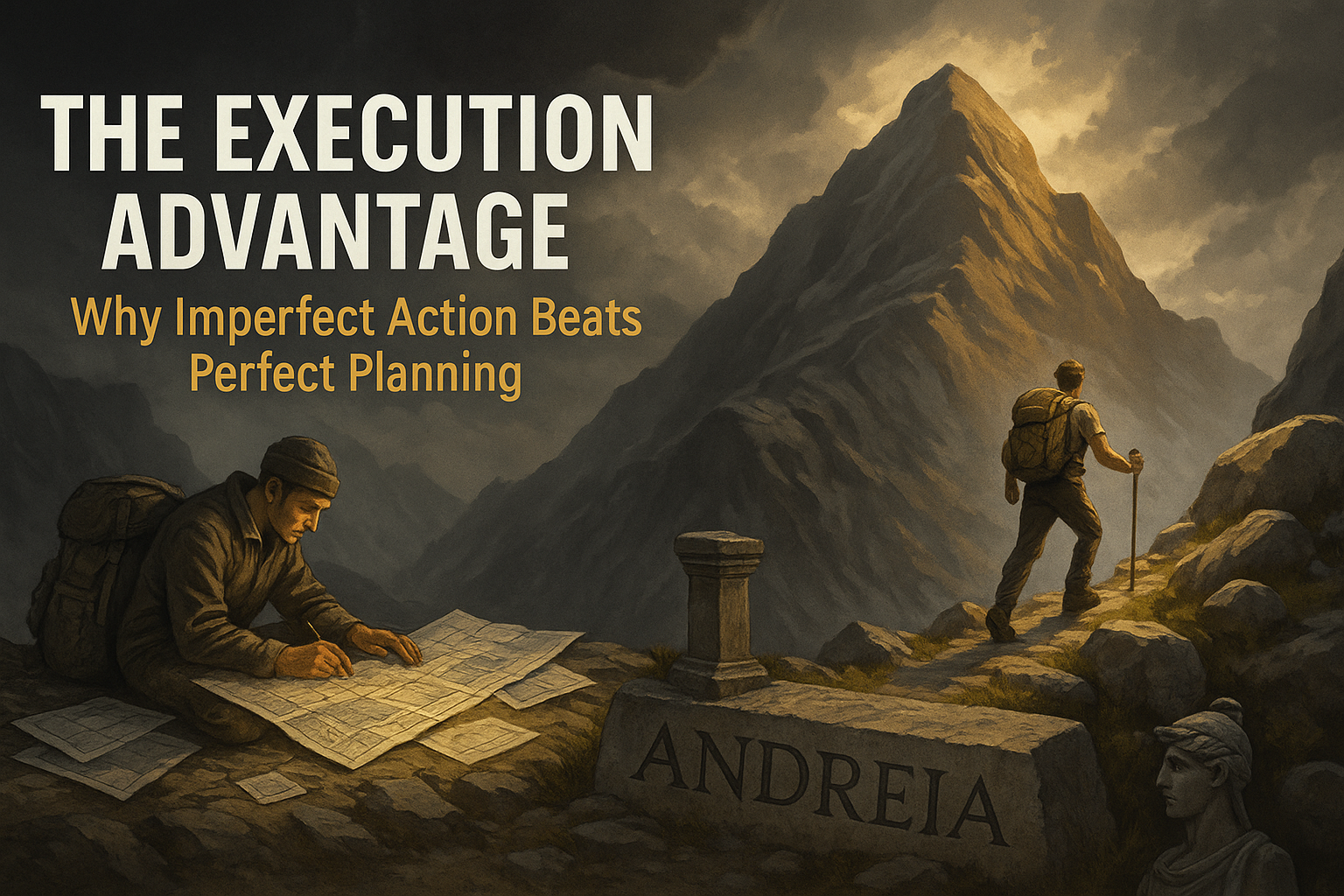
The Execution Advantage: Why Imperfect Action Beats Perfect Planning
Perfect plans are usually perfectly wrong. Here's why imperfect action creates better results than perfect planning, and how to build the execution advantage through courage and rapid iteration.
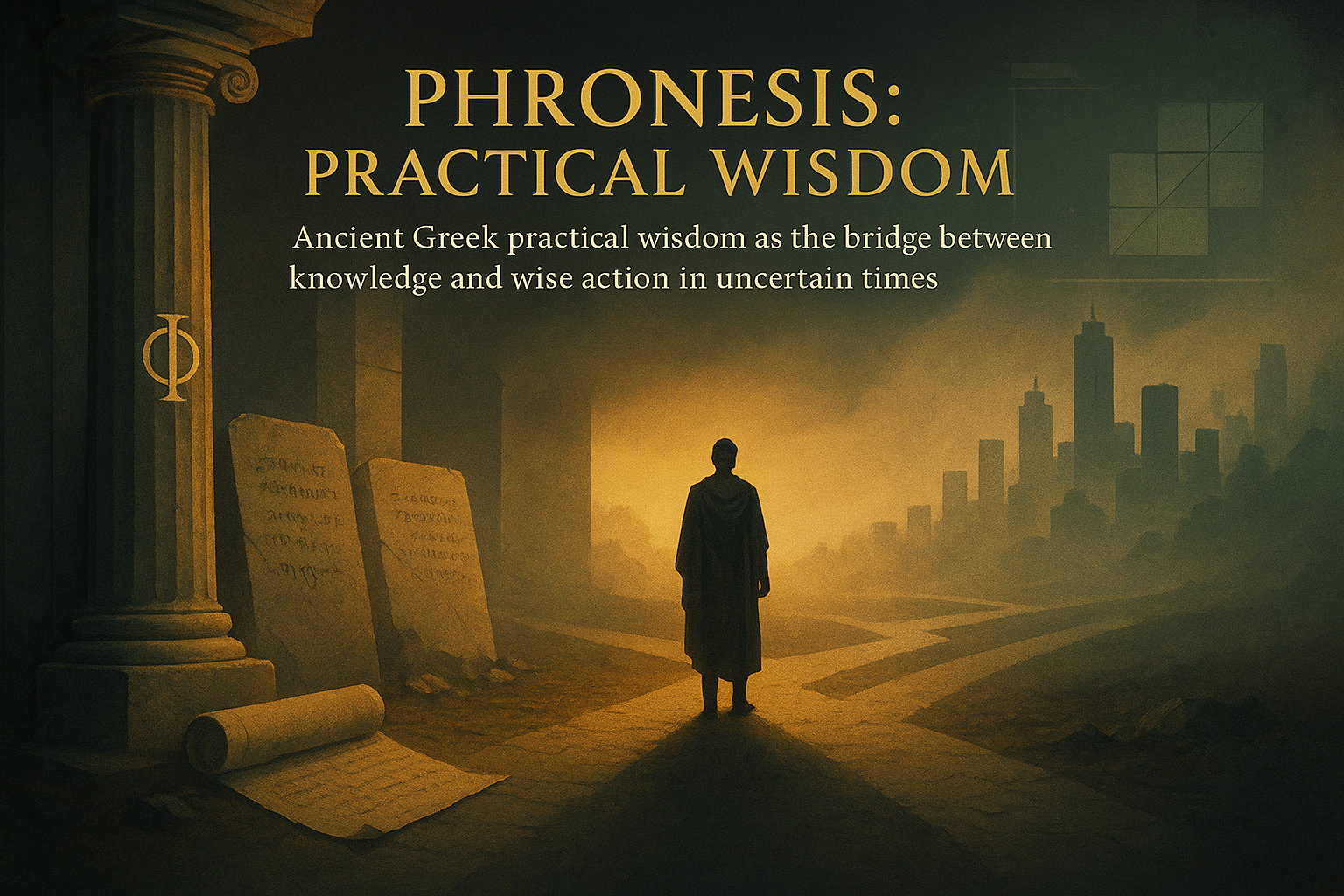
Phronesis: The Lost Art of Practical Wisdom
The ancient Greeks had a word for the leadership skill we desperately need today: phronesis. It's not about having all the answers, it's about acting wisely when you don't.
Between Trapezes: Navigating AI Uncertainty with Ancient Wisdom
In the moment between letting go of one trapeze and grasping the next, there's a space where everything depends on trust, timing, and practical wisdom. For leaders navigating AI transformation, this moment isn't a crisis, it's where excellence is forged.