Kinesis vs Energeia: Key Differences in Greek Philosophy
You spend most of your life in one of two modes, and the difference between them determines whether your achievements feel hollow or fulfilling. Kinesis is movement, change, the process of going from one state to another. When you build a house, you are engaged in kinesis. When you walk to the store, you are in kinesis. When you study for an exam, you are performing kinesis. Each of these activities is directed toward a point of completion that lies outside the activity itself. Once the house is built, the building stops. Once you arrive at the store, the walking is done. Once you pass the exam, the studying has served its purpose. The activity is incomplete at every moment until it reaches its terminus, and once it reaches that terminus, it is over. Energeia is something fundamentally different. It is activity that is complete at every moment it occurs. When you see, the seeing is complete right now. You are not partially seeing on the way to full seeing. When you contemplate, the contemplation is not building toward a separate result. It is fully itself in the present moment. When you live virtuously, the virtuous living is not a means to some external product. It is its own end, complete in each instant of its exercise. Aristotle developed this distinction in Metaphysics Theta 6 as one of his most penetrating insights into the nature of activity. The grammatical test he used is elegant: kinesis verbs have distinct present and perfect tenses (I am building / I have built), because the activity and its completion are different states. Energeia verbs collapse these: I am seeing and I have seen are simultaneously true. The activity and its completion coincide. The significance for how you live is direct and practical. A life organized entirely around kinesis is a life of perpetual incompleteness. You are always building toward something, always in transit, always treating the present moment as a means to a future destination. Each achievement, once reached, immediately gives way to the next goal, because kinesis ends when its target is hit, and then you need a new target to fill the void. A life that includes energeia has a different quality. The person engaged in energeia is not waiting for some future state to arrive. The activity they are engaged in is complete and valuable right now. Aristotle connected energeia directly to eudaimonia because flourishing is not something you arrive at. It is something you do, continuously and completely, in each moment of its exercise.
Definitions
Kinesis
(κίνησις)
KIN-eh-sis
Movement or change in its most fundamental sense—the transition from potentiality to actuality. In Aristotle’s philosophy, kinesis encompasses all forms of becoming: growth, alteration, locomotion, and transformation from what something could be into what it is.
Energeia
(ἐνέργεια)
en-ERG-ay-ah
The state of being at work, actuality, or the full realization of potential. In Aristotle’s metaphysics, energeia is the complement to dynamis—where dynamis is the power to become, energeia is the becoming itself made actual. The oak tree is the energeia of the acorn’s dynamis.
Key Differences
| Aspect | Kinesis | Energeia |
|---|---|---|
| Completeness | Kinesis is incomplete at every moment until it reaches its endpoint. The house is not built until the building is finished. The journey is not over until you arrive. | Energeia is complete at every moment it occurs. Seeing is fully seeing right now. Contemplating is fully contemplating in this instant. There is no incomplete version. |
| Endpoint | Kinesis terminates when its goal is reached. Once the house is built, the building ceases. The activity self-destructs upon achieving its purpose. | Energeia has no terminal point. You do not finish seeing or complete contemplating. The activity continues as long as it is exercised, without a threshold that ends it. |
| Temporal Structure | Kinesis is sequential and progressive. You move through stages: foundation, walls, roof. Each stage builds on the last toward a future completion. | Energeia is fully present at each instant. There are no stages to pass through. The activity is entirely what it is in every moment of its exercise. |
| Examples | Building a house, walking to a destination, learning a skill, recovering from illness. Each has a definite endpoint and is incomplete until that endpoint is reached. | Seeing, thinking, living well, contemplating truth. Each is complete in every moment of its occurrence and does not aim at a separate terminus. |
| Relationship to the Good Life | Kinesis is necessary but instrumental. You must build, travel, and acquire to create the conditions for a good life. But kinesis itself is not what makes life good. | Energeia is constitutive of eudaimonia. Aristotle identified flourishing as an energeia because the good life is an activity that is complete and valuable at every moment, not a goal to be reached later. |
Completeness
Kinesis is incomplete at every moment until it reaches its endpoint. The house is not built until the building is finished. The journey is not over until you arrive.
Energeia is complete at every moment it occurs. Seeing is fully seeing right now. Contemplating is fully contemplating in this instant. There is no incomplete version.
Endpoint
Kinesis terminates when its goal is reached. Once the house is built, the building ceases. The activity self-destructs upon achieving its purpose.
Energeia has no terminal point. You do not finish seeing or complete contemplating. The activity continues as long as it is exercised, without a threshold that ends it.
Temporal Structure
Kinesis is sequential and progressive. You move through stages: foundation, walls, roof. Each stage builds on the last toward a future completion.
Energeia is fully present at each instant. There are no stages to pass through. The activity is entirely what it is in every moment of its exercise.
Examples
Building a house, walking to a destination, learning a skill, recovering from illness. Each has a definite endpoint and is incomplete until that endpoint is reached.
Seeing, thinking, living well, contemplating truth. Each is complete in every moment of its occurrence and does not aim at a separate terminus.
Relationship to the Good Life
Kinesis is necessary but instrumental. You must build, travel, and acquire to create the conditions for a good life. But kinesis itself is not what makes life good.
Energeia is constitutive of eudaimonia. Aristotle identified flourishing as an energeia because the good life is an activity that is complete and valuable at every moment, not a goal to be reached later.
When to Apply Each Concept
When to Choose Kinesis
Recognize kinesis when the task in front of you has a definite endpoint and the value lies in reaching that endpoint. Building projects, learning new skills, solving specific problems, and achieving measurable goals all involve kinesis. Accept that these activities are means to ends and plan accordingly.
When to Choose Energeia
Cultivate energeia when you want your daily experience to be valuable in itself, not merely instrumental to some future state. Contemplation, virtuous action, deep engagement with meaningful work, and genuine presence with others are all forms of energeia. The person who can find energeia within their kinesis, who can be fully alive in the process and not only in the result, has access to a richer experience of living.
Frequently Asked Questions
What is the difference between kinesis and energeia?
Kinesis is movement or change directed toward an endpoint, incomplete at every moment until it reaches that endpoint. Energeia is activity that is complete at every moment it occurs, with no separate terminus. Aristotle distinguished them in the Metaphysics to explain why some activities are inherently fulfilling while others are only instrumentally valuable.
Kinesis vs energeia in Aristotle?
In Metaphysics Theta 6, Aristotle distinguishes kinesis (incomplete change with a terminal point) from energeia (complete activity that is its own end). His grammatical test: kinesis verbs distinguish present from perfect tense (I am building vs. I have built), while energeia verbs coincide (I am seeing and I have seen are simultaneously true). This distinction is central to his account of actuality and his theory of eudaimonia.
What does Aristotle mean by kinesis?
Kinesis in Aristotle refers to incomplete change or movement directed toward a definite endpoint. Examples include building, walking to a destination, and learning a specific skill. The defining feature is that kinesis is not yet what it aims to be at any moment before completion. Once the goal is reached, the kinesis is over. It is inherently transitional and incomplete in its nature.
How does energeia differ from movement?
Energeia differs from movement (kinesis) in that it is complete at every moment of its occurrence. Movement is going somewhere you have not yet arrived. Energeia is being fully where you are. A person building a house (kinesis) is not yet done. A person seeing (energeia) is fully seeing right now. Aristotle used this distinction to argue that the good life (eudaimonia) is an energeia, not a kinesis, because flourishing is not a destination but an ongoing activity.
Articles Exploring Kinesis or Energeia (23)
You Optimized Away Everything Worth Doing
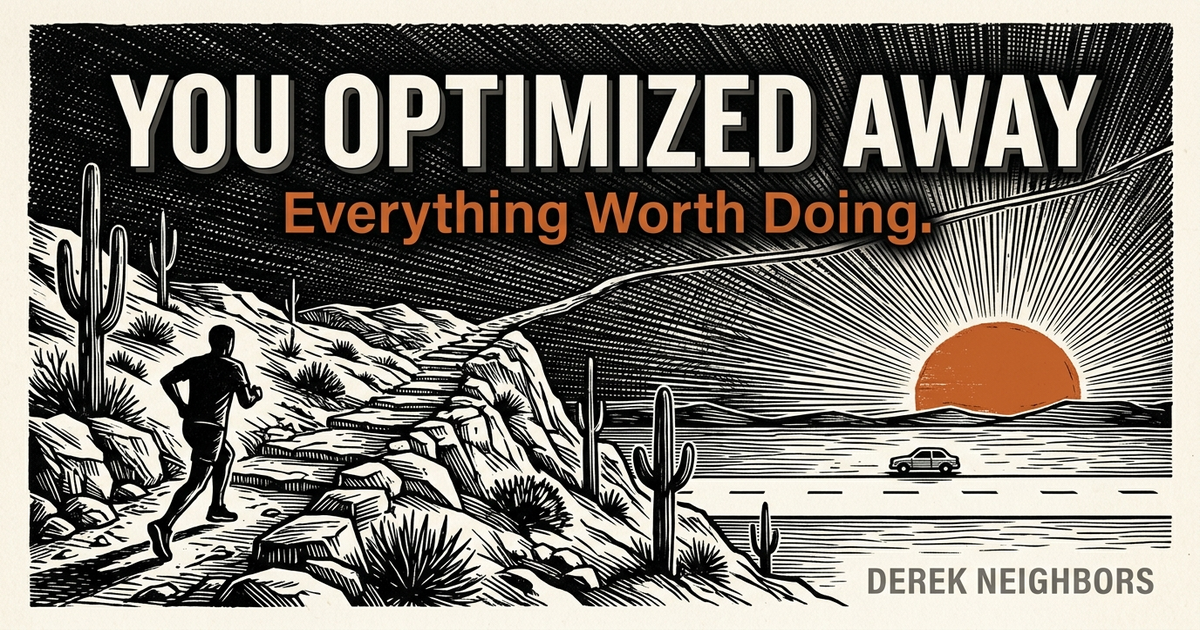
Anyone can walk over and drop a golf ball in the hole. Golf exists because you agreed to use a stick from far away. Remove that rule and you did not make golf efficient. You deleted golf. Most of us are running the same move on our lives: treating every obstacle as a defect, removing the ones that made an activity worth doing, and then wondering why the free time feels like a void. Bernard Suits called the alternative the lusory attitude. The Greeks called the space it fills schole. Here is how to tell which obstacles to remove and which ones to keep.
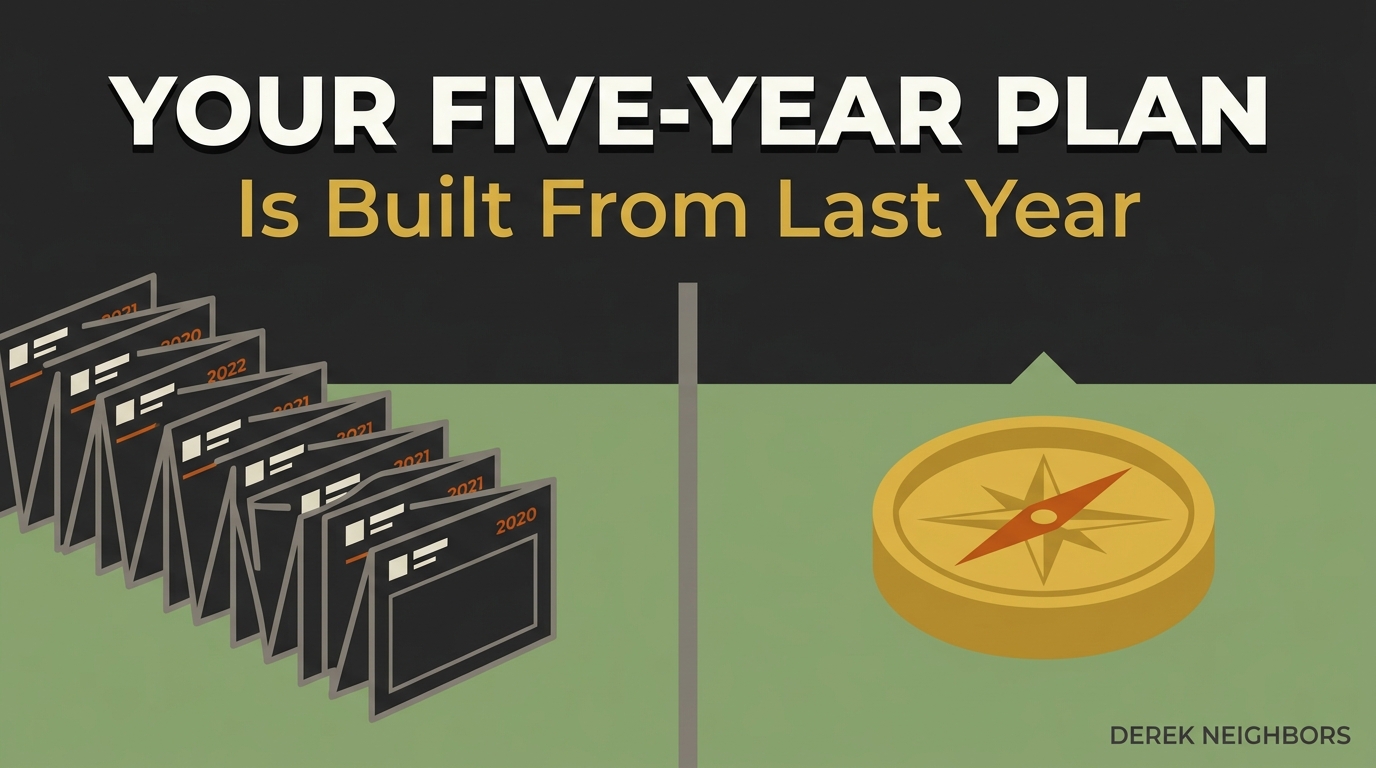
Your Five-Year Plan Is Built From Last Year
I sat through an offsite that wrote 2029 as last year with nicer fonts. The futures worth living stay invisible until you stack skills, relationships, and harder rooms.
You Can't Talk a Proud Culture Into Changing
A strong culture will nod in the all-hands and return to the process that already made it proud. Conversion speeches bounce. The usable move is a small office with different rules and a scoreboard the old culture can see.

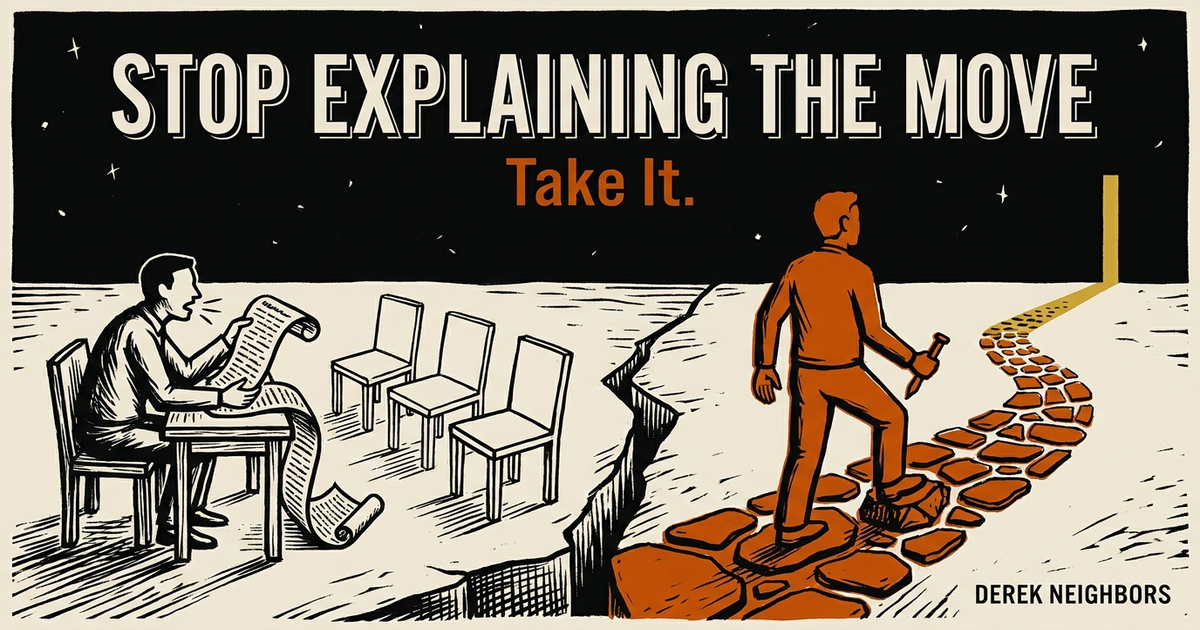
Stop Explaining the Move. Take It.
Preemptive defense feels responsible. It often spends the attention and nerve your practice needed. Ancient courage puts the step first and the account second, and only when an account is actually owed.
You Don't Need More Time. You Need Higher Stakes.
You keep shopping for more hours: earlier alarms, cleaner calendars, better tools. Seneca's diagnosis was sharper. Life is not short. Most of it gets wasted by people who do not feel its weight. A child, a diagnosis, a business with real customers compresses the day and somehow yields more. The compression did not steal the time. It exposed how much was already drifting. You need higher stakes, not another system.

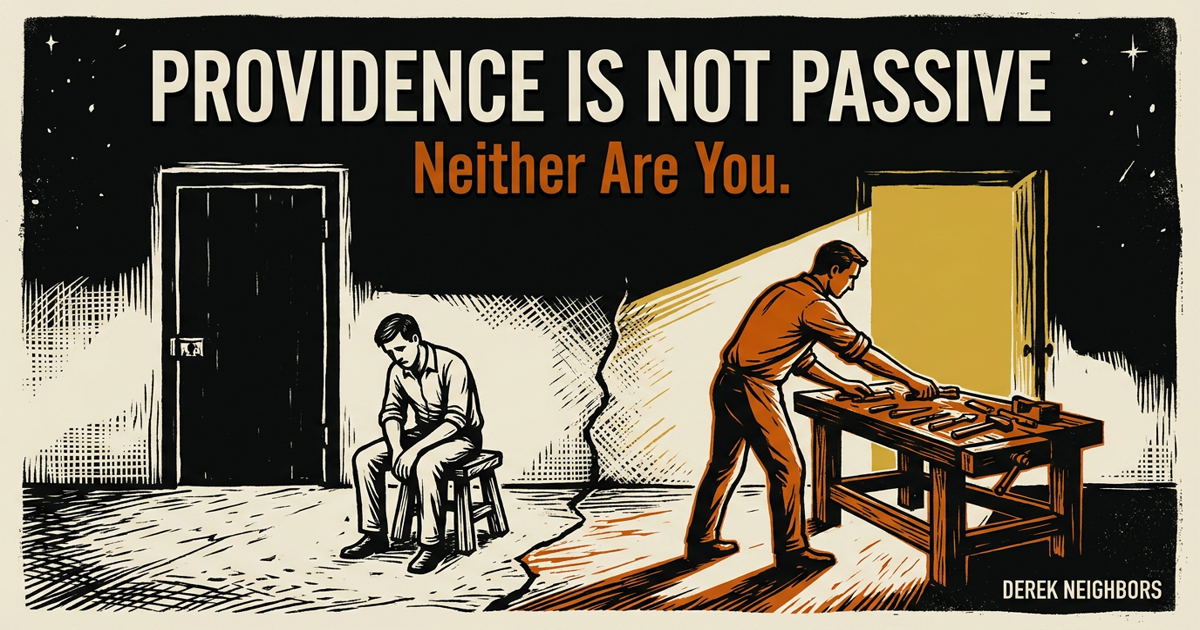
Providence Is Not Passive. Neither Are You.
Believing the universe is on your side means nothing if your calendar proves you are waiting. The Stoics welded trust in providence to being-at-work. Pronoia without energeia is costume. This is the challenge: meet the field armed, or stop calling the wait faith.
Living the Dream Is Mostly Grunt Work. That's the Good News.
The day you finally get the dream is the day it stops feeling like one. Fear shows up, the calendar disappears, and the summit moment never comes. Most people read this as failure. It's the strongest evidence yet that the dream became real.

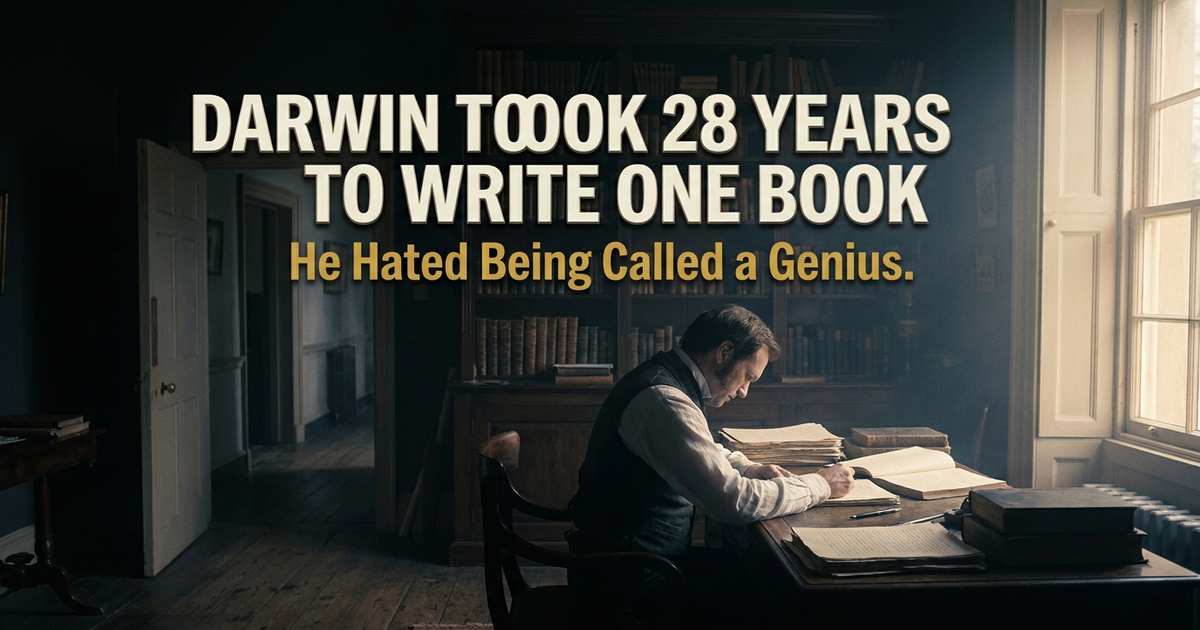
Darwin Took 28 Years to Write One Book. He Hated Being Called a Genius.
Charles Darwin spent twenty-eight years between the HMS Beagle's return in 1836 and the publication of On the Origin of Species in 1859. Eight of those years he spent classifying barnacles. He described himself in his autobiography as not a quick thinker or writer. The word the public eventually used for him was genius. He hated it. Genius is a hindsight label we paste onto a long, mostly invisible accumulation of patient daily work, and the lightning-bolt myth of insight survives because it lets the rest of us off the hook for not enduring the years of karteria, patient endurance, the actual builders endured.
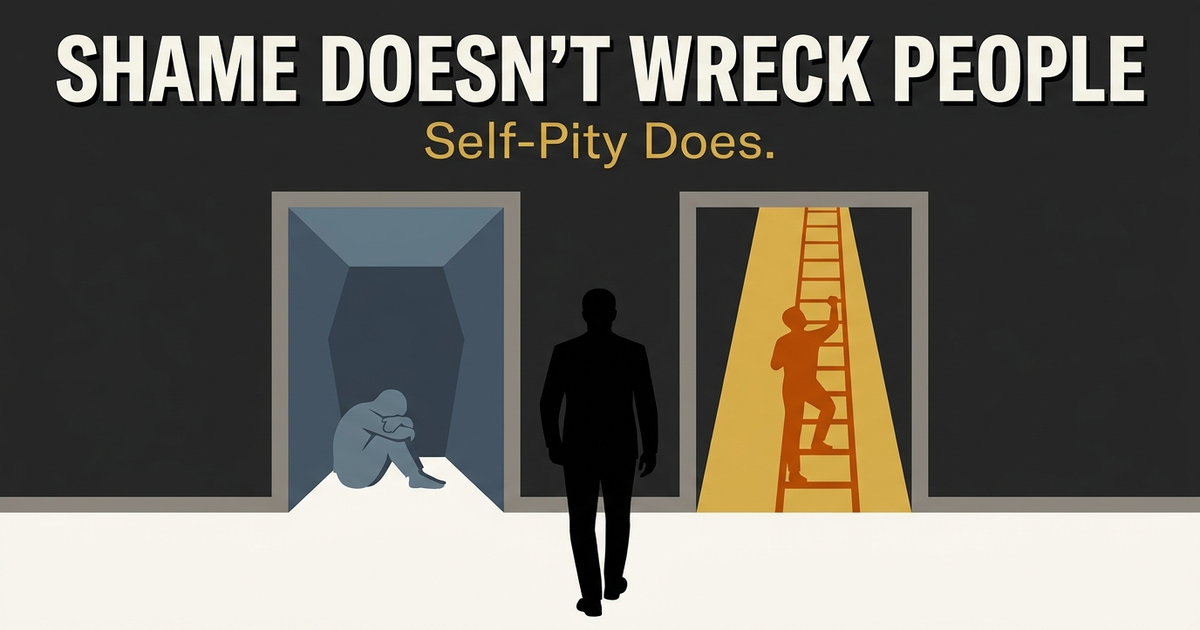
Shame Doesn't Wreck People. Self-Pity Does.
Shame is the recognition of the gap between who you are and who you wanted to be. The Greeks called it aidos and treated it as a moral faculty, not a wound to be silenced. The same shame, in two people facing the identical failure, produces two opposite trajectories. Self-pity sits in the gap and decorates it. Self-respect uses the gap as instruction. Most people pick the response that feels gentlest in the moment because the gentle one is the closer door. Decades later it turns out to be the most expensive door in their lives.
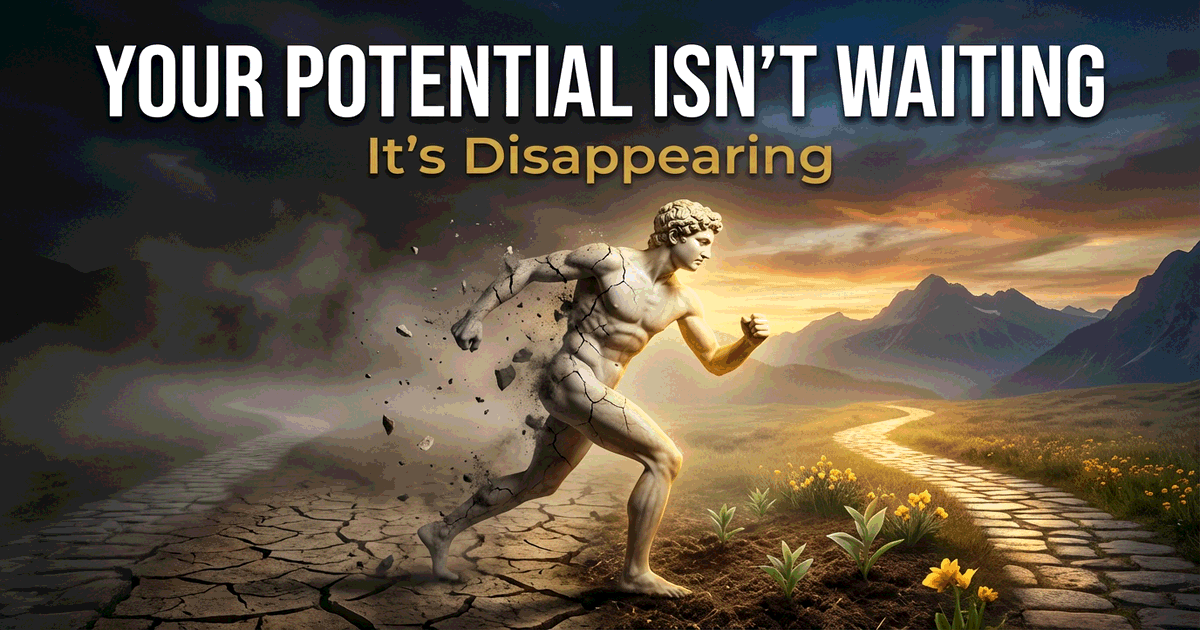
Your Potential Isn't Waiting. It's Disappearing.
We talk about untapped potential like it's a savings account, sitting there earning interest while you figure things out. Aristotle had a different word for it. And his version has an expiration date.
Why Arguing Your Point Is Always a Losing Strategy
For the second time in this series, Greene and the ancient philosophers agree. Demonstrate, don't argue. But they agree for different reasons, and the difference reveals whether you're performing power or practicing excellence.
You Stopped Growing and Didn't Even Notice
You can look back ten years and barely recognize who you were. You can acknowledge enormous personal transformation. And yet, right now, you believe you're basically done becoming. Psychology calls this the end of history illusion. The Greeks called it the opposite of flourishing.
Your Best Days Aren't Behind You. Unless You Keep Looking Back.
The glory days trap isn't about memory. It's about identity. Living in the past is a form of self-protection that guarantees self-limitation.
Most People Need a Crisis to Try Their Hardest. That's a Character Flaw.
Crisis unlocks extraordinary performance. But needing crisis to access your best means your best isn't really yours. It belongs to whatever circumstances happen to arrive.

What If Your 'Personal Best' Is Actually Your Personal Belief?
Everyone treats their personal best as an objective measurement. But what if it's actually a prophecy? What if the limit you keep hitting is the limit you keep expecting to hit?
You're Not Getting Ready. You're Hiding.
Preparation is the most sophisticated form of procrastination. It feels productive. It looks responsible. And it keeps you exactly where you are.

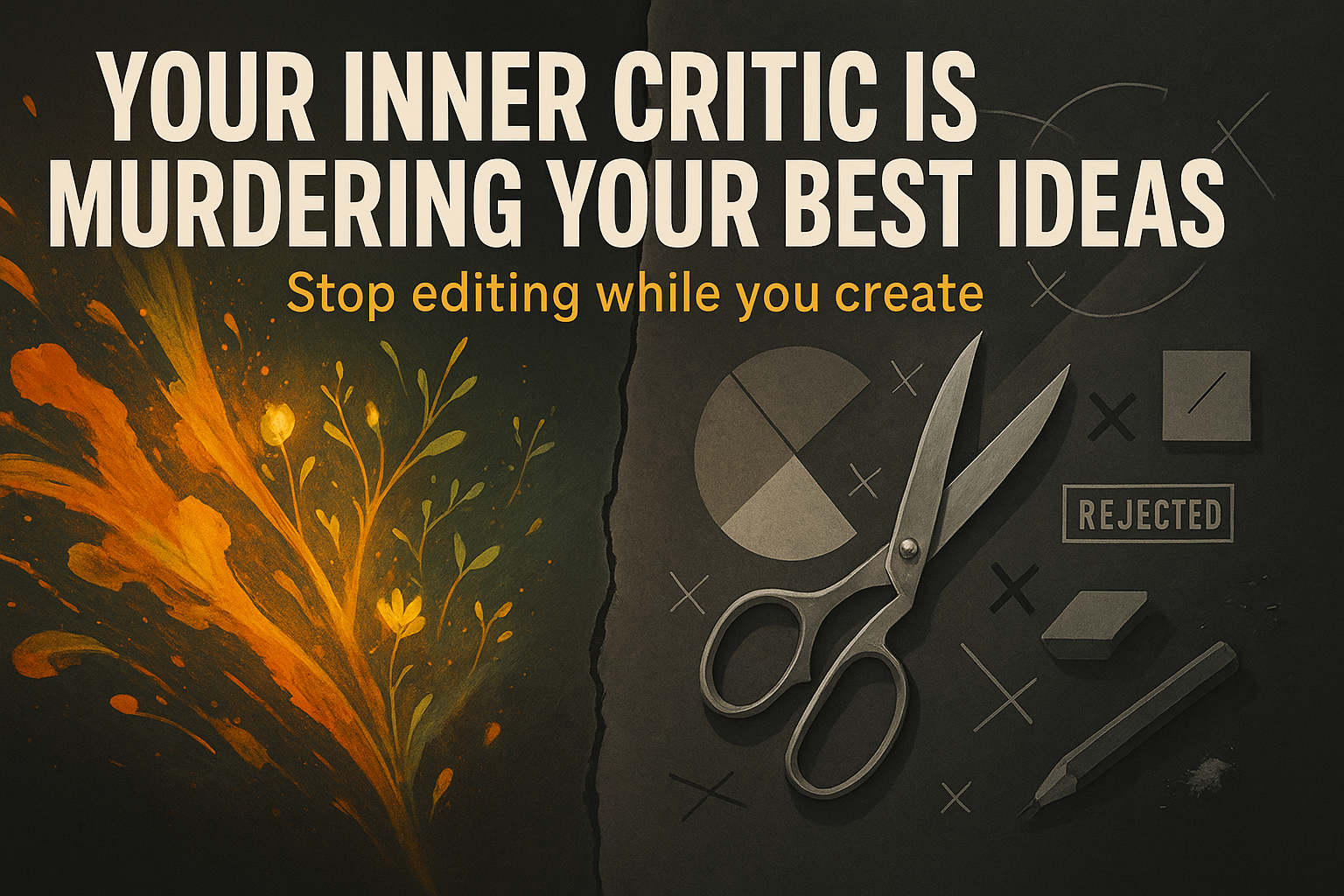
Your Inner Critic Is Murdering Your Best Ideas in the Crib
Your inner critic isn't the enemy. But letting it judge while you create guarantees mediocrity. Excellence requires opposite mindsets—and knowing when to deploy each.
Stop Waiting for Flow - Start Training It Like Every Other Skill
You can spend another year waiting for flow to happen, or you can spend the next 12 weeks training it like the ancient Greeks did, systematically, progressively, relentlessly.

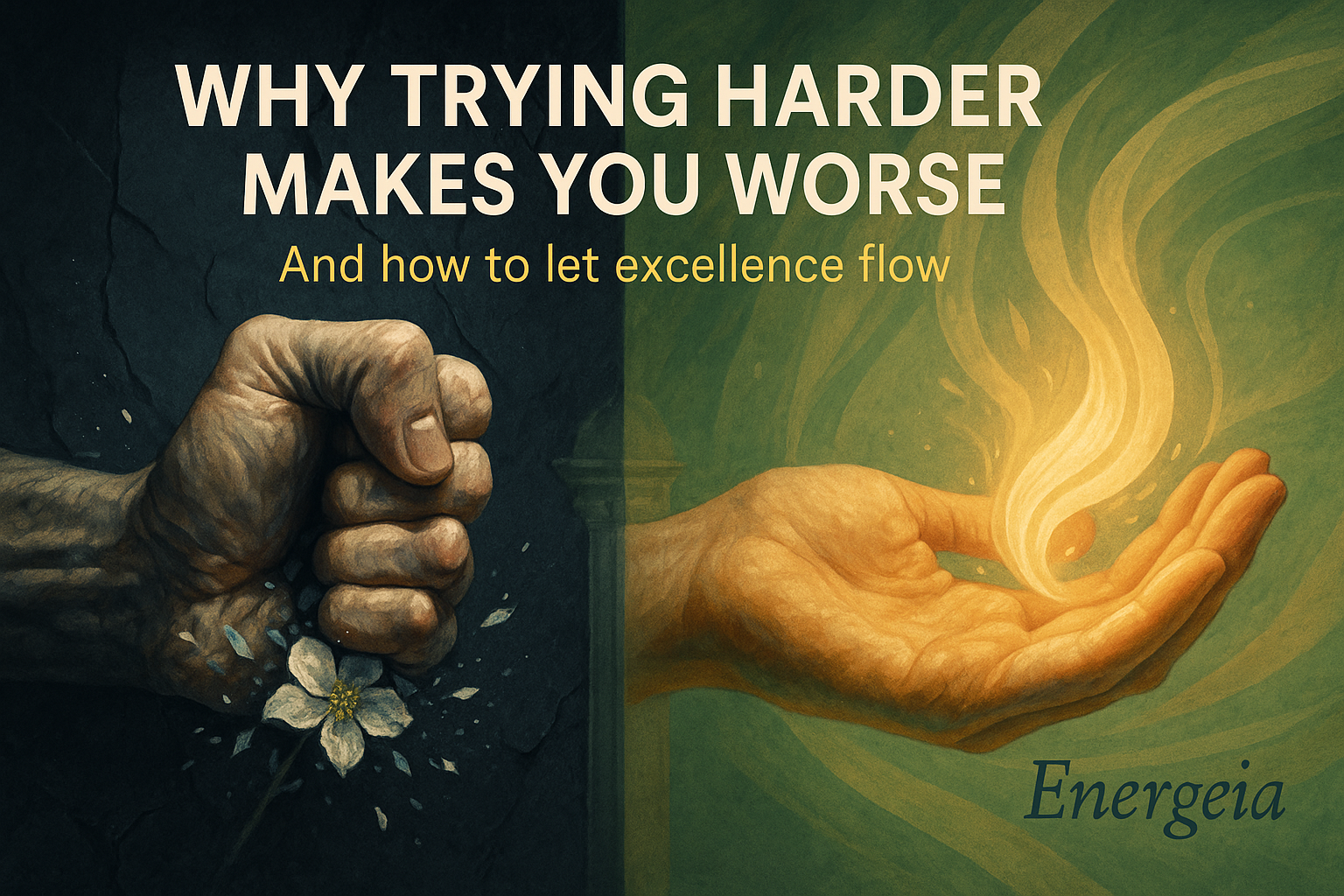
Why Trying Harder Makes You Worse (And How to Let Excellence Flow)
You built the conditions. You trained your attention. Now stop trying so hard. The excellence you're forcing toward shows up when you allow it to emerge.
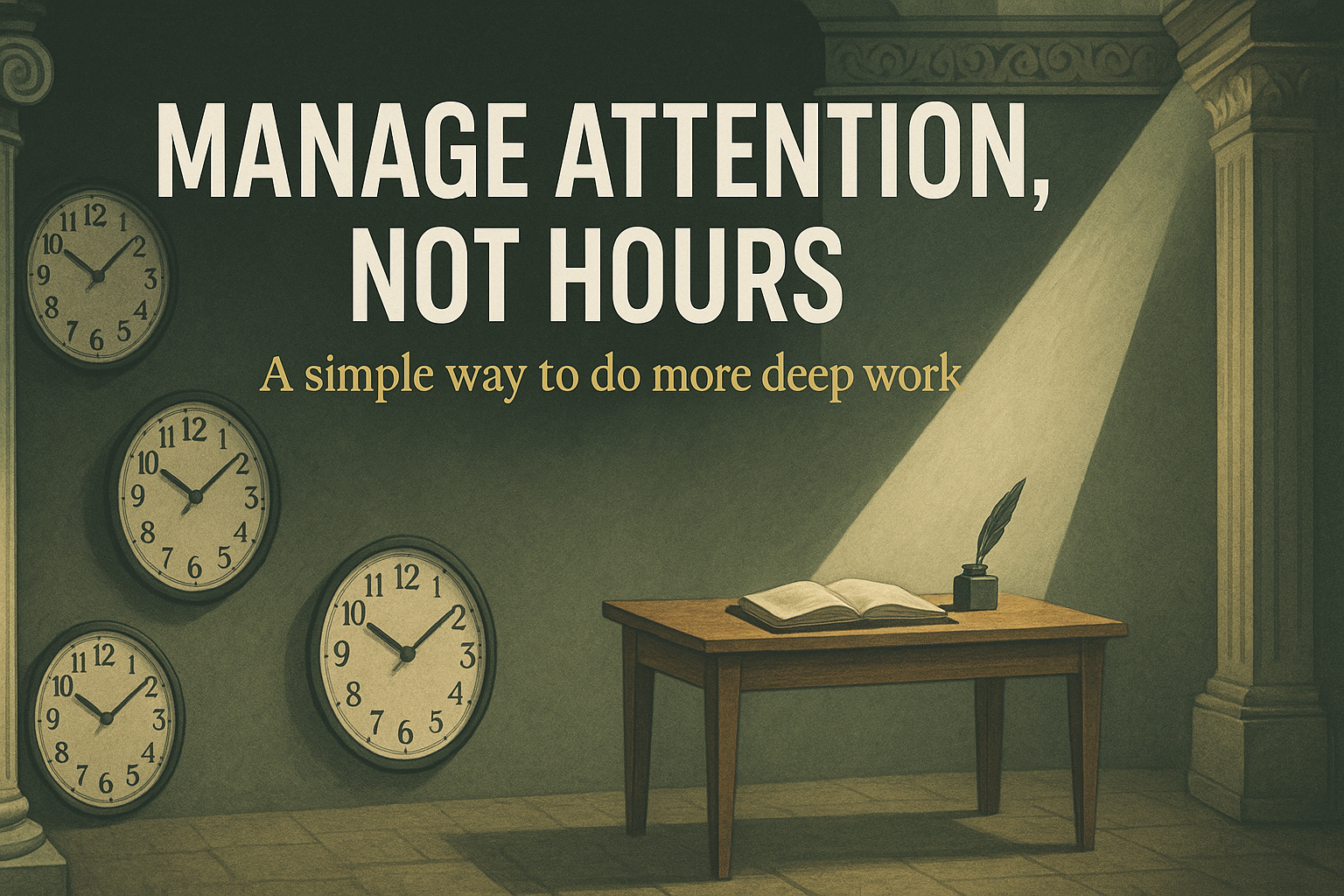
Manage Attention, Not Hours: How to Do Work That Matters
You don't need more hours, you need cleaner attention. When you defend attention, deep work shows up and the needle finally moves.
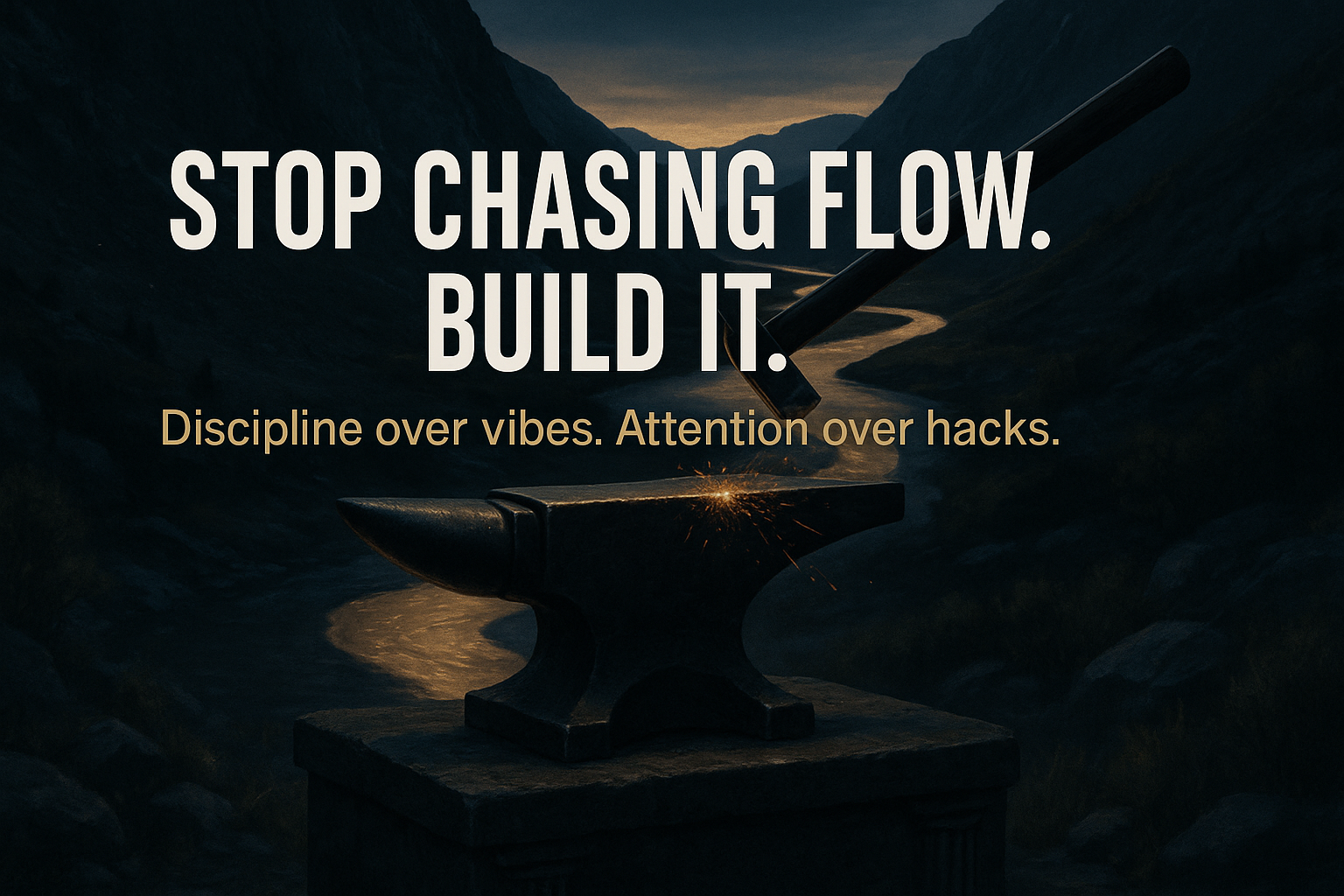
Stop Chasing Flow. Build It.
Flow doesn't show up when you beg it. It shows up when you remove what blocks it. The people who hit flow states most aren't gifted, they're disciplined about building the right conditions.
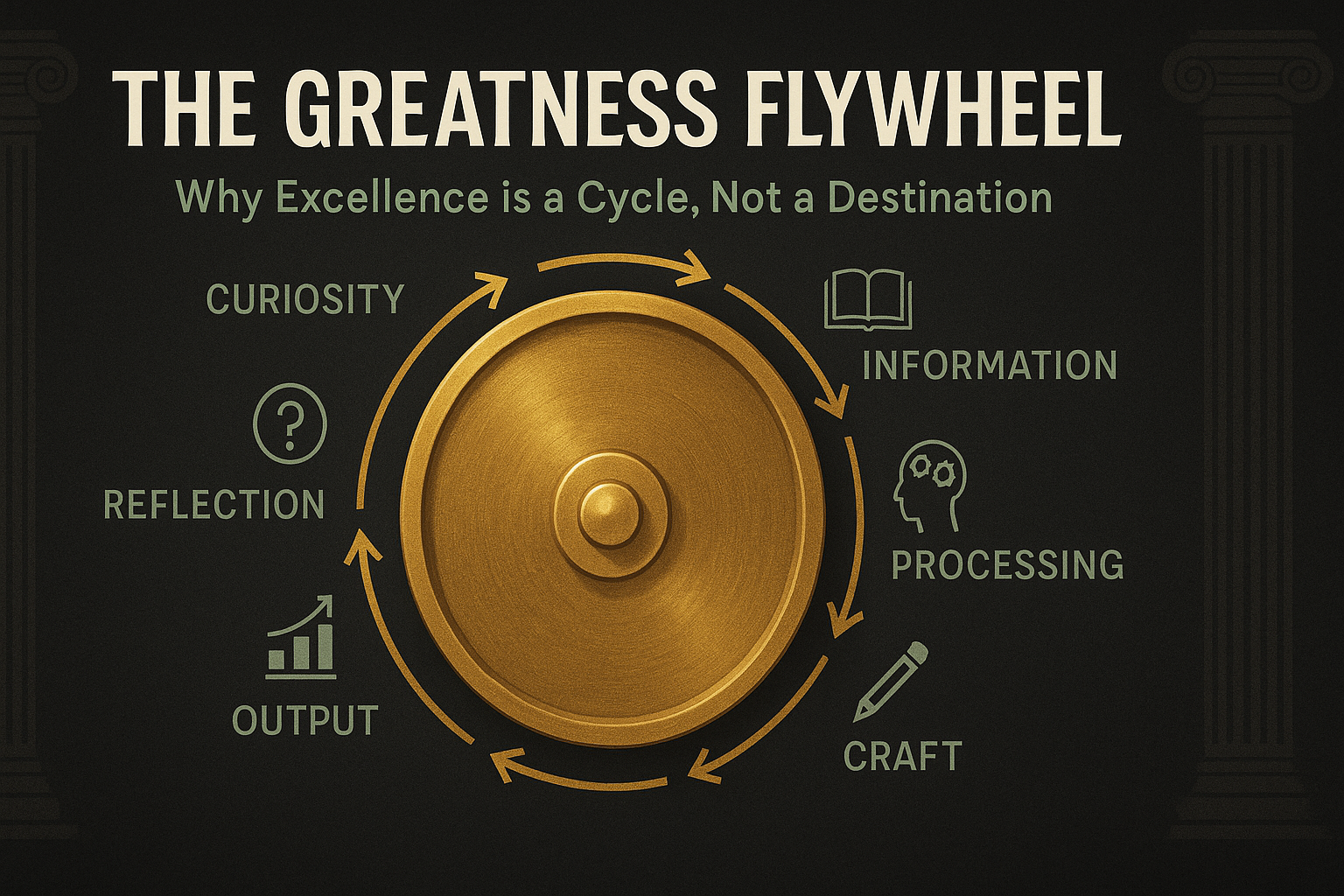
The Greatness Flywheel: Why Excellence is a Cycle, Not a Destination
Excellence isn't a destination you arrive at once and maintain through willpower. Excellence is a flywheel. The six-stage cycle that transforms ancient Greek wisdom into systematic excellence methodology.
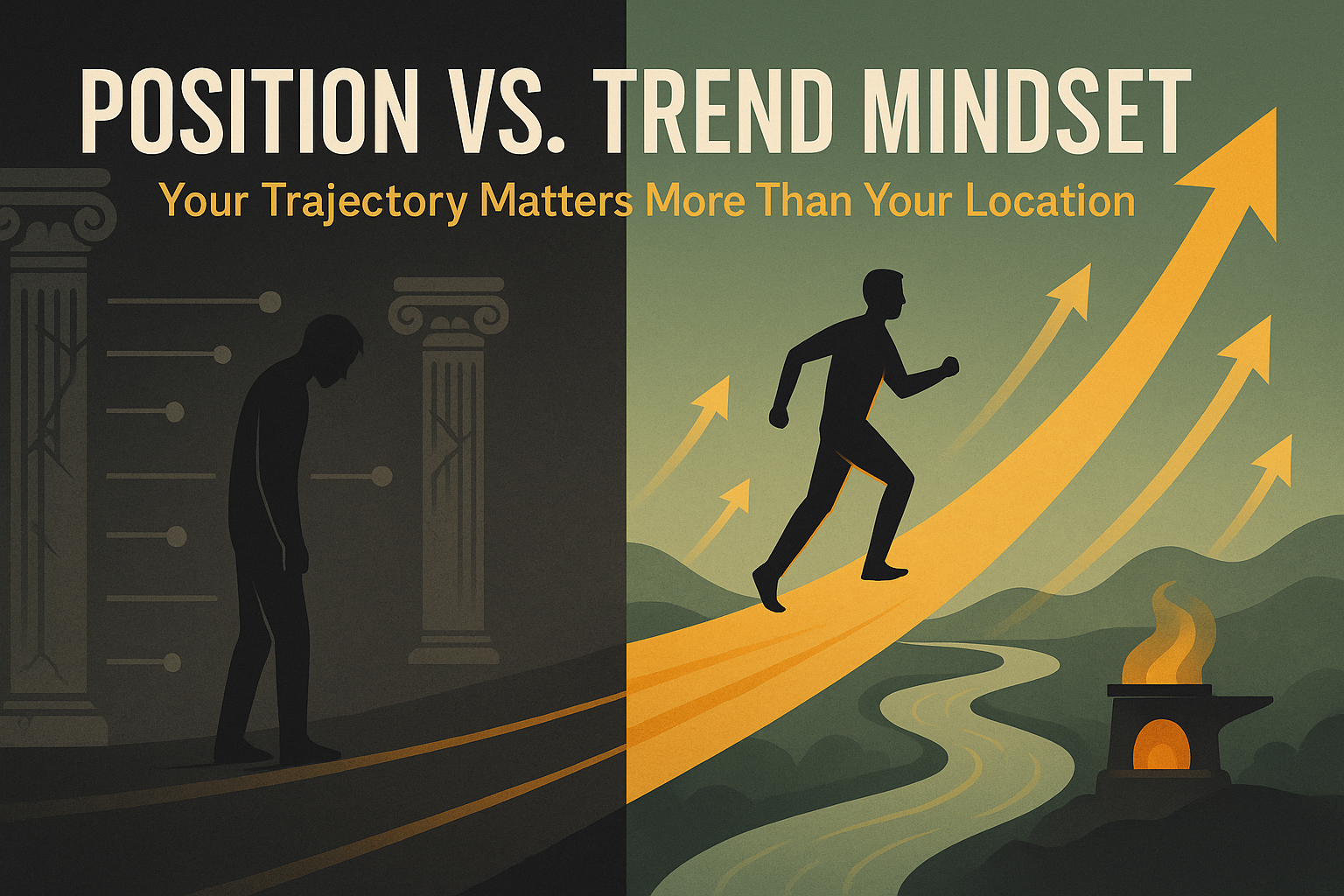
The Position vs. Trend Mindset: Why Your Trajectory Matters More Than Your Current Location
The fundamental difference between position thinking (comparing to others) and trend thinking (tracking your own trajectory). Why your direction matters more than your location.