Most Meetings Are Built So Nobody Changes Their Mind
By Derek Neighbors on October 18, 2026
Picture a design review at a company that just crossed eighty engineers. Two senior engineers each wrote a proposal for the new agent orchestration layer. One wants a queue with workers. The other wants a single service that holds all the run state. Both docs are good: ten pages each, diagrams, a cost model, a section on failure modes.
The meeting runs forty-five minutes and nobody is quiet. Every question in the room is aimed at the other person’s doc. The queue engineer asks how the state service survives a crash halfway through a run. The state engineer asks how anyone will debug a job that bounced through four workers. Both answer well, and both hear the answer and come back with a sharper version of the same question.
At 2:45 someone says, “Let’s take this offline.” Both engineers walk out believing exactly what they believed at 2:00.
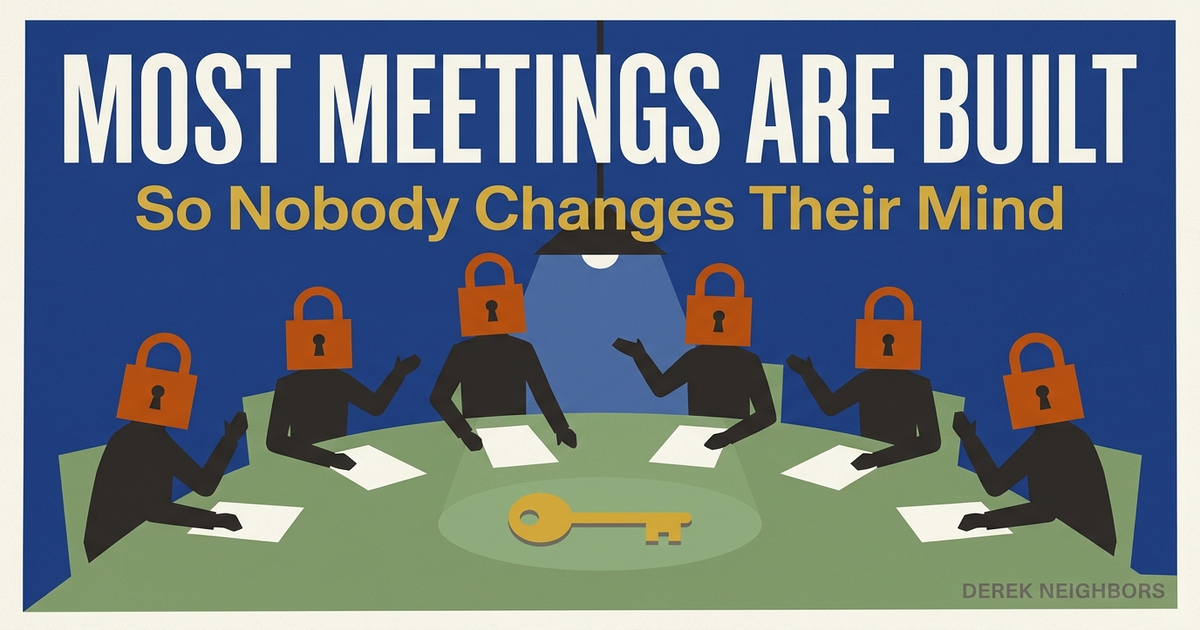
Earlier this month I wrote about what happens when the boss speaks first and the room goes silent. This room was loud, and the noise did not help. The meeting was built so nobody had to change their mind, and nobody did.
The Beginning State: Five People Thinking Out Loud
Go back to when that company was five people and a whiteboard. Somebody draws a box and says, “What if the agent writes to a table and we poll it?” Somebody else says, “That breaks when two runs touch the same row.” The first person says, “Oh, right,” erases the box, and draws a different one.
That exchange takes ten seconds and costs nothing. The idea was never written down, so nobody owned it, and losing it cost nobody any face.
Plato’s early dialogues tend to end in the same place. In the Laches, Socrates and two generals chase the question “what is courage?” until every answer has failed and they are left in aporia, stuck with no easy answer left. That sounds like a bad meeting. For Socrates it was progress, because now everyone in the conversation knew what they did not know. Small teams live in that state all day and call it figuring things out.
They have no process for discovery, and they do not need one. Nobody in the room has anything to defend yet.
The Progression: How Ideas Get Owners
No one decides to stop thinking out loud. The habit wears away as the company grows, through a series of changes that each make sense on their own.
Somewhere around thirty people, the whiteboard turns into a proposal doc with a name at the top. That is good practice, and it changes what “I was wrong” means. At the whiteboard it meant the idea was wrong, and in the review it means your doc lost, in front of the people who write your performance review.
Next, the meeting starts happening before the meeting. People share the doc with a few allies in DMs a day early, line up support, and walk into the review already knowing how the room will split. The review becomes a place to count votes that were cast the day before.
Then the docs get better. With Claude, any engineer can turn a rough idea into a clean ten-page proposal in an hour, with diagrams and a cost model. I love that. They also mean each person walks in with a finished case instead of a question, and people defend finished cases.
Last, the incentives catch up. Promotion packets say “drove the decision on the orchestration layer.” Very few say “changed my mind in the design review, and the system is better for it.”
The cognitive scientists Hugo Mercier and Dan Sperber offer a reason this goes wrong so fast. In their book The Enigma of Reason, they argue that human reasoning evolved mainly to argue: to come up with reasons that justify what we already think, and to judge the reasons other people give us. We are lazy judges of our own arguments and sharp judges of everyone else’s. I think of it as a lawyer for the self. Put a group of those lawyers on a shared question and they catch each other’s mistakes, which is why groups that argue toward an answer often beat people reasoning alone. On opposite sides of a contest, the same lawyers each get better at defending.
Socrates had names for both rooms. In the Meno, he says that if a contentious debater asked him a question, the kind of man who argues to win (the Greek word gives us “eristic”), he would state his answer and dare the man to refute it. Between friends who want to talk, he says, the answer should come more gently and more dialectically, using only terms the other person agrees they understand. The question can be identical in both rooms, and the difference is whether the people asking it are trying to win. The design review at eighty engineers has drifted into the first kind of room without anyone choosing it.
The Advanced State: A Room Where Being Wrong Out Loud Is the Win
A mature team cannot go back to five people at a whiteboard, so it builds a room where changing your mind is cheap again, on purpose, with eighty people in it.
Socrates set the standard in the Gorgias. He tells Gorgias he is one of those people who are glad to be refuted when they say something untrue, glad to refute others, and no less glad to be refuted than to refute. His reason is practical. Getting rid of a bad belief of your own is a bigger gain than getting rid of someone else’s, because you are the one who has to live with it.
The Socratic elenchus, testing a claim by questioning it until it holds or breaks, depends on that attitude. The same questions that help a person who wants to be right only produce a better defense from a person who wants to win.
The modern versions sound similar. In 2012 Jason Fried wrote up a conversation with Jeff Bezos, who said the people who are right a lot are the people who change their minds a lot. The futurist Paul Saffo’s phrase “strong opinions, weakly held” makes the same point: form a view fast, then go looking for proof you are wrong.
Not every changed mind counts. An engineer who moves because the most senior person pushed has failed too, in the other direction. What the advanced room trains is the middle: moving for a reason you can name, and holding when the only thing pushing is rank or volume.
So what does that look like in practice? An engineer says, “I was wrong about the queue. Your design handles retries better than mine,” and nothing bad happens to them. The design that ships often has no single author, because it took the best piece of each doc. The engineer who changed their mind walks into the next review with more trust than before, because the room has seen them move when the evidence moved.
The Integration: How to Build Meetings Where People Change Their Minds
Small teams get discovery for free. Past thirty or so people you have to build it, because every change in the progression keeps pushing the other way. These are the moves I would make this week.
-
Put the meeting type on the invite. Write “discovery” or “decision” in the title. A discovery meeting ends with a better question or a changed mind. A decision meeting ends with a call, and not every decision needs a discussion. Mixing the two is how a review turns into a vote count.
-
Make every proposal say what would change its author’s mind. One line at the top of the doc: “I would drop this design if load tests show the queue adds more than a second per run,” or “if we need cross-region failover this year.” Now the author has told the room where to push, and losing on that point means the doc did its job.
-
Restate before you attack. In Intuition Pumps, Daniel Dennett describes a rule he credits to the game theorist Anatol Rapoport: before you criticize a position, re-express it so clearly and fairly that its owner says, “Thanks, I wish I’d thought of putting it that way.” In the design review, the queue engineer summarizes the state design until its author nods, and only then asks the hard question. A lot of disagreements end during the summary, because the two people were never arguing about the same thing.
-
Have the model argue against you first. Before the review, give Claude your doc and ask for the strongest case against it, written as if by someone who wants the other design to win. Then ask for two more options nobody in the room wrote, including one that combines both docs. The model has no position to protect and no promotion packet. Walk in with four options on the table, two of them owned by nobody, and the room has somewhere to go besides one side beating the other.
-
End with the update round. Save the last five minutes for one question to each person: what do you believe now that you did not believe when we started, and what changed it? Write the answers in the notes. “My view held, and here is the strongest objection it survived” is a good answer. So is “nothing.” Three meetings in a row where nobody moved and no view survived a real objection means the meetings are restating positions you could have read in the docs.
-
Give credit for the update. When an engineer drops their own design after the load test, say so by name in the Slack recap and again at review time. That one sentence tells the whole team what you reward.
You do not need to run the meeting to start. Moves two, three, and four work from any chair: put the line about what would change your mind at the top of your own doc, restate the other proposal before you go after it, and ask the model for the case against your design before anyone else makes it.
Then run the test. Look at your last three meetings and count the times someone said “I was wrong” or “you changed my mind,” along with the reason that did it. If the count is zero, the room is the first thing for a leader to fix, and that still does not excuse anyone sitting in it. Whether you are willing to be refuted is your call, in a good room or a bad one. Socrates said his line in an Athens that was never built for it. A team that argues every week and never moves has the same problem as a team that never disagrees, and it is harder to spot because the meetings feel so busy.
Final Thoughts
A meeting where nobody’s view got tested cost every person in it an hour and produced nothing the docs did not already say. Small teams think out loud without trying, and growing teams lose the habit one sensible change at a time: names on docs, votes in DMs, polished proposals, promotion packets that reward winning. Socrates was glad to be refuted because it meant he was carrying one less wrong idea around. The wasted hour matters less than the engineer who walks out still holding a wrong idea they could have dropped at 2:15, and who will defend it again next quarter. Build rooms where saying “I was wrong” is the cheapest thing anyone can do, and the hour starts producing something again.
If you want to practice leading meetings where people think together and change their minds, MasteryLab is built for that kind of work.
FAQ
How do you run a meeting where people change their minds?
Label the meeting as discovery or decision. Ask each proposal author to write down what would change their mind. Have people restate the other position before they criticize it. Close with a round where each person says what they believe now that they did not believe at the start and what changed it, and give public credit to the people who changed their minds.
What is the Socratic elenchus?
The elenchus is Socrates’ method of testing a claim by asking questions until the claim either holds up or contradicts itself. It works when the person being questioned wants to find the truth. With someone who only wants to win, the same questions just sharpen their defense.
What is the difference between eristic and dialectic?
Eristic arguing tries to win the exchange, while dialectic tries to find the answer together. In Plato’s Meno, Socrates says he would answer a contentious debater bluntly and dare him to refute the answer, but would answer friends more gently, using only terms both people agree they understand.
What does “strong opinions, weakly held” mean?
The phrase comes from the futurist Paul Saffo. Form a strong view quickly so you have something to test, then go looking for evidence that you are wrong, and change the view when you find it. Most teams practice the first half and skip the second.