Why Voluntary Struggle Prepares You for Involuntary Battles
By Derek Neighbors on December 19, 2025
I live in the desert. Rain is rare enough that people here forget how to drive in it. When the sky opens up, the logical response is to stay inside, wait it out, maybe enjoy the novelty from a dry window.
I do the opposite. When rain comes, I run in it.
Not because I enjoy being cold and wet. Because I know something most people forget: the conditions you train in are the conditions you’re prepared for.
The Training Run That Became Something Else
We all have our bitch voice. Mine tells me constantly. The cold sucks. The wet sucks. Anything less than sunshine, you can stick it up your ass.
A few months back, I headed out when the rain started. Nothing unusual. Just another opportunity to practice discomfort while everyone else stayed comfortable.
Then the wind arrived.
Not wind. Violence. The kind of gusts that make you question whether forward motion is even possible. The temperature dropped. The rain went from annoying to freezing, the kind that stings exposed skin and makes your hands go numb.
I was five or six miles from my car. No shelter. No shortcuts. Just the trail back through conditions that were actively trying to end my run.
My feet were waterlogged, slosh coming out of my shoes with every step. Freezing. The bitch voice was screaming: stop, find cover, wait it out, this is stupid.
But here’s the weird part. Somewhere in the middle of all that misery, I recognized this was training. Not comfortable. Not enjoying it. But I accepted it as necessary, doing the thing other people wouldn’t do. That’s where the magic happens. In the gap between what your bitch voice demands and what you do anyway.
I kept moving. One foot, then the next. The car was the only way out, and standing still wouldn’t get me there any faster. So I grit my way through it, cold and wet and telling my bitch voice to shut up, until I finally reached the parking lot and sat shivering in the driver’s seat.
At the time, it felt like nothing but suffering. A miserable experience that proved nothing except my questionable judgment.
I didn’t realize I was paying my dues.
The Race That Tested the Account
Fast forward to race day. A 17K, nothing extreme. The kind of distance I’d done dozens of times. Show up, run hard, go home.
The weather at the start line was fine. Cool, cloudy, race-appropriate.
Then, moments after crossing the start, the rain arrived.
Not a drizzle. Real rain. The kind that soaks through layers in minutes and turns the trail into a slick mess. The temperature dropped. Wind picked up. Conditions that would make any reasonable person reconsider their life choices.
I watched it happen around me. Runners slowing down. Some stopping to reassess. Others moving toward trees, looking for shelter, waiting to see if it would pass.
And something in me recognized this moment.
I’d been here before. Not this exact trail, not this exact race, but this exact discomfort. The cold hands, the stinging rain, the body asking permission to quit. I’d already had this conversation with myself, alone on a desert trail, five miles from anywhere.
The difference was stark: this time, I knew how the conversation ended.
I kept cranking.
Not because I’m tougher than anyone else. Because I’d already practiced being in exactly this situation. My nervous system had processed freezing rain and wind before. The discomfort was familiar, not novel. While others were experiencing this for the first time and trying to figure out what to do with it, I was just running.
The voluntary suffering had become involuntary capability, feeding the greatness flywheel where excellence cycles rather than arrives.
The Ancient Wisdom of Askesis
The Greeks had a word for this: askesis. It meant disciplined training, the voluntary self-imposed difficulty that builds capacity for what you can’t control.
Athletes practiced it. Warriors lived it. Philosophers wrote about it.
Here’s what most people miss: everyone with rational capacity owes the development of capacity for involuntary difficulty. This isn’t inspiration. It’s obligation. The form differs, someone without material resources practices different voluntary struggles, but the obligation is universal. Circumstances don’t determine obligation. They only determine the form the struggle takes.
The core insight was simple: you can’t schedule the moments that will test you. But you can prepare for them by seeking out difficulty when difficulty isn’t required.
Seneca put it plainly:
Set aside a certain number of days, during which you shall be content with the scantiest and cheapest fare, with coarse and rough dress, saying to yourself the while: Is this the condition that I feared?
He wasn’t recommending poverty tourism. He was recommending askesis. Practice deprivation before deprivation finds you. Experience discomfort voluntarily so that when it arrives involuntarily, your capacity is already built.
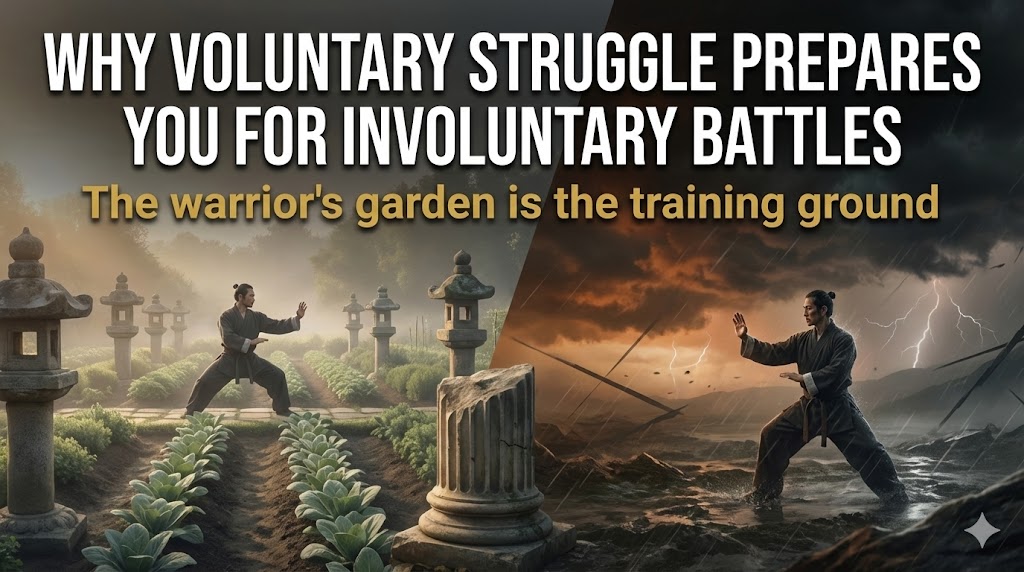
This is the difference between the warrior and the gardener.
The warrior tends his garden in peacetime. He cultivates peace because he has the capacity for battle, not because he lacks it. His calm is chosen strength, not naive ignorance.
The gardener thrust into war has no such foundation. He’s never practiced difficulty. He’s optimized for good conditions, trained only when training felt pleasant, avoided discomfort whenever the option was available.
Same storm. Radically different responses.
The difference isn’t talent. It’s what they did with all the ordinary days before the extraordinary one arrived.
Why Comfort Is the Real Danger
Avoiding discomfort doesn’t protect you from it. It just ensures you’ll be unprepared when it shows up anyway.
Every comfortable morning when you could have done the hard thing, every avoided conversation when you could have faced it, every workout skipped because you didn’t feel like it: these aren’t neutral choices. They’re withdrawals from an account you’ll need later.
The involuntary battles of life don’t send calendar invites. They don’t wait until you’re ready. They arrive while you’re sleeping, while you’re comfortable, while you’re convinced everything is fine.
Your capacity in that moment was determined months or years earlier.
The runner who only trains in perfect conditions has never experienced their body in bad ones. When bad conditions arrive on race day, they’re not just facing the weather. They’re facing it for the first time. No muscle memory. No practiced response. Just novel suffering and a nervous system trying to figure out what to do.
The runner who sought out bad conditions during training has already been here. The suffering isn’t novel. It’s familiar. And familiar suffering is dramatically easier to manage than novel suffering.
This applies far beyond running.
The leader who only takes feedback when they’re ready has never processed criticism under pressure. When the board delivers unexpected news, they crumble not from the content but from the context.
The entrepreneur who only makes decisions when information is complete has never navigated ambiguity. When the market shifts without warning, paralysis sets in not from the situation but from the lack of practice.
The person who only has hard conversations when they’re emotionally regulated has never maintained composure under fire. When the relationship crisis hits at the worst possible moment, capacity fails because it was never built.
askesis isn’t about suffering for its own sake. It’s about building capacity, the integrated physical, mental, and moral capability to meet difficulty with virtue rather than collapse, when capacity-building is still optional.
This is how voluntary struggle relates to arete, the actualization of human potential. Every neural pathway forged, every emotional regulation practiced, every response rehearsed becomes available automatically when difficulty arrives uninvited.
The Practice of Voluntary Struggle
This isn’t complicated, but it requires intention.
Seek out the conditions everyone else avoids. Run in the rain when you could stay dry. Take the cold shower when hot is available. Have the difficult conversation before it becomes urgent. The goal isn’t misery. The goal is familiarity with discomfort so that discomfort loses its power to stop you.
Train when training feels unnecessary. The best time to build capacity is when you don’t need it, so build habits for your worst day, not your best. Waiting until crisis to develop crisis capability is like waiting until the race to start training. Build the deposits during peacetime.
Embrace the difficult version. When you have a choice between easy and hard, choose hard more often than feels reasonable. Not always. Not compulsively. But enough that difficulty stops being a stranger.
Trust the invisible compound. Voluntary struggle doesn’t announce its benefits until they’re tested, because progress feels like nothing until it feels like everything. You’ll wonder why you’re doing this. The payoff often comes months or years later, in a moment you couldn’t have predicted, when capacity you forgot you were building becomes the only thing that saves you.
Marcus Aurelius called this praemeditatio malorum: rehearsing difficulty before it arrives. Not to be pessimistic. To be ready. To ensure that when the involuntary battle shows up, you’ve already fought a hundred voluntary ones.
Paying Your Dues
That training run in the freezing rain felt like nothing but cost at the time. Suffering with no obvious return. A miserable experience that proved nothing except my questionable judgment.
But I was paying dues. Every step back to the car was money in an account I didn’t know I was building.
Race day was the collection. The same conditions that stopped other runners just triggered recognition in me. I’d been here. I knew this feeling. I knew how the conversation with my bitch voice ended. The only difference was the timing.
That’s what askesis looks like in practice. The currency is discomfort. You pay during the optional moments. You collect during the unavoidable ones.
The people who handle crisis didn’t develop that capability in crisis. They built the character foundation in peace, through a thousand small choices to tell their bitch voice to shut up and do the work anyway.
Final Thoughts
What voluntary struggle do you owe? What’s your bitch voice telling you that you’re listening to instead of doing what’s required?
Pick one thing this week. The cold shower. The hard conversation. The workout in bad weather. The feedback you’ve been putting off. Do it before you have to.
Your bitch voice will scream. You’ll question your judgment. You’ll wonder why you’re making life harder than it needs to be. Do it anyway. That’s the whole point.
The rain is coming. It always does. The only question is whether you’ve been running in it.
Ready to build the disciplines that compound into capability? MasteryLab provides the community and framework for people committed to the voluntary struggle. Because the involuntary battles are coming whether you’re ready or not.