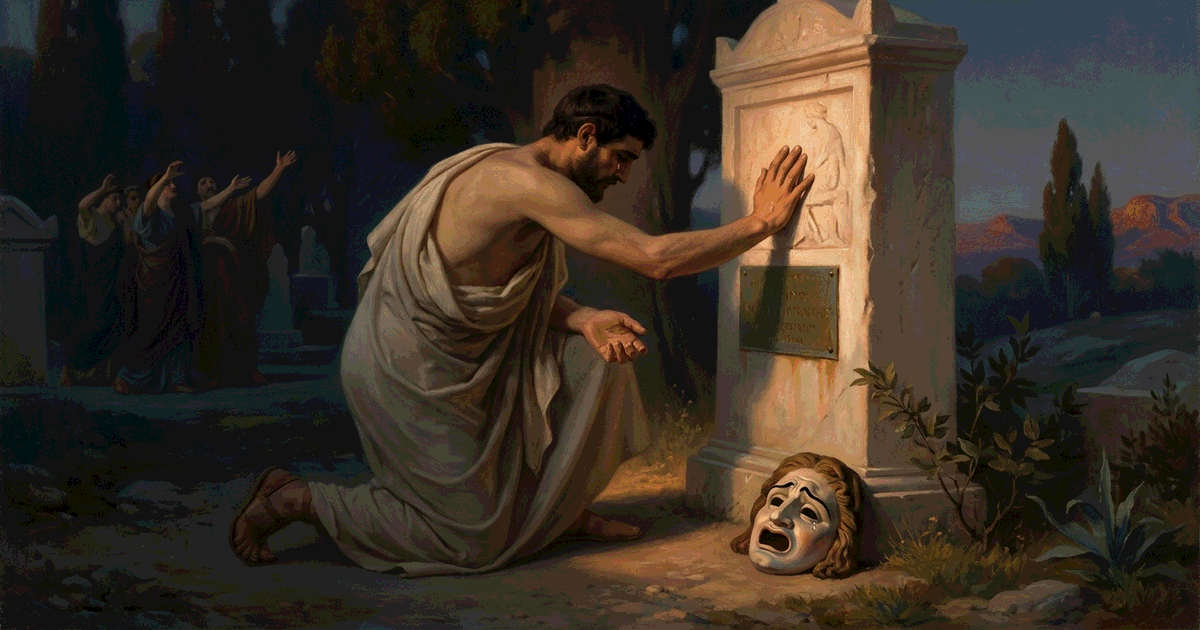
Metriopatheia (μετριοπάθεια): Meaning, Definition & Modern Application
meh-tree-oh-PAH-thay-ah
The moderation of passions and emotions, not their elimination. A measured response to life's circumstances that neither suppresses feeling nor surrenders to emotional excess.
Etymology
Derived from metrios (moderate, measured, within due bounds) and pathos (passion, emotion, suffering). The compound literally means ‘measured passion’ or ‘moderate feeling.’ This term emerged in Peripatetic philosophy as a counterpoint to Stoic apatheia, affirming that emotions have proper places and proportions in human life.
Deep Analysis
The concept of metriopatheia represents one of ancient philosophy’s most sophisticated engagements with human emotional life. It emerges from the Peripatetic tradition as a direct response to what Aristotle’s successors perceived as the Stoic overreach in demanding apatheia, the complete elimination of disturbing passions.
Aristotle himself laid the groundwork in the Nicomachean Ethics, though he did not use this precise term. His doctrine of the mean explicitly addresses emotional responses: we should feel anger ‘at the right things, with the right people, and also in the right way, at the right time, and for the right length of time’ (NE 1125b). This is not a call for emotional tepidness but for emotional precision. The person who never feels anger at injustice is as deficient as the one who rages at minor slights.
The term gained explicit currency in the debates between Peripatetics and Stoics during the Hellenistic period. The Stoics, particularly Chrysippus, argued that emotions (pathē) are judgments that something good or bad is present or anticipated. Since the sage recognizes that only virtue is truly good and only vice truly bad, the sage experiences no disturbing passions about externals. The Peripatetics countered that this position demands an impossible and perhaps undesirable transformation of human nature.
What makes metriopatheia philosophically interesting is its implicit claim about the architecture of human flourishing. It asserts that emotions are not merely permitted but necessary components of the good life when properly calibrated. Fear, for instance, serves as a warning system. Anger mobilizes us against genuine threats and injustices. Even grief honors what we have lost and reinforces what we value. To eliminate these responses would not perfect human nature but impoverish it.
The concept creates a fascinating tension with enkrateia (self-control) and sophrosyne (temperance). Enkrateia suggests a struggle against desires, an internal conflict where reason must continually battle passion. Metriopatheia implies something more elegant: a character so well-formed that emotions naturally arise in proper proportion. The person of metriopatheia does not fight their anger; their anger simply matches the situation. This points toward the Aristotelian insight that virtue is not just about controlling nature but about developing a second nature.
Practically, metriopatheia requires what we might call emotional intelligence coupled with moral perception. You must first accurately perceive the situation: Is this slight intentional? Is this loss permanent? Is this praise merited? Then you must have cultivated the emotional responsiveness that generates appropriate feeling. This double requirement explains why metriopatheia develops slowly. It demands both wisdom (phronesis) to judge situations correctly and habituated character (hexis) to feel accordingly.
The concept also carries political implications that ancient thinkers explored. Aristotle notes that citizens need appropriate anger to defend the city and appropriate fear to respect its laws. A polity of entirely passionless individuals would lack the emotional fuel for civic engagement. Yet a polity ruled by unmoderated passion descends into faction and tyranny. Metriopatheia thus becomes a civic as well as personal virtue.
One paradox deserves attention: metriopatheia seems to presuppose what it aims to create. How can you calibrate your emotions appropriately before you have developed appropriate emotional responses? The answer lies in the Aristotelian emphasis on habituation and role models. You learn metriopatheia by practicing it imperfectly, observing others who embody it, and gradually refining your responses through experience and reflection. The standard is not given in advance but discovered through living.
The later Stoics, particularly those of the Roman period, show some convergence with this position. Seneca distinguishes between the ‘first movements’ (propatheia) that arise automatically and the assent we give to sustaining them. Marcus Aurelius repeatedly works to moderate rather than eliminate his responses. This suggests that the stark opposition between Stoic apatheia and Peripatetic metriopatheia softened in practice, even if the theoretical distinction remained.
Modern Application
You face emotional triggers constantly in leadership: criticism, setbacks, praise, unexpected success. Metriopatheia teaches you to feel these responses fully while keeping them proportionate to circumstances. Rather than suppressing your frustration at a failed project or your excitement at a win, you calibrate your emotional response to what the situation actually warrants, maintaining both your humanity and your judgment.
Historical Examples
Marcus Aurelius provides perhaps the clearest historical embodiment of metriopatheia, though he was nominally committed to Stoic apatheia. His Meditations reveal not a man who has eliminated emotion but one who continuously works to calibrate it. When he writes of the need to ‘accept the things to which fate binds you’ and to ‘love the people whom fate brings you together with,’ he describes emotional work, not emotional absence. Cassius Dio records that during the Marcomannic Wars, when plague and invasion threatened the empire simultaneously, Marcus maintained what observers described as concerned but not desperate leadership. He sold palace furnishings to fund the war rather than raise taxes, an action revealing both appropriate gravity about the crisis and measured confidence in eventual success.
Pericles, as depicted by Thucydides, demonstrates metriopatheia in political leadership. During the plague that devastated Athens and killed his own sons, Pericles maintained his strategic judgment while clearly feeling the losses. Thucydides notes that Pericles wept at the funeral of his last legitimate son but continued to advocate for the policies he believed would save the city. He did not suppress his grief, nor did he allow it to distort his political judgment. This balance eventually failed as the Athenian assembly, lacking similar calibration, swung between despair and reckless hope.
Seneca’s own life illustrates both the value and difficulty of metriopatheia. Despite his Stoic commitments, his letters reveal a man who felt deeply: the loss of friends, the frustrations of political life, the fear of death. His advice to Lucilius repeatedly emphasizes moderation rather than elimination of feeling. When facing his ordered suicide under Nero, Tacitus describes Seneca as neither panicked nor artificially serene. He comforted his weeping friends, reminded them of philosophical teachings, and proceeded with dignified sadness. His final words, as reported, expressed measured regret at leaving life’s work incomplete without complaint about its injustice.
How to Practice Metriopatheia
Start each morning by identifying one emotion you typically overreact to and one you tend to suppress. Name them explicitly.
Track your emotional responses throughout the day using a simple 1-10 scale. When you feel anger, fear, or excitement, pause to rate its intensity, then rate what intensity the situation actually warrants. Notice the gap.
Practice the ‘proportionate pause’: when strong emotion arises, take three breaths and ask, ‘What response does this situation deserve?’ Not what it triggers, but what it merits.
Create an ‘emotional calibration journal.’ Each evening, record one moment where your emotional response exceeded the situation and one where you dampened appropriate feeling. Analyze both.
Seek feedback from a trusted colleague: ‘Did my reaction to that news seem proportionate to you?’ External perspective reveals calibration errors you cannot see.
Review historical examples weekly. Read about figures who maintained measured responses under pressure. Note their specific techniques.
Practice graduated exposure: deliberately place yourself in mildly triggering situations and consciously modulate your response before escalating to more challenging scenarios.
Application Examples
Your company loses a major client who represented 15% of revenue. The initial emotional response is panic, catastrophizing about layoffs and failure. Others on the team swing to denial, minimizing the significance.
Metriopatheia calibrates the response: genuine concern that motivates action without panic that distorts judgment. The loss matters and should be felt, but it does not merit despair.
A close friend cancels plans at the last minute for the third time. You feel hurt and angry but question whether you are overreacting. You also wonder if you should just not care.
Moderate feeling recognizes the pattern deserves attention and honest conversation. Suppressing the hurt enables continued disrespect. Rage destroys the friendship unnecessarily.
A team member publicly criticizes your decision in a meeting. You feel your face flush and your mind race to defensive responses or sharp rebukes.
Proportionate response acknowledges the discomfort, pauses before reacting, and assesses whether the criticism has merit. The emotion signals something important; the measure determines whether you learn from it or merely react to it.
A product failure affects thousands of customers. Some leaders respond with visible anxiety that spreads through the organization. Others project false calm that employees see through immediately.
Metriopatheia produces appropriate urgency: serious attention without paralysis, concern without panic. Teams read emotional cues from leaders and calibrate accordingly.
After years of work, your initiative succeeds beyond all projections. The temptation is either to celebrate excessively or to immediately deflect to the next challenge without acknowledging the achievement.
Measured joy honors the accomplishment without inflating your sense of self. You feel the win fully while maintaining awareness of what contributed beyond your efforts and what challenges remain.
Common Misconceptions
Many people confuse metriopatheia with emotional repression or ‘keeping it together.’ The concept actually validates emotion as essential to human flourishing. The goal is not to feel less but to feel accurately. Suppressing legitimate anger at injustice or grief at loss is as much a failure of metriopatheia as excessive rage or paralyzing sorrow.
Another error treats metriopatheia as a fixed formula: feel exactly 60% of what you initially feel, or always count to ten before responding. The concept is far more demanding. It requires judgment about what each unique situation warrants. Some circumstances merit intense emotional response. Others merit very little. The skill lies in discerning which is which, not in applying a universal dampening function.
Finally, some assume metriopatheia means always appearing calm to others. External presentation and internal calibration are distinct. Sometimes appropriate feeling should be visible to communicate seriousness or build connection. The measured leader may show genuine anger to signal that a violation will not be tolerated. The measure is in whether the feeling fits the situation, not in whether others can see it.
I spent years oscillating between two failed approaches to emotion in leadership. Early in my career, I believed passion was the fuel of excellence. I let myself feel everything intensely, which sometimes inspired teams and sometimes terrified them. I remember a quarterly review where my visible frustration at missed targets sent a productive meeting into defensive chaos. The data warranted attention, not the emotional display I produced.
Then I overcorrected. I studied Stoicism and concluded that the answer was to become unflappable, to project calm regardless of circumstances. This worked better in some ways but created its own problems. Teams stopped bringing me bad news because my measured non-reactions made them uncertain whether I grasped the severity. I had traded emotional excess for emotional absence.
Metriopatheia gave me language for what I was missing: the goal is not to feel less but to feel accurately. When I coach leaders now, I watch for both failure modes. Some need permission to modulate their reactions downward. Others need permission to feel and express more, to let their teams see that things matter.
The breakthrough for me came during a company crisis when we discovered a significant security vulnerability. My old pattern would have been either visible panic or forced calm. Instead, I asked myself what response the situation actually merited. The answer was serious, focused concern that communicated urgency without suggesting we were doomed. That calibration, feeling the weight of the situation without being crushed by it, let me lead effectively through resolution.
What I tell clients now is simple: your emotional responses are data, but they need interpretation. The anger you feel might be exactly right, slightly high, or wildly disproportionate. Your job is to develop the judgment to know which and the character to respond accordingly. This is harder than either letting it all out or locking it all down, but it is the only approach that preserves both your humanity and your effectiveness.
Frequently Asked Questions
What is metriopatheia and how is it different from apatheia?
Metriopatheia means moderating emotions to appropriate levels, while apatheia aims at eliminating disturbing passions entirely. The Peripatetics (Aristotle's school) argued that emotions like anger and fear serve important functions when properly proportioned. Stoics countered that only complete freedom from passion brings true peace.
How do you practice metriopatheia in stressful situations?
The key practice involves pausing to assess whether your emotional response matches the actual significance of the situation. Ask: 'What does this circumstance actually warrant?' Then consciously calibrate your reaction upward or downward. This preserves genuine feeling while preventing over or under-reaction.
Is metriopatheia about suppressing emotions?
No. Metriopatheia explicitly rejects suppression. The goal is appropriate expression, not elimination. Grief at genuine loss is proper; excessive grief that paralyzes you is not. Anger at injustice is fitting; rage that destroys your judgment is not. The concept validates emotion while demanding proportion.