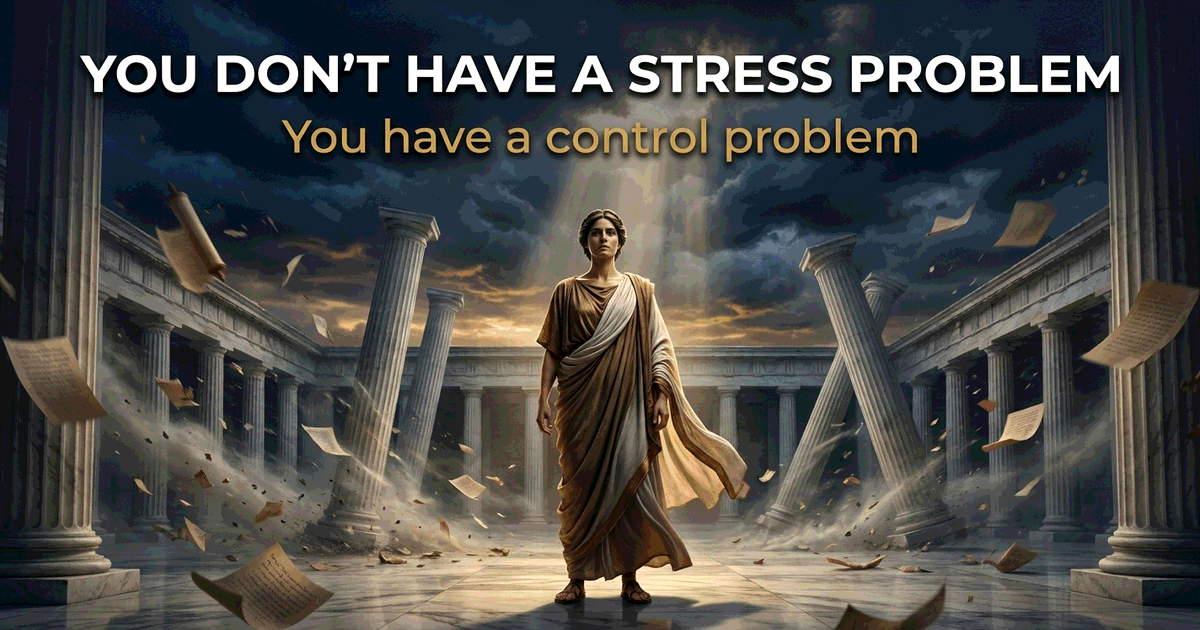
You Don't Have a Stress Problem. You Have a Control Problem.
By Derek Neighbors on May 6, 2026
It is Sunday night. Nothing is wrong. The week has not started. You are not at work. There are no fires, no meetings, no decisions in front of you. And yet, somewhere around eight in the evening, the knot arrives in your stomach, the shoulders tighten, the mind starts running through Monday before Monday has any right to exist.
If stress came from circumstances, this moment would be impossible to explain. The circumstance is rest. The stress is full-blast.
Most people don’t pause to notice this contradiction. They take the dread as proof that the week is going to be hard, instead of evidence that something else is generating the response. The dread is upstream of the inputs. It produces the inputs in advance, the way an old job’s pressure can keep running long after the job is gone.
The Stoics, twenty-three centuries ago, named this with surgical precision. They were not denying that the world creates pressure. They lived with empire, slavery, exile, plague, war. What they argued was something more useful: the pressure is real, and the suffering you feel under it is manufactured somewhere else, in a place you can actually reach.
This teaching does not begin in a corner office. It is the same teaching that applies in the hospital room next to a sick child, in the cell, in the grief of a sudden loss, and on the morning after the eviction notice. The illustrations in this piece are drawn from the working life I know. The principle is older and broader than any of them.
That place has a name. prohairesis. The faculty of choice. The most important real estate you own and the part you almost never visit.
The Apparent Contradiction
Stress, in this piece, means the inner disturbance that arises when the mind treats an external event as a threat to the self. Not the event. Not the pressure. The disturbance produced by your judgment of them.
Two things both feel true.
The first is that stress comes from outside. Your boss is unreasonable. The deadline is tight. The market is moving sideways. The kids are sick. The mortgage is due. Reduce the inputs, you tell yourself, and the stress will drop. So you say no to a meeting, delegate a project, take a vacation. For about a week, it works. Then the same internal weather returns. Different inputs, same temperature.
The second is what Epictetus said: “It is not events that disturb people, it is their judgments concerning them.” If that is true, then external pressure is not actually doing the work most people think it is doing. Something else is.
Both can be right at the same time. The events are real. The judgments about the events are where the suffering is built. This is not a clever trick of language. It is a structural claim about where stress lives.
The proof is everywhere if you look. Two leaders get the same bad email at 9am. One spirals for three hours, derails their day, snaps at a colleague, sleeps badly, carries the weight into the next morning. The other reads it, identifies what needs a response, sends a five-minute reply, returns to the work that was already in front of them. The email is identical. The events are identical. The stress is not.
If the email caused the stress, the stress would be the same in both leaders. It is not. So the email is not the cause. The cause is what each of them did with the email in the moments after they read it. That is where the work is. That is where the work is almost never done.
The Deeper Truth
The Stoic claim is not that pressure does not exist. It is that pressure is the room and your response is the rent. Most people are paying far too much rent.
prohairesis is the faculty that handles the response. Epictetus, who was born a slave and walked with a permanent limp from a beating he received as a young man, made prohairesis the structural center of his entire philosophy. His argument was simple. Almost every external thing is outside your control. Your body, your reputation, your possessions, the actions of others, the weather, the economy, time itself. You can lose any of it without warning. The one thing nobody can take is your capacity to choose how you respond to what happens.
That capacity is a faculty of the soul, not a feature of the body. It is the same faculty in the slave and the emperor, in the field hand and the financier. Material conditions can compress the space available to exercise it. They do not erase it. This is why the Stoics insisted the work was available to anyone willing to do it.
Choose well, your inner state stays sovereign. Choose poorly, the world owns you regardless of your job title or net worth.
This is where the Stoics introduced apatheia. The word translates badly into English and has nothing to do with apathy or not caring. apatheia is the trained capacity to keep your inner state from being hijacked by the disturbing passions, the pathē, that ride you when attention has lapsed. Decades of practice produce it. Personality alone does not. Marcus Aurelius wrote about it from a war tent on the Danube while running an empire that was actively falling apart around him. The pressure was real. The response had been built over years, in private, away from the empire it eventually held together.
A note on limits. There are conditions in which the gap between trigger and response is biologically narrowed: trauma, severe anxiety, neurodivergent wiring, chronic pain. The teaching does not vanish in those bodies, but the work looks different and sometimes requires support beyond philosophy. Honesty about that is part of the discipline, not a retreat from it.
This is the resolution of the apparent contradiction. The pressure is external and real. The stress is internal and trainable. Both are true, always. The mistake is collapsing them into one phenomenon and treating the inputs as if reducing them is the path to peace.
It is not. There is no version of your life where the pressure goes to zero. There is only the version where you train the response and stop confusing the input with the output.
The Integration
The integration has structure. Four moves.
First, acknowledge the input. The deadline is tight. The boss is unreasonable. Naming reality is the precondition for working with it. The Stoics worked from unflinching contact with how things actually were. The denial move looks like composure from the outside and produces brittleness underneath, which is why people who use it tend to break in moments where the trained operator just steadies and continues.
Second, locate your jurisdiction. Of the ten things weighing on you right now, write them down. Then mark which ones you actually control. In my experience, lists like this tend to collapse from ten to two or three. The rest is weather. You can prepare for weather. You cannot decide whether it rains.
Third, spend energy proportionally. This is where many people get it backwards. The math goes upside down. Most attention pours into the items you cannot move, and almost none into the few you can. The few get neglected, get worse, become legitimately worrying inputs themselves, and the cycle compounds. Reverse the proportion and a different life is possible inside the same circumstances.
Fourth, train the gap. The space between trigger and response is a muscle. The first time you pause for five seconds before reacting to a charged email, it feels artificial. Six months in, it is automatic. The Stoics called the active form of this discipline enkrateia, self-mastery through effort. White-knuckling, in the early stages. Eventually it becomes effortless. That transition is the entire game.
What you are training, over time, is a different default. The reactive default treats every input as a threat to be neutralized or a demand to be fulfilled. The trained default treats every input as data to be examined, with the examination itself being the work.
The Mastery
What does advanced practice look like? Four moves.
Daily inventory. At the end of the day, list three stress responses from the past twelve hours. For each one, ask whether the trigger was inside or outside your control. The pattern most people uncover, when they actually run the audit, is that a substantial portion of their stress is grief over things they could not have prevented or wasted effort on things they could not have moved. Knowing this does not eliminate the pattern. Naming it begins to weaken it.
Pre-commit your responses. Stoics practiced premeditatio malorum, the rehearsal of setbacks before they arrive. Rehearsal, not pessimism. Spend five minutes the night before walking through what could go wrong tomorrow and how you would respond. When the actual event arrives, your nervous system has been there before. The response is already half-built. I have watched this single practice change how people sleep on Sunday nights more than any sleep hygiene advice ever has.
The morning gate. Before the inbox opens, before the phone, before any input from the outside world, name what you actually control today. Three to five items, written down. The rest is weather. Treat this as sovereignty practice rather than a productivity hack. You are reminding the part of you that runs on autopilot where the real work lives. This is the same disciplined attention that produces presence under pressure rather than borrowed confidence.
Pursue ataraxia, not productivity. ataraxia is the Stoic term for tranquility, the settled inner state that apatheia produces when the destructive passions have been disarmed. Apatheia is the discipline. Ataraxia is what the discipline yields. The goal is refusing to be deformed by what you cannot control. Relaxation is a separate question, sometimes a related one, often unrelated entirely. Productivity tends to be the byproduct calm people generate. The practice is not aimed at it.
The mastery move is this: stress stops being something that happens to you. It becomes a signal that your attention has wandered into a jurisdiction that was never yours.
Final Thoughts
The Stoics were soldiers, statesmen, exiles, slaves, emperors. They were in high-pressure lives, often violent ones, and the practice was their only ground.
The paradox holds. Pressure is real. Stress is internal. Both, always.
You will spend twenty years trying to engineer your life down to zero pressure if you do not learn this. It cannot be done. The few who give up on that project and turn to the actual work, the work of training the response, build something the rest never get: a self that meets pressure without being warped by it.
The work is unglamorous. There is no app for it. Nobody will praise you for it because it happens entirely inside you and most of it looks like nothing from the outside. The payoff, measured in years rather than weeks, is the only durable freedom this work pays toward.
If you’re ready to build the discipline that meets pressure without breaking, MasteryLab.co helps leaders forge the character that ancient wisdom demands.