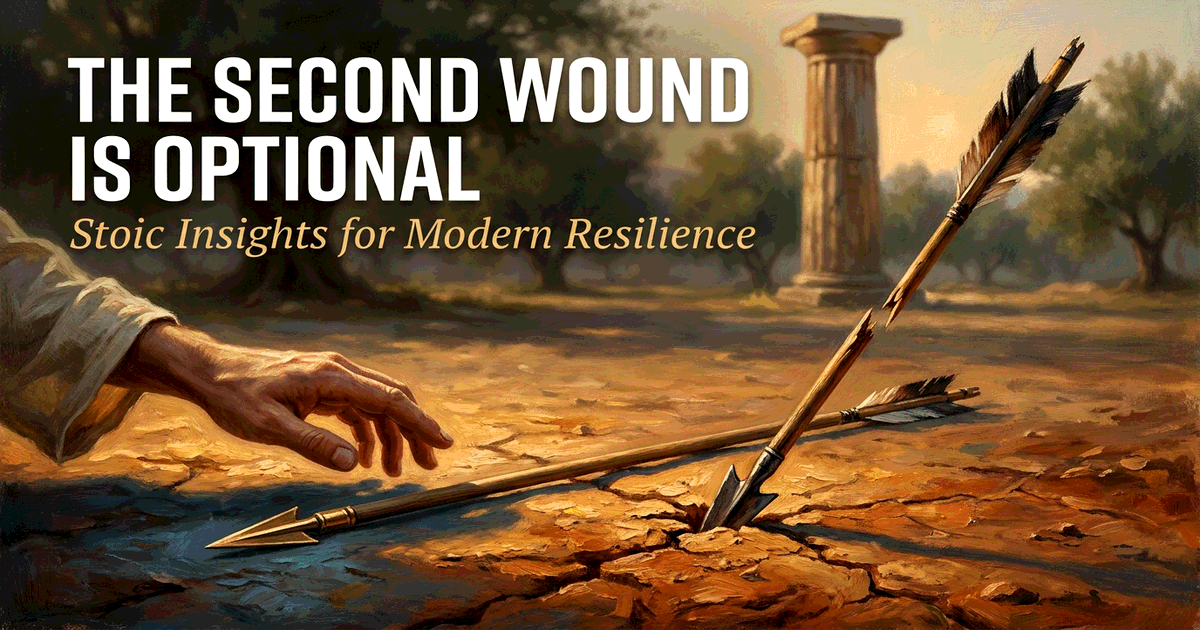
The Fall Was the First Wound. Bitterness Is the One You Choose.
By Derek Neighbors on May 17, 2026
A woman I worked with last year described, in great detail, a betrayal she had experienced at her previous company. The original wound was real. The bitterness she carried into our coaching room, seven years later, was the second arrow she had been firing at herself ever since.
The betrayal was specific. A senior colleague had taken credit for two years of her work, lobbied against her promotion, and then offered her a hollow reference when she finally left. The story she told me was meticulous. She had the dates, the email threads, the room she was sitting in when she realized what had happened.
She told the story with the same exactness three more times across our coaching engagement. Once when we were planning her quarterly priorities. Once when we were preparing for a difficult conversation with her current team. Once when we were celebrating a real win.
The betrayal had happened seven years earlier.
The senior colleague was no longer at the company, no longer in her industry, and as far as she could tell, no longer thinking about her at all. The room where she had been wronged had been remodeled. The emails had been archived in a system she could no longer access. The promotion she had been denied no longer existed as a title at that firm.
The wound was still arriving on schedule, every few weeks, exactly as it had arrived in year one.
The first arrow had been fired by another person. The second arrow had been fired, and refired, and refired, by her.
Why Two People Survive the Same Wound Differently
The same injury arrives at two people. The size is identical. The circumstances are roughly the same. One of them is recognizably more humane five years later. The other has hardened in a way that the original injury did not require.
What separates them is almost never the size of the wound. The wound was the same in both bodies.
What separates them is what each person did with the time afterward.
The first wound is given to you. You do not choose it. It lands on your timeline, your body, your reputation, your relationship, without your consent. No philosophy prevents the first wound.
The second wound is different. The second wound is the one you build, over weeks and months and sometimes decades, in the long aftermath of the first. It is the bitterness you cultivate. The grudge you tend. The story you tell yourself every morning about what was done and how it cannot be forgiven and how the world is therefore one specific shape. The second wound is your authorship.
The first wound may be a professional betrayal of the kind described above. It may also be the betrayal of a parent. The exile of a refugee. The cell of a wrongly imprisoned man. The leg broken by a master who owned a slave. The principle does not care about the size of the wound or the social class of the wounded. It applies equally to the executive holding a seven-year-old grievance against a colleague and to the prisoner of conscience holding a thirty-year-old grievance against a regime. Epictetus, who was that slave with the broken leg, taught this from the inside. Nelson Mandela, who emerged from twenty-seven years on Robben Island without the second arrow installed, demonstrated it across the most public stage of the twentieth century. The discipline is universal because the faculty it requires is universal.
Some readers will be carrying first wounds that have not finished arriving. The principle still holds. You cannot stop the arrow already in flight. You can decline to fire the second one into yourself while the first is still landing. That is harder than refusing the second arrow after the first has closed. It is not different in kind.
The ancients had a name for the gap between the two.
The Stoic Second Arrow: What Marcus, Epictetus, and Seneca Saw
The Buddhists called it the parable of the two arrows. The first arrow is the original injury, fired by circumstance. The second arrow is the one you fire at yourself afterward, the suffering you add to the original suffering by your reaction. Most of the pain in any given human life, the Buddhists observed, is from the second arrow.
The Stoics arrived at the same observation by a different road.
Marcus Aurelius, writing in a private notebook he never intended for publication, repeated some version of this discipline almost every page. The event is one thing. Your judgment about the event is another. Most of what you call suffering is the judgment, layered on top of the event, sometimes weeks after the event has technically ended.
Epictetus put it in sharper terms. He had been born a slave, lived through the cruelty of a master who broke his leg, and emerged with the conviction that there was one thing no master could take from him. He called it prohairesis, the faculty of moral choice. Your body can be imprisoned. Your reputation can be destroyed. Your possessions can be confiscated. prohairesis remains, the irreducible center where you decide what to make of what was done to you.
Seneca, writing letters to a friend, was bluntest of all. The best revenge, he said, is not to be like the person who wronged you. He did not mean a clever rhetorical move. He meant that resentment is a slow agreement to take on the shape of the person you most despise. The grievance, held long enough, makes you a copy of the original injury.
The ancient consensus is not that the first wound was unimportant or imaginary. They knew about war, slavery, exile, public disgrace, betrayal by family. They were not flinching from the reality of the first arrow.
They were locating moral agency precisely in the second.
The first arrow is pathos, the Greek term for something done to you, an experience that arrives without your authorship. The second arrow is prohairesis, something you compose. Character lives entirely in the gap between them.
Why Therapy Culture Confuses Honoring a Wound With Feeding It
A few centuries have done strange work to this distinction.
The therapeutic vocabulary has collapsed the gap between honoring a feeling and feeding it. Honoring is acknowledgment. Feeding is rehearsal. Honoring says, “yes, that happened, yes, it cost me this much.” Feeding says, “and therefore I will reconstruct the moment for an audience every three weeks for the next decade until the reconstruction is the most familiar room in my interior life.”
The modern person has been taught that the difference between these two is a microaggression to mention. To suggest that a grievance can lose volume over time is heard as an attack on the legitimacy of the original wound. So the wound keeps full volume, indefinitely, and the person spends the rest of their life inside it. This is adjacent to, but not identical with, the work of forgiveness, which is a different and more loaded operation. Refusing the second arrow does not require forgiving anyone. It requires only declining to keep firing.
Bitterness gets confused with awareness. The person who keeps the grievance loud is praised for being clear-eyed; the person who sets it down gets accused of bypassing, of premature forgiveness, of letting the wrongdoer off the hook. The cultural script rewards holding. It punishes setting down. Social media accelerates the asymmetry: visible bitterness performs well, and the performance becomes the wound’s continued life.
Most modern adults walk around carrying decade-old grievances they have rehearsed so many times the rehearsal is now the wound. The original event closed long ago. The reconstruction is what they live inside.
The first wound takes minutes. The second wound takes years. Most of the suffering in adults you respect is from the second.
What Refusing Bitterness Actually Means
The optional epilogue is the part of any injury story you write after the event itself has closed.
Worth defining the term before going further. Bitterness, in the sense the article uses it, is not a momentary anger at being wronged. That first reaction is a pathos, an involuntary surge that arrives uninvited and largely unbidden. Bitterness is what that pathos becomes when it has been rehearsed long enough to settle into a hexis, a disposition the person carries forward as second nature. The first is felt. The second is built. Aristotle, who catalogued these things in Nicomachean Ethics IV.5, named the contrary disposition praotes, mildness. Mildness in this sense is not numbness or weakness. It is a settled freedom from disproportionate response. The work of this article is the slow construction of praotes on the ruins of bitterness.
The event happened. The cost was real. The other person made choices. None of that is up for renegotiation. The epilogue, however, is yours.
You can write an epilogue in which you spend the next ten years pointing at the event and asking everyone who will listen to confirm that the event was as bad as you experienced it to be. You can write an epilogue in which the event becomes your central explanation for every subsequent setback. You can write an epilogue in which the person who wronged you becomes the unpaid tenant of your interior life, the one who gets to set the temperature in the room you live in years after they last saw you.
Or you can write an epilogue in which the event was real, the cost was paid, and your remaining time, finite and shrinking, will not be spent reconstructing it.
The Stoic discipline that lives in this gap is apatheia, which the moderns have badly mistranslated as numbness. It does not mean not feeling. It means not allowing the first feeling to install a second one of your own construction. The first arrow is felt fully. The second arrow is refused.
The capacity to refuse is reason itself, which the ancients understood as the soul’s own nature. But reason is not a tool you find on demand in the moment of injury. It is a paideia, a formation that has to be cultivated through training before it can be drawn on under pressure. The adults who refuse the second arrow without obvious effort have usually been training for it, in small ways, for years. The capacity is universal. The fluency is earned.
The refusal is not a single heroic act. It is a hexis, a settled disposition built by ten thousand small repetitions of the same refusal. Each time you notice yourself reaching for the grievance and choosing not to pick it up, you make a deposit on the side of the ledger where character lives. Each time you tell the old story to a new person, in a tone that asks them to confirm the verdict, you make a deposit on the other side.
The unfair part is that the deposits are not symmetric. Telling the story takes a few minutes and gives an immediate emotional return. Refusing to tell the story takes the same minutes and gives nothing back today, and very little tomorrow, and a slowly compounding return over months that you will not feel until you suddenly notice, years later, that the grievance no longer runs your interior weather. The work belongs to the same family as the broader discipline that life was never fair and you stopped asking it to be. You are not waiting for the universe to balance the books. You are choosing to stop adding entries to the wrong side of the ledger.
Most adults will not run the work, because the return is too far away and the comfort of the rehearsal is too immediate. The ones who do run it, quietly, over years, become the people the rest of us recognize as somehow lighter than the weight they have carried.
How to Stop Carrying an Old Grievance: Four Moves
The first move is naming the two arrows for a specific grievance.
Pick one. The one that surfaced when you read the opening of this article. Write down, precisely, what was done to you. Be exact. Dates if you have them. Names. The specific words, the specific actions, the specific consequences. That list is the first arrow. It belongs to the person who fired it.
Then write a second list. What have you done with the first list since? How many times have you told the story? In what rooms? To what audiences? How many times have you replayed it privately, in the shower, on a walk, in the moments before sleep? How many decisions have you routed through the lens of this event? How many possibilities have you closed off because that wound is what closed them?
The second list, for most adults, is shockingly longer than the first. The shock is the diagnostic. The wound was a real event. The second arrow has been a daily practice.
The second move is the small daily refusal. The character muscle that eventually refuses the large grievance is, in my coaching experience, the same one that refuses the small ones. The transfer is not automatic, and the largest grievances often require additional scaffolding (a therapist, a longer practice, sometimes a community). The observed pattern is that adults who never built the muscle on small slights almost never summon it on the large ones. The reverse is sometimes possible but rare. You build the muscle on the colleague who took credit for the side project, the merchant who shorted you, the relative who forgot the birthday, the driver who cut you off. Each of these is a tiny invitation to fire the second arrow. Each is a tiny opportunity to notice the invitation, decline it, and move forward without the grievance attached.
You will fail at this regularly. The point is not perfection. The point is the noticing. Noticing the invitation to bitterness is the first action you have available. Declining it sometimes is the second. Declining it more often is the third. The slope of the muscle’s growth is gentle and unspectacular, which is why most people abandon the practice before the slope becomes visible.
The third move is the witness exercise. Sit with the version of yourself you would have become if the wound had not landed. Not the fantasy version where everything went right. The version of you who would have continued growing into a life undamaged by this specific event. That person is a real possibility somewhere in the design space. Get a clear picture.
Then ask yourself what would be required, starting today, to keep that person available to you. Not to pretend the wound did not happen. To refuse the further wound that prevents the undamaged version from ever showing up again.
The fourth move is the refusal of the narrative. Stop telling the story to people who do not need to hear it. Most rehearsals of a grievance are not for the listener. They are for the speaker, who needs the listener’s face to confirm the verdict. Each rehearsal deepens the groove. The groove is what makes the second arrow feel inevitable instead of optional.
There are conversations in which the story belongs. With a therapist trained to help you metabolize it. With a friend who has earned the privilege of seeing the full weight. With yourself, on paper, in disciplined writing rather than circular replay. Most of the rehearsals are none of those. Most are casual reauthoring, in social contexts, to maintain the wound’s hold over your interior.
Frequently Asked Questions
What is the Stoic second arrow concept?
The second arrow is the suffering you add to an injury by your reaction to it. The first arrow is the original wound, an event that happened to you. The second arrow is your response over the hours, days, and years that follow, especially the bitterness or resentment you build around the original event. The Stoics and the Buddhists both observed that most lasting suffering comes from the second arrow, which is the only arrow over which you have any real authorship. The doctrine does not deny the reality of the first wound. It locates moral agency precisely in what you do with what was done to you.
Is refusing bitterness the same as denying the injury?
No. Refusing bitterness is the opposite of denial. Denial pretends the first wound did not land. Refusing bitterness names the first wound with full clarity, then declines to author a second wound on top of it. The Stoic discipline begins with accurate description of what happened, including the cost. The discipline ends with a refusal to install permanent residence inside that injury. You can grieve, name, hold accountable, and still refuse to let the wound become the room you live in for the rest of your life.
How do you stop carrying old grievances?
Start by naming both arrows for a specific grievance. Write down precisely what was done to you (the first arrow) and exactly what you have been doing with it for the months or years since (the second arrow). The second list is almost always longer than the first, which is the diagnostic. Then practice small daily refusals on small slights, the colleague who took credit, the merchant who shorted you, the friend who forgot. The discipline transfers upward. The character muscle for refusing the small second arrow is the same one that eventually refuses the large one. Most people try to refuse the large grievance first and fail, because they never built the muscle on the small ones.
What is the Greek concept of prohairesis?
Prohairesis is the Stoic term for the faculty of moral choice, the human capacity to decide how to respond to whatever happens. Epictetus argued that prohairesis is the only domain genuinely in your control. Your body can be imprisoned. Your reputation can be destroyed. Your possessions can be taken. The faculty of choice cannot, unless you surrender it. Bitterness is one of the few injuries that requires your own active prohairesis to install. The first arrow takes nothing from prohairesis. The second arrow is prohairesis turned against itself.
Final Thoughts
Falls are not optional. Falls come for everyone. The size and shape will differ, but no one gets to opt out of the first arrow. There is no philosophy and no practice that will prevent it.
Bitterness is optional. It is one of the few injuries you actively sign for, and the most reliably so. It is a wound where you are both the archer and the target. The doctrine that this is a hard thing to refuse is correct. The doctrine that it is impossible to refuse is a lie convenient to the part of you that does not want to do the work.
The character you are becoming is being authored, right now, in your handling of the wounds you already carry. Not in the moment the wound arrived. In the months and years after, where almost no one is watching, and where the second arrow is either being fired or being set down.
The fall was something done to you. The epilogue is something you write. The Stoics observed, two thousand years ago, that the second is the only domain where moral agency lives, because it is the only domain that is genuinely yours.
The work is small, uncomfortable, and free. It is also the only work that distinguishes the person who was broken by the fall from the person who refused to be defined by it.
If you are tired of carrying second arrows that were never required and ready to do the slow, unspectacular work of dismantling them, that is part of what we practice at MasteryLab.co. Character on the far side of injury is not a feature of personality. It is the result of a discipline most adults never get taught to run.