Good Intentions Are Why Most Dreams Die
By Derek Neighbors on December 6, 2025
I’ve run nearly every day for ten years.
I’ve built the fitness to run an ultramarathon multiple times over. I’ve trained through winters, through injuries, through the kind of consistency that makes people assume I must be serious about this. I told myself I was going to run an ultra. Someday. When the timing was right. When I found the right race.
For years, I never signed up. Never committed. Never showed up to a starting line.
I had the capability. I had the intention. I had everything except the one thing that actually matters: the entry form with my name on it.
This year, something shifted. I signed up for three 26Ks and a 50K. I’ve already finished one of them. No more waiting for the right moment. No more intending to do the thing I’ve been capable of doing for years.
No more good intentions.
The difference between the runner who dreams about ultras and the runner who finishes them isn’t fitness. It’s not talent or time or support. It’s the willingness to stop intending and start committing.
My example is ultramarathons. Yours might be something else entirely. The principle doesn’t care about your circumstances. Viktor Frankl watched fellow prisoners in Auschwitz divide into two groups: those who found something to do each day, however small, and those who waited for conditions to improve. The first group survived at higher rates. Not because action changed their circumstances. Because action changed them. Conditions don’t improve. You act or you don’t.
The Comfortable Lie We All Believe
Everyone believes good intentions matter. We celebrate them. “At least their heart was in the right place.” We forgive ourselves for failed outcomes because we meant well. Entire relationships survive on the premise that intention counts for something.
The logic seems obvious. Caring about a dream is the first step toward building it. Wanting something is how you start. Planning and preparing and intending are all just early phases of the same process.
Except they’re not.
The ancient Greeks made a distinction we’ve lost. They separated praxis (action) from logos (speech, thought, intention). Aristotle understood that virtue isn’t what you say or believe. It’s what you consistently do. Character isn’t formed by wanting to be courageous. It’s formed by repeatedly acting with courage until it becomes who you are.
We’ve collapsed this distinction. We treat intention and action as points on the same spectrum. We assume that strong enough wanting eventually becomes doing. But intention and action aren’t different degrees of the same thing. They’re different things entirely.
And intention, left alone, doesn’t grow into action. This is akrasia at its most seductive: you know what to do and still choose not to do it.
It replaces it.
How Good Intentions Kill Dreams
Here’s what nobody tells you about announcing a goal: the announcement itself triggers a reward response. Your brain registers the commitment as partial completion. You feel good. You feel like you’ve started something.
You haven’t.
I’ve watched this pattern play out hundreds of times. Public commitment to a goal often reduces follow-through rather than increasing it. The satisfaction of declaring your intention provides just enough psychological reward to make the actual effort feel optional.
This isn’t weakness. It’s mechanism. Your brain evolved to conserve energy. If it can get the feeling of achievement without the cost of effort, it will take that deal every time.
But you’re not just a brain. What separates humans from other animals is the capacity to reason about what’s worth doing and then choose it anyway. The mechanism pulls toward comfort. Reason can override the mechanism. That’s not willpower. That’s the distinctly human ability to see what’s good and act on it even when the easier path is available.
Good intentions kill dreams through four specific mechanisms:
The satisfaction loop. Announcing triggers reward. The reward reduces urgency. Reduced urgency delays action. Delayed action never catches up.
The identity shortcut. “I’m the kind of person who writes” feels almost as good as actually writing. The identity claim becomes a substitute for the identity-forming behavior.
The effort exemption. Intentions feel like they should count for something. When you’ve been thinking about, planning for, and caring about a goal, starting to feel like you’ve already put in work. You haven’t.
The perpetual delay. Your backup plan is why your main plan keeps failing. “I’ll start when…” becomes the permanent state. When the conditions are right. When you have more time. When you feel ready. The intention stays pure while the action never materializes.
Dreams Have Engineering Requirements
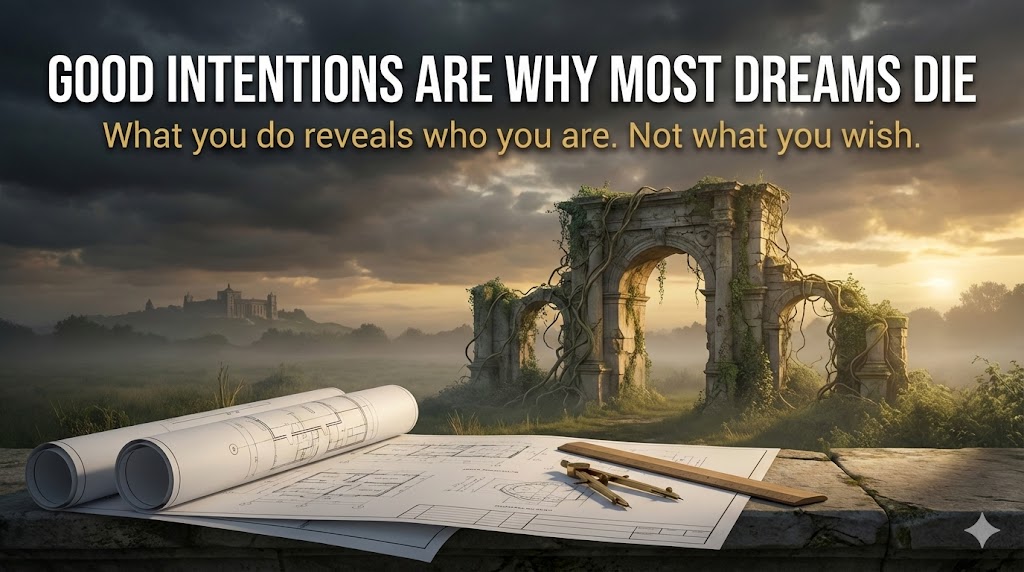
A bridge that collapses kills everyone regardless of how well-intentioned the engineer was. The laws of physics don’t accept sincerity as a load-bearing material.
Dreams work the same way.
Aristotle introduced the concept of ergon, the proper function of a thing. A knife’s ergon is to cut. An eye’s ergon is to see. The ergon of a dream is to be built.
When you substitute intention for engineering, you abandon the proper function entirely. You’re not building the dream. You’re just thinking fondly about it.
Dreams require daily action, not daily intention. They require systematic breakdown into concrete steps, not vague commitment to eventual progress. They require measurement of actual movement, not feeling of effort. They require adjustment based on what’s working and what isn’t, not adjustment of expectations to match your lack of progress.
This isn’t optional. Aristotle argued that the ergon of a human being is to actualize our rational and practical capacities. We don’t just benefit from action. We owe it. Choosing intention over action isn’t a preference. It’s a failure to become what we’re capable of becoming.
The people who actually build things have a different relationship with their goals. They spend almost no time on intention and almost all time on execution. They don’t need motivation because they’ve engineered systems that run whether they feel like it or not.
They’ve stopped hoping. They’ve embraced the boring truth about excellence.
They’ve started building.
Holding Both Truths
Intentions set direction. That’s all they’re for. You need to know what you’re building before you can build it. The problem isn’t having intentions. The problem is stopping there.
Direction without movement is just pointing at a destination while standing still.
The integration looks like this: intention sets the target. Engineering builds the path. Daily action walks the path. Character is forged in the gap between knowing what you want and actually doing something about it.
The common pattern is getting the ratio backwards. Enormous energy on intention, clarity, planning, and vision. Minimal energy on execution. Invert it. Almost all of your effort should go to engineering, almost none to intention.
Once you know what you want, the only remaining question is: what will you do today?
Not what will you plan. Not what will you consider. Not what will you research or prepare for or think about.
What will you do?
The Engineering Questions
The people who build things that matter have a different set of questions running in their heads.
What’s the smallest step I can take today? Not the biggest step. Not the most impressive step. The smallest. The one that requires so little that you can’t talk yourself out of it.
What would I need to do every day to make this inevitable? Dreams that depend on heroic effort eventually fail. Dreams that depend on consistent small effort eventually succeed. What’s the daily behavior that, compounded over time, makes your goal unavoidable? Build habits for your worst day, not your best.
What metric would tell me I’m actually moving? Not feeling like you’re making progress. Measuring it. Something you can look at that either went up or didn’t.
What’s the first thing that will fail, and how will I handle it? Everything breaks. Plans never survive contact with reality. The question isn’t whether you’ll hit obstacles. It’s whether you’ve engineered a response to them in advance.
These questions pull you out of the comfortable fog of intention and into the uncomfortable clarity of action. They force you to translate hoping into engineering.
When the Work Becomes Identity
At the mastery level, something shifts. The daily practice becomes identity. You don’t intend to be a writer. You write. You don’t intend to be disciplined. You do the work whether you feel like it or not.
The Greeks called this hexis, a stable disposition formed through repeated action. You don’t become a writer by intending to write. You become a writer by writing daily until the question of whether you’ll write today stops being a question at all.
The shift sounds like this:
From “I want to” to “I do.” From “I plan to” to “I’m building.” From “Someday I’ll” to “Today I’m.” From “I’m passionate about” to “I show up for.”
At this level, you stop needing intentions at all. The work has become identity. The engineering has become invisible because it’s now just how you operate. You don’t announce projects. You don’t need accountability partners. You don’t require motivation.
You just show up and build until one day people notice what you’ve created.
The Only Honest Measure
Look at the last 90 days of your life. Not what you intended. Not what you planned. Not what you felt passionate about or cared deeply about or meant to do.
What you actually did.
That’s the only honest measure of who you are and what you’re building. Your calendar shows your real priorities. Your bank statement shows your real values. Your output shows your real commitment.
Everything else is story.
Final Thoughts
Pick one dream you’ve been intending to pursue. Not the easiest one. The one that actually matters. The one you’ve been “working on” for months or years without much to show for it.
Now answer one question: what specific action will you take in the next 24 hours?
Not research. Not planning. Not thinking about it. A concrete, measurable action that moves you one step closer.
If you can’t answer that question, you don’t have a dream. You have a fantasy. And fantasies don’t need engineering. They just need your continued intention.
Your dreams don’t care about your intentions. They don’t care about your potential, your vision, or your passion. They only respond to one thing: what you actually build.
The gap between who you are and who you want to become isn’t bridged by intention. It’s bridged by what you do today, because finishing matters more than starting. And tomorrow. And the day after that.
Good intentions are why most dreams die.
But they’re also the last excuse you’ll need to release before you can finally start building.
Intentions don’t build anything. Neither does reading articles about it. MasteryLab is where people who are done talking finally start building.