Hubris vs Akrasia: Key Differences in Greek Philosophy
Both hubris and akrasia lead to self-destruction, but they arrive there from opposite directions, and mistaking one for the other guarantees you will choose the wrong corrective. Hubris is the arrogance of overreach. It is the act of transgressing limits that you know exist, driven by an inflated sense of your own power, status, or exemption from the rules that govern others. The person with hubris sees the boundary and crosses it deliberately. They know the limit and believe it does not apply to them. In the tragic tradition, hubris is the defining error of the hero who destroys himself by refusing to accept what the gods and fate have established as the boundaries of human action. Akrasia is the failure of will. It is the experience of knowing what you should do, understanding why it matters, and failing to do it anyway. The person with akrasia does not defy limits out of arrogance. They cannot summon the resolve to act on what they know to be right. Socrates found akrasia so puzzling that he initially denied its existence, arguing that no one who truly knows the good could fail to pursue it. Aristotle disagreed, recognizing that the human capacity for knowing better while doing worse is real and pervasive. The internal experience of these two conditions could not be more different. Hubris feels like power. The person in the grip of hubris is confident, energized, and certain of their own superiority. They are not struggling with themselves. They are asserting themselves against external constraints that they believe are beneath them. Akrasia feels like weakness. The person in the grip of akrasia is conflicted, frustrated, and disappointed in themselves. They are struggling with themselves, watching their own failure unfold in real time, unable to close the gap between intention and action. The reason this distinction matters practically is that the corrective for each condition is the opposite of what the other requires. Hubris needs humility: the recognition that you are not exempt from the limits that apply to everyone else, that your power has boundaries, and that exceeding those boundaries carries consequences you cannot escape. Akrasia needs strengthened resolve: the development of prohairesis (moral purpose) and the kind of character training that closes the gap between knowing and doing. If you apply the wrong corrective, you make the problem worse. Teaching humility to the person with akrasia reinforces their sense of inadequacy when what they need is the confidence to act on their convictions. Teaching assertiveness to the person with hubris amplifies their already excessive confidence when what they need is the discipline to recognize their limits. The first step in addressing either pattern is diagnosis. When you fail, ask which failure you are experiencing. Did you overshoot because you believed the rules did not apply to you? That is hubris. Did you fall short because you could not summon the will to act on what you knew? That is akrasia. The answer determines everything that follows.
Definitions
Hubris
(ὕβρις)
HOO-bris
Excessive pride or arrogance that leads one to transgress natural or divine limits, often resulting in downfall. In Greek thought, hubris represented the dangerous overstepping of human boundaries—the fatal assumption that one is beyond the constraints that govern mortal life.
Akrasia
(ἀκρασία)
ah-KRAH-see-ah
Weakness of will—acting against your own better judgment. For Aristotle, akrasia occurs when you know what is good but fail to do it, overcome by passion, appetite, or momentary impulse.
Key Differences
| Aspect | Hubris | Akrasia |
|---|---|---|
| Relationship to Knowledge | Hubris involves knowing the limits and choosing to defy them. The person with hubris is not ignorant. They see the boundary and deliberately transgress it. | Akrasia involves knowing the right action and failing to perform it. The person with akrasia is not confused about what they should do. They cannot close the gap between knowledge and action. |
| Emotional State | Hubris is characterized by inflated confidence, a sense of exemption from ordinary limits, and the energy that comes from asserting superiority. | Akrasia is characterized by internal conflict, self-disappointment, and the frustration of watching yourself fail to do what you know you should. |
| Philosophical Tradition | Hubris belongs primarily to the tragic and religious traditions. Greek tragedy depicts hubris as the defining error that brings divine punishment (*nemesis*) upon the overreaching hero. | Akrasia belongs to the Socratic-Aristotelian ethical tradition. Socrates questioned whether it exists. Aristotle analyzed its mechanisms in Nicomachean Ethics Book VII. |
| Direction of Error | Hubris is overreach, exceeding beyond what is appropriate, claiming more than you deserve, or acting as though limits do not apply to you. | Akrasia is collapse below your own standards, falling short of what you know to be right, failing to live up to your own understanding. |
| Remedy | Hubris requires humility and the recognition of limits. The corrective is learning to see the boundaries you have been ignoring and accepting that they apply to you as much as to anyone. | Akrasia requires strengthened resolve and the development of prohairesis (moral purpose). The corrective is building the capacity to act on your knowledge through practice and disciplined training. |
Relationship to Knowledge
Hubris involves knowing the limits and choosing to defy them. The person with hubris is not ignorant. They see the boundary and deliberately transgress it.
Akrasia involves knowing the right action and failing to perform it. The person with akrasia is not confused about what they should do. They cannot close the gap between knowledge and action.
Emotional State
Hubris is characterized by inflated confidence, a sense of exemption from ordinary limits, and the energy that comes from asserting superiority.
Akrasia is characterized by internal conflict, self-disappointment, and the frustration of watching yourself fail to do what you know you should.
Philosophical Tradition
Hubris belongs primarily to the tragic and religious traditions. Greek tragedy depicts hubris as the defining error that brings divine punishment (*nemesis*) upon the overreaching hero.
Akrasia belongs to the Socratic-Aristotelian ethical tradition. Socrates questioned whether it exists. Aristotle analyzed its mechanisms in Nicomachean Ethics Book VII.
Direction of Error
Hubris is overreach, exceeding beyond what is appropriate, claiming more than you deserve, or acting as though limits do not apply to you.
Akrasia is collapse below your own standards, falling short of what you know to be right, failing to live up to your own understanding.
Remedy
Hubris requires humility and the recognition of limits. The corrective is learning to see the boundaries you have been ignoring and accepting that they apply to you as much as to anyone.
Akrasia requires strengthened resolve and the development of prohairesis (moral purpose). The corrective is building the capacity to act on your knowledge through practice and disciplined training.
When to Apply Each Concept
When to Choose Hubris
Recognize hubris when you find yourself believing that ordinary constraints do not apply to you, when success has made you feel invulnerable, or when you are tempted to take what is not yours because you feel entitled to it. The question hubris demands is: am I overestimating my position relative to the limits that actually bind me?
When to Choose Akrasia
Recognize akrasia when you find yourself failing to act on convictions you genuinely hold, when the gap between your intentions and your actions keeps widening, or when you repeatedly choose the easier path while knowing it is the wrong one. The question akrasia demands is: what is preventing me from doing what I already know I should?
Frequently Asked Questions
What is the difference between hubris and akrasia?
Hubris is arrogant overreach, the deliberate transgression of known limits driven by an inflated sense of one's own power or exemption. Akrasia is weakness of will, the failure to act on what you know to be right despite understanding its importance. Hubris exceeds boundaries. Akrasia fails to meet standards. Both produce destructive outcomes, but the internal experience and the appropriate correctives differ fundamentally.
Hubris vs akrasia in Greek philosophy?
Hubris comes from the Greek tragic tradition, where it names the fatal arrogance that leads heroes to defy gods and fate, bringing nemesis upon themselves. Akrasia comes from the Socratic-Aristotelian ethical tradition, where it names the puzzling human capacity to know the good and fail to pursue it. Hubris was a religious and social offense. Akrasia was an ethical and psychological problem. Both describe failures that destroy individuals, but from opposite starting points.
Is hubris the same as akrasia?
No. Hubris and akrasia describe opposite patterns of failure. The person with hubris has excess confidence and exceeds their limits. The person with akrasia has insufficient will and falls below their standards. Hubris says, 'The rules do not apply to me.' Akrasia says, 'I know the rules but cannot follow them.' Confusing the two leads to applying the wrong corrective, which worsens the original problem.
How do you tell the difference between arrogance and weakness of will?
Examine the direction of the failure and the emotional state that accompanies it. Arrogance (hubris) feels powerful: you exceed limits because you believe you are above them. Weakness of will (akrasia) feels conflicted: you fall short because you cannot summon the resolve to act on your knowledge. If your failure involved taking too much, asserting too aggressively, or ignoring limits, it is likely hubris. If it involved failing to act, not following through, or choosing the easier path against your better judgment, it is likely akrasia.
Articles Exploring Hubris or Akrasia (22)
Make Someone Untouchable and the Failure Is Already Yours
A founding architect nobody was allowed to question. A senior engineer who questioned him once and got moved. Two years of pull requests with zero comments that everyone called quality. Then the migration that took the platform down, with a root cause that had been raised in the one review that got silenced. Athens ran the same story with Alcibiades in 415 BC and lost a fleet. The moment an organization decides someone is beyond reproach, the failure that follows belongs to everyone who agreed, and there is an old Greek word for the thing they got backwards.
Act Like a King and You Start Needing the Bow
Law 34 of the 48 Laws of Power tells you to act like a king so the room treats you like one. The tactical truth is real. Rooms copy how you price yourself, and cheap familiarity can collapse the work. The character cost arrives when bearing becomes a standing request for deference. You start needing the bow. The ARETE alternative still holds a standard for how you are treated, then roots that standard in inner sufficiency instead of a court.
Stop Treating Yourself Like an Enemy You Have to Defeat
A rest day sat on the plan and I snuck a session anyway. Sitting still felt like losing the person I was becoming. I was occupying a part of myself that had a job: recover.
The Big Guy Breaks When You Refuse to Stay Down
Position feels like invincibility until someone smaller keeps standing after every punch. The damage is not only physical. It lands in the story the big guy told about being untouchable. If you are on top, keep training the grit that got you there. If you are behind, make refusal your strategy.

Your Standards Didn't Slip. You Stopped Measuring.
After the win you stopped looking at the bar, kept a fluent story about why, and called the soft week strategy. Rewards end. Standards renew. Measuring is the difference.
Hard Times Build Character. Easy Times Expose It.
Training virtue for hard times is the easy half. The real exam starts when constraints fall away and the only person who can stop you is you. Hard times build the muscle. Easy times tell you what the muscle was for.

What You Sacrifice First Is What You Actually Love
Most people believe they hold their values in balance: family, work, health, growth, all weighted more or less equally. Plato argued that nobody actually lives this way. Every soul is ordered by a single ruling love, and everything else gets ranked beneath it. The proof is not in what you claim to value. The proof is in what you sacrifice first when two of your loves collide, because the thing you protect last is the thing you actually love.
You're Asking Fear the Wrong Question.
There is a decision you have been circling for months. Two voices are arguing about it in your head. Voice one is fear, and fear's question sounds adult and responsible: will this be worth what it costs? Voice two is regret, and regret only asks one question, the one fear refuses to ask. The Stoic tradition built an entire decision discipline around the fact that human beings systematically ask the wrong question at the moment a choice is live. Epictetus had a name for the place where this gets decided. The Greeks called it the only domain that actually matters.
Knowing Better Doesn't Make You Better. Most Self-Help Stops at Step One.
The reader who has read seventy books on character is roughly the person they were five years ago. The gap is not a willpower failure. The gap is a method failure. Epictetus described the three-stage path that produces formed character, and the modern self-improvement industry has built a market by pretending the last two stages are optional.

Stop Buying Productivity Apps. Your Disorganization Is a Character Problem.
Most adults have a folder of dead productivity apps and a quiet sense that they are uniquely undisciplined. They are not. They have run a ten-thousand-iteration experiment in which they said they would do something and then did not. The fix is not a better system. It is the ancient discipline of pistis, faithfulness to your own word, rebuilt one small kept promise at a time.

You Knew It Was Over Years Ago. You Just Couldn't Say It Out Loud.
The truth shows up in a thirty-second moment with no audience. Most people register it, file it, and spend the next five years pretending they didn't. The years of pretending are the actual cost.
If You Can't Be Alone, You'll Never Be Free
Most people skip the foundation and wonder why their freedom feels so hollow. Schopenhauer named the prerequisite. The Greeks named the practice. You have been arranging your life to avoid both.
If You Need to Destroy Your Enemies, You Were Never Really Winning
Greene says leave nothing to chance and annihilate your opponent completely. But total destruction requires total obsession with another person's existence. The Greeks called this failure of character, not strength. Megalopsychia, greatness of soul, means your purpose is too large for any single enemy to define.
Your Team Doesn't Tease You. That Should Terrify You.
The capacity to receive what you give is the mark of integrated character. Leaders who dish out sharp feedback but bristle when it comes back their way reveal something they would rather not face: their strength was a performance all along.

Build Habits for Your Worst Day, Not Your Best
You've been designing habits for the version of you that exists after good sleep, full of motivation, in ideal conditions. That version shows up maybe 20% of the time. Here's how to build for the other 80%.

Your Life Right Now Is Just Your Last 90 Days Playing Out
Your fitness, your bank account, your relationships, your opportunities right now aren't revealing your identity. They're showing you what you've been doing for the past 30-90 days. That's not philosophy. That's physics.

Stop Counting Other People's Money: It's Making You Poor
Every moment you spend obsessing over others' achievements is a moment not creating your own. Envy doesn't just feel bad, it actively steals the fuel you need for your own work.

Akrasia: Why You Sabotage What You Know Is Right
You know exactly what you should do. You've known for months. So why aren't you doing it? The ancient Greeks had a word for this: akrasia, acting against your better judgment. And they understood it's the ultimate killer of excellence.
The Discipline Gateway: Why Real Freedom Costs More, Not Less
The brutal truth about freedom: it's not the absence of constraints, it's the wisdom to choose the right ones.
AI-First Leadership: Guiding Organizational Transformation
Most leaders want AI transformation results without undergoing the leadership metamorphosis it requires. Here's what AI-first leadership actually demands.

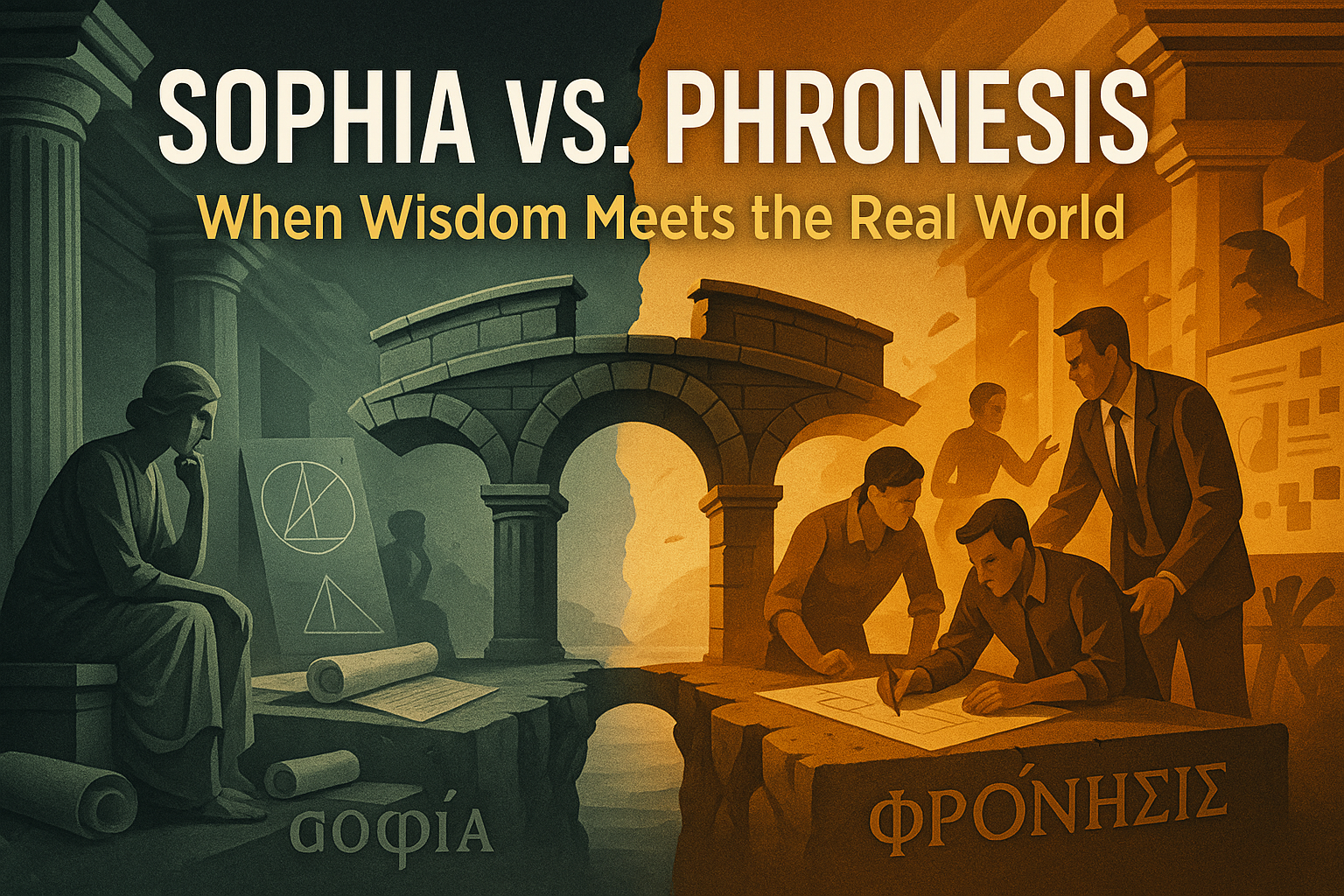
Sophia vs. Phronesis: When Wisdom Meets the Real World
Why brilliant strategies fail and how ancient Greek wisdom provides the solution through integrating theoretical and practical wisdom.
The Skinner's Law Productivity Revolution: Hacking Motivation Through Pain and Pleasure
Discover how B.F. Skinner's revolutionary insights into pain and pleasure can engineer unstoppable motivation. Learn the five-method framework that turns behavioral psychology into practical productivity mastery.