Stop Buying Productivity Apps. Your Disorganization Is a Character Problem.
By Derek Neighbors on May 16, 2026
Open your phone. Find the folder where you have been collecting productivity apps over the years.
Notion you used for three weeks. Obsidian you set up over a weekend and never touched. Todoist with seventeen overdue tasks from 2024. Things with three half-built projects. The bullet journal in the drawer with eleven pages filled. The leather planner that cost ninety dollars and stopped at January.
That folder is not a tooling history. It is a record of a relationship you have with your own word.
The Lie The Industry Sells
The pitch is always the same. The reason you cannot stay organized is friction. Friction in the wrong tool. Friction in the wrong method. Remove the friction and the work will flow. Buy this app, this course, this template, this notebook. You will be free.
This is convenient because it diagnoses the problem outside you, where you cannot be embarrassed by it, and locates the cure in something you can purchase. Both moves serve the seller. The cycle is durable. You will be back next year with the same problem, slightly older, slightly more cynical, slightly more convinced that you are uniquely undisciplined.
You are not. You are undisciplined in a specific way the productivity industry refuses to name, because naming it would end the business.
The tools themselves are adiaphora, indifferent. They are not the obstacle and they are not the cure. The obligation runs through you regardless of what is in your hand. A person with no phone and no app owes the same fidelity to their own word as a founder with seventeen integrated dashboards.
The Real Diagnosis: Disorganization Is a Character Problem
You have run a ten-thousand-iteration experiment on yourself in which you said you would do something and then did not.
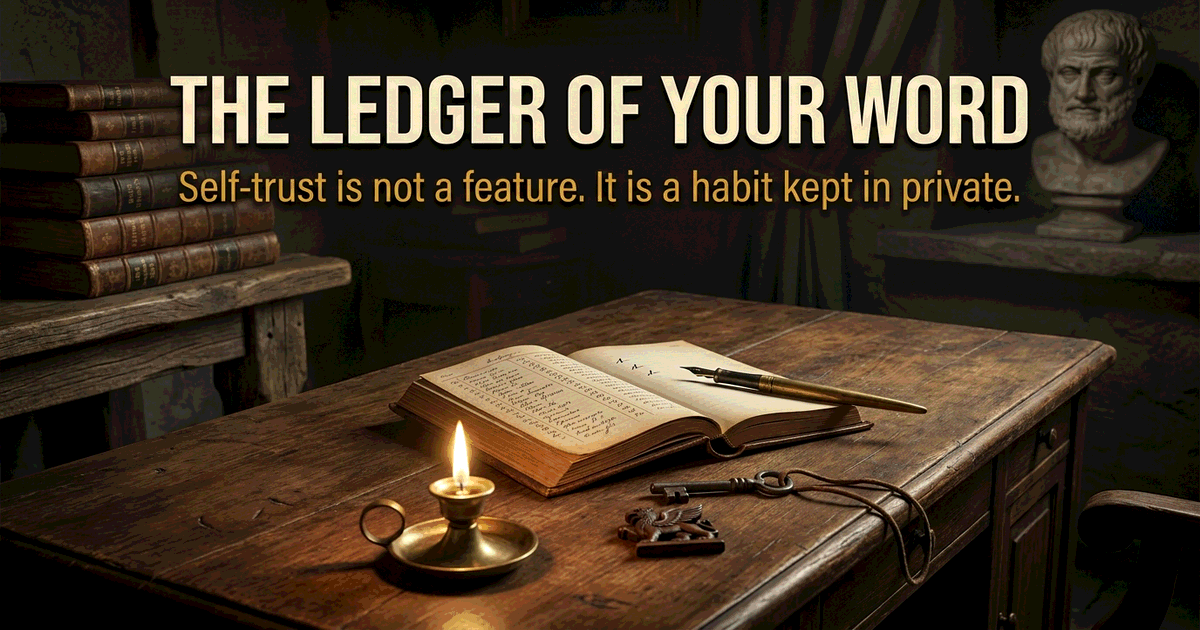
It started small. “I will work out tomorrow morning.” “I will respond to that email after lunch.” “I will study at eight tonight.” “I will call my mother on Sunday.” “I will save fifty dollars before payday.” “I will quit the habit on the first of the month.” Each time, your nervous system filed an entry in a quiet ledger. The ledger is a metaphor, but the data it records is not. The ledger does not record what you said. It records what you actually did in the hours after you said it. None of those promises requires an app or a tool. They are the broken word of a slave, an executive, a student, a parent, a soldier, anyone with the rational capacity to make a small commitment and the freedom to keep it or not.
After enough iterations, the ledger reaches a verdict. The verdict is that this person’s word, when spoken to themselves, is not load-bearing. Whatever they declare at 9 a.m. on Sunday for the coming week is a hope, not a contract. Whatever appears on the to-do list is a wish list. Whatever they plan for tomorrow morning is fiction unless someone external is also expecting it.
That verdict is the ancient condition the Greeks called akrasia, weakness of will, the gap between what you intend and what you do when no one is watching. The Greeks did not treat akrasia as a system issue. They treated it as a character condition with a specific cure.
Pistis: The Word Behind Every System
In classical Greek, pistis meant faithfulness, trustworthiness, the quality of a person whose word could carry weight. The Romans called it fides. Both cultures understood that pistis was the substrate every other virtue rested on, because without it your commitments to courage, justice, or wisdom were performances you put on for an audience.
The word was used most often for trust between persons. Aristotle used it in the Rhetoric for the credibility a speaker offers an audience. Plato listed it among the cognitive states on the divided line. I am extending it here to the relationship every other trust derives from, the relationship a person has with themselves. The argument is that you cannot maintain pistis with anyone else, in any direction, while you are quietly running a deficit with yourself.
Aristotle observed that virtue is not an act but a hexis, a settled disposition produced by ten thousand small repetitions. The relationship between pistis and hexis is that the second produces the first. hexis is the formed pattern, built by reps. pistis is the trust the pattern earns from itself, arriving slowly as a downstream consequence. You do not become trustworthy to yourself in one heroic gesture. You become trustworthy by keeping one small promise in a dark moment when nobody is watching, and then another, and then another, until your nervous system has new data to revise the ledger.
Most adults have spent years adding entries on the wrong side. By the time you arrive at any productivity method, the foundation is already rotted. The method asks you to make a plan and execute it. You make the plan. You do not execute it. The system fails. You blame the system.
The system did not fail. It worked exactly as designed for someone who already had pistis. The user showed up without the prerequisite.
I have written before about the cost side of this dynamic in The Integrity Loop, where the destruction of confidence is the downstream consequence of broken self-promises. The productivity angle is the upstream version of the same problem. The same broken-promise mechanism that erodes confidence in public also makes every personal organizing system collapse in private. The two articles are about the same root and different fruit.
What Disorganization Actually Costs
The visible cost is missed deadlines, late birthdays, dropped balls, the feeling of being slightly behind on everything. That part is annoying but manageable.
The invisible cost is worse. When you have no pistis with yourself, you cannot trust your own forecasts. You set a goal and quietly assume you will not hit it. You plan a project and add three months because you know how this goes. You commit to a habit and brace for its eventual abandonment. The whole interior of your work life is run by an operator who does not believe the manager.
The further cost is that ambitious goals become unsafe to set. The cost of declaring something and failing publicly compounds, so you stop declaring. You hedge. You preserve plausible deniability with yourself. You set quiet downward-revised goals you can probably hit. You call this maturity. It is not maturity. It is a self-protective settlement after years of unmet commitments.
Worst of all, broken pistis travels. The same person who cannot trust their own word does not really trust anyone else’s, because they know how cheap a word can be. The disorganized inner life leaks into a guarded outer life.
A confounder is worth naming. Some people appear organized for years on borrowed structure. The job, the spouse, the team, the deadline, the assistant. The external scaffolding compensates for the missing internal pistis, and the result looks indistinguishable from the real thing from the outside. The structure holds until it does not. The job changes. The team is dismantled. The deadline ends. The structure that was carrying the pistis disappears and the person discovers, often at fifty, that they never built the thing they assumed they had. Borrowed organization was real organization for a while. It was not character.
The Reframe: Smaller Promises, Kept Religiously
The repair is not heroic. It is the opposite of heroic.
Make promises so small you would be embarrassed by them, and keep them with disproportionate seriousness. Not “I will exercise daily.” Try “I will put my running shoes next to the door tonight.” Then keep that promise tonight. Then make another small one tomorrow. Treat the small promise as if it were a contract with a person you respect, because it is.
The point is not the shoes. The point is the new entry on the ledger. After thirty consecutive entries on the right side, your nervous system starts the slow work of revising the verdict. After ninety, the revision becomes legible. After a year, you have rebuilt the substrate that every productivity system was assuming you already had.
This is hexis under construction. It is unglamorous, invisible, and free. The productivity industry will not sell it to you, because there is nothing to sell. The work is to keep one tiny promise tonight that nobody will see and nobody will applaud.
It also requires nothing you do not already possess. Not an app. Not a notebook. Not a coach. Not a quiet study or an empty morning. The practice of pistis is available to a refugee with a single pencil and a single hour, to a field laborer who promises herself she will not eat the last crust at dinner so her child can, to a prisoner who tells himself he will read one page tonight and then reads it. The principle predates the productivity industry by two thousand years and will outlast it by two thousand more. The class of the practitioner is not relevant. The keeping of the small word is.
Three Questions To Run This Week
- In the last seven days, what is one thing you told yourself you would do that you did not do? That is a ledger entry. It happened whether you noticed it or not. Notice it now.
- What is the smallest possible version of a promise you could keep tomorrow without negotiation? Not the heroic version. The version a child could keep. The version that is almost insultingly easy.
- Who else needs to know about it? Almost certainly nobody. The work of pistis is private. External accountability is a useful crutch in some situations and a permanent prosthesis in too many others. The muscle you are trying to grow is internal. It only grows when you carry the weight alone.
Run these for thirty days before you download another app. In my coaching experience, almost nobody who finishes the thirty days still feels they have a productivity problem. I cannot tell you the result is universal. I can tell you I have not yet met the exception.
The thirty-day frame is not arbitrary. It is the minimum window in which the inner ledger has enough new data to question its old verdict. Less than thirty days and the muscle is in motion but the belief has not caught up. More than ninety and you stop noticing you are doing the work, because the work has become a hexis. The dangerous middle, in the people I have walked through this practice, is days seven to twenty, when the early novelty has worn off and the new ledger entries have not yet accumulated into a felt sense of trust. That is the stretch most people abandon and conclude, again, that they are uniquely undisciplined. They are not uniquely undisciplined. They quit one week before the foundation would have set.
The other reason most adults will not run the thirty days is that the practice contradicts the broader cultural script about discipline being for losers, or for joyless ascetics, or for people whose lives are so empty they need rules to fill them. That script is convenient cover for the actual avoidance. The repair work of pistis is not joyless. It is the slow recovery of the most important relationship in your life, the one you have with the person who will be there when everyone else has gone home. That relationship is worth thirty days of small kept promises in the dark.
Final Thoughts
The productivity industry has trained a generation to externalize a character problem and then sell them tools that cannot fix it. The tools are not malicious. Most of them are well-designed and do exactly what they say they will do for a user who arrives with pistis already in place. For a user who does not, they become another item in the folder of dead apps and another small entry on the wrong side of the ledger.
You do not need a better system. You need a settled belief, earned by small visible evidence, that your word to yourself is something that holds. That belief is built one boring kept promise at a time, with nobody watching, over a much longer period than any course will tell you.
The ancients understood this. They did not have apps. They had pistis, hexis, and the willingness to keep a small word in a quiet hour. That discipline still works. The reason it sounds underwhelming is that it cannot be packaged. It can only be practiced.
The work is available to you tonight. The apps were never the issue.
If you are tired of buying the next system and ready to rebuild the foundation every system silently requires, that is what we practice at MasteryLab.co. Self-trust is not a feature you toggle. It is a muscle. We teach you how to grow it.