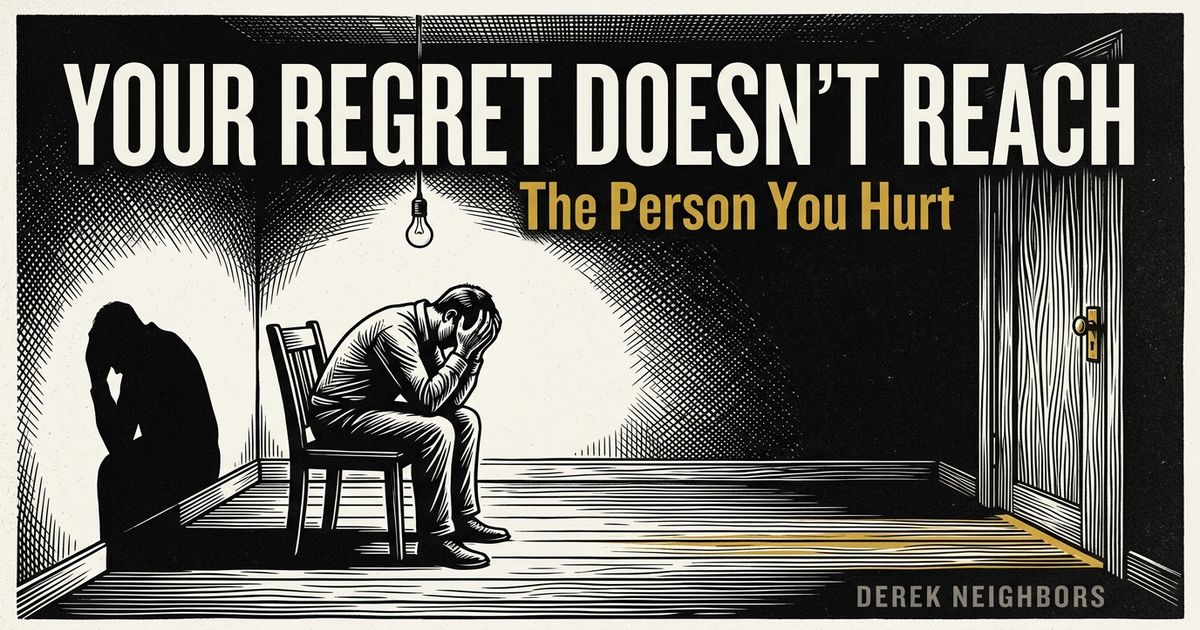
Your Regret Doesn't Reach the Person You Hurt
By Derek Neighbors on October 1, 2026
You cut someone off in a design review. Eight people in the room, and you said her idea sounded junior. You knew it was wrong before you got to your car. You replayed it at 2am and again on the drive in. The next morning you were extra warm to her in Slack, and you never said a word about the review.
A month later she had stopped talking in design reviews. You had felt terrible the whole month, and none of it reached her.
Regret stays inside the person who made the mistake, and remorse goes looking for the person who got hurt. They start from the same sick feeling, but only remorse reaches the person you hurt. Most of us, me included, are very good at regret and have done remorse well a handful of times. We count the first as if it were the second.
What Regret Looks Like From the Inside
Regret is busy, and that is why it is easy to confuse with moral work. It runs the replay at 2am and rehearses the speech you would give if you ever gave it.
Regret also talks. You tell a peer, “I was out of line in that review,” and the peer says you are being too hard on yourself, which helps a little. Now two people have heard about the harm, and neither of them was the one harmed.
Next comes the extra warmth. You praise her work in a channel she reads and add an emoji. You are paying a debt in a currency the other person never agreed to accept, and without telling them it is a payment.
Eventually you start avoiding her. You stop posting in her channel and let someone else run the next review she is in, and you wait for it to blow over. Sometimes it does, in the sense that nobody mentions it again.
Every one of those moves happens inside your head or in front of someone who was not hurt. From the inside they feel like suffering, and suffering feels like it should count for something. Whatever it counts for, she never sees any of it.
Regret does some good when it changes what you do next. The next engineer in that design review never gets talked over. She is still owed a sentence from you, because the change protects someone else and leaves her where you left her.
Three Questions That Tell Regret From Remorse
You can sort it out in about a minute.
1. Who is the sentence about? Listen to what you say when you think about it. “I can’t believe I did that.” “I’m better than that.” “What is wrong with me?” Every one of those has you as the subject. Remorse sounds different: “She lost the room because of me.” “He stayed up redoing the work I broke.” When the sentence in your head is about you, you are in regret.
2. Has the person heard anything? A specific sentence, from you, to them. Warmth does not count, and neither does a better tone in the next meeting or telling their manager you feel bad. If the person you hurt could not repeat back what you said to them about it, nothing has reached them.
3. Who is doing the work right now? This one catches people who think they apologized. If the person you hurt is reassuring you, telling you it is fine, telling you not to worry about it, the apology has turned back around. They took the hit, and now they are also managing your feelings about the hit.
Side by side, the difference looks like this:
| Regret | Remorse | |
|---|---|---|
| Who the sentence is about | You | The person you hurt |
| Where it happens | In your head, or with someone who was not hurt | With the person who was hurt |
| What they get from it | Nothing they can see | A plain admission and a fix |
| What it asks of you | Time and pain | A conversation you do not control |
Regret Protects the Story You Tell About Yourself
Aristotle has a word for regret: metameleia (μεταμέλεια), literally a change in what you care about after the fact. In Book IX of the Nicomachean Ethics he uses it in a passage about bad people, and he says they “are full of regret.” They are at odds with themselves, he says, wanting one thing and doing another, and the regret is what that split feels like from the inside. In that passage heavy regret is a symptom of a divided person, and he does not offer it as evidence of a good heart.
Marcus Aurelius defines it more tightly. In Meditations 8.10 he calls regret (his word is metanoia) a kind of reproach of yourself for having neglected something useful. The reproach is aimed at yourself, and for Marcus that is fine, because it is a signal. Something useful got neglected, so go do the useful thing. The failure is stopping at the reproach, and most of us stop there.
The English word “remorse” comes from the Latin remordere, to bite again. It keeps biting, and it does not stop on its own. You stop it by doing something.
We stay in regret because it protects your picture of yourself. In the replay you are still a decent person who did one bad thing and feels awful about it, which is the kind of person who would never do it again. Repair puts that picture at risk. To repair, you have to walk up to her and say the plain sentence, “I called your idea junior in front of the team, and that was wrong,” and then stand there while she decides what she thinks of you. The replay is painful, but you control it, and the conversation is a risk you do not control. The replay hurts enough to feel like penance, and it never asks you to stand in front of anyone.
I wrote earlier this year about the difference between shame and self-pity. That piece covered the inside job, what you do with the gap between who you are and who you meant to be. You can do that job perfectly and still owe someone a sentence. It is also a different regret from the one I wrote about in asking fear the wrong question, which is regret about a life you have not tried yet. This one is about something you already did to someone.
When Remorse Turns Into Another Harm
Remorse can go wrong too, and it usually goes wrong by getting large.
A leader realizes she crushed someone in a meeting. She books a 1:1, and it runs twenty minutes. She explains her week, her stress, the pressure from above. She tears up, says she feels sick about it, and asks if they are okay. The engineer spends the meeting saying “it’s fine, really, don’t worry about it.” They walk out having comforted their boss about the thing their boss did to them.
The remorse was sincere, and it got so big that it turned back into regret with an audience. The person who was hurt ended up carrying it.
You see the same thing in a public apology timed for the apologizer’s relief, before the hurt person has decided how they feel, and in the apology that ends with “can we be good?” and wants the answer now.
Repair has a right size, and you can miss it in either direction. Too little leaves the person alone with the harm, and too much hands them your feelings to carry as well. A cutting remark in a review calls for one honest sentence and a corrected record. If your apology is bigger than what you did, ask whose need it is meeting.
How to Make Amends Without Making It About You
1. Say what you did in one sentence. Name the act: “I called your idea junior in front of the team, and that was wrong.” Leave out “if,” “I’m sorry you felt,” and the paragraph about your week. If you cannot say it in one sentence, you are still deciding whether it was really your fault.
2. Go to them, inside a day. Go to the person before you mention it to their manager, a peer, or the team channel. The longer you wait, the more the silence says for you, and what it says is that it did not matter enough to mention.
3. Ask what it cost them, then listen. “What did that cost you?” is a hard question to ask. You may learn the damage was bigger than you thought. She might have stopped bringing ideas to reviews, or started looking at other teams. You need to know that, and you cannot learn it from the replay.
4. Fix it where it broke. Harm done in front of eight people gets corrected in front of the same eight: “In last week’s review I dismissed an approach too fast. I was wrong, and I want to hear the rest of it.” A private apology for a public hit leaves the room believing the hit.
5. Change the behavior where they can see it. The apology is a promise. The next three reviews are where she finds out whether you meant it.
6. Then stop. Do not ask for forgiveness on a schedule. Do not check in every week to see if you are okay now. Let her decide what the relationship is. Your job was the sentence and the fix, and what she does with them is up to her.
Sometimes you cannot reach the person. They left the company, they will not take the meeting, or they are gone for good. The duty moves instead of leaving with them, to what you can still fix: correct the record with the people who heard the wrong version, and treat the next person in that seat the way you should have treated them.
Build the Repair Reflex
Repair gets cheaper with practice, and more expensive with every day of silence. A sentence you could have said the next morning is hard to say a month later, because now you also have to explain the month.
So practice on the small ones. Interrupted someone in standup? Tell them at the end of standup. Sent a sharp Slack message on a bad day? Reply in the same thread. Quick, plain repairs build the habit for the day you do something that actually hurts someone.
If you lead people, they are learning what happens after a mistake by watching you. A leader who never says “that was on me” out loud teaches a team to hide mistakes, and a team that hides mistakes finds out about them in production. Repairing in the open shows everyone that the sentence is survivable. It is one of the few leadership behaviors you cannot fake, because it only counts when the other person hears it.
The 2am replay does not have to go away. Treat it as a prompt instead of a punishment. When it starts, ask one question: who needs to hear from me tomorrow? Write the name down and go back to sleep. Then send the sentence in the morning.
Final Thoughts
Feeling bad about what you did tells you something real. It means you know the standard, and you know you missed it. That feeling has one job, which is to get you out of your chair and over to the person you hurt. If it stays in your head, it can run for years without helping the person you hurt, and you will mistake the hours you spent hurting for the work you never did.
The repair helps you too. In Plato’s Gorgias, Socrates argues that doing wrong harms the one who does it more than the one who suffers it, and that a wrongdoer should go looking for correction the way a sick man goes looking for a doctor. Staying in the replay keeps you stuck with what you did, and saying the sentence is what frees you, though your share of that only arrives by way of the person you hurt.
You probably already know who it is. There is someone who has been waiting a week, or a year, for one plain sentence from you. Write it today and send it, or say it out loud at their desk, and then let them decide what happens next.
If you want to work alongside people who say “that was on me” out loud and then fix it, MasteryLab is where that happens.
FAQ
What is the difference between regret and remorse?
Regret is pain about what you did that stays with you: you replay it, you wish it undone, and the person you hurt never hears about it. Remorse is the same pain pointed at the person who got hurt, and it pushes you to tell them what you did and fix what you can. Regret centers your picture of yourself, and remorse centers the person you hurt.
What does metameleia mean?
metameleia is the ancient Greek word for regret. It comes from a verb meaning that what you care about has changed after the fact. Aristotle uses it in Nicomachean Ethics IX.4 to describe bad people, who he says are full of regret because they are at odds with themselves. In his account the regret is a symptom of that inner split, and it does nothing for anyone else.
How do you make amends without over-apologizing?
Say what you did in one plain sentence, to the person, within a day. Ask what it cost them and listen without defending. Fix what you can in the same place the harm happened, then change the behavior where they can see it. Keep the apology shorter than the harm. If they end up comforting you, the apology has turned back toward you.
Is self-blame a sign that you care?
It is a sign that you care about something, usually your picture of yourself as a decent person. Caring about the person you hurt shows up as action toward them: a sentence they actually hear, a fix they can see. Self-blame that never leaves your head can run for months while the other person gets nothing from it.